Land of the Giants

Deinotherium giganteum skeleton in Bucharest, Romania, By Flavius70 from Wikimedia commons

Deinotherium giganteum skeleton in Bucharest, Romania, By Flavius70 from Wikimedia commons

There are tales that Giants roamed our lands. Gigantic bones enigmatically poking out of the ground have, until fairly recently, led to some wonderful creations of mythical creatures. With a relatively unexplored world and with only a handful of animals known to people, any bone, especially disproportionately massive, would lead to some spectacular creations. In ancient times, large bones found were thought to belong to Giants. Even as recently as 1678, fossil dwarf elephant remains found on Sicily were examined and told to be the bones of giants. In the 1500 and 1600s, the only rational answer for enormous bones found that could not be explained, was, obviously, evidence of  Giants that once roamed the world.

With quaint old, white walled buildings radiating the suns warmth, topped with terracotta tiles, the picturesque city of Chaumont, in Eastern France was once thought to belong to giants. One place in this city, was known as the Field of Giants. Here, huge bones had been found for decades. Early in the new year in 1613, digging deep in the ground, an enormous skeleton was discovered. So enormous were the bones, that they deserved a story just as gargantuan. A local surgeon acquired the bones and (as an expert) identified them as belonging to a giant; King Teutobochus, a King from the first Century BC. The bones were not those of a giant man. It was only a few decades ago, in the 1980s, that casts of the original bones were actually looked at and identified as belonging to the awesome giant elephant, Deinotherium.

A wonderful illustration of Deinotherium showing it perculiar long legs, backwards curving tusks and thick trunk. (Image from here)

A wonderful illustration of Deinotherium showing it peculiar long legs, backwards curving tusks and thick trunk. (Image from here)

Evolving in the Early Miocene, around 20 million years ago, this distant cousin of the modern day elephant was a massive animal. Overshadowing a double decker bus, with a height of around 4.5 meters, the Deinotheres were the biggest Proboscids. For a group that was around for almost 19 million years, it wasn’t particularly diverse, with only three known species; Deinotherium giganteum, D. bozasi and D. indicum. Then again, a small number of species within a Genus does not necessarily mean they were not successful. Far from it. This was a very specialised Genus, which evolved in Africa and spread out across Europe and Asia. What’s more, the average time on Earth for a vertebrate species is just one million years, these three species were around for a combined 19 million years.

The evolutionary tree of th elephants. Deinotherium split off fairly early, around 20 million years ago. (Image from here)

The evolutionary tree of the elephants. Deinotherium split off fairly early, around 20 million years ago. (Image from here)

Deinotheres (which literally means terrible beast) were also very strange beasts with some extremely peculiar features. Sticking out as just plain odd, the tusks are the most noticeable feature; unlike the familiar curved iconic tusks of modern elephants and mammoths, these tusks curve backwards and from the lower jaw! We are not sure why they curved back. Maybe they were used to scrape bark from trees, or were key for a male to secure a group of females. What we do know is that these unique tusks served a purpose because this group were around for a long time.

Other parts of the head were equally weird when you look a little closer. The teeth were not like the flat, grinding teeth of elephants around today, they were ridged, and appear to be for shearing their food rather than crushing it. The shape of the head itself was weird; it was actually pretty small for a creature of this size. Shorter, and flatter on top, the large nasal opening suggests a strong, powerful trunk. But as the soft parts do not fossilise, we can’t say how long or short it was. Looking at the whole animal, it is likely to have been fairly long: the legs of Deinotheres were longer that the squat Woolly Mammoths, so a long trunk would be needed to reach to the ground, if only to drink.

Deinotheres would have been an incredible sight for human eyes. In fact, the longest living species which survived right up to the dawn of the Twilight, Deinotehrium bozasi, survived up until around 1.6 million years ago where some human species would have been around to witness this incredible creature. The other two species died out long before; the Asian D. indicum became extinct around 7 million years ago, and the European D. giganteum, became extinct somewhere between 4 and 2 million years ago.

Africa sustained Deinotherium bozasi for a very long time; almost as long as the Genus itself. If it was so successful, for such a long geological range, why did this wonderful giant die out? Humans were not the culprits for the demise of these beasts. D. bozasi fossils have been recovered from sites in Africa alongside species of hominins, for example, the famous Laetoli site. However, there is no evidence that they were hunted, or butchered. Something else was happening. Something big. To the very east of the African continent, forces deep below were slowly ripping the land apart. Very slowly, the East African Rift Valley was forming.

The complex East African Rift Valley system. (Image from here)

The complex East African Rift Valley systems showing fault plane, and where tectonic plates meet. (Image from here)

Covering the Earths hot, molten interior is a thin crust; wafer thin in the oceans, and a little thicker on continents. This crust doesn’t cover the whole planet in one nice wrapping, like an egg shell. Rather, it is incredibly active; spewing out the molten blood of the planet in some places, and devouring old crust in others in a eternal cycle of growth and destruction. What enables the planet to be so active (which ultimately enables life to have evolved, climate to change, and sea levels to rise and fall), is the crust is made up of plates. Where tectonic plates meet different things may happen. If two plates ‘slide’ against each other this can cause severe earthquakes, as seen in the San Andreas Fault in California. If a plate is being pushed beneath another plate, the old crust is slowly being dragged deep down back inside the very belly of the Earths to be melted back to molten rock again, as can been see off the islands of Japan. Two plates being pushed apart allow new hot molten magma to be pushed up, creating new crust, and can push continents apart or create vast oceans (like the Atlantic Ocean). In East Africa, we are witnessing the formation of two new tectonic plates and the very beginnings of a new ocean (albeit, extremely slowly!). Beginning around 20 million years ago, extensive hot magma forced from deep within the planet has been pushing its way up, forcing the eastern side to be pushed eastward, and a few miles on the western side to be pushed westwards. Eventually this will spread large enough to push the two plates apart, creating a new ocean.

What do plate tectonics have to do with the end of the last  Deinothere? Surprisingly, it seems, it may be rather a lot. This whole region in East Africa is an  extremely active area, and has been for the last 20 million years,  with numerous volcanoes along its length. All of this activity, with earthquakes, volcanic eruptions and new land forming will have an effect on the surrounding environment. The area is hotter, and drier. Coupled with the intensive climatic changes of the Pleistocene, the African landscape has changed significantly in the last few million years. Forests have given way to more open grassland savannahs which can tolerate drier environment; and the shrinking of forests resulting from the activity of the East African Rift Valley is one of the theories that pushed early hominins out of the trees and into the open grasslands. With a drastically changing environment for such an enormous, specially adapted animal, it appears Deinotherium bozasi could not adapt quick enough. This incredibly successful animal vanished from our world forever. But not before small groups of hominins saw herds of these creatures trumpeting across the landscape.

Written by Jan Freedman (@JanFreedman)

Further Reading:

Cerling, T. E, Harris, J. M & Leakey, M. G. (1999), ‘Browsing and Grazing in Elephants: The Isotope Record of Modern and Fossil Proboscideans’, Oecologia. 120 (3). pp.364-374. [Full article]

Harris, J. M. (1976), ‘Evolution of feeding mechanisms in the Family Deinotehriidae (Mammalia: Proboscidea)’, Zoological Journal of the Linnaean Society. 56. pp.331-362. [Abstract only]

Harrison, T. (2011) ‘Paleontology and Geology of Laetoli: Human Evolution in Context: Fossil Hominins and the Associated Fauna’, Volume 2.’ Springer. [Book]

Kalb, J, et al. (1982), ‘Vertebrate Faunas from the Awash Group, Middle Awash, Afar, Ethiopia’, Journal of Vertebrate Paleontology. 2 (2). pp.237-258. [Full article]

Leakey, M. G, et al. (1996), ‘Lothagam: A record of faunal change in the Late Miocene of East Africa’, Journal of Vertebrate Paleontology. 16 (3). pp.556-570. [Full article]

Poulakakis, N, Lymberakis, P & Fassoulas, C. (2005). ‘Deinotherium giganteum (Proboscidea, Deinotheriidae) from the Late Miocene of Crete’, Journal of Vertebrate Paleontology. 25 (3). pp.732-736. [Full article]

Wendt, H. (1970), ‘Before the Deluge’, Paladin. [Book]
Posted in Deinotherium | Tagged , , , , , , , , , , | 5 Comments

Shiva’s beast

A giraffe kissed me (when I was twelve) and I liked it.

It was a hot August day in Dublin Zoo, and the beautiful creature simply leaned over the fence and administered a big giraffy sloppy kiss to my face. I have never recovered from that action. It was the start of a long love affair with these graceful yet bad-assed critters.

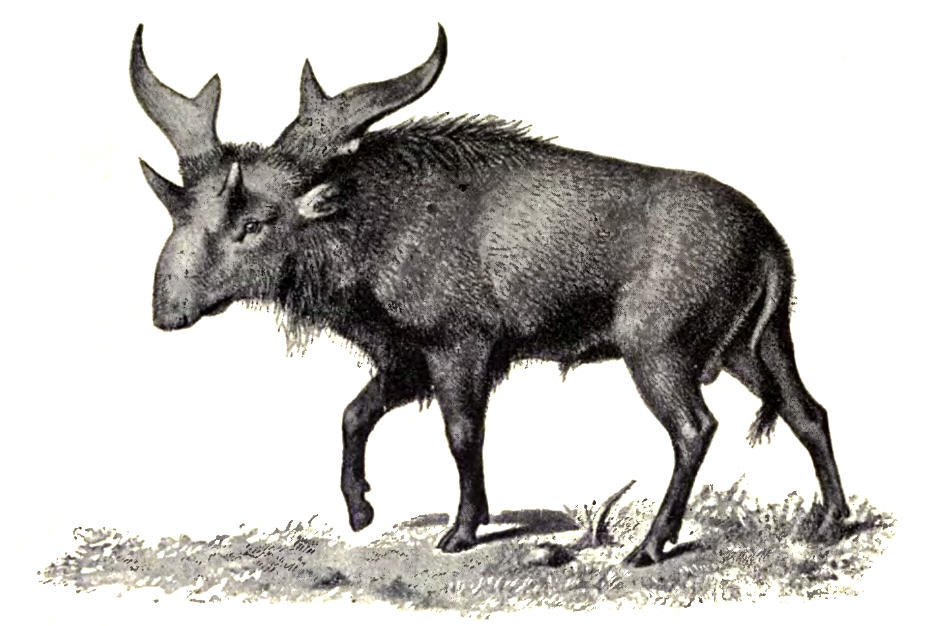
Our modern giraffe, Giraffa camelopardalis, comes to us from the same ancient and elegant lineage as the genus Sivatherium. Remains of these beasts have been found in Africa but also in India, hence the name of SivatheriumShiva’s animal; the king of Indian deities as befits a creature with a literal crown of antler-like horns. They are believed to have only become extinct some 8,000 years or so ago, and it’s debated if the poignant rock art of the Sahara desert does indeed show species of Sivatherium, but more about that later. They were fantastical looking creatures; standing over 2 meters at the withers, with a full height of more than 3.5 meters, they were more powerfully built than modern giraffes. These wonderful animals had a short, broad skulls holding two pairs of horns: the front horns were fairly small, while the ones at the back were large, curved and palmate for shaking bushes for food as much as combat! We are used to the long, slender necks of modern G. camelopardis, but Sivatherium was having none of that! This was the ‘Rocky’ of the Giraffidae family. Strong, sturdy shoulders and a powerfully built bull-neck to hold up those ferocious antler structures (known to palaeontologists as ossicones), you would not intentionally mess with a Sivatherium of any species! One of the debates about Sivatherium’s feeding habits is whether it had the long tongue of modern giraffes, or if it relied on its teeth more. Certainly fossil remains show the teeth were more suited to mixed grazing, but the jury is still out.

A wonderful old school illustration of Sivatherium, recreated to be a little moose like. Not the wonderful ornatment head. (Image from here).

A wonderful old school illustration of Sivatherium, recreated to be a little moose like. Note the wonderful ornament on it’s head. (Image from here).

The earliest humans in Africa would have witnessed herds of these truly awe-inspiring creatures grazing on a landscape that would change dramatically through to the Neolithic period.  While it is likely prehistoric humans did hunt Sivatherium, their fate seems inextricably linked to the gargantuan and dramatic environmental changes of the Quaternary. The evolution of humanity too is linked to the conditions of Pleistocene Africa. The region we know as the Sahara has gone through fluctuations of climate, alternating between periods of aridity which have been relieved by wet periods which turned the dry landscape into green savannah. The earliest of these fluctuations have been linked to the evolution and diversification of hominids, but this is not the story of Lucy and her kin. This is the story of the Sivatherium.

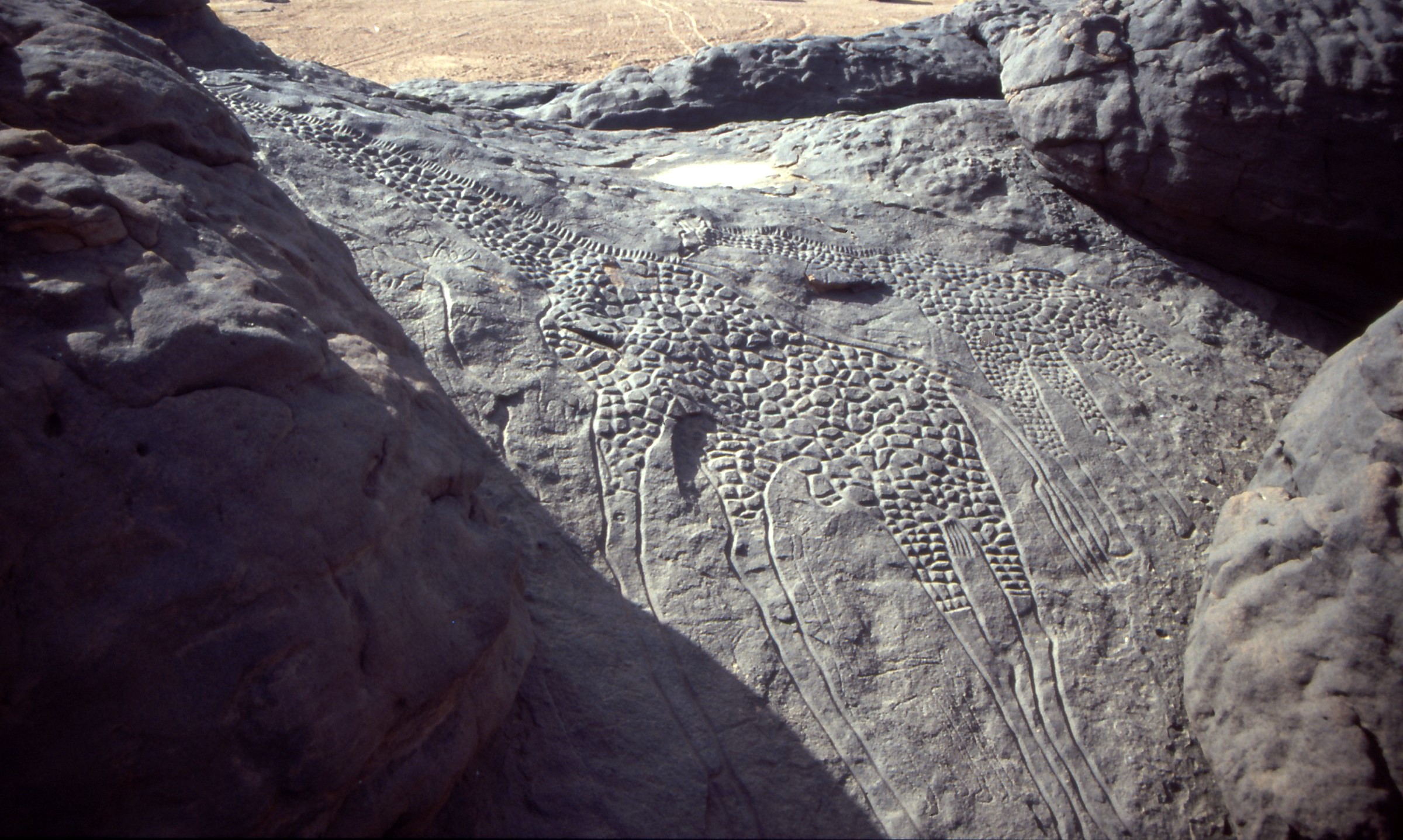
Around about 9,000 years ago, the deserts of Africa were getting quite a soaking under climate conditions now known as the Neolithic Subpluvial. This was a time of plenty, where the desert bloomed, encouraging all sorts of creatures to live there, including wonderful African megafauna such as Sivatherium spp. Humans of course followed the herds of creatures, often with surprising results – in Nigeria there is an ancient petroglyph of a recognisable G. camelopardalis with a leash around its neck, possibly indicating a domestic scene, or the rope could be a lasso, in which case showing evidence of hunting.

DabousGiraffe

Petroglyphs of giraffes with leash/lasso from the site of Dabous, north of Agadez, Niger. Image from here

With the Sahara and Sahel regions filled with wild creatures, fowl, lakes full of fish, it must have been a kind of Neolithic Garden of Eden ( complete with happy, colourful snakes too!) compared to the millennia previously when the Sahara was as dry and barren as it is today. Nothing, however, lasts forever. The climate shifted again, with the barren sands reclaiming the landscape gradually to form the conditions of the region which we know it for today.

There have been numerous studies performed on the bones of Sivatherium which all testify to a peculiarly high incidence of dental enamel hypoplasia. The teeth of the various species of Sivatherium were deficient in enamel, which was a problem for an animal that needed to consume tough vegetation, such as tree shoots, shrubs and more. It’s been considered that this indicates malnourishment from environmental stresses. Similar stresses have been noted on rhinoceros species during the Miocene climate changes in North America. As the preferred vegetation of Sivatherium withered and died from the encroaching desertification of their homelands, the babies would have suckled from their mums for too long. If mum wasn’t getting the nutrients she needed, the malnourishment spread to the little baby Giraffids.  The end of the Neolithic Subpluvial meant the end of Sivatherium in Africa, as recently as the past 7 to 8 thousand years ago. They were not alone – it’s been estimated that at least 24 large African mammals of the Pleistocene vanished forever as the sands began their rulership of the African Holocene landscape.

While other parts of the globe suffered much greater megafaunal extinction through the Late Quaternary, there is a terrible sadness in that humans created a lasting record of the time when the Sahara was a place of life and beauty. Petroglyphs such as those at Tassili n’Ajjir, in Algeria, and Kuppenhole, in Tanganyika depict images of everyday life among Pleistocene wildlife. Sivatherium’s habitat changed, they could not adapt to the stresses of climate change combined with being hunted by humans so they passed into the stuff of legend.

Or did they? There is a strange and persistent palaeontology ‘urban legend’ which suggests the last of the creatures may not have died out until the end of the Sumerian Empire. A strange figurine found during archaeological excavations in the 1930s at Kish, Iraq, shows a creature with two sets of horns, a stocky elk-like neck and a giraffe-like face….Could the creature have survived as the regal pet of the Bronze Age Sumerian warlords? While it’s unlikely, it’s a fascinating idea – and the great thing about archaeology of course is that we can’t rule out that one of these days, more conclusive evidence just might be found to prove the creature made it out of Africa for another few thousand years!

Written by Rena Maguire (@JustRena)

Further Reading:

More on the Sivatherium ‘figurine’ by @TetZoo here.

Bedaso, ZK, Wynn, JG, Alemseged, Z, and Geraads, D 2013, ‘Dietary and paleoenvironmental reconstruction using stable isotopes of herbivore tooth enamel from middle Pliocene Dikika, Ethiopia: Implication for Australopithecus afarensis habitat and food resources’. Journal of Human Evolution. 64. pp.21-38. [Abstract only]

Colbert, E.H. 1936. ‘Was the Extinct Giraffe (Sivatherium) Known to the Early Sumerians?’  American Anthropologist New Series. 38.4pp.605-608. [Abstract only]

Domínguez-Rodrigo, M, et al. 2014, ‘Study of the SHK Main Site faunal assemblage, Olduvai Gorge, Tanzania: Implications for Bed II taphonomy, paleoecology, and hominin utilization of megafauna’, Quaternary International. pp.322-323. [Full article]

Faith, J.T 2014, ‘Late Pleistocene and Holocene mammal extinctions on continental Africa’, Earth-Science Reviews. 128. pp.105-121. [Abstract only]

Faith, J. T 2011, ‘Ungulate community richness, grazer extinctions, and human subsistence behavior in southern Africa’s Cape Floral Region’. Palaeogeography, Palaeoclimatology, Palaeoecology. 306. pp.219-227. [Abstract only]

Franz-Odendaal, T Chinsamy, A and Lee-Thorp, J. 2013. ‘High prevalence of enamel hypoplasia in an early pliocene giraffid (Sivatherium hendeyi) from South Africa’   Journal of Vertebrate Palaeontology. 24.1. pp.235-244. [Abstract only]

Franz-Odendaal, T. A., J. A. Lee-Thorp, and Chinsamy, A. 2002. ‘New evidence for the lack of C4 grassland expansions during the Early Pliocene at Langebaanweg, South Africa’. Paleobiology 28. pp.378–388. [Full article]

Geraads, D; Reed, K and Bobe, R.n 2013. ‘Pliocene Giraffidae (Mammalia) from the Hadar Formation of Hadar and Ledi-Geraru, Lower Awash, Ethiopia’. Journal of Vertebrate Paleontology. 33.2. pp.470. [Abstract only]

Mead, A. J. 1999. ‘Enamel hypoplasia in Miocene rhinoceroses (Teleoceras) from Nebraska: evidence of severe physiological stress’. Journal of Vertebrate Paleontology 19. pp.391–397. [Full article]

Pachur, H and  Hoelzmann, P 1991, ‘Paleoclimatic implications of late quaternary lacustrine sediments in Western Nubia, Sudan’, Quaternary Research, 36. pp.257-276. [Abstract only]


Posted in Sivatherium | Tagged , , , , , , , , | 4 Comments

Dire times for bone crushing dogs

Dogs. (Hu)man’s best friend. For around 15,000 years, these furry, sensitive canines have been our close companions. All dogs alive today descended from a wolf ancestor into a massive array of variations today; from the laughable but slightly cute Chihuahua, to the unbelievable enormous Great Dane. Around 35 million years ago, a small group of Canidae in North America branched off from the main family, evolving into a new sister group, the SubFamily Borophaginae. These were dogs, but different; they had an awesome name. These were the ‘bone crushing dogs’.

The Borophaginae were a very successful split off group to the Canidae. Running around for over 33 million years, on five toes, instead of the modern dog equivalent of four, this group had at least 28 Genera and 66 different species, and were the most dominant predators across the isolated continent of North America. This impressive diversity, and longevity, resulted in some awesome animals. There were some, like the massive Epicyon, which were as big as a bear, and others, like Strobodon stirtoni, which mimicked cats. The group survived solely in North America until into the very dawn of the Twilight, around 1.8 million years ago.

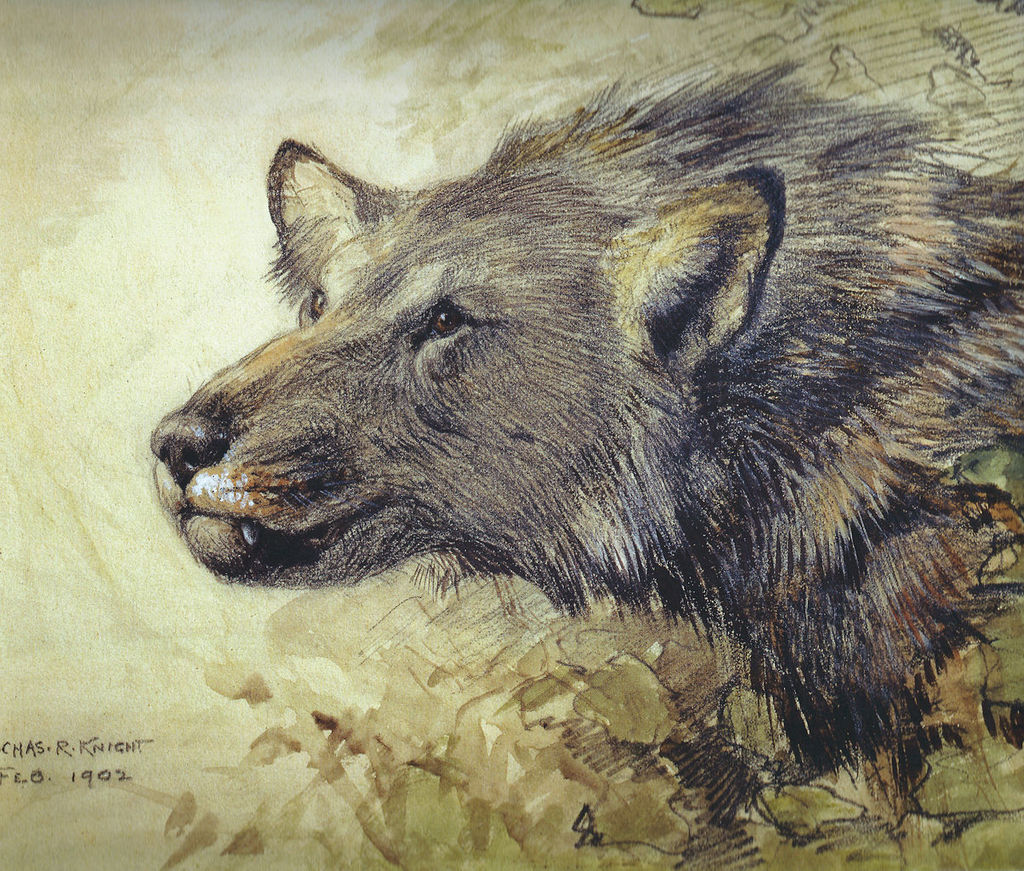
A gorgeous illustration of Borophagus (possibly B. diversidens). Illustrated by the ultra talented palaeoartist Charles Knight in 1902. (Image from here)

A gorgeous illustration of Borophagus (possibly B. diversidens). Illustrated by the ultra talented palaeoartist Charles Knight in 1902. (Image from here)

The last of the bone crushing dogs was our beast, Borophagus diversidens, which survived into the beginning of the Pleistocene after a long, successful reign of around 5 million years. The Borophaginae were unknown before the discovery of this species in 1892. Famous for naming of a plethora of new dinosaur species, Edward Dinker Cope also discovered and named many other types of animals. Including mammals. Based on just one fragment of a jaw, with a few teeth, found at the Blanco Formation of Texas, Cope described not just a new species, or even Genus, but a whole SubFamily. Since then many more fossils have been found, showing its range from Mexico all the way up to Canada. And of course, more fossils mean a greater understanding of this extinct creature, which was (as far as we know) the last survivor of this highly successful group of dogs.

This was no beauty. Not really even a runner up in Crufts. With a bulging forehead, and short powerful jaws, it was about the size of a large fox, but with more robust bones. The teeth were the key feature for this species; the premolars were huge. These teeth were made for crushing and crunching, and that’s just what they did. Because of their strong, powerful jaws, and massive, thick teeth it has been assumed that these were scavenging animals filling a niche in North America as the spotted hyenas do today in Africa. Only we know that the incredible spotted hyena, which was was more widespread during the Pleistocene is also a formidable pack hunter. B. diversidens is a very common fossil at numerous sites, indicating a very successful animal. Huge numbers of British sites hold a myriad of hyena remains showing that caves were used as family dens; could this bone crushing dog have been a family animal and pack hunter too?

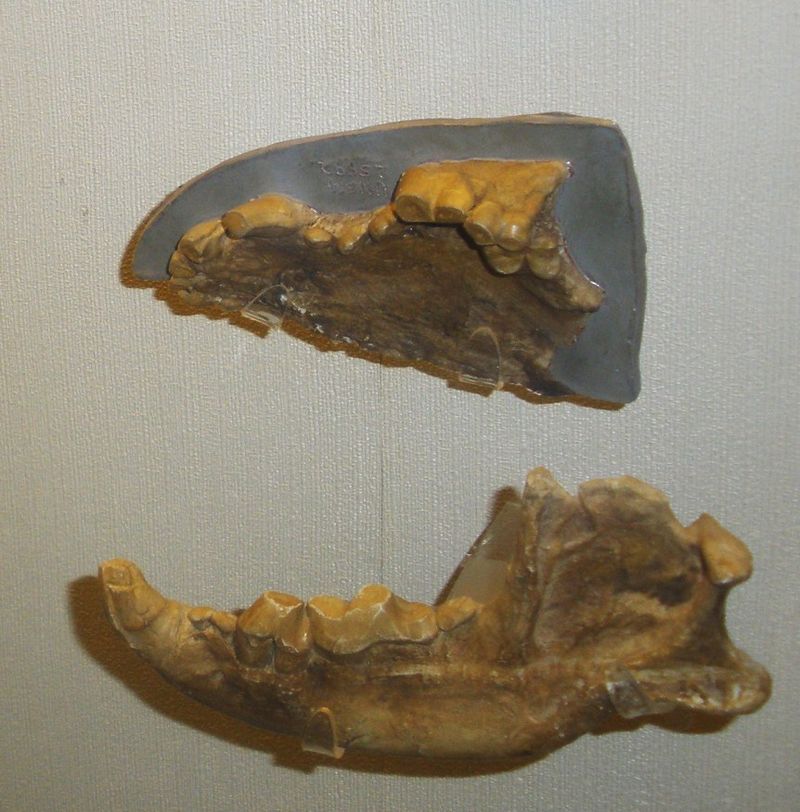
Fossils of Borophagus diversidens. The premolars are huge, (Image from here)

Fossils of Borophagus diversidens. The premolars are huge, similar to the spotted hyena today.(Image from here)

As was the way with naming new species based on just one fossil fragment, it has lead to confusion, renaming and reclassifying. Since it’s initial discovery, Borophagus diversidens has had seven different names! When palaeontologists find fossils, they compare it to other known fossils to try and identify it. If there is enough difference, they may name a new species. However, if a palaeontologist finds a fossil, but there is nothing to compare it to, then a new species may be named. This is one of the major problems with naming new species based on individual specimens. But, as more fossils are found, and more complete specimens, other fossils can be checked and reassessed. When more complete fossils of B. diversidens turned up, those seven other species became redundant, and were reassigned to its rightful owner.

The last of this great side line of dogs occurred around 1.8 million years ago. After a huge variety of different species, and being successful for over 33 million years, the end of the bone crushing dogs came swiftly. Humans were not to blame for the extinction of this species, for once. Around this time, the climate was changing in North America, resulting in less prey. There were plenty of other predators around, including species of Smilodon and the American Hyena but they had their niches which differed from the bone crushing dog. There was also a new predator on the scene. It appears that another canid species which can trace its blood line back 33 million years to when they last shared a common ancestor may be to blame. Dire Wolves (Canis dirus), recently made popular by the Sigil of the Starks, evolved in North America around the same time as the decline of the last bone crushing dog. These were big predators, which were very likely social animals which would have hunted in packs. With addition pressures from a faster, bigger predator, it seems our little beast slunk away into history.

Written by Jan Freedman (@Jan Freedman)

Further reading:

Dalquaest, W. W. (1969), ‘The Bone-crushing dog Borophagus diversidens Cope,’ Quaternary Journal of the Florida Academy of Sciences. 31. pp.115-129. [Full article]

Montgomery, T. H. (1904), ‘A list of the types of fossil vertebrates in the Museum of the University of Texas’, Biological Bulletin. 8 (1). pp.56-58. [Full article]

Prothero, D. R. (2006), ‘After the Dinosaurs; the Age of Mammals,’ Indiana University Press. [Book]

Wang, et al. (1957), ‘Phylogenetic systematics of the Borophaginaw (Carnivora, Canidae)’, Bulletin of the AMNH. 243. [Abstract only]

Wang, et al. (2010), ‘Dogs: Their Fossil Relatives and Evolutionary History,’ New York: Columbia University Press. [Book]

Werdelin, L. (1989), ‘Constraint and Adaptation in the Bone-Cracking Canid Osteoborus (Mammalia: Canidae)’, Paleobiology. 15 (4). pp.387-401. [Abstract only]

Posted in Bone Crushing Dog | Tagged , , , , , , , , , , , , , , | 2 Comments

The most lonely places

“Vouronpatra: A large bird which haunts the Ampatres [marshy places] and lays eggs like the ostrich’s; so that the people of these places may not take it, it seeks the most lonely places.”

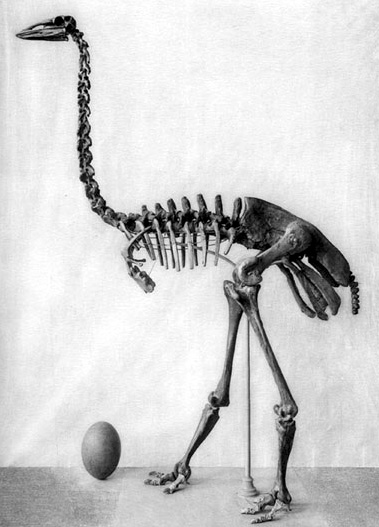
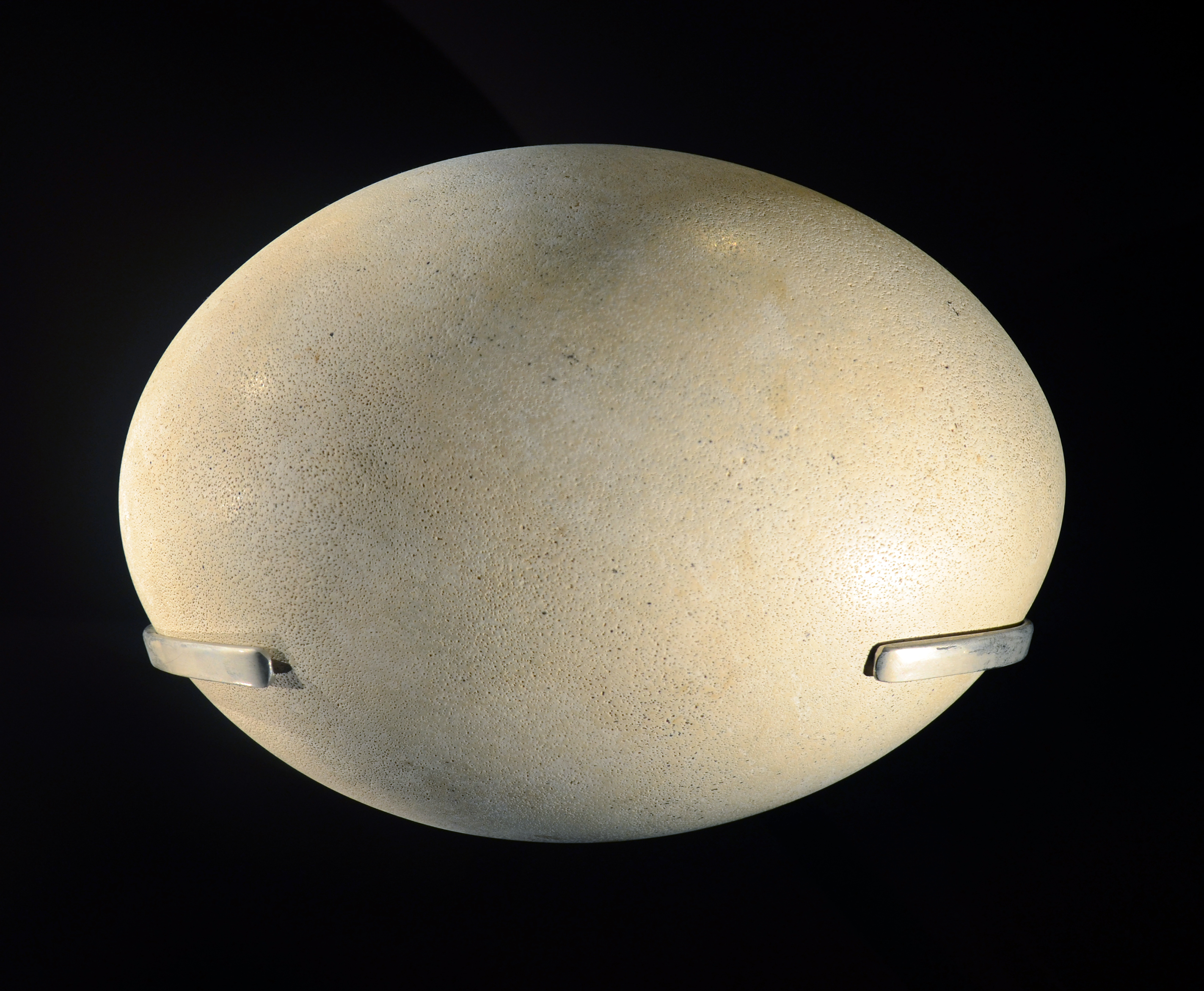
Aepyornis maximus  skeleton and egg

Aepyornis maximus skeleton and egg. Public domain image.


The beasts of the Pleistocene cause us so much wonder because they tend to be large, strange, and extinct. It is their palpable absence that defines how we think about the recent geological past. We can put them in a box along with dinosaurs, trilobites, and things from long, long ago. But there are anomalies which force us to reconsider how different the Pleistocene was, and ask whether the extinctions were really part of the natural order. There were populations of mammoth (Mammuthus primigenius) that survived up until only a few thousand years ago on Wrangel island and St. Paul island. The giant Irish elk (Megaloceros giganteus) eked out a living in the Ural mountains until the early Neolithic. The islands of the Mediterranean had endemic populations of hippo and elephant that squeaked into the Holocene. New Zealand had the giant moa that probably lasted until the 13th century AD. These examples tell of megafauna that almost survived into history.

Along with New Zealand, one of the last large pristine environments to be colonised by humans was the island of Madagascar. Settled from the east by Indonesian seafarers sometime around the first century AD, the pioneering Malagasy found an exotic eden, filled with giant lemurs and tortoises, pygmy hippos, and bizarre carnivores. They also found the largest bird ever known to have lived: the legendary elephant bird.

Two genera of elephant bird are known (Aepyornis and Mullerornis) and a handful of species. The largest (and probably latest surviving) was Aepyornis maximus, a giant at around 400kg. The elephant birds were members of the palaeognaths or ratites, a group of birds that includes the modern ostrich, emu, cassowary, rhea, and kiwi, as well as the recently extinct New Zealand moa. In life Aepyornis probably looked like a giant cassowary or emu, drab coloured for the most part. We don’t know for certain, because unlike the New Zealand moa, we’ve never found any feathers from an elephant bird to give evidence of the plumage.

However, there is one feature of the living Aepyornis that has left evidence in abundance: their record-breaking eggs. Bigger than any known dinosaur egg, the elephant bird eggs are probably the largest single-cell ever produced by nature. Larger than a rugby ball when whole, several examples are known that had been used as water containers by the Malagasy, even into the 19th century. Others have been found with the embryo still inside! [Read about the scanning and 3D printing of one example here]. On some Madagascan beaches the surface is almost entirely eggshell pieces, evidence perhaps of communal breeding amongst this extinct species. One quirk of biology amongst the ratites is that it is exclusively the males that brood the eggs- if Aepyornis did engage in group laying it would have been very much an old-boys club on the beach!

Aepyornis egg in the MNHN, Paris. Public Domain

Aepyornis maximus egg in the MNHN, Paris. Public Domain image

There are a few whole eggs in private collection, although Madagascan law now rightly forbids the export of such important items of natural history. The well-known naturalist Sir David Attenborough has a reconstructed egg, which was given to him (in broken pieces) while filming on the island. This egg was recently radiocarbon dated (by @tommyhigham) to the 7th-8th century AD.

Another recent scientific innovation involving elephant bird egg has been the isolation of ancient DNA from the shell itself. Given the rarity of elephant bird bones and the superfluity of eggshell, they offer the potential to really get a handle on the demography and biology of these lost giants.

The extinction of the elephant birds is slightly mysterious. Humans were certainly the root cause but there is surprisingly little evidence of the hunting and butchery of adult birds (there is one record of a human modified tibiotarsus). It is likely that a continuous and sustained collection of the giant eggs for consumption and cultural usage caused the extinction of the mighty Aepyornis and Mullerornis. But when did this occur? The latest radiocarbon dates on Aepyornis bone are from the first few centuries AD, the latest dates from eggshell are 10th or 11th century AD (with radiocarbon dating there is a range of uncertainty associated with each date). Of course, it is extremely unlikely that we will ever date the very last bird or egg that lived (and the discrepancy between dates from rare bone and abundant eggshell show this). Could the elephant bird have survived into the time when Europeans were present on Madagascar? The opening quote to this article is from the French Governor to Madagascar (in the 17th century it was a French colony), Etienne de Flacourt. In his book “Histoire de la grande isle Madagascar” he talks of native beasts such as the “Tretretretre”, which was a calf-sized animal with the face of a man and monkeylike feet (possibly a late-surviving giant lemur). His description of the “Vouronpatra” may be the only surviving evidence we have of the living Aepyornis. However, in the process of researching this post I came across one last possible record from another Frenchman, dating to 1667 (about ten years after Flacourt). Known only as Ruelle, the account from his journal is as follows:

“We met a terrible winged dragon … one day out hunting with a soldier who was accompanying me, we saw one at the foot of a tree, that rose into the air as soon as we saw it, with a horrible hissing and red eyes of fire. When he had risen to the height of two spears he began to fall upon us, so I fired a shot that caused him to fall at my feet, with a frightful writhing about. My soldier companion killed it with another shot. It was 15 feet long. The head and body big like a calf tapering from the wings to the tail. Its scales were black and yellow; the wings were three feet in diameter. It had two rough and scaly feet. The body, we skinned to present it to Mr. Marquis de Mondevergue”

It seems that even if the vouronpatra sought “the most lonely places”, they were not protection enough.

Written by Ross Barnett (@DeepFriedDNA)

Further Reading:

Burney, D. A., L. P. Burney, L. R. Godfrey, W. L. Jungers, S. M. Goodman, H. T. Wright, and A. J. Jull. “A Chronology for Late Prehistoric Madagascar.” J Hum Evol 47, no. 1-2 (Jul-Aug 2004): 25-63.[Abstract]

Burney, D. A., and Ramilisonina. “The Kilopilopitsofy, Kidoky, and Bokyboky: Accounts of Strange Animals from Belo-Sur-Mer, Madagascar, and the Megafaunal “Extinction Window”.” American Anthropologist 100, no. 4 (1999): 957-66.[Abstract]

de Flacourt, E. Histoire De La Grand Isle Madagascar. Paris: Alexandre Lesselin, 1658.[Full Book]

Goodman, S. M., W. L. Jungers, and V. Simeonovski. Extinct Madagascar. University of Chicago Press, 2014.[Book]

Hébert, Jean-Claude. “La Relation Du Voyage a Madagascar De Ruelle (1665-1668).” Études océan Indien 25-26 (1998): 9-94.[Abstract]

Heuvelmans, B. “22.The Tratratratra, Vorompatra, Etcetera.” Translated by Rupert Hart-Davis. In On the Track of Unknown Animals, 601, 1958.[Book]

Mitchell, K. J., B. Llamas, J. Soubrier, N. J. Rawlence, T. H. Worthy, J. Wood, M. S. Lee, and A. Cooper. “Ancient DNA Reveals Elephant Birds and Kiwi Are Sister Taxa and Clarifies Ratite Bird Evolution.” Science 344, no. 6186 (May 23 2014): 898-900.[Full Text]

Oskam, C. L., J. Haile, E. McLay, P. Rigby, M. E. Allentoft, M. E. Olsen, C. Bengtsson, et al. “Fossil Avian Eggshell Preserves Ancient DNA.” Proceedings Of The Royal Society B-Biological Sciences 277, no. 1690 (2010): 1991-2000.[Full Text]

Perez, V. R., L. R. Godfrey, M. Nowak-Kemp, D. A. Burney, J. Ratsimbazafy, and N. Vasey. “Evidence of Early Butchery of Giant Lemurs in Madagascar.” J Hum Evol 49, no. 6 (Dec 2005): 722-42.[Full Text]

Rawlence, N. J., J. R. Wood, K. N. Armstrong, and A. Cooper. “DNA Content and Distribution in Ancient Feathers and Potential to Reconstruct the Plumage of Extinct Avian Taxa.” Proceedings of the Royal Society of London: Series B (2009).[Full Text]


Posted in Elephant Bird | Tagged , , , , , , , , , , , , , , | 5 Comments

Buttercup the Mammoth

Woolly Mammoths are the most well-known, and most well-loved, of all Ice Age animals. Their great size along with their long, shaggy hair has hit the ‘cute chord’ in the hearts of many. Humans have a strong emotional connection with elephants (most do anyway), so perhaps the idea of a slightly bigger, much hairier elephant is pretty easy to relate to. They have been depicted in stunning cave art, and in family films like the fabulous Ice Age. Plus, mammoths lived until very recently, with the last surviving population living on the small isolated Wrangel Island in relict steppe habitat, north east of Russia, until only around 4,000 years ago.

Another reason they are so dear to us is that we have mammoths with hair and flesh, almost as if they died yesterday. Unlike almost all extinct animals where we have just the bones, we can see what a mammoth really looked like because frozen in the ice are real mammoths! The ground in the northern part of the beautifully varying landscape of Siberia is permanently frozen. This frozen soil, ‘permafrost’, can be up to 3 or 4 meters deep below the surface. Sometimes the permafrost can be deeper, where a bog or a pond has frozen the soil solid. And sometimes in these bogs, something else lies frozen.

Mammoths have been slowly thawing out of the Siberian permafrost for centuries. A thousand years ago, it was thought by people in Siberia and China, that these giant hairy beasts were enormous rats that used their massive teeth to dig underground where they lived. And of course, these terrifyingly oversized rats died when they reached the surface and hit the sunlight. A beautiful tale, but we know that these ‘giant rats’ are the frozen bodies of woolly mammoths that marched across this cold, icy landscape tens of thousands of years ago.

Many frozen mammoths have been found and been studied by scientists. The impeccably preserved baby mammoth, Lyuba, has been dissected and CT scanned revealing much about her short life, and even how she died. Another calf, Khroma, has been studied in detail (click here for a nice write up on these two mammoths). These, and a few others, have revealed a lot about what we know of woolly mammoths today, from the foods they ate, how long they weaned for, and how their bodies worked in the cold temperatures of the Steppe. Perhaps surprisingly, good mammoth carcasses that thaw out of the permafrost are quite rare. Bones and tusks are more common, because they are harder, but the soft flesh quickly decomposes and is scavenged by wolves. And the permafrost is a pretty massive area (an area roughly the size of the USA). So trundling across this cold, barren wasteland in the hope of spotting a little tusk poking out of the frozen ground often ends in disappointment.

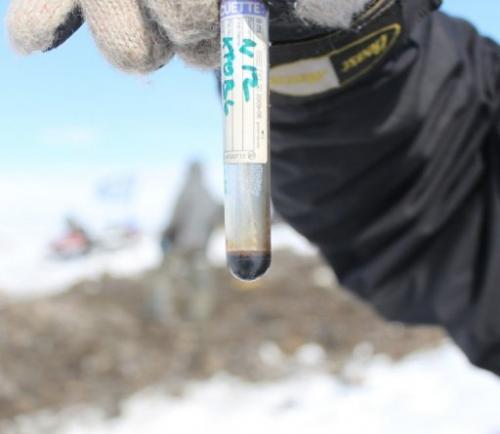
However, specimens are found. And one particularly spectacular mammoth was discovered very recently in 2013. On the second largest of the Lyakhovsky Islands in northern Siberia, tusks were discovered and the locals informed researchers at Siberian Northeastern Federal University. It looked to be a very well preserved specimen (click here for a nice write up). What was fascinating about this frozen specimen some kind of red liquid was drained out of it, that appeared to be blood. I remember tweets on Twitter floating round questioning the validity of the images; could this be mammoth blood? The story of the find was all over the internet (click here).

A tantalising picture of a vial with some red liquid inside. (Image from here)

A tantalising picture of a vial with some red liquid inside. Could this be real mammoth blood? (Image from here)

The truth would be revealed on the beautifully crisp, starry evening of Sunday 23rd November 2014, where the first televised autopsy of a frozen mammoth carcass was aired in the UK. Woolly Mammoth: the Autopsy was lead by a team of experts around the world, the programme would literally delve inside this frozen mammoth to discover more about its history and examine whether or not cloning a woolly mammoth is possible.

We are helped along in the documentary by the fantastic palaeobiologist, and TrowelBlazer, Tori Herridge from the Natural History Museum, London, who breaks down the jargon to give us the facts in nice easy to digest chunks. A natural presenter, Tori brings a human touch to the documentary, while passionately and emotionally explaining about the tough life and story of this 40,000 year old mammoth, which has been endearingly named Buttercup.

Buttercup was a female mammoth, with peculiarly large tusks! She was very well preserved, with a leg missing, and some flesh which had been eaten before she was frozen. Otherwise, a very well preserved mammoth; with the majority of the internal organs, lovely soft orange-brown fur, and her trunk all still there. Buttercup’s teeth show us that this mammoth was old, well into her 50s. Mammoths, like elephants have 6 sets of molars in their lifetime, and Buttercup was on her last set. What’s more, these molars were very well worn, so she was coming to the end of this final set, which were slightly twisted at the end: an unusual feature maybe showing Buttercup had ulcers, or other problems in her jaw. Her insides reveal what she ate.

Elbow deep inside the mammoth there was evidence of Buttercup’s last meal. She was eating grasses and buttercups. But, there was something strange inside some of her organs. Hard round nodules were found in her liver and intestine. They may be stones which were accidentally swallowed by the old mammoth; they have been sent off for tests because they are oddly very nicely rounded and all of a fairly similar size.

The tusks tell even more of Buttercup’s life. In incredible detail. Professor Dan Fisher, at the University of Michigan’s Department of Geological Sciences and Museum of Paleontology, lives for mammoth tusks. He can read a tusk like you or I can read a book. Buttercup’s tusks were large for a female mammoth, possibly due to her old age. This matriarch had lived a very long and, as her tusks reveal, a very successful life. Fisher CT scanned the tusks which showed clear growth lines. Female tusks grow more slowly when they are pregnant and feeding a calf; the CT scan revealed that Buttercup gave birth to eight children. Incredibly the hidden detail within the tusks tell us that she lost one calf whilst she was weaning it. Towards the final few years of her life, the growth lines in the tusks are fairly consistent, which Fisher suggests indicates, the menopausal stage of this mature female.

A beautiful illustration of mammoths by the talented Tabitha Paterson.

A beautiful illustration of mammoths by the talented Tabitha Paterson.

Buttercup was an old mammoth. She was on her last set of teeth, well into her 50s, and had given birth to eight young. With only one dying before it was fully weaned, Buttercup left her legacy. Her end was brutal and not fitting for this old mother. Buttercup was found frozen, with her rear sticking upwards; it seems the mammoth was trapped in a bog, and tried to push down on her front legs to escape. But she couldn’t. Trapped in the bog, she was exposed and defenceless, as predators moved in. Evidence on her skin indicates she was eaten. Eaten alive. Fortunately she must have sunk into the bog before too much of her was eaten, and her amazingly preserved body tells her story, 40,00 years later.

The strange liquid that was discovered coming out from the mammoth when she was first discovered was also analysed. The fluid seemed less viscous than blood we are familiar with, but it did have haemoglobin in it, although the red blood cells were broken up. But this was the first ever liquid mammoth blood found in a specimen (dried and frozen blood has been found before). Microscope slides of the blood showed cells which Russian scientists interpreted as white blood cells, but it seemed as though bacteria was present in the fluid. The researchers are still analysing samples to find out why it is liquid and not solid in such cold temperatures. This ‘flowing blood’ got scientists excited, because of the possibilities of cloning. One group of scientists from SOOAM Biotech Research Center in South Korea have full claims to the tissue of Buttercup to test cloning after funding a very expensive lab at the North Eastern Federal University in Siberia. The SOOAM Biotech Research Center have already successfully cloned dogs (apparently that’s a thing?!). In theory it is pretty simple; find an intact mammoth cell, complete with DNA, insert it into an Asian Elephant egg, give it a little electricity, and implant it into a surrogate. Hey presto, you have a clone of Buttercup. But cells containing intact DNA are rarely preserved – DNA normally breaks down pretty fast. Not to mention the ethics of an Asian elephant being a surrogate. (Debating the ethics of cloning the woolly mammoth is beyond this short post. Personally, I do wholeheartedly agree with Tori’s wonderfully written piece for The Guardian about her views on cloning the mammoth here.)

There is another way of ‘cloning’ a mammoth. Scientists in America have been working on genetically modifying elephant DNA to make it more mammoth like. It sounds simple: cut out a segment of elephant DNA and replace it with a gene to grow more hair, cut out another section and replace it with a gene for cold tolerant blood, and so on, until you have what looks like a mammoth. Not strictly a clone, and not technically a mammoth, this man-made animal takes away the problems of searching for intact mammoth DNA. It also takes away the ethical issues with having a surrogate, as the team are looking at growing the fetus outside the body. (George Church, at Harvard University, leading the research, explains in more detail here.)

This one beautiful discovery has shown us what life was like for one individual. A mother, a matriarch, who met a unfortunate, terrible end. Buttercup has also opened up the possibilities of bringing science fiction to life; cloning a woolly mammoth may actually become a reality in the next few years. Herds of magnificent woolly mammoths may once ago lollop across the Siberian permafrost.

Tori Herridge is on Twitter: @ToriHerridge

Buttercup the mammoth is also on Twitter: @IceAgeButtercup

Written by Jan Freedman (@JanFreedman)

Art by Tabitha Paterson (@TabithaPaterson)

*Postscript: Before watching Woolly Mammoth: the Autopsy, I watched Frozen for the first time with my little ones. It was a fun film. And yes, there may have been tears. (Damn it Disney! Every *single* time!!) That evening, I, with Mammoths and Frozen on the brain, may have shared a re-jig of Anna’s song:

Do you wanna clone a Mammoth?

Come on lets get some blood,

I’ve never seen Mammoth DNA before.

Come on show yourself,

It’s only been 40,000 years.

Do you wanna clone a Mammoth?

It doesn’t have to be a Mammoth.


Now of course, there is more. There is a classic, well known song from Frozen. But, lets just imagine if Buttercup was singing instead of Elsa. What would Buttercup sing about….. (and yes, this is possibly the geekiest thing I have ever written. Oh gawd. Here you are.)…..


The wind blows hard

on the tundra tonight,

not a creature to be seen.

Entombed in my Kingdom deep in the ground, 

and it looks like I’m the queen.

The ice is slowly melting

as the temperatures are getting warmer.

It can’t keep me in, my blood is flowing,

I need to get out of this sauna!

Someone has seen my fresh blood.

Be the quiet girl you’ve always had to be. 

Conceal, don’t feel, no one knows you’re here.

Well, now they know!

*

Let it flow. Let it flow!

I won’t hold back anymore!

Let it flow. Let it flow!

Take me now for sure.

I don’t care what they’re going to do.

Let them find out about my life.

The cold never bothered me anyway.

*

It’s funny how some time,

makes everything seem small.

For 40,000 years I’ve be trapped beneath the ground. 

It’s time to see what I can do,

be born again and make my sound!

Clone me, right or wrong,

I’m finally free of the ice to sing my song!

*

Let it flow. Let it flow!

Clone me if you can!

Let it flow. Let it flow.

Bring me back. Bring back my clan!

Here I lie on this metal bench,

let the world know.

*

My teeth tell of my old years,

and I was on my last set.

My tusks tell how many calves I had,

and I lost one, and I was sad.

And one thought sinks on me like an icy blast.

I can’t go back; the past is in the past!

*

Let it flow. Let it flow. [Wriggles mammoth hips]

And I will rise again.

Let it flow. Let it flow.

That old matriach is gone.

Here I lie. On this metal bench.

My cells are to be cloned for me to live again!

The cold never bothered me anyway.

Posted in Woolly Mammoth | Tagged | 4 Comments

The burrowers

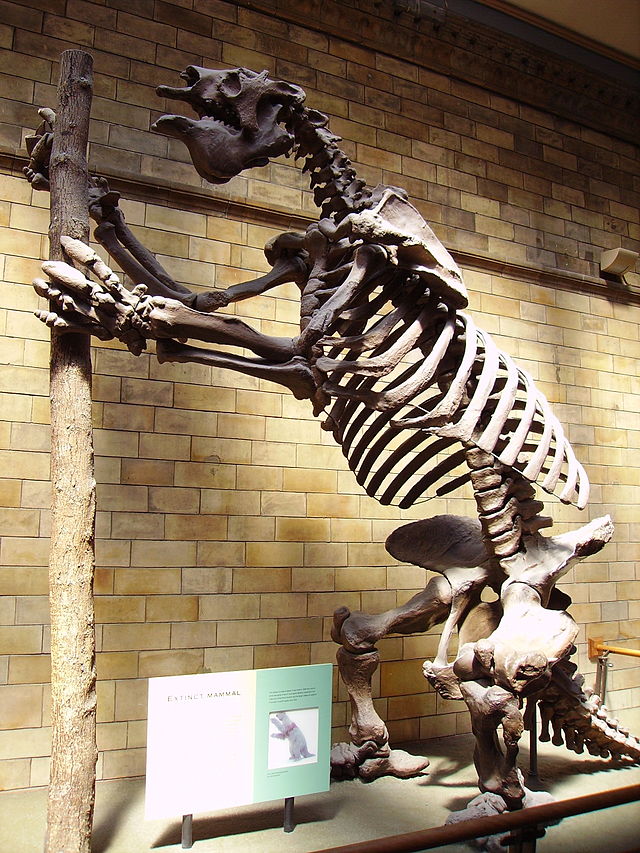
To witness the full majestic sight of the Giant Ground Sloth in all it’s glory, it is best to visit at twilight. For around half an hour after the museum doors open, and then again for around half an hour just before they close, there are few visitors to distract you. Walk along the grand corridor, past exquisite remains of reptiles that once thrashed around in the warm Jurassic seas, which now line the walls watching you form their rocky entombment. At the end of the corridor, standing handsomely, proudly in the corner, is the Giant Ground Sloth; the truly magnificent Megatherium americanum.

Almost a decade ago, I volunteered at the Natural History Museum, London in the fossil mammals department. Each morning, often before museum visitors were pouring in, I would admire this massive beast; its robust legs, its massive rib cage that must have once housed an enormous gut, the giant claws, and that cute looking head. Then, I would silently slink through a secret door to carry out my work with some awesome Ice Age fossils.

The truly awesome Goant Ground Sloth, Megatherium americanum (Image from here)

The truly awesome Giant Ground Sloth, Megatherium americanum, standing proud on display at the Natural History Museum, London.  (Image from here)

Megatherium was a true giant. One of the largest Twilight Beasts, this was the largest sloth to have walked the Earth. The enormous creature would have towered above any human, and standing upright on its back legs, it would have easily been able to peer inside the top windows of a double decker bus. Massive, robust leg bones could have held the bulk of this beast as it reared up and fed from higher branches, or even to defend itself against predators, like a foolhardy Smilodon.

Skeletal reconstructions generally have Megatherium standing, and rightly so, for this is the best way to show off the impressive size. Illustrations do vary from these sloths grabbing branches whilst standing, to crawling on all fours. Looking at the short legs, although thick and strong, they would have struggled to keep an animal this size upright permanently; if it had to travel for long distances, it is most likely that it travelled on four legs. Interestingly, most of the Megatherium footprints which have been preserved in 10,000 year old mud show this sloth to be walking on its back legs. Perhaps it was easier to walk on two legs than four along the sticky, squelchy, muddy banks?

Fossils have been found across South America, from sites in Chile, Brazil, Argentina, and Uruguay. This was one of the first fossils outside of Europe to be described. Eight years after the first specimens were shipped back to Madrid, the great French anatomist, Georges Cuvier, published the first description of this extinct sloth. He correctly assigned the fossils to the sloth Order, Pilosa, and thought its giant claws were used for digging tunnels: Cuvier had created a mole bigger than an elephant! (This actually wasn’t that fanciful. Mammoths thawing out of the permafrost in Siberia were thought by the local people to have been giant burrowing moles, where they used their tusks to dig, and sadly died on exposure to the sun.).

Cuvier was right in taking such an interest in the claws. Longer than your forearm, Megatherium claws on it’s hands and feet were immense. Swiping with their giant arms, and very likely causing serious damage, this was a giant not to be messed with. Some researchers suggest they were used to bring down leaves from high branches; beneficial when you are bigger and can stretch further than other herbivores. Their teeth indicate they had quite a varied diet, from leaves and fruits on trees to succulent plants closer to the ground, and these large claws may easily have been used to dig up plant roots and tubers to feed upon.

There is a striking similarity between Megatherium‘s claw shape to an animal in the same Order, but with a much more specialised lifestyle. Anteaters have huge claws (resulting in their seemingly odd gait) which they use to rip open termite nests and then use their incredibly long, sticky tongues to feed solely on these nutritious insects. Recent excavations in Southern Brazil show that Cuvier’s original thoughts about a  subterranean giant were actually not that far off. Incredible tunnels up to 100m long, and over a meter high have been found which were dug out by Pleistocene sloths! The soft sediment still preserves the claws marks from the creatures who painstakingly dug them out. Giant armadillos and ground sloths (possibly including Megatherium) dug into the earth, with their big claws. They clearly did spend some time underground. These palaeoburrows are remarkable evidence of the habits of an extinct creature (click here for a nice image). But the use of these burrows is still unknown. There has been little found inside the burrows to indicate if they were used for hibernating, or living in. A colleague recently suggested the possibility that the males may have patiently dug out these burrows to attract a female. They are very cleanly made, with a lot of effort, and taking a lot of time to move the sediment out of the tunnel. Perhaps Megatherium was the sloth version of the Bower Bird. It is difficult to test this today, but if true, these giants were making their own little tunnel of love!

To see the true size of Megatherium, here is that classic blue VW Beetle with (Image from here)

To see the true size of Megatherium, all you need is that classic blue VW Beetle for scale. And of course the chap with the hat. (Image from here)

Some researchers have thought that Megatherium could have been a scavenger, using its massive bulk to steal carcasses from other predators. The Giant Ground Sloth would have had no problems scaring away any animal if it chose to scavenge half eaten kills from other predators. There is little real evidence to say the diet was supplemented with fresh flesh, apart from the massive claws. But the claws are not enough. You need sharp teeth to cut the meat and chew it. Megatherium lacked any sharp slicing teeth. The molars were ridged like many herbivores for chomping up vegetation. In fact, this giant lacks the front incisors which are normally used for nipping grass or leaves; instead, there may have been a very long tongue like a giraffe, or big, prehensile lips, similar to a rhinoceros.

Although fur has been found preserved in caves for Mylodon, none has yet been found for Megatherium. It is possible the fur was long and shaggy, not too dissimilar to the preserved fur from Mylodon, or the thick long fur of sloths alive today. The gorgeous tree sloth has long thick hair, and is known to harbour green algae, that makes it look green, blending in beautifully with the surrounding forest. There is a hidden world within the fur. It teems with insects, parasites, and fungi. Whatever the colour, or thickness of Megatherium’s fur, this giant was very likely a walking island for dozens of tiny species. Along with the extinction of Megatherium presumably most of these tiny animals who called it home vanished too. It is often strange to think that there are so many species that have existed on our planet that we will never know were there.

From trundling around South America for over 2 million years, the great Megatherium vanished fairly recently, around 10,000 years ago. Towards the end of the Pleistocene, the climate was changing, which had an effect on so many of the Twilight Beasts. From the warm temperate, arid to semi-arid environments the Giant Ground Sloth was at home in, the environment changed to cooler and drier with more grasses. For the ginormous browsing herbivore, the changing landscape was a big problem. On top of their shrinking natural habitat, a new creature was on the scene; Homo sapiens. In Argentina, the sites of Arroyo Seco and Paso Otero have revealed Megatharium americanum bones,  alongside human artifacts. No cut marks have been found on the bones yet. But, with spears and other projectiles, humans could have easily, and safely, attacked this giant. Large mammals will often have large gestation periods. Elephants, for example, carry their baby for around 2 years; for a mouse, it is around 20 days. With Megatherium under stress from a changing environment, and additional pressures from being hunted, their long gestation time would not have allowed them to increase their numbers quickly enough.

Bones of Megatherium were sought after by the Victorians. Along with Mammoth, the Giant Ground Sloth was a creature to behold and admire. Soon, the great dinosaurs stole the lime light, pushing the Giant Ground Sloth back into obscurity. Whilst walking past the magnificent skeleton at the Natural History Museum, more than a dozen times I have heard children, and adults, excitedly, but rather sadly, exclaim, ‘Wow! Look at this dinosaur!’ Megatherium americanum is a beast dear to my heart, and needs no title of ‘dinosaur’ to beef it up.

Written by Jan Freedman (@JanFreedman)

Further Reading:

Bargo, M. S. (2001), ‘The Ground Sloth, Megatharium americanum: Skull shape, bite forces, and diet’, Acta Palaeontol. Pol. 46 (2). pp.173-192. [Full article]

Boyd, J. P. (1958), ‘The Megalonyx, the Megatherium and Thomas Jefferson’s Lapse of Memory’, Proceedings of the American Philosophical Society. 102(5). pp420-435. [Abstract only]

Casinos, A. (1996). “Bipedalism and quadrupedalism in Megatherium: An attempt at biomechanical reconstruction”. Lethaia 29. pp.87–96. [Abstract only]

de Iuliis, G,  & Cartelle, C. (1994). ‘The medial carpal and matacarpal elements of Eremotherium and  Megatherium‘, Hournal of Vetebrate Palaeontology. 13(4). pp.525-533. [Abstract only]

de Iuliss, G. (1995), ‘Relationships of the Megatheriinae, Nothrotheriinae, and Planopsinae: Some skeletal characteristics and their importance for Phylogeny’, Journal of Vertebrate Palaeontology. 14(4). pp.577-591. [Abstract only]

Fariña, R. A. & Blanco, R. E. (1996). ‘Megatherium the stabber’, Proceedings of the Royal Society of London 263 (1377): 1725–1729. [Abstract only]

Heinrich, T. F, et al. (2011) ‘Karstic features generated from large palaeovertebrate tunnels in Southern Brazil’, Espeleo-Tema. 22(1). pp.139-153. [Full article]

Higginbotham, et al. (2014), ‘Sloth Hair as a Novel Source of Fungi with Potent Anti-Parasitic, Anti-Caner and Anti-Bacterial Bioactivity’,  PLoS ONE 9(1). e84549. doi:10.1371/journal.pone.0084549 [Full article]

Martin, P. S. (2005), ‘Twilight of the Mammoths: Ice Age Extinctions and the Rewilding of America’, University of California Press. [Book]

Pinero, J. M. L. (1988), ‘Juan Bautista Bru (1740-1799) and the description of the genus Megatherium“, Journal of the History of Biology. 21 (1). pp.147-163. [Abstract only]

Posted in Giant Ground Sloth | Tagged , , , , , , , , | 11 Comments

Darwin’s 18 pence

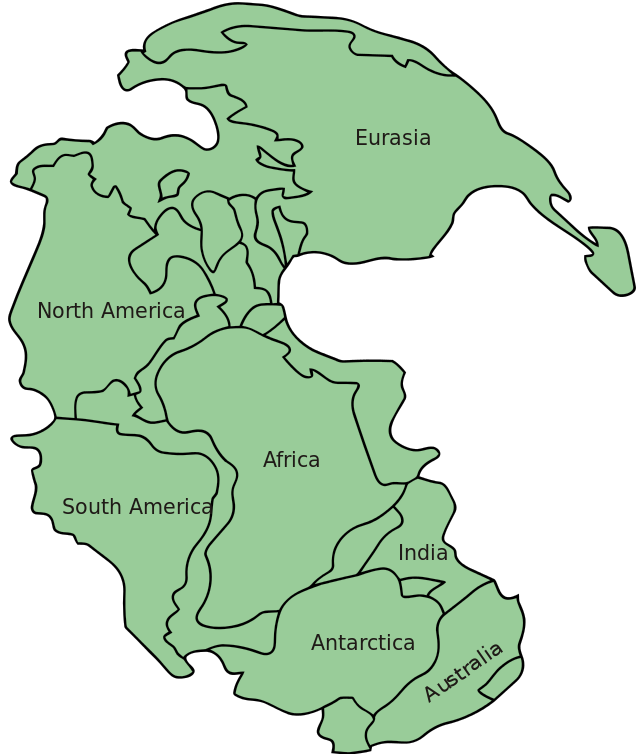
South American Pleistocene beasts were super weird. They owe their peculiar evolution to events that happened deep within the very bowels of the planet, hundreds of millions of years ago. Almost all the land that we know today was squashed together to form one massive, enormous supercontinent called Pangaea around 300 million years ago. Incredibly slowly, it began to be ripped apart by the powerful forces of plate tectonics, spreading the plates across the surface of the earth, like a thin skin riding ontop of the thick yellow custard beneath. Hot, sticky magma rose from below, pushing plates apart at the rate of fingernails growing, creating new oceans. The North of this  huge landmass began to break up first, around 175 million years ago. Around 30 million years later, the South part of Pangaea (named Gondwana) began to painstakingly break apart. Here, the recognisable outline of South America split from Africa, and for the next one hundred and forty million years drifted in isolation. And with it, so did the animals.

Almost all the current continents in one place. The supercontinent, Pangea. (Image from here)

Almost all the current continents in one place. Crashing together around 300 million years ago, the supercontinent, Pangea. (Image from here)

The extinction of the dinosaurs, along with the isolation of this fairly large landmass, allowed the surviving animals to move around freely, adapt to new environments and evolve into some of the most incredible creatures of the recent past. From the wonderfully weird heavily armoured Glyptodonts, to the bonkersly bizarre Macrauchenia which couldn’t decide if it was a camel or an elephant this really was the land of the beasts. The freaky big, hooved Toxodon was no exception.

An old school illustration of Toxodon platensis. (Image from here)

An old school illustration of Toxodon platensis. (Image from here)

The discovery of this giant is all down to one young man exploring the tough terrain of South America. On October 1st 1833, the 23 year old records in his diary the first finding of remains he saw of this creature; “a curious and large cutting tooth.” It baffled him. He wrote to his friend back in England, “I got a tooth which puzzles even my conjectures. It looks like an enormous gnawing one.” He found a few more bones in the next month, until he struck gold: he bought a skull off a boy in Uruguay for 18 pence. The best 18 pence anyone ever spent. This was the skull of a new creature, a large beast that had lived in the not too distant past.

The passionate young man was of course Charles Darwin. At the age of just 22, young Darwin joined the HMS Beagle as the captains companion (in those days, a captain only socialised with someone from a similar class, and with a five year voyage ahead, a captain needed someone just to talk to to keep sane). This was the famous voyage of the Beagle that changed Darwin’s whole life, and his thinking about life. It wasn’t just the Galapagos Islands that got Darwin thinking. The fossils he found in South America played a big part in developing his ideas about evolution and extinction. Darwin found a number of remains of extinct animals from South America, including fossils of giant ground sloths (Mylodon and Glossotherium), mastodons, the weird Macrauchenia, and Toxodon.

Toxodonts were big beasts, with a robust skeleton hinting at a similar appearance to a stocky rhinoceros. Huge extensions of bone coming out of the vertebra (called apophyses) would have attached enormous muscles to the animal, holding up its large body. As with the giant sauropod reconstructions in the very early 20th century, this great beast was always viewed as living in swampy areas, where the large body could only survive in water. The skeleton says otherwise. The larger, long back legs means the head is facing down, closer to the ground: not an ideal adaptation for an animal that spent its time living in swamps. And the sediment where Toxodon fossils have been found hold evidence of a arid, grassy environment, typical of the South American Pleistocene.

A familiar chap posing as a scale next to a wonderful Toxodon. (Image from here).

A familiar chap posing as a scale next to a wonderful Toxodon platensis. (Image from here).

As with many Twilight Beasts, Toxodon was described and named by the rather frightful Richard Owen. Toxodon means ‘bow teeth’ due to the very curved nature of the tooth. These teeth do resemble rodent teeth, but of gigantic proportions! In his original description, Owen does assign these extinct giants to the Rodentia Order. As is often the way with early taxonomy, species are shuffled out from one Order and placed into another based on the latest evidence and fossil finds: they were moved into the extinct Order Notoungulata, which were large hooved mammals living in South America.

The big stocky Toxodon was a common herbivore in South America. It’s head hung low, facing the ground, and it had strong flat teeth; both were perfect for grazing the luscious grasslands, and it is thought they would have browsed low lying bushes. With just four species of Toxodon, they were not the most diverse of creatures, but they were well adapted for living where they did.

The unique creatures evolved in isolation for millions of years at home on a large island landmass. Even when North America joined to South around 3 million years ago, and many beasts moved up or down the newly formed bridge during the Great American Interchange, the Toxodon appears to have stayed put. One tooth recently found in Texas, America, suggests that some of these big beasts may have moved north (although the species wasn’t identified, and other fossils are lacking).

One predator that headed South, and would have enjoyed a juicy Toxodon meal, was Smilodon. The bulky size of Toxodon would have not protected it from this formidable predator, and the sabretooth would have added pressure to population of the big herbivores. But not enough to make them extinct, for the hunter and the prey co-existed for tens of thousands of years. A common story appears when we talk about the extinction of one of our amazing Twilight Beasts: changing environment and humans. The climate was changing for these animals, the grass lands were dying out with warmer climates. These slow reproducing giants were hit hard, and suffered a new threat from humans: arrow heads have been found at several sites with Toxodon remains. For this enigmatic giant, their comfortable lives could not keep up with a sudden changing world.

Written by Jan Freedman (@JanFreedman)

Further Reading:

Charles Darwin’s Beagle Diary online.
Charles Darwin’s correspondence online.

Astolfo, G. M., et al.  (2004). ‘Vegetation changes and megafaunal extinctions in South America: Comments on de Vivo and Carmignotto (2004)’, Journal of Biogeography. 31(12). pp.2039-40. [Full article]

Baffa, O, et al. (2000). ‘ESR dating of a toxodon tooth from a Brazilian karstic cave’. Applied Radiation and Isotopes 52 (5): 1345–1349. doi:10.1016/S0969-8043(00)00093-2

Cope, E. D. (1881). ‘Note on the structure of the posterior foot of Toxodon’, Proceedings of the American Philosophical Society. 19 (108). pp.402-403. [Full article]

Fernicola, J. C., Vizcaino, F, and de Iuliis, G. (2009), ‘The Fossil Mammals collected by Charles Darwin in South America during his travels on board the HMS Beagle’, Revista de la Asociatión Geológica Argentina. 64 (1), 147-59. [Full article]

Lundelius, J. R., et al. (2013), The first occurrence of a Toxodont (Mammalia, Notoungulata) in the United States. Journal of Vertebrate Paleontology. 33(1). pp.229-232. [Abstract only]

Martin, P. S. (2005), ‘Twilight of the Mammoths: Ice Age extinctions and the rewilding of America‘, University of California Press. [Book]

Norma, L. N, Musalem, S., & Cerdeno, E. (2000). ‘A new Toxodont from the Late Micene of Catamarca, Argentina, and a Phylogenetic analysis of the Toxodontidae’, Journal of Vertebrate Paleontology20(3). pp.591-600. [Full article]

Quammen, D. (February 2009), ‘Darwin’s First Clues’. National Geographic: 45. [Full article]

Posted in Toxodon | Tagged , , , , , , , , , , , , , | 9 Comments

The sabretooth salmon

Almost everyone has heard about sabretooth cats, mostly thanks to the incredibly fun Ice Age movie series with the cool cat, Diego. But it wasn’t the only sabre toothed beastie of the Pleistocene. There was of course, the more unfamiliar British sabretooth, Homotherium. But there was something else….lurking in the waters…. something really, really big. I present to you one of the real oddities of the Pleistocene, Oncorhynchus rastrosus (synomyn Smilodonichthys rastrosus) – the sabre toothed salmon.

Yes, you read that correctly.

Salmon.

Sabre toothed.

And they were really large. This is no fish-tale. O. rastrosus was around 2m long; although, according to fossil evidence, many grew well beyond 3m in length. The teeth are the main feature of this huge fish – the synomyn species name is derived from the huge protruding canine teeth jutting from its top jaw, resembling the fangs of Smilodon. Now, all male salmon have these little upper teeth, mostly used to see off other males during the spawning season but nothing comparable to the fangs of the giant sabre tooth salmon. Appearance-wise, this giant of the Pacific northwest rivers resembled the modern sock-eye salmon; genetically they’re not terribly far removed from each other. There’s some debate about just how close the genetic links are: Oncorhyncus rastrosus and Smilodonichthys rastrosus are pretty much the same critter, with Oncorhyncus being the more ‘correct’ nomenclature, though as I was told by one of its fans, S. rastrosus is much cooler!

Not the greatest of images of the sabretooth salmon ever, but it shows the size of those big teeth.

Not the greatest of images of the sabretooth salmon ever, but it shows the size of those big teeth. Although they are depicted here as pretty ferocious fish, they actually fed on the tiny little organisms that float in the water, the plankton.

They are creatures whose lives are shrouded in mystery. Despite the first fossil skulls being found in 1917 in Oregon, we know very little about their habits, or even an accurate date of extinction.  It’s commonly believed they migrated from the deep freshwater rivers of Oregon and California out to the Pacific to feed on microscopic marine organisms. As this is one of the ‘original’ salmonids, palaeontologists – and palaeoichthyologists for that matter! –  have been keen to try and work out if the taxa began as freshwater or marine creatures, to try and understand the dramatic spawning migration patterns and paths which our modern day salmon still perform. There’s been palaeomagnetic analysis carried out on lake sediments where O. rastrosus once lived, as of course, migration is influenced by magnetoception ( the ability to use earth’s magnetic fields to locate the region where spawned themselves) – if a wobble or change in that field occurs, migration will be a bit messed up. As we know there have been several magnetic ‘ wobbles’ over deep prehistory, lake sediment analysis can hopefully create a  more solid chronology of when this giant salmon ruled the rivers of northwest America. If anyone has ever watched the event of salmon sprinting and splashing up rivers, they’ll know it’s an amazing, and quite awe-inspiring thing to witness. Now imagine how majestic and exciting it would be to see a fish up to 3 metres long, leaping from the waters of deep, fast rivers, making its way back to its place of birth, to start the cycle of reproduction all over again.

In truth, we aren’t even quite sure of the exact period of the Pleistocene in which the sabre tooth salmon became extinct, but it is suspected that its demise is linked to climate change, which makes it a pretty important story to compare to our own world today. There’s been surprisingly little modern research on this amazing fish, despite the modern interest in all things pertaining to climate change and sea level changes.  One of the more recent papers, however, by Stearley and Smith in 1993, suggests that this enormous fish was indeed a migratory (or anadromous) species, which makes it likely that its demise during the Pleistocene was caused by changes in sea-temperatures and subsequent declining micro-organisms to feed off.  The sabre tooth salmon started off as a Miocene creature, perhaps 12 million or more years ago, and landscapes were different; more importantly, climate was different. The stomping grounds (or splashing grounds?) of this giant salmon were deep lakes and rivers created by seismic activity of deep prehistory. By the very end of the Miocene period, the northern hemisphere was getting colder. The Pleistocene saw the beginnings of further climate fluctuations, which of course would create the glaciation event we call the Ice Age.  Colder seas and rivers meant less available plankton for O. rastrosus.  There were also sea level changes and alterations to inland waterway hydrology systems, especially as glaciation encroached across North America. We know from Smith et al’s paper of 2007 there were still specimens swimming around Oregon around 700,000 years ago, but the fact is, we just don’t know exactly how long into the Quaternary O. rastrosus survived.

Palaeoenvironmentally, this fish is the one that got away. We’ve no idea if any human ever set eyes on this massive fish leaping from the clear waters. It is one of the few creatures where we can probably state that humankind was not involved in some way in its extinction. Yet there is so much we still have to learn about this plankton eating gentle giant of the Pleistocene, and it does seem to be a fabulous PhD or postdoctoral study just waiting for someone to come along and take the bait! Because it’s likely S.rastrosus required similar environmental conditions to modern salmon, its story could hold huge implications for extant species in the light of our changing environment and climate.

Addendum: A huge thanks to @smilodonichthys who checked this for the most up-to-date facts over in Oregon!  We’re hoping to persuade  our Twitter pal to blog the discovery of fully fanged skulls on one of their expeditions! Meantime, there’s @smilodonichthys ‘ s dad’s blog here to check out fishy fossily frolics in the gorgeous northwest of the US!  http://bernietheichthyosaur.blogspot.com/

Written by Rena Maguire (@JustRena)

Further Reading:

Brown, B, (1995), Mountain in the clouds: a search for the wild salmon. Washington: University of Washington Press. [Book]

Casteel, R. W, (1974), ‘Use of Pacific salmon otoliths for estimating fish size, with a note on the size of late Pleistocene and Pliocene salmonids’. Northwest Science. 48.3: 175-179. [Full article]

Casteel, R. W., & Hutchison, J. H. 1973. ‘ Orthodon (Actinopterygii, Cyprinidae) from the Pliocene and Pleistocene of California’. Copeia 358-361. [Full article]

Cavender, T.M., and Miller, R.R. (1972), ‘Smilodonichthys rastrosus: A new Pliocene salmonid fish from western United States’. Museum of Natural History, University of Oregon, Bulletin 18:1-44. [Full article]

D.J. Easterbrook, J.L. Roland, R.J. Carson, N.D. Naeser. (1988) ‘Application of paleomagnetism, fission-track dating, and tephra correlation to Lower Pleistocene sediments in the Puget Lowland, Washington’ in Easterbrook, D.J (Ed.) Dating Quaternary Sediments, Geological Society of America Special Paper. 227:139–165. [Abstract only]

McDowall, R. M. (2001), ‘The origin of the salmonid fishes: marine, freshwater… or neither?’ Reviews in Fish Biology and Fisheries11. 3: 171-179. [Abstract only]

Smith, G.R; Morgan, N and. Gustafson, E. 2000. ‘Fishes of the Mio-Pliocene Ringold Formation, Washington: Pliocene Capture of the Snake River by the Columbia River’ University of Michigan Museum of Paleontology Paper. 32: 1–47. [Full article]

Smith, G. R; Montgomery, D. R; Peterson, N & Crowley, B. (2007), ‘Spawning sockeye salmon fossils in Pleistocene lake beds of Skokomish Valley, Washington’. Quaternary Research 68.2: 227-238. [Full article]

Stearley, R.F and Smith, G.R. (1993), ‘Phylogeny of the Pacific trout and salmon (Oncorhynchus) and genera of the family Salmonideae’. Transactions of the American Fish Society. 122: 1-33. [Full article]

Maher, J. C., Trollman, W. M., & Denman, J. M. (1973). Geological Literature on the San Joaquin Valley of California. USGS. [Book]

Posted in Sabre tooth salmon | Tagged , , , , , | 1 Comment

A unicorn out of the twilight

On 20th October 2014, a northern white rhino died in a zoo. Animals die in zoos all the time but what made this unfortunate death even sadder is that there are now only six individual northern white rhinos left on the planet. And all of these are captive individuals; there have been no sightings of wild northern white rhinos (Ceratotherium simum cottoni) since 2007. In just a decade poachers slaughtered around 500 individuals, reducing the wild population to just 15, with a small increase in numbers, all wild northern white rhinos were then slaughtered for their horn. In 2011, another subspecies of rhinoceros, the western black rhinoceros (Diceros bicornis longipes), was declared extinct.

A northern white rhino (mage from here)

A most incredible animal, a northern white rhino (Ceratotherium simum cottoni) at San Diego Zoo safari park. (Image from here)

Today there are only five species of rhinoceros belonging to just four genera left; the White Rhinoceros (Ceratotherium simum) (this is actually split into two sub-species; the southern white rhinoceros, and the critically endangered northern white rhinoceros); the Black Rhinoceros (Diceros bicornis) (split into now three sub-species); the Indian Rhinoceros (Rhinoceros unicornis); the Javan Rhinoceros (Rhinoceros sondaicus); the Sumatran Rhinoceros (Dicerorhinus sumatrensis). In the past, there were many, many more species.

The family Rhinocerotidae evolved around 50 million years ago, with the earliest fossils found in North America. Closely related to tapirs and horses, belonging to the Perissodactyla, at least 26 different genera of rhinos have lived on the planet. Today, less than a handful survive.

Rhinos have been successful in a huge variety of different environments. The relatively unknown narrow nosed rhinoceros (Stephanorhinus hemitoechus) was plodding across Britain around 125,000 years ago when the climate was much warmer, and hippopotamus bathed in the warm rivers across the land. The huge, shaggy woolly rhinoceros (Coleodonta antiquitatis) was perfectly adapted to life on the cold Mammoth Steppe until around 14,000 years ago when the temperatures warmed and the Steppes vanished. Our Twilight Beast was an unusual rhinoceros that was at home on the open grassy plains.

The first fossil of our beast that was described came from a Princess’s cabinet of curiosity. TrowelBlazer Yekaterina Vorontsova-Dashkova, also known as Princess Dashkov, donated her ‘Cabinet of Natural History and other Rarities’ to the Natural History Museum at Moscow University in 1807. The director of the museum, a rather grand looking man, with a rather grand looking name, Johann Gotthelf Fischer von Waldheim, saw the fossil and knew it was something new. An anatomist and entomologist, von Waldheim knew some of the big names of the time including Darwin’s hero Alexander von Humboldt and the great French naturalist Georges Cuvier. Based on this one jaw, von Waldheim described a whole new Genus of extinct rhinoceros; Elasmotherium.

One of the key features defining this genus was its teeth. Highly evolved for tough grazing, their jaws had no front incisors, or canines; just two flat cubic premolars and three very similar molars. To give extra ‘tooth’ for the wear and tear, the teeth are hypsodont; there is more enamel above, and below, the gum line for longer lasting teeth. Hypsodont teeth are typical in grazing animals, like cows and horses, because grass is a tough plant which can wear down teeth. There is also evidence that Elasmotherium was euhypsodont: like some rodents, its teeth grew continuously throughout life. Today, the white rhinoceros are grazers, and the only living rhinos with hypsodont teeth.

Of the three species of Elasmotherium discovered so far, one was the largest rhinoceros ever to have lived. Reaching sizes comparable to the woolly mammoth, Elasmotherium sibiricum was a truly magnificent beast. Also known as the Steppe Rhinoceros, this enormous rhinoceros had some very unusual features, which has led to this beast quite possibly being the most frequently reinvented creature of the Pleistocene.

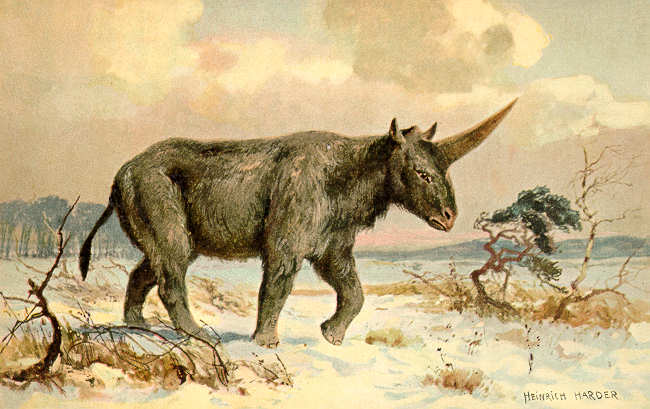
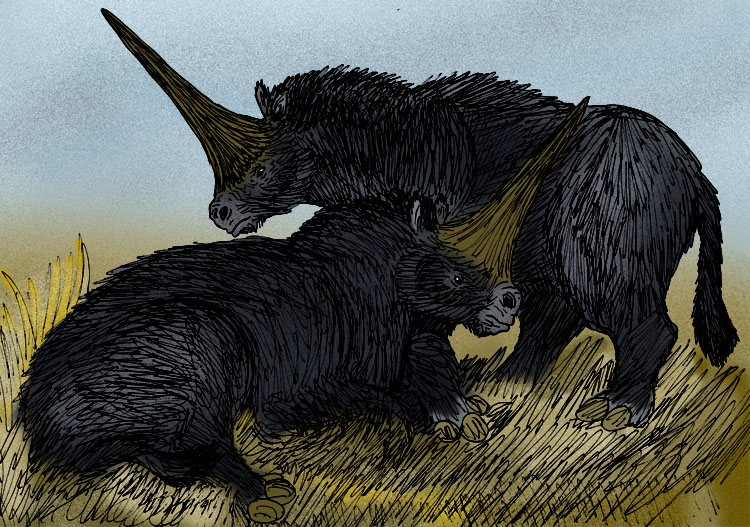
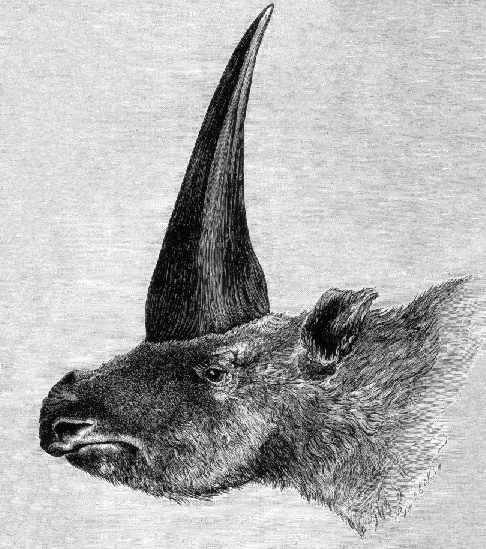
A lovely early illustration of Elasmotherium  (Image from here)

A lovely early illustration of Elasmotherium sibiricum with it’s long legs from the 1920s. The overall appearance looks more like a horse than a rhinoceros. The artistic representations of this giant have varied more than any other Pleistocene animal. (Image from here)

Early reconstructions of E. sibiricum varied hugely. Some depictions in the 1920s, like that above, gave it a horse-like appearance. In the 1930s it was given the look of a stumpy hippopotamus creature creeping out of swamps. As more fossils turned up, the image was changed. Fossil leg bones suggest that this rhino, which lets remember was almost the size of a woolly mammoth, had rather long, slender legs compared to other rhinos. This suggested that E. sibiricum could run. Not exactly as slender as that in the image above, because it was a massive animal, but there is no doubt it could still run at some pace. An almost complete skeleton was discovered in 1964 in the quaint little village of Gaerskaya in Russia. This allowed renewed interpretation of this huge rhino to be, well, more rhino like.

A more recent artists vision of the wonderful Steppe Rhinoceros. (Image from here)

A more modern artists vision of the wonderful Steppe Rhinoceros. Notice the enormous horn covering most of the head. (Image from here)

The feature that has seen the most variation is the horn. And this beast certainly had a horn. Reconstructions have varied from small rounded stumps to enormous 2 meter long horns in the middle of its head (that’s a horn bigger than an adult human!). Unfortunately no remains of E. sibiricum horns have been found, so any reconstructions are incredibly speculative. The skulls found do have a huge proturbance in the centre of the head, which had large blood vessels circling it. Similar to other rhino species, this raised dome would have held a horn. The size of the raised dome is huge, so the horn would undoubtedly have been large, but how big is unknown.

But enough skulls have been found to hint at sexual dimorphism; males have much more robust skulls and larger domes, whereas the females have more gracile skulls and smaller domes. One very intriguing fossil, known as the Guriev Skull, has a wound on it’s skull from a sharp pointed object which had healed during  its life. The wound is very likely to have been from another E. sibiricum; perhaps evidence of males fighting for a female.  

One of the first illustrations of Elasmotherium (Image from here)

One of the first illustrations of the awesome giant from 1878. This is one of my favourites, although it does look a little like a grumpy reindeer with a massive horn stuck to its head. (Image from here)

From current fossil finds, the giant Steppe Rhino appears to have been restricted to Russia, Aisa, Ukraine, and Kazakhstan. There is no solid evidence of this animal living in Europe. Reports of remains from Hungary and Italy have no images, or actual specimens. There is one fossil reported from the Rhine Valley of Germany from the 1850s, but this is disputed; embedded in the fossil is a small mollusc only found in the Pleistocene sediments of Russia.

There is one final enchanting possibility that Elasmotherium sibiricum was in Europe, and was seen by early humans. An enigmatic piece of cave art at Rouffignac Cave in France appears to be an illustration of E. sibiricum, with its unique horn.

A tracing of (Image from here)

A tracing of  the painting of a rhinoceros at Rouffignac Cave, France. Some have suggested that this is a painting of Elasmotherium sibiricum due to the one large horn. (Image from here)

The outline of this painting is uncannily similar to paintings of woolly rhinoceros from Chauvet Cave, France. The large hump on the rhinoceros back is very similar, and the curvature and size of the horn is a close match.

A painting of a woolly rhinoceros from Chauvet Cave, France. (Image from here)

A painting of a woolly rhinoceros from Chauvet Cave, France. (Image from here)

This enormous beast appears to have vanished around 50,000 years ago. Some questionable fossils push the date a little to 37,000 years ago which need further research. More fossils need to be found to extend the date of this amazing rhinoceros. If the painting from Rouffignac Cave is that of an Elasmotherium sibiricum, then it would extend its range to Europe, and push its extinction to around 30,000 years ago.

Apart from the vague possibility from Rouffignac Cave above, any evidence of human/E. sibiricum is yet to be found. The numerous sites holding fossils of this giant have not yielded any human remains, or artefacts. The fossils themselves show no evidence of butchery by humans. In China and Russia, there are tales of a large one horned beast that have been passed down through generations: the unicorn. Perhaps humans did see Elasmotherium sibiricum in all its glory, and the memories have been passed down over the warmth of the camp fires.

Written by Jan Freedman (@JanFreedman)

Further reading:

Beddard, F. E. (1902), ‘Mammalia’, The Cambridge Natural History, McMillan & Co. [Full Book]

Belyaeva, E. I. (1975), ‘About the hyoideum, sternum and metacarpal V bones of Elasmotherium siiricum Fischer (Rhinocerotidae),’ Journal of the Palaeontological Society of India. 20. 10-15. [Full article]

Cerdeno, E & Nieto, M, (1995), ‘Changes in Western European Rhinocerotiae related to climatic variations’, Palaeogeography, Palaeoclimatology, Palaeoecology114. 325-338. [Full article]

Deng, T, (2008), ‘A new elasmothere (Perissodactyla, Rhinocerotidae) from the late Miocene of the Linxia Basin in Gansu, China’, Geobios47. 719-728. [Full article]

Noskova, N. G. (2001), ‘Elasmotherians – evolution, distribution and ecology’, The World of Elephants – International Congress, Rome 2001. p126-128. [Full article]

Prothero, D. R. (2006), After the Dinosaurs. The Age of Mammals’, Indiana Press. [Book]

Qiu, Z, & Qiu, Z, (1995) ‘Chronological sequence and subdivision of Chinese Neogene Mammalian faunas’, Palaeogeography, Palaeoclimatology, Palaeoecology116. 41-70. [Abstract only]

Stuart, A. J. (1982), ‘Pleistocene vertebrates in the British Isles’, Longman Group Limited. [Book]

Zhegallo, V. et al. (2005), ‘On the fossil rhinoceros Elasmotherium (including the collections of the Russian Academy of Sciences’, Cranium22. 3. 17-40. [Full article]

Posted in Elasmotherium | Tagged , , , , , , , , , , , , , , , , , , , , , , , , , , , , , , , | 1 Comment

The pouched lion

Owen_thyacoleoskull

Partial skull of Thylacoleo carnifex from a paper by Richard Owen

Australia is a land stripped of megafauna. The largest surviving kangaroo is a dwarf compared to the elephants, giraffes, rhinos, and hippos of Africa. Similarly, the largest living carnivorous marsupial, the Tasmanian devil (Sarcophilus harisii), is a stunted furball when placed against the lions, tigers, hyenas and bears that frighten us in the old world. But, a quick look at the Devil’s lifestyle is enough to persuade us that perhaps this was not always the case. Tas is a scavenger by trade. Sniffing out carcasses and crunching bones. Who was producing the carcasses that allowed the Devil to fill the scavenging niche? The answer may lie with one of the most awesome carnivores to have ever lived: Thylacoleo carnifex, the marsupial lion.

The marsupial lion (Image by Jan Freedman)

The marsupial lion  was by no means an enormous predator. But it was a formidable beast. (Image by Jan Freedman)

Make no mistake, Thylacoleo is a mysterious beast. When fossils of the animal were first found in New South Wales and sent to the infamous Richard Owen in London, even he was not entirely sure where the animal fitted. Additional material and close study eventually allowed scientists to place Thylacoleo into the diprotodontia (along with the extinct diprotodon, and the living wombats, koalas, and kangaroos). This affinity is reflected in the unique dentition of T.carnifex: it has two teeth at the front, but modified into Nosferatu-like prongs. More incredible yet are the molars. Many are familiar with the carnassial shearing that the battery of molars and premolars perform in placental carnivores, acting like a pair of scissors to slice through flesh. In Thylacoleo, this function is performed by just two teeth; massive and elongate, they extend along the mandible and maxilla to form a biological set of shears. In fact, research on the skull of Thylacoleo suggest it may have had the strongest bite for its size of any carnivore known. Even the giant diprotodon may have been hunted!

The mandible of Thylacoleo, showing the incredible shearing molar.

The mandible of Thylacoleo, showing the incredible shearing molar.

We can see the damage the shearing molars did to prey in some fossils found at Lancefield swamp in Victoria. Initially interpreted as human cutmarks, reanalysis suggested that the paired and opposing cuts found on the bones were most parsimoniously explained by the action of upper and lower molars of the marsupial lion. These powerful teeth left tell-tale marks on both sides of the bones as they were chewed. Like modern-day cats it seems that Thylacoleo was not a bone cruncher and mainly ate muscle and flesh (leaving plenty of scraps for Tas). Also like the felids, T.carnifex appears to have evolved dextrous paws, with the killing tool an oversize thumb claw on the pes, which may have been hyper-mobile. The other claws might have been retractable too.

journal.pone.0052957.g004

Bitemarks caused by Thylacoleo on remains from a site in SE Australia. Images from Camens et al.

These unusual (for a marsupial) features may have been emphasised in an enigmatic piece of cave art from Western Australia. The image, drawn with red ochre in a cave shelter along Admiralty gulf shows a large transversely striped animal. While the stripes would immediately suggest a Thylacine, other characters point towards an identity with the marsupial lion. The artist has made the creature look stocky, with massive forelimbs, completely unlike the lithe Tassie tiger. The paws of the animal have been emphasised with the hint of a large thumb claw. The head is square, with triangular ears, in contrast to the dog-like head and rounded ear of the Thylacine. I don’t know if the image represents Thylacoleo or Thylacinus. If the former it would suggest that a striped pelage evolved independently within the dasyuromorphia (the order that the Thylacine and Devil belong to) and the diprotodontia (the order that the marsupial lion belongs to).

The unusual rock art claimed as Thylacoleo. Image from Ackerman and Willing.

The unusual rock art claimed as Thylacoleo. Image from Ackerman and Willing.

And what happened to the marsupial lion? Well, like the demise of the diprotodonts and Megalania, this is still a mystery. We know that humans first arrived in Australia around 46,000 years ago. When the megafauna disappeared is not clearly known, but seems to be soon after. Was Australia big enough to cope with two apex predators? Many doubt it. We know from bitter experience with the Thylacine that humans do not tolerate other predators.

Reconstruction of Thylacoleo by Nobu Tamura via Wikimedia Commons

Reconstruction of Thylacoleo carnifex by Nobu Tamura via Wikimedia Commons

Written by Ross Barnett (@DeepFriedDNA)

Further Reading:

http://www.naturalworlds.org/thylacoleo/

Ackerman, K., and T. Willing. “An Ancient Rock Painting of a Marsupial Lion, Thylacoleo Carnifex, from the Kimberley, Western Australia.” Antiquity 83, no. 319 (2009).[Full Text]

Camens, A. B., and S. P. Carey. “Contemporaneous Trace and Body Fossils from a Late Pleistocene Lakebed in Victoria, Australia, Allow Assessment of Bias in the Fossil Record.” PLoS One 8, no. 1 (2013): e52957.[Full Text]

Horton, D. R., and R. V. S. Wright. “Cuts on Lancefield Bones: Carnivorous Thylacoleo, Not Humans, the Cause.” Archaeology in Oceania 16, no. 2 (1981): 73-80.[Abstract]

Owen, R. “Additional Evidence of the Affinities of the Extinct Marsupial Quadruped Thylacoleo Carnifex (Owen).” Philosophical Transactions of the Royal Society B-Biological Sciences 178 (1887): 1-3.[Full Text]

———. “On the Affinities of Thylacoleo.” Philosophical Transactions of the Royal Society B-Biological Sciences 174 (1883): 575-82.[Full Text]

———. “On the Fossil Mammals of Australia. Part Ii. Description of an Almost Entire Skull of the Thylacoleo Carnifex, Owen, from a Freshwater Deposit, Darling Downs, Queensland.” Philosophical Transactions of the Royal Society B-Biological Sciences 156 (1866): 73-82.[Full Text]

Wells, R. T., P. F. Murray, and S. J. Bourne. “Pedal Morphology of the Marsupial Lion Thylacoleo Carnifex (Diprotodontia: Thylacoleonidae) from the Pleistocene of Australia.” [In English]. Journal of Vertebrate Paleontology 29, no. 4 (Dec 12 2009): 1335-40.[Abstract]

Wells, R. T., and B. Nichol. “On the Manus and Pes of Thylacoleo Carnifex Owen (Marsupialia).” Transactions of the Royal Society of South Australia 101 (1977): 139-46.[Full Text]

Wroe, S., C. McHenry, and J. Thomason. “Bite Club: Comparative Bite Force in Big Biting Mammals and the Prediction of Predatory Behaviour in Fossil Taxa.” Proc Biol Sci 272, no. 1563 (Mar 22 2005): 619-25.[Full Text]


Posted in Marsupial Lion | Tagged , , , , , , , , , , , , , , | 7 Comments