The surprising cheetah

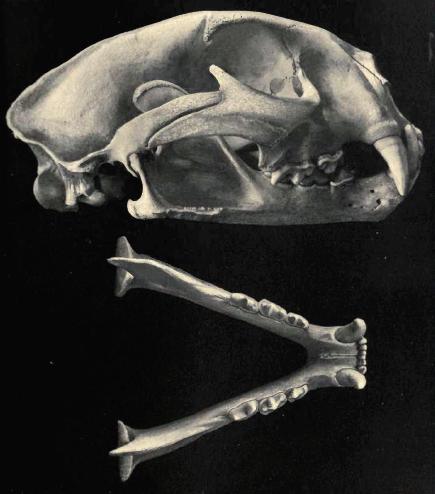
Skull of Puma concolor, image from here

Skull of Puma concolor, image from here

A cheetah stands yawning. Its shoulders shiver as it makes a feeble attempt to get rid of some irritating flies. Nearby, two spotted cubs hide under a bush to keep them safe from roaming lions, while a herd of antelope graze. Can you picture it? Would it surprise you to learn that I am describing a speculative scenario set in the late Pleistocene of Wyoming? The lithe predator species here is Miracinonyx trumani, the American cheetah, not the African cheetah (Acinonyx jubatus). The lions menacing those cubs are American lions (Panthera leo atrox) not African lions (Panthera leo leo). And the antelopes are the supremely weird pronghorns (Antilocapra americana).

The American cheetah is perhaps the most enigmatic of felid taxa. No one had any idea it existed until the 1970s! Prior to this, material we now know belongs to M. trumani was assumed to be a kind of puma or was so fragmentary it was mistaken for other Pleistocene Felidae.

This all changed when the pitfall site of Natural Trap Cave was excavated [currently being re-excavated- follow #NTCave14 on Twitter]. At the bottom of this inescapable deathtrap, excavators found the remains of mammoth, lions, bighorn sheep, camels, and bison, as well as thousands of smaller animals. Crucially, as the cave is over 80 feet deep (measured from the surface) any creature that falls in is instantly killed (or severely incapacitated until death), with no escape and no potential for post-mortem disturbance. This has led to many articulated and associated remains being found, the most important of which were from Miracinonyx. From these remains, researchers were able to show that the animal had a whole suite of features that separated it from puma. These included spectacularly long legs, a shortened skull with enlarged nares, and specialised features of the fibula. Initially, researchers assumed that these adaptations must be due to a shared ancestry and placed Miracinonyx as the sister species to Acinonyx, implying that the African cheetah may have been just another New World endemic that migrated back to the old world (like dogs, horses, and camels). Later research tied all these specialisations into convergently evolved adaptations to a highly cursorial lifestyle. In effect, the American cheetah looked like the African cheetah because they had both evolved to be extremely fast, pursuit predators, and not due to a close phylogenetic relationship. The final piece in the puzzle of Miracinonyx origin came in 2005, when I was lucky enough to extract some ancient DNA from a piece of M.trumani humerus from Natural Trap Cave, dated at 19,765±80 radiocarbon years old. With a lot of help from colleagues and friends, we did some phylogenetic analyses that showed with a high degree of statistical support that Miracinonyx trumani and Puma concolor were sister species, that diverged approximately three million years ago. Our initial conclusion was that perhaps the divergence date was significant, as this was approximately the time when grassland prairie started to expand in North America, providing opportunities for a savannah predator to evolve.

However, there may be a bit of a problem with this straightforward scenario. Bones discovered within caves at the Grand Canyon have recently been attributed to Miracinonyx. Could the “American cheetah” have been more like an “American snow leopard”, hunting on the scree and sheer cliffs of this mountainous environment? I am not completely convinced, although the suggestion is very intriguing. The Grand Canyon material was only compared to modern puma and Pleistocene Miracinonyx material and grouped with Miracinonyx, mostly on the basis of larger size. However, we know that Pleistocene puma were much larger than modern day puma, and if the canyon material could be compared to a dataset that included Pleistocene puma I am sure they might provide a better match. The puma is perhaps the most versatile large cat in the world and can hunt in habitats as diverse as tropical rainforest and Canadian tundra. Canyon living would be no problem.
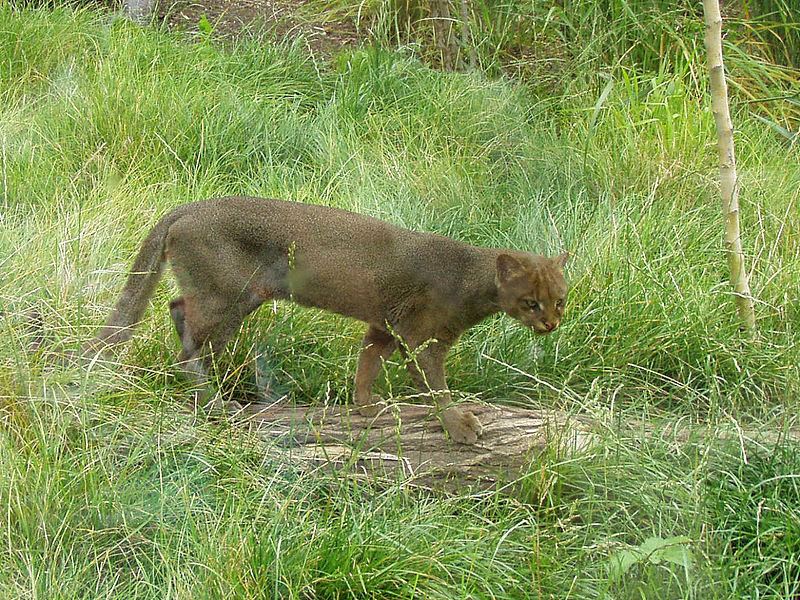
The jaguarundi (or eyra). This housecat sized South American endemic is sometimes tamed as a pet by local Quechua groups.

The jaguarundi (or eyra). This housecat sized South American endemic is sometimes tamed as a pet by local Quechua groups. Image from here.

So, if Miracinonyx trumani and Puma concolor evolved from a common ancestor, where did that cat come from? The puma lineage consists of three living cats (as well as numerous extinct ones). The most basal member is the cheetah, found in Africa and Asia (there is still a small population of cheetah in Iran), while the puma and the jaguarundi (Herpailurus [Puma] yagouaroundi) are found in the New World. There is in fact a potential ancestor for the Miracinonyx, puma and jaguarundi known from the Old World: Puma pardoides. This strange cat has been found in various sites all over Eurasia and could possibly be the starting point for jaguarundi, puma, and Miracinonyx.

A small note on the etymology of Miracinonyx. It comes from a compound of the Latin “mirus” (=astounding, surprising), and the linnean genus for cheetah “Acinonyx” (which itself comes from the Greek prefix a- and -kineo, to move: a reference to the supposedly non-retractile claws in cheetah). The American cheetah line died out at the same time as American lions, sabretooths, and ground sloths at the end of the Pleistocene.

Written by Ross Barnett (@DeepFriedDNA)

Further Reading:

Miracinonyx trumani from the Grand Canyon. Jean-Paul Hodnett

Did false cheetahs give pronghorns a need for speed? Brian Switek (@laelaps)

Big spotted pumas… Miracinonyx redux?Darren Naish (@TetZoo)

Adams, D. B. “The Cheetah: Native American.” Science 205 (14 September 1979): 1155-58. [Article]

Barnett, R., I. Barnes, M. J. Phillips, L. D. Martin, C. R. Harington, J. A. Leonard, and A. Cooper. “Evolution of the Extinct Sabretooths and American Cheetahlike Cat.” Current Biology 15, no. 15 (2005): R589-R90. [Article]

Hemmer, H., R. D. Kahlke, and A. K. Vekua. “The Old World Puma – Puma Pardoides (Owen, 1846) (Carnivora : Felidae) – in the Lower Villafranchian (Upper Pliocene) of Kvabebi (East Georgia, Transcaucasia) and Its Evolutionary and Biogeographical Significance.” Neues Jahrbuch für Geologie und Paläontologie 233, no. 2 (Aug 2004): 197-231. [Article]

Kurtén, B. “Fossil Puma (Mammalia:Felidae) in North America.” Netherlands Journal of Zoology 26 (1976): 502-34. [Article]

Martin, L. D., and B. M. Gilbert. “Excavations at Natural Trap Cave.” Transactions of the Nebraska Academt of Sciences and Affiliated Societies VI (1978): 106-16. [Article]

Martin, L. D., B. M. Gilbert, and D. B. Adams. “A Cheetah-Like Cat in the North American Pleistocene.” Science 195 (1977): 981-82. [Article]

Morgan, G. S., and K. L. Seymour. “Fossil History of the Panther (Puma Concolor) and the Cheetah-Like Cat (Miracinonyx Inexpectatus) in Florida.” Bulletin of the Florida Museum of Natural History 40, no. 2 (1997): 177-219. [Article]

van Valkenburgh, B., F. Grady, and B. Kurtén. “The Plio-Pleistocene Cheetah-Like Cat Miracinonyx Inexpectatus of North America.” Journal of Vertebrate Palaeontology 10, no. 4 (December 1990): 434-54. [Article]


Posted in Cheetah | Tagged , , , , , , , , , , | 7 Comments

Crash of the Titans

Rhinoceros are magnificent beasts. Their muscular and armored bodies sit on top of thick, stocky, legs giving these animals a literally awesome sense of power. Their massive heads, topped with it’s unique horn creates an ancient, almost mythical, persona to this beast. These Titans are often seen with one or a few others; rarely do they move in a big group (also know as a crash). Today there are five species of rhinos; the White Rhinoceros (Ceratotherium simum) (this is actually split into two sub species; the southern white rhinoceros, and the northern white rhinoceros); the Black Rhinoceros (Diceros bicornis) (split into four sub species); the Indian Rhinoceros (Rhinoceros unicornis); the Javan Rhinoceros (Rhinoceros sondaicus); the Sumatran Rhinoceros (Dicerorhinus sumatrensis).

All species of rhinoceros are under threat of extinction today not by changing climate or by increased competition, but by another mammal, the ironically named ‘wise man’, a.k.a Homo sapiens. Hunted for just their horns more and more rhinos are sadly being killed each year. The most threatened and on the verge of extinction, the Sumatran rhinoceros, is the last link to one of the most wonderfully adapted Twilight Beasts the Pleistocene saw.

During the last 2.6 million years there were several different species of rhinoceros adapted for different environments, including the gracile ‘little’ Christol’s rhinoceros (Dicerorhinus megarhinus), the lonely Etruscan rhinoceros (Dicerorhinus etruscus), the warm loving Merck’s rhinoceros (Dicerorhinus kirchbergensis), the colder loving Steppe rhinoceros (Dicerorhinus hemitoechus) and the more familiar Woolly Rhinoceros (Coelodonta antiquitatis).

A Woolly Rhinoceros standing proudly by Charles Knight. (Image from here)

A strong, proud woolly rhinoceros (Coelodonta antiquitatis) painted by Charles Knight. (Image from here)

Stocky, hairy, and powerful, the woolly rhino was a rhinoceros that could happily live in the blistering cold glacial periods. Incredibly preserved frozen carcasses from Siberia have provided a lot of information about the appearance of these extinct beasts. Their thick skin, with the addition of short fur kept their large bodies warm. Short ears and a short tail also kept out the cold. Frozen carcasses show the feet lacked the splayed padding that was suited for living in deep snowy environments; so instead of spreading the weight over the snow, these rhinos would have sunk into the snow making it very tricky to walk. Cold glacial times were often times of bitter coldness, and also times when the landscapes were dry deserts where very little rain, and snow, fell; perfect conditions for this hairy rhinoceros.

Due to their larger size, bones and teeth of woolly rhinos are more likely to be preserved than smaller mammals, so they are commonly found at Pleistocene sites. These fossils give us a glimpse into their ancient distribution, but also provide more; they can tell us what they ate. It’s massive head was positioned close to the ground, along with thick lips and thick enameled teeth, show that this was a grazing animal. Pollen analysis found in teeth and in frozen specimens show they were mainly eating grasses, mosses and low lying herbaceous plants.

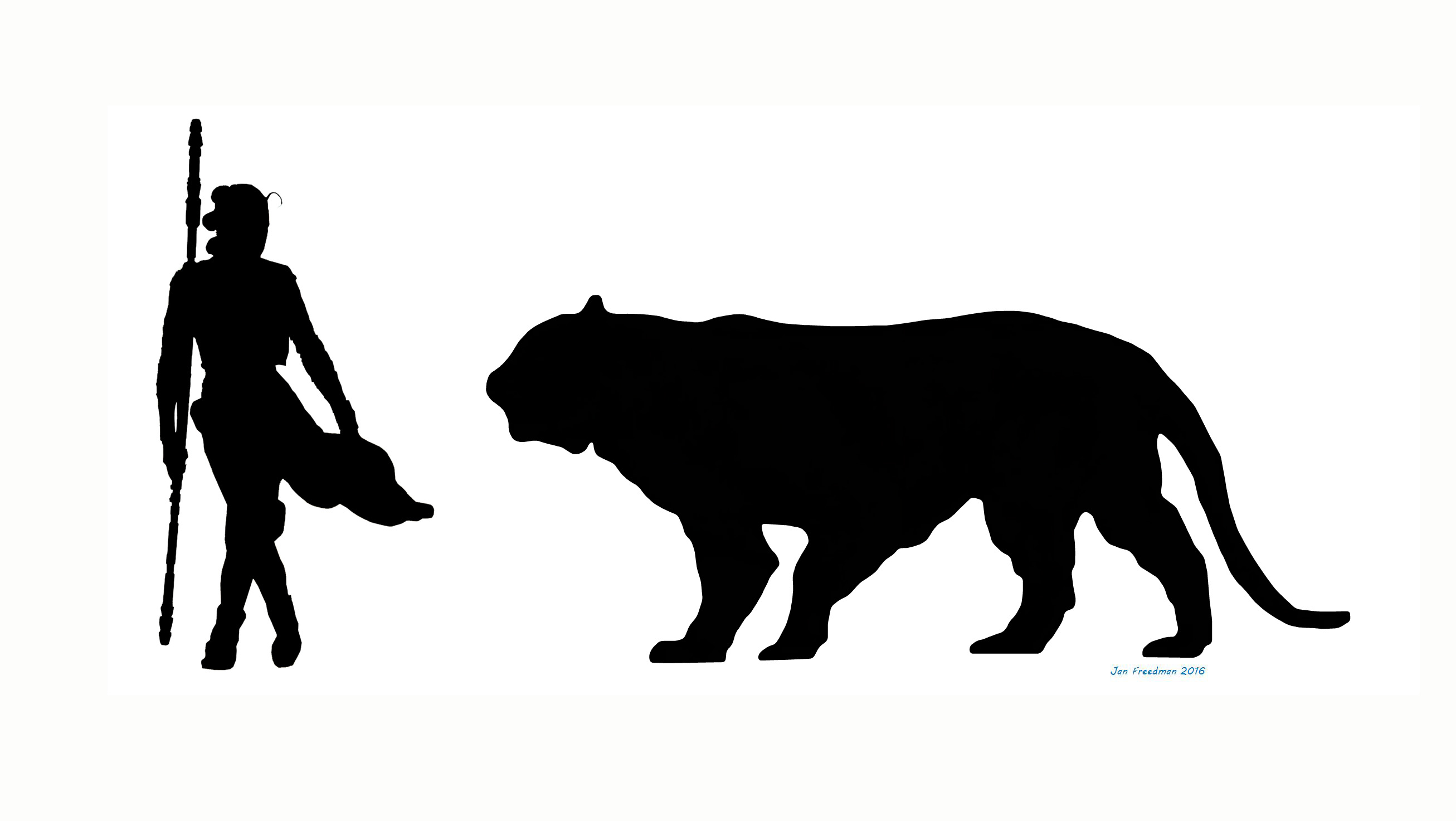
fadfa (Image by Jan Freedman)

Just Rey alongside a Woolly Rhinoceros to get a sense of the scale of this magnificent creature. (Image by Jan Freedman)

Evolving around 3.6 million years ago in the Tibetan region, the Coelodonta antiquitatis spread westward across Siberia and Europe. However, this big hairy animal was not just restricted to the cold tundra. Fossil finds have shown their distribution to have spread to environments where it was not always cold. Fossils in Spain have been associated with warmer environment where grasses covered the land; not a cold steppe, but a luscious temperate meadow.

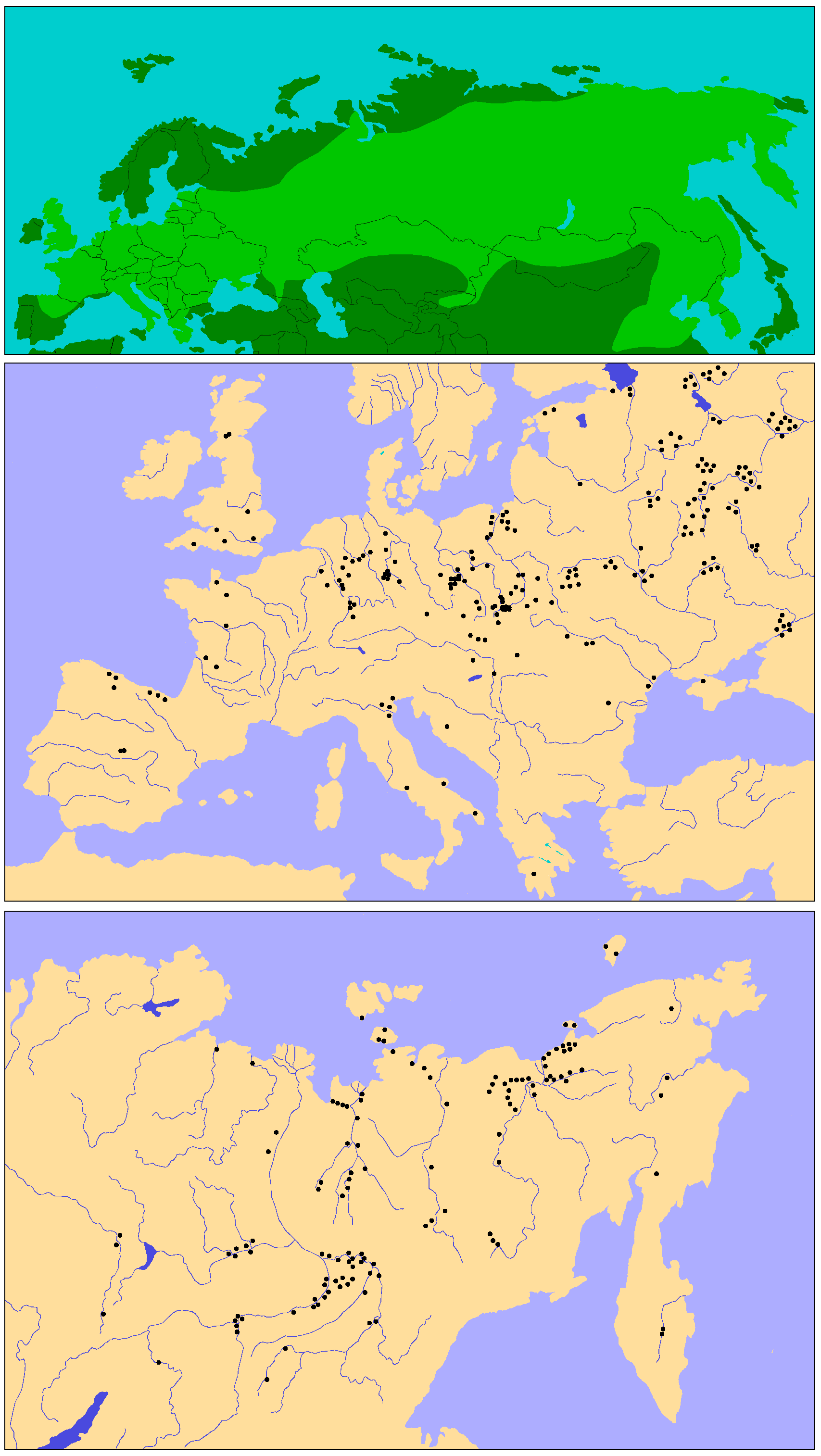
The distribrution of the Woolly Rhinoceros (Coelodonta antiquitatis) (Image from here)

The distribution of the Woolly Rhinoceros (Coelodonta antiquitatis). In the top image, the light green band illustrates the distribution across the Eurasian continent. The two images below show where Woolly Rhino specimens have been found, represented by the black dots. (Image from here)

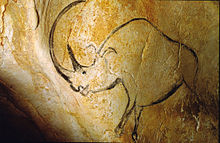
The front horn of the woolly rhinoceros is perhaps one of the most fascinating features of this amazing animal. It was big, perhaps as long as my arm (they could be around 60cm long). A clear use for such a formidable horn was defense against potential predators. Obviously the sizes and shapes varied from individual to individual, but many showed wear or flattening. Some have suggested that this oversized horn was used to clear snow to find the food beneath. However, we have already seen that Woolly Rhinos were not at home in the snow, so this is perhaps an unlikely scenario. It is more likely that the horns were actually used for fighting other males during the rutting season. (To see these magnificent Titans fighting, crashing into each other and grappling with their horns would have been a wondrous sight. Beautiful cave art at Chauvet, France, has captured two woolly rhinos in the middle of a fight. Click here and scroll down to view.)

Interestingly, woolly rhinos didn’t follow woolly mammoths up across the Bering Striats over into America. Several species made their way to the Americas this way including Bison, Musk Ox, Reindeer and even humans. The range of Coelodonta antiquitatis extended tantalisingly close to the Bering Straits in the west and extended far across Siberia to the east. It may be that he rhinos were generally solitary animals, and rarely travelled as a crash so were more vulnerable to packs of predators. These lumbering giants were also very sensitive to changes in the environment, and it may be that they travelled as far as their preferred food would allow.

The decline of woolly rhinos happen over a fairly long period of time. Specimens have been found all over Britain from along the coast of Plymouth and Torquay, across to Goats Hole Cave in Swansea, up to Creswell Crags in Derbyshire, and as far north as Bishopbriggs in Scotland. Once widespread in Britain, it slowly began to decline. Radiocarbon dates show the decline was not a one time; they migrated northwards, with older specimens in the south and the youngest specimens in the north. The last woolly rhinos in Britain are currently found at Bishpsbriggs, Scotland, and date to around 35,000 years old, coinciding with a warming period which replaced the grasses with different vegetation.

These great animals survived on the icy tundra of Siberia until around 20,000 years ago. The frozen landscape will often reveal a mummified carcass of woolly rhinos, looking as fresh as the day it died. The last stand of these Titans was in the Urals in Russia, where they survived until only 14,000 years ago. It appears the warmer climate at this time changed the type of vegetation in the environment and this specialist rhinoceros couldn’t adapt quick enough.

There is some evidence that humans may have hunted woolly rhinos, but not as a main source of meat and it is very unlikely that hunting contributed to their extinction. Humans did come across woolly rhinos, and appear to have observed them, for they are portrayed as magnificent animals in beautiful cave art. Early humans were clearly in awe of the woolly rhinoceros. The Chauvet Caves in France have almost captured the spirit of the live animals onto the walls for us to see 20,000 years later.

A glorious cave painting of a woolly rhinoeros. (Image from here)

A glorious cave painting of a woolly rhinoceros from Chauvet Caves, France. (Image from here)

The last link to the shaggy woolly rhinoceros is it’s closest living relative, the Sumatran rhinoceros. Sadly there are a few people today who do not look at rhinos in the same way as their ancestors and are not viewed in the same light. It is very likely that these amazing animals too will become extinct like their long lost hairy cousins.

Written by Jan Freedman (@janfreedman)

Further reading:

Exellent overview of woolly rhinoceros by @Tetzoohttp://blogs.scientificamerican.com/tetrapod-zoology/2013/11/09/remarkable-life-appearance-of-woolly-rhino/

Deng, T., et al. (2011), ‘Out of Tibet: Pliocene Woolly rhino suggests High-plateau origin of Ice Age megaherbivores’, Science 6047, 1285-1288. [Full article]

Jacobi, R. M. et al. (2009), ‘Revised radiocarbon ages on woolly rhinoceros (Coelodonta antiquitatis) from western central Scotland: significance for timing the extinction of woolly rhinoceros in Britain and the onset on the LGM in Central Scotland’, Quaternary Science Reviews. 28. 2551-56. [Abstract only]

Kurten, B. (1968), ‘Pleistocene mammals of Europe’, The World Naturalist. [Book]

Markova, A. K. et al. (2013), ‘New data on changes in the European distribution of the mammoth and woolly rhinoceros during the half of the Late Pleistocene and the Early Holocene’, Quaternary International. 292. 4-14. [Full article]

Stuart, A. J, & Lister, A, M. (2012), ‘Extinction chronology of the woolly rhinoceros Coelodonta antiquitatis in the context of late Quaternary megafaunal extinctions in northern Eurasia’, Quaternary Science Reviews. 51. 1-17. [Full article]

Stuart, A. J. (1982), ‘Pleistocene vertebrates in the British Isles’, Longman Group Limited. [Book]

Sutcliffe, A. J. (1985), ‘On the track of Ice Age mammals’, British Museum (Natural History) [Book]

Posted in Woolly Rhinoceros | Tagged , , , , , , , , , , , , , , , , , , , , , , , , | 20 Comments

The beasts within

Ask anyone to think of Pleistocene beasts and they will invariably conjure up images of herds of woolly mammoth, bison and horses sweeping majestically across the grassy plains, perhaps with a pack of dire wolves or lone short-faced bear stalking them at a distance. Indeed, it is these charismatic animals, with their large and impressive skeletons now reconstituted in museums across the world, that have inspired many young children to go on and become paleontologists later in life.

But as that person continues to dream of the Pleistocene, little thought will likely be spared for the beasts within, such as Strongyloides shastensis and Archeococcidia nothrotheriopsae. Their diminutive size does not lend well to impressive museum displays or awe-inspiring dioramas, and there is slim chance that they are on anyone’s re-wilding wish lists. And, as someone who has spent the past decade studying extinct megafauna, I have been as guilty as anyone in overlooking them in the past. But now they deserve a voice, for it is beasts such as these that could actually represent the majority of biodiversity lost in global late Quaternary extinction events.

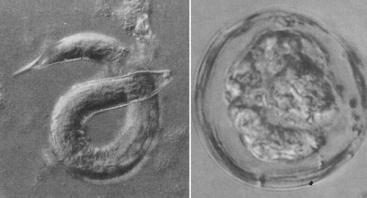
The nematode Strongyloides shastensis and coccidian Archeococcidia nothrotheriopsae once foraged in the digestive tracts of Shasta ground sloth. Their habitat disappeared at the end of the Pleistocene, and as a result they is now likely extinct. Images from Schmidt & Duszynski (1992).

The nematode Strongyloides shastensis and coccidian Archeococcidia nothrotheriopsae once foraged in the digestive tracts of Shasta ground sloth. Their habitat disappeared at the end of the Pleistocene, and as a result they is now likely extinct. Images from Schmidt & Duszynski (1992).

Strongyloides shastensis and Archeococcidia nothrotheriopsae were both gut parasites of the Shasta ground sloth, first described by Gerald Schmidt and Donald Duszynski in 1992. Parasites are simply a fact of life for most wild animals. From an invertebrate biologist’s viewpoint, the charismatic megafaunal beasts of the Pleistocene were simply mobile habitats, providing shelter and food for diverse communities of smaller organisms. These included a terrifyingly large array of different beasts including nematodes (roundworms), trematodes (fluke worms), coccidians and hepatazoons (both single celled parasites), lice, and mites. Some of these organisms would have lived on external surfaces of their hosts (e.g. lice) while others would have been found in various organs, the bloodstream, or gastrointestinal tract. Many of these organisms were likely host-specific, that is, they could only have survived on, or in, a single host species. But having lives that were so intertwined with particular host-species also created obvious issues. For example, what would happen if those species were to suddenly go extinct?

Loss of mutualistic, or parasitic species, along with their partners is a process known as ‘co-extinction’ and it has been suggested that this process may be the main driver of biodiversity loss during mass extinction events such as those of the late Quaternary (see Koh et al. 2004, Dunn 2009, Dunn et al. 2009). However, studying late Quaternary co-extinctions clearly has its challenges. Small organisms without hard body parts are under-represented in the fossil record, and the dependence of parasites on their hosts means they are seldom found in the external environment. As a result, little is known about exactly how prehistoric parasites responded to habitat loss. Well-documented cases of even relatively recent parasite co-extinctions (e.g. the huia louse, Rallicola extinctus) are rare, due to the challenges of taxonomic identification of parasites and the difficulty of proving parasite host-specificity.

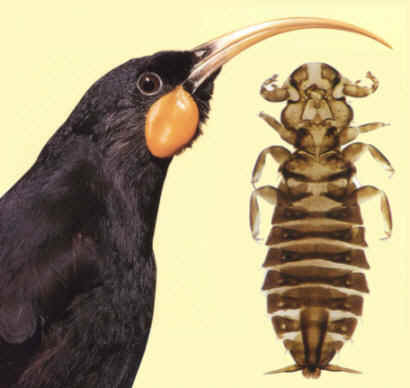
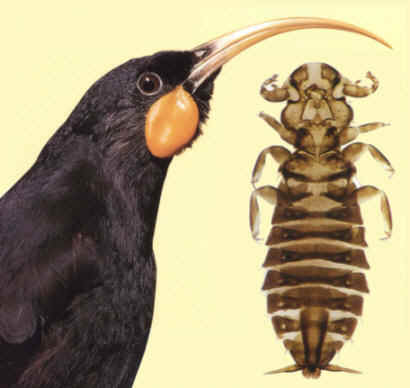
The extinct New Zealand huia (Heteralocha acutirostris) and the equally extinct louse (Rallicola extinctus) that once lived on the huia’s feathers. (Image from here)

The extinct New Zealand huia (Heteralocha acutirostris) and the equally extinct louse (Rallicola extinctus) that once lived on the huia’s feathers. (Image from here)

Coprolites (ancient, fossilised dung) may provide a key to understanding the co-extinction process, by offering a unique window into the lives and deaths of some parasites; such as those that inhabited the gastrointestinal tracts of megafauna. In fact, it was coprolites of the Shasta ground sloth, preserved for millennia in Arizona’s Rampart Cave, that allowed Schmidt and Duszynski the first insights into the micro-beasts that were once associated with that species. By digging in the poo, they found the tiny parasites.

More recently, myself and colleagues have begun to investigate parasites in coprolites from the moa, the large extinct ratite birds of New Zealand. In our first study published last year (Wood et al. 2013) we were able to show that with a reasonable sample size of coprolites assigned to different moa species using ancient DNA identification, it is possible to determine with some degree of confidence whether the parasite taxa seen in the coprolites were host-specific or not (and several were).

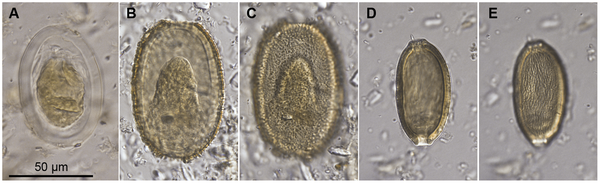
Eggs of parasitic nematodes isolated from coprolites of the giant New Zealand moas. (Images from Wood et al., 2013)

Eggs of parasitic nematodes isolated from coprolites of the giant New Zealand moas. (Images from Wood et al., 2013)

With recent advances in techniques for extracting ancient DNA from coprolites, and rapidly developing DNA sequencing technologies, we likely now have the opportunity to examine Pleistocene co-extinctions in greater detail than has previously been possible. Such research may help broaden our understanding of late Quaternary extinction events, allowing us to look not only at extinctions in vertebrate faunas, but also into the cryptic, and potentially more dramatic, consequences for invertebrate communities. So, the next time you picture a mammoth wandering through the ice and snow, spare a thought for those who went along for the ride!

Written by Jamie Wood (@larusnz)

Edited by Jan Freedman (@janfreedman)

Further Reading:

Bush, A.O., Kennedy, C.R. (1994) ‘Host fragmentation and helminth parasites: Hedging your bets against extinction.’ International Journal of Parasitology 24, 1333–1343. [Abstract only]

Dunn, R.R. (2009) ‘Coextinction: anecdotes, models, and speculation’. In: Turvey S, editor. Holocene extinctions. Oxford: Oxford University Press. 167–180. [Book]

Dunn, R.R., Harris, N.C., Colwell, R.K., Koh, L.P., Sodhi, N.S. (2009) ‘The sixth mass coextinction: are most endangered species parasites and mutualists?’ Proceedings of the Royal Society of London Ser B 276, 3037–3045. [Full article]

Ferreira, L.F., Araujo, A., Duarte, A.N. (1993) ‘Nematode larvae in fossilized animal coprolites from Lower and Middle Pleistocene sites, Central Italy’. Journal of Parasitology 79, 440–442. [Full article]

Koh, L.P., Dunn, R.R., Sodhi, N.S., Colwell, R.K., Proctor, H.C., et al. (2004) ‘Species coextinctions and the biodiversity crisis.’ Science 305, 1632–1634. [Abstract only]

Schmidt, G.D., Duszynski, D.W. (1992), ‘Parasites of the extinct Shasta ground sloth, Nothrotheriops shastensis, in Rampart Cave, Arizona’ Journal of Parasitology 78. 811–816.  [Full article]

Wood, J.R., Wilmshurst, J.M, Rawlence N.J., Bonner, K.I., Worthy, T.H, Kinsella, J.M., Cooper, A. (2013), ‘A Megafauna’s Microfauna: Gastrointestinal Parasites of New Zealand’s Extinct Moa (Aves: Dinornithiformes)’ PloS ONE 8(2). E57315. [Full article]

Posted in Parasites | Tagged , , , , , , , , , , , , , , , , , | 2 Comments

Of dwarfs and dragons

Stegodon

Little and large. Two different Stegodon species; the large mainland species on the left, with the smaller dwarf species on the right. (Art by Matt Salusbury)

Stegodons were just one branch of the rather diverse probiscidean family tree (the family that includes elephants, mastodons, gomphotheres and mammoths). The stegodons, like the mammoths and elephants, are generally thought to have arisen in Africa, and ended up in Asia, migrating all the way to what’s now Japan before this line eventually became extinct. The preponderance of stegodon remains suggests they some species may once have been very common and numerous.

The conventionally-sized stegodons of mainland Asia were probably slightly bigger than the biggest of today’s elephants. While they would have looked quite a lot like elephants, it is likely that they probably had their tusks closer together than their modern counterparts. These enormous tusks would have been so close, that they couldn’t have let their trunk dangle down between them like modern elephants do, so they may have draped their trunk over the edge of one of their tusks. Most stegodon species were massive, up there with the tallest of the mammoths, somewhere around 3.9 metres (13 feet) in height at the shoulder, almost as tall as a double decker bus.

The largest Stegodon species reaching the size of the woolly mammoth. (Image from here)

The largest Stegodon species reaching the size of the woolly mammoth. (Image from here)

The stegodons’ gently curving tusks were longer than their trunks, and some fossils have been found which were 3 metres (well over 9 feet) long. They may have had longer front legs than back legs, with a sloping back. But most of the differences between stegodons, mastodons, mammoths and elephants were down to the teeth or the ridges or layers of enamel on their teeth, or even just the thickness of the layers of enamel on their teeth. “Stegodon” means “roof tooth,” and these giants had very distinctive teeth for a different diet than that of modern elephants.

Stegodons included the earliest known examples of island dwarfism among the Proboscidea, dating all the way back to around 16 million years ago, long before the modern elephants arose. From the landmass that became Japan (imaginatively called ‘proto-Japan’), the gompothere Stegolophodon lived long before the emergence of the Elephantidae (the family that includes the forest elephant, the savannah elephant and the Asian elephant, as well as mammoths). It is thought that Stegolophodon gave rise to all later Stegodon species.

There was a “dwarf” version of Stegalophodon, which like its huge ancestor had four tusks, two coming out of the top jaw and also two emerging from the bottom jaw. The fossils so far discovered don’t show for sure whether the bottom-jaw tusks protruded from the gum enough to have been visible. It may have taken Stegalophodon several million years to evolve into its proto-Japanese dwarf version. This is incredibly slow for island dwarfism to evolve, and very likely indicates that the ancestors were not isolated from other populations and only truly evolved dwarfism when they were completely separated.

Then there was the-not-actually-all-that-small dwarf stegodon Stegodon aurorae. Found at two sites in Japan from about 1.8 million years ago, this species reached a still very impressive height of 8 or 9 foot (up to 2.7 metres) at the shoulder. This big dwarf was still pretty small compared to it’s mainland ancestor (which was around 12ft, or 3.6metres).

The shorter legs of some of the pygmy elephants and pygmy stegodons may have been an adaptation for what palaeontologist Paul Sondaar described as “low gear locomotion”, allowing these pygmies to scramble up and down cliffs and over rocks to reach upland pastures. Sondaar has even suggested that the tendency of island elephants to evolve into pygmies had more to do with the rugged terrain of the islands and the need to scramble up and over such terrain on the islands than any food shortages elephants may have encountered there. Size estimates for another dwarf stegodon, Stegodon sondaari, like all the prehistoric pygmy probosicidians, are forever being revised. For the moment, it’s generally held to have been 20-30% smaller than the Java version of Stegodon from which it was descended.

The Indonesian island of Flores is well known for the miniature human species Homo floresiensis (also known as the ‘hobbit’). In the past, this island has been home to other wonderful beasts, including another pygmy stegodon, Stegodon sondaari. This shrunken beast also had short legs in proportion to the rest of its body, and a very short jaw. Stegodon sondaari is thought to have been smaller than a water buffalo, making it about half the size of its presumed mainland ancestor, the slightly pointy-headed Stegodon trigoncephalus.

Homo (Image from here)

Homo floresiensis skull, roughly about half the size f a modern human skull.  (Image from here)

There’s a confusing array of different fossil stegodons, stegolophodons and elephants from Indonesian islands of Flores and nearby Sulawesi and from other islands of the Indonesian archipelago. We’re even unsure about whether some of these were elephants or stegodons. One of the many fossil species from Sulawesi, for example, is currently known as Elephas celebensis because – for the moment – we think it was more likely to have been an elephant than a stegodon. Elephas celebensis was an earlier arrival to Flores than the later “mid-sized” Stegodon sondaari, which was the dwarf descendant of a second wave of proboscidian arrivals to the island in Mid-Pleistocene period – between 780 and 120 thousand years ago.

Stegodon sondaari is presumed to have died out about a million years ago, before the arrival of anything even vaguely human-like on Flores. There is some puzzlement about the still living Komodo dragon, named after the Indonesian island of Komodo, much smaller than Flores and immediately to its West. Komodo dragons, at up to three metres long from head to tail, are the world’s biggest living land reptile. These humungous lizards still live on Komodo, and on three other equally tiny islands close by. There are even believed to be populations of them left in isolated pockets along the coast of much bigger Flores immediately to the East.

The bewilderment surrounding the Komodo dragons is how it could have grown so big on local islands, where there aren’t any reasonably big indigenous animals by way of prey. (Its current diet of deer, goats and pigs was introduced much later.) Biologist Walter Auffenberg speculated in the early 1970s, as have others since, that when the large monitor lizards that were the presumed ancestors of the Komodo dragons arrived on the islands the original proto-Komodo dragon food would have been some kind of pygmy probiscidian like the little Stegodon sondaari. While large mammals tend to get smaller over time on islands, it was thought the Komodo dragons had evolved into bigger forms.

Relatively recently, thoughts have changed again about Komodo dragons. In 2004, palaeontologists showed that the the dragons kept more or less the same size as their ancestors, which were from the mainland Australia. The fossils show that their rage was much bigger than it is currently, and that these incredible reptiles are not an example of island gigantism (the opposite of island dwarfism).

Another, later wave of arriving stegodons clambered ashore on the Flores in the Late Pleistocene, eventually evolving into Stegodon florensis insularis. The dwarf hominids, Homo floresiensis, that shared the island, along with cat-sized giant cave rats and giant flightless storks, may have killed and eaten Stegodon florensis. The various reconstructions of this species that I’ve seen put it somewhere between the size of a modern water buffalo or slightly taller at the shoulder than the height of a modern human.

Comparasion of Stegodon and Homo fle (Image from here)

Comparasion of the mini-Stegodon and Homo floresiensis with modern human an African elephant.  (Image from here)

However, caution needs to been read into reconstructions, as  nearly all the stegodon bones of the butchery site at Flores’ Liang Bau caves were juvenile. The current thinking  is that Homo floresiensis killed and ate the juveniles of yet another stegodon – a larger, more conventional-sized and more recent arrival. Given their own size and primitive weaponry (we’re unsure whether they had discovered how to make fires or not) the “hobbits” may have wisely decided only to go for the juveniles of this species and to stay away from the bigger adults where possible.

Sometime around 17,000 years ago, the dry climate of the island of Flores suddenly started to get wetter, and then after that came a big volcanic eruption. These two events seem to have finished off all of these dwarf and giant exotics that had been unique to Flores. Homo floresiensis – probably along with the  dwarf and conventionally-sized stegodons it hunted – had disappeared by the time modern humans showed up shortly later on Flores around 11,000 years ago.

Note from the author:

This text is adapted from my book Pygmy Elephants (CFZ Press, 2013, http://pygmyelephants.blogspot.co.uk, @Pyg_Eleph), and the attached drawings are all from Pygmy Elephants too.  I drew the “Stegodon sondaari and monitor lizard” illustration back in 2010, showing an S. sondaari running away from a solitary monitor lizard. Since then I’ve seen photos of a sort of Komodo dragon feeding frenzy over a dead deer, which suggests the monitors that were the ancestors of Komodo dragons may have hunted in packs.

Written by Matt Salusbury (@Pyg_Eleph)

Edited by Jan Freedman (@janfreedman)

Further Reading:

Giant fossil bird found on ‘hobbit’ island of Flores, BBC News, 

http://news.bbc.co.uk/earth/hi/earth_news/newsid_9261000/9261713.stm quoting Zoological Journal of the Linnean Society.

Cavaretta, C., Gioia, P., Mussi,M., & Palombo, M. R. (2001), ‘La Terra degli Elefanti Alti del 10 Congresso Internazionale’, Consiglio Nazionale della Richerhe, Rome. [Full article]

Shoshani, J., & Tassy, P. (1996), ‘The Proboscidea’, Oxford University Press. [Book]

Sondaar, P. (1994), ‘Paleoecology and evolutionary patterns in horses and Island mammals’, Historical Biology, Volume 8, Issue 1-4. (Paul Sondaar proposed the “low gear locomotion” idea in this and other works. [Full article]

van der Geer, A, Lyras, G., de Vos, J., & Dermitzakis,M, (2010), ‘Evolution of Island Mammals: Adaptation and Extinction of Placental Mammals on Islands’, Wiley-Blackwell. [Book]

Posted in Stegodon | Tagged , , , , , , , , , , , , , , , | 4 Comments

Mammoths!

Mammoths

A herd of woolly mammoths (Mammuthus primigenius) on the cold, dry Mammoth Steppe. This is a wonderful illustration from Charles Knight. (Image from here)

The first animal that pops into anyone’s head when you say ‘Ice Age’ will be the woolly mammoth. This is the iconic animal of the Pleistocene. There were other large proboscideans lolloping across the landscape, including the mastodon and the incredible gomphotheres, but it’s the woolly mammoths that are dear to our hearts. Their enormous size, the large shaggy coat, and the massive curved tusks has led to fame in films including Ice Age, 10,000BC and of course, the classic 2006 horror Mammoth). The noun, mammoth, has also slipped into the English language to become a well-used, and pretty awesome, adjective. The more we find out about the woolly mammoth, the more awesome it becomes.

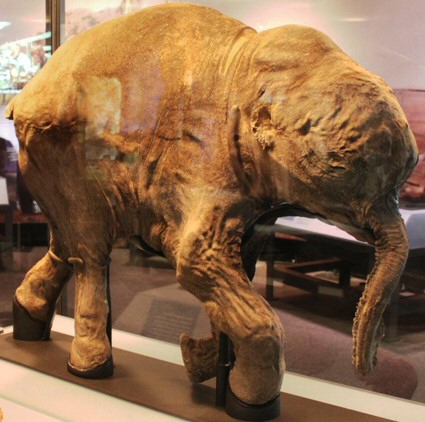
Frozen woolly mammoth carcases have been thawing out of the permafrost in Siberia for centuries. The bodies look so fresh that they were thought by the local people to be giant burrowing mole-like creatures. Not burrowing giants, but 40,000 year old woolly mammoths! Preserved in such incredible detail, these frozen specimens have aided this hairy beasts iconic status; it is easier to relate to something that you can see, and unlike many fossils, the frozen mammoths are all flesh. Newly discovered specimens from Siberia are hot topics in the press, such as the incredibly beautiful baby mammoth, Lyuba. Through these amazingly preserved animals we are discovering more about this species anatomy, and increasing our knowledge of how these extraordinary creatures lived.

The beautifully preserved baby woolly mammoth, Lyuba. This is the best preserved mammoth so far discovered on the icy tundra of Siberia. (Image from here)

The beautifully preserved baby woolly mammoth, Lyuba. This is the best preserved mammoth so far discovered on the icy tundra of Siberia. (Image from here)

Around 5 million years ago the mammoth lineage evolved in Africa, with the ancestor of all mammoths Mammuthus subplanifrons. In Europe there were a few different mammoth species, including the Southern mammoth (Mammuthus meridionalis) and the Steppe mammoth (Mammuthus trogontherii). But there is only one woolly mammoth, Mammuthus primigenius. This species appears to have evolved in Siberia around 800,000 years ago from the Steppe mammoth, with the first European evidence dating to around 200,000 years ago.

Throughout the entire Pleistocene Epoch (2.6 million years ago until around 10,000 years ago), the climate changed dramatically; extremely cold dry periods gave way to warmer luscious periods in rhythmic cycles. This ever changing climate obviously had an effect on the animals living at this time. When winter came, it hit hard. Luckily for the woolly mammoth, this was a good thing. They were at home on the aptly called Mammoth Steppe, which was a very cold dry environment with little trees, but lots of low shrub vegetation and grasses. The steppes sustained many herds of different animals including horses, reindeer, bison and giant deer (and of course the predators).

Warmer climates would force the mammoths to follow the retreating steppe, heading north in the warmer months, and migrating south as the steppe expanded during the colder months. During some years the winters lasted much longer and the habitat of the steppe environment expanded. Herds of mammoths and other beasts moved across the expanding landscapes, and with more water trapped in the enormous glaciers, there was more land. This allowed the woolly mammoth to travel all across Siberia, Europe, and even to North America across the land bridge of the Bering Straits. (An interesting aside several species did move to North America this way, including lions and humans. The fantastic woolly rhinoceros, which enjoyed the same environment as woolly mammoths, didn’t make it across. Neither did hyenas.)

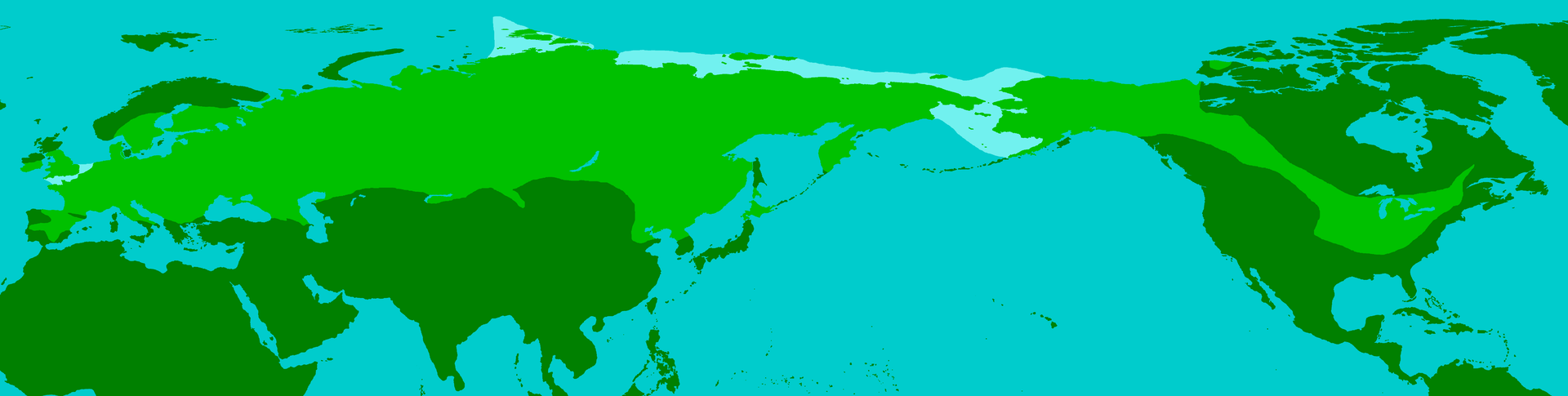
The light green band show the extent of the range of the woolly mammoth. (Image from here)

The light green band show the extent of the range of the woolly mammoth. (Image from here)

With woolly mammoths literally defrosting in Siberia, we know more about this Twilight Beast than any other. Its familiar shaggy hair varied from light to dark colour, and could grow up to 40 cm long! It was light to dark brown coloured. This big beast was adapted for braving the cold temperatures. Glands in the skin would secrete oils into this thick matt of hair which would have given the hair better insulation. Below these oily glands was a thick layer of fat, covering the body. Short ears and a short tail minimised any heat loss from the body. There was also a large flap of skin covering the anus to keep it warm.

With two enormous curved tusks, the mouth only had four molars; two at the top and two at the bottom. These molars were impressive. Apart from being pretty big (about the length of my arm), they were made from pates of enamel with dentine holding them together. What was really unique was that new plates grew from the back, pushing out the ‘older’ more worn plates out at teh front of the tooth. Such big beasts needed a lot of food, so replacing the plates of the molar was one adaptation; the other was replacing the entire tooth; woolly mammoths had six sets of molars during their 60 or so year life. Their flat ridged teeth give clues to what they ate; but the frozen remains gives us much more detail! Plant remains in the teeth and intestines of frozen carcasses show they were mainly feeding from grasses and sedges. They were not too much of a fussy eater, because remains of flowers, herbaceous plants, mosses, shrubs and trees have also been found.

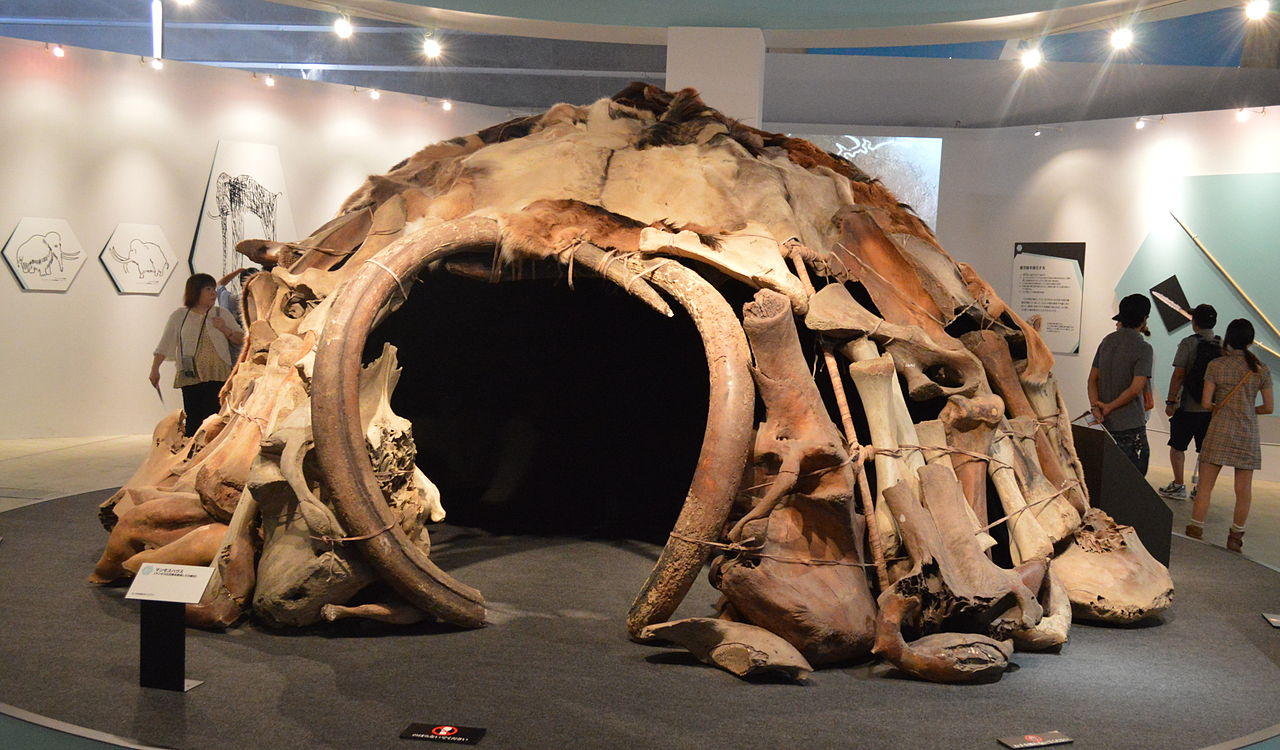
Both Neanderthals and humans encountered woolly mammoths, and both would have hunted the mammoth, and scavenged carcasses. Cut marks on bones show they were butchered for their meat and it is likely their skin was used for clothing and shelter. Incredible finds in the Ukraine and over 70 sites in Russia, have shown that the bones of these giants have been used to make huts. The bones have also been used as fuel on fires, which was vital on the cold tundra where there was little firewood. These giants were essential to the survival of early humans in these extremely harsh environments.

Replica hut made from woolly mammoth bones. (Image from here)

Replica hut made from woolly mammoth bones after sites excavated in the Ukraine. (Image from here)

Early humans had an intimate relationship with these hairy giants. As well as an essential food resource, the magnificent woolly mammoth has been depicted on many cave walls in France, including Grotte de Cussac, Chauvet Caves and Font-de-Gaume. Their ivory has been used to carve some incredible beautiful intricate figure sculptures. We can never know how humans viewed the giants when they saw them, but I like to imagine it was with awe and respect.

There are views that the extinction of the woolly mammoth was caused by ‘overkill’, where humans killed them all. Recent radiocarbon date studies have shown that as the climate changed so did the distribution of this beast. Towards the end of the Pleistocene, the warmer temperatures reduced the amount of steppe environment the woolly mammoths enjoyed. The small herds followed the food northwards, until they could follow no more. Human hunting may have been the final blow for this species under pressure. Currently the latest woolly mammoths in Europe were as young as 9,760 years ago. In Siberia, however, something survived.

To the north east of Russia in the East Siberian Sea, a population of mammoths became isolated on a small island; Wrangel Island was the home to the last woolly mammoths. They became isolated and survived for almost 6000 years, until a changing climate and the new threat of humans finally saw the end to an amazing species. The youngest specimens date to around 4000 years ago. It is ncredible to think that while the pyramids were being built, the woolly mammoth made thier last stand on a small isolated island.

Written by Jan Freedman (@JanFreedman)

Further Reading

Ferretti, M. P. (2003). ‘Structure and evolution of mammoth molar enamel’. Acta Palaeontologica Polonica. 3 48: 383–396. [Full article]

Gunthrie, R. D. (2004), ‘Radiocarbon evidence of mid-Holocene mammoths stranded on an Alaskan Bering Sea island’, Nature. 429. (6993). 746-9. [Abstract only]

Lister, A, & Bahn, P. (2007), ‘Mammoths – Giants of the Ice Age’, (3rd Edition). London: Frances Lincoln. [Book]

Markoca, A. K. et al. (2013), ‘New data on changes in the European distribution of the mammoth and the woolly rhinoceros during the second half of the Late Pleistocene and the early Holocene’, Quaternary International. 292. 4-14. [Full article]

Martin, P. S. (2005), ‘Twilight of the Mammoths: Ice Age Extinctions and the Rewilding of America’, University of California Press. [Book]

Stone, R. (2002), ‘Mammoth. The Resurrection of an Ice Age Giant’, Fourth Estate, London. [Book]

Stuart, A. J. et al. (2002), ‘The latest woolly mammoths (Mammuthus primigenius Blumenbach) in Europe and Asia: a review of the current evidence’, Quaternary Science Reviews. 21. 1559-69. [Full article]

Stuart, A. (2005), ‘The extinction of woolly mammoth (Mammuthus primigenius) and straight-tusked elephant (Palaeoloxodon antiquus) in Europe’, Quaternary International. 126. 171-7. [Abstract only]

Sutcliffe, A. J. (1985), ‘On the track of Ice Age mammals‘, British Museum (Natural History). [Book]

Posted in Woolly Mammoth | Tagged , , , , , , , , , , , , , , , , , , , , , , | 38 Comments

The lolloping shovel mouth

Gorgeous Gompothere. (Image from here)

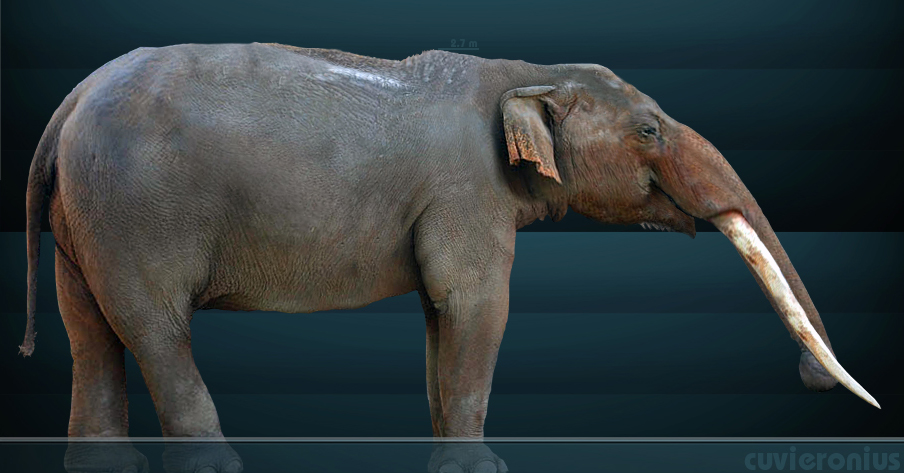
Gorgeous gomphothere. Cuvieronius, a genus of gomphothere only recently extinct (Image from here)

My first introduction to gomphotheres was a research critique of a seminal Quaternary paper by Janzen in ‘Science’ journal. Something about these peculiar and ungainly looking distant cousins of today’s noble elephant fascinated me! Everyone has of course heard of woolly mammoths, but gomphotheres are perhaps less well known by the public,  and more of a connoisseurs Pleistocene creature by their very strangeness, and  I think their very endearing faces!

Gomphotheridiiae were members of the Proboscidea order, which also includes the more swish woolly mammoth (Mammuthus primigenius) and the mastodon (Mammut americanum). Where the mammoth became the byword for something colossal, the Gomphotheriidae became a little forgotten. Not anymore.

Imagine a smallish elephant with a shorter snout and four tusks – two at the top and two at the bottom. Then imagine that the tusks at the bottom pan out to create a shovel which could sweep food up in a flash. Nature being nature, gomphotheres evolved: one group had short lower jaw of todays elephant, and the other kept the long shovel jaw we associate with the entire family. The structure of their blunt shovel or wedge shaped lower tusks meant they were the ultimate fruit eating opportunists, and their success as a group spans millions of years, from the Miocene to the very age of humans.

These amazing prototype tuskers evolved first on the savannahs of Miocene Africa, some 22 million years ago. Nelly the sort-of-elephant packed her trunk and said goodbye to that continent. In an occurrence which is now known by palaeo sorts as the ‘Proboscidean Datum Event’ early gomphotheres headed for Asia and Europe where they spread even further, making this group one of the most cosmopolitan of  Pleistocene creatures. Specimens found as far as China and the Americas showing that these animals lolloped all over the planet.

Land bridges were a key factor in these wonderful animals’ migrations. Looking for new lands brimming with juicy fruits and tasty seeds, they made their way eventually into North America via Beringia, the ‘bridge’ which once existed between Alaska and Siberia connecting the two land masses allowing animals to move freely.

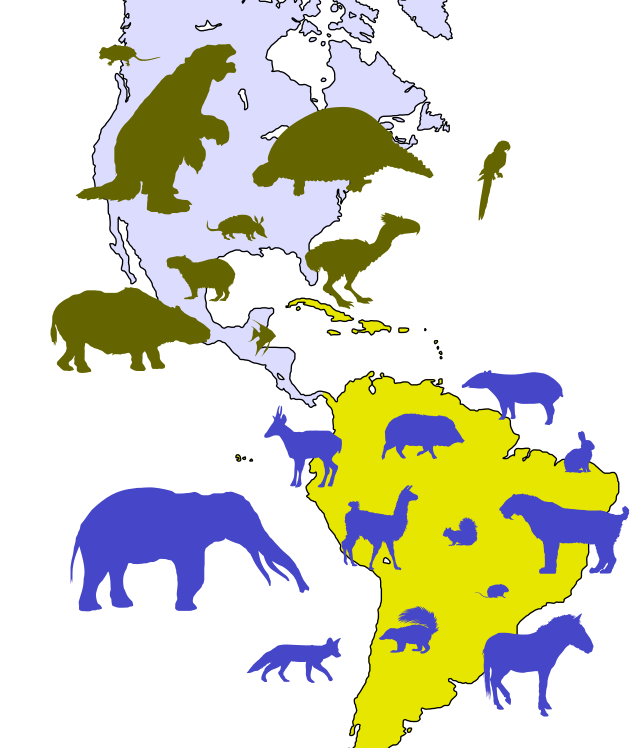
North and South America had been separate land masses until the formation of the Isthmus of Panama during the late Pliocene, around 3 million years ago. This corridor allowed the exchange of plants and animals between what were previously isolated continents, resulting in many species making their way to the warmer climates of South America. This period is known as the Great American Biotic Interchange (GABI) and it is during this time that two genera of Gomphotheriidae, Cuvieronius and Stegomastodon crossed from North to South America looking for new and tasty vegetation.

The Great American Interchange. As North an South America (Image from here)

The Great American Interchange. North and South America were separate continents for millions of years. When they joined together creatures from the north moved south, and those from the south moved north.  (Image from here)

The South American genera of Stegomastodon and Cuvieronius evolved to have different feeding patterns; Stegomastodon adapted to a warmer savannah-like ecosystem along the Atlantic coastline of South America, while Cuvieronius was more suited to the cooler temperatures of the Andes corridor. They do appear to have been fussy eaters (maybe why I like them!), as they only liked certain fruits, with which they developed a symbiotic relationship: gomphotheres liked to wander, and they spread the pollen and seeds of their favourite fruits wherever they went via their skin and poo!

So how did such a spectacular and successful herbivore become extinct? The answer may lie in a combination of factors. Their heyday came as the Ice Age was marching slowly but steadily into the pages of history and palaeoecology. Gomphotheres were specialists, and specialists are the animals that are hit worst when the environment around them changes. When climate change decreased the diversity of plant taxa, the gomphothere was faced with imminent extinction because of their dietary preference, shown by studies of the isotope δC13 taken from teeth and tusks found in South America. As the gomphothere declined in South America, dependent vegetation could no longer disperse or germinate without the megafaunal dispersers creating – at least in some parts of South America – a rather sad mutual demise.

Nothing is ever that simple, of course. Some sites have shown that gomphotheres were hunted by early human settlers. It is possible the South American extinctions are a combination of environmental change and humans doing what they sadly do: overhunting.  Recent excavations of El Fin del Mundo, Mexico have produced evidence of Clovis-era hunting of North American gomphotheres. The site has produced assemblages of bones belonging to juveniles, combined with finely worked chert and quartz spear-heads. Calibrated radiocarbon dating has suggested a date of 13,390 BP. These are the youngest gomphothere fossils so far discovered. What’s even more incredible, is there is direct evidence at this site of humans, the Clovis hunters, were hunting these magnificent animals.

As to the rest of the world? We really don’t know what was happening at the end of the Pleistocene in places like China, but it’s likely that climate change and humans affected the habitat of these unique critters. They are one of the many incredible Twilight Beasts our ancestors most likely saw with their own eyes lolloping across the plains. Our own Pleistoicene Beastmaster here, Jan, has a thing for the Auel books, and it’s a bit sad that the gomphothere was not mentioned in those books! So, spread a little gomphothere love for these amazing Twilight Beasts; seek them out in your local museum, and think how wonderful they must have been in the flesh!

Written by Rena Maguire (@justrena)

Further Reading:

Alberdi, M.T., Prado, J.L, Jaureguizar E O, Posadas, P, Donato M. (2011), ‘Paleobiogeography of trilophodont gomphotheres (Mammalia: Proboscidea): A reconstruction applying DIVA (Dispersion-Vicariance Analysis)’ Revista Mexicana de Ciencias Geológicas 28(2). 235-245. [Full article]

Dillehay, T.D. & Collins, M. (1988). ‘Early cultural evidence from Monte Verde in Chile’. Nature, 332. 150-152. [Abstract only]

Dominato V, Mothe D, Avilla L and Bertoni-Machado C. (2009). ‘A ação de insetos Em vertebras cervicais de Stegomastodon waringi (Gomphotheriidae: Mammalia) do Pleistoceno de Águas de Araxá, Minas Gerais, Brasil’, Rev Bras Paleo 12.77-82. [Full article]

Donatti C, Galetti M, Pizo, M,. Guimares P and Jordano L.  (2007), ‘Living in the Land of Ghosts: Fruit Traits and the Importance of Large Mammals as Seed Dispersers in the Pantanal, Brazil’, in Dennis A, Schupp R, Westcott D and Green R.J (Eds.) Seed Dispersal: theory and application in a changing world. Oxford: CABI Publishing, pp. 104-123. [Book]

Guthrie, R.D.(1984), ‘Mosaics, allelochemics and nutrients. An ecological theory of late Pleistocene Megafaunal Extinction’  in: Martin, P.S. and Klein, R.G., (Eds.) Quaternary extinction: A Prehistoric Revolution Tucson, University of Arizona Press. 259-298. [Book]

Janis, C.M.  (1993), ‘Tertiary Mammal Evolution in the Context of Changing Climates, Vegetation and Tectonic Events’, Annual Review of Ecology and Systematics 24. 467-500. [Full article]

Janzen, D.H. and Martin, P. S. (1982), ‘Neotropical anachronisms: the fruits the Gomphotheres ate’. Science. 215. 19–27. [Full article]

McFadden B.J. (2000), ‘Cenezoic Mammalian Herbivores from the Americas: reconstructing ancient diets and terrestrial communities’, Annual Review of Ecological Systems. 31. 33-59. [Full article]

Miller, K. G and Fairbanks, R. (1983), ‘Evidence for Oligocene-Middle Miocene abyssal circulation changes in the Western North Atlantic’ Nature.  306 ( 5940). 250-253. [Full article]

Mothe, D, Avilla L and Winck, A.  (2010), ‘Population structure of the gomphothere Stegomastodon waringi (Mammalia: Proboscidea: Gomphotheriidae) from the Pleistocene of Brazil’, Anais da Academia Brasileira de Ciências, 82 (4). 983-996. [Abstract only]

Prado J.L, Alberdi, M.T, Azanza B, Sanchez B and Frassinetti D. (2001), ‘The Pleistocene Gomphotheres (Proboscidea) from South America: diversity, habitats and feeding ecology’ in Cavaretta, G, Gioia, P, Mussi, M and Palumbo M.R (Eds) The World of Elephants. Rome. Consiglio Nazionale delle Richerche. 337-340. [Book]

Prado, J.L., Alberdi, M.T. Sanchez, B. & Azanza, B., (2003).’ Diversity of the Pleistocene Gomphotheres (Gomphotheriidae, Proboscidea) from South America’ in: Reumer, J.W.F., De Vos, J. & Mol, D. (Eds) Advances in Mammoth Research (Proceedings of the Second International Mammoth Conference, 1999) Rotterdam. Rotterdam. Natuurmuseum. 347-363. [Book]

Prado J.L., Alberdi, M.T.  Sanchez B & Gómez G. (2011), ‘The extinction of Equidae and Proboscidea in South America: A test using Carbon isotope data’, Estudios Geológicos, 67 (2). 363-373. [Full article]

Sanchez B, Prado J.L, and Alberdi M.T (2004), ‘Feeding ecology, dispersal and extinction of South American Pleistocene gomphotheres (Gomphotheriidae, Proboscidea)’ Paleobiology 30 ( 1) 146-161. [Full article]

Sanchez G, Gaines E, Holliday V, Arroyo-Cabrales J. (2009), ‘El Fin del Mundo’, Archaeology Southwest, 23 (3) 6-7. [Full article]

Posted in Gompothere | Tagged , , , , , , , , , , , , , , | 10 Comments

The Nipple Tooth

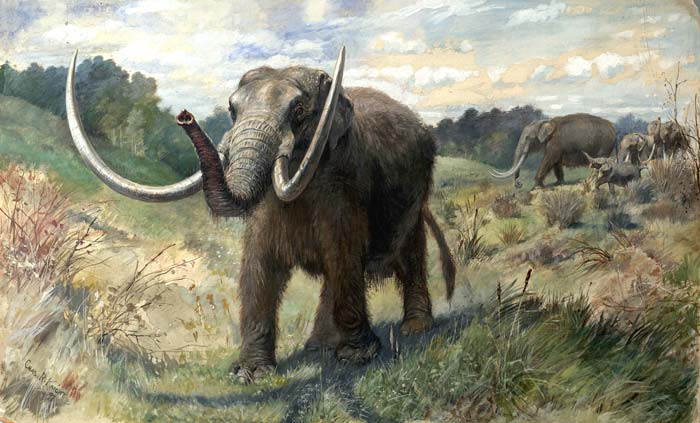
A magnificent Mastodon, illustrated by Charles Knight. (Image from here)

A magnificent Mastodon (Mammut americanum), illustrated by Charles Knight. (Image from here)


In the everyday language of superlatives “mammoth” and “mastodon” are used almost interchangeably. Yet, despite superficial similarities due to homology through shared ancestry, the animals could not be more different. Mastodons are known from both the old world and the new, but only one species is the mastodon. Mammut americanum was a late Pleistocene species known from North America that holds a special place in the history of palaeontology as one of the first fossils to be recognised from an extinct animal.

Mastodon means, literally, “breast-tooth” or “nipple-tooth”. Unlike the flat, plate-like grinding teeth you see in elephants and mammoths, mastodons had a series of rounded tubercles that appeared suggestive to taxonomists of the time (I think it says more about the taxonomists than the teeth). Mastodons evolved to be browsers of the forest, using their teeth to crush, rather than grind, twigs, leaves, and fruit. The pointed domes of the first teeth to be unearthed suggested to no less a luminary than Thomas Jefferson that this unknown animal (the incognitum) was an elephant-sized carnivore. President Jefferson was an incredible polymath, and devoted a lot of time to palaeontology in the Americas. As well as the mastodon, he also described the first fossil ground sloth: the great claw or Megalonyx. He thought it was a type of lion, but despite this error the species Megalonyx jeffersonii is named in his honour.

A mastodon (Mammut americanum) tooth from Ohio. Public domain Via Wikimedia commons.

A mastodon (Mammut americanum) tooth from Ohio. Public domain Via Wikimedia commons.


Besides the teeth, the tusks are different in mammoth and mastodon. Mammoth tusks curve in two directions (like a corkscrew), mastodon tusks curve in only one (like a rainbow). There are also differences in the microstructure of the tusks. Experts use something known as Schreger lines, growth rings within the tusk dentin, to discriminate between proboscidean species with up to 95% confidence. This is not just an obscure factoid in Quaternary palaeontology: Schreger lines can be used in law to distinguish between African and Indian elephant ivory (illegal) and mammoth and mastodon ivory (legal).

The mastodon has also been the subject of a number of recent scientific advances. In 2007, the complete mitochondrial genome of the mastodon was sequenced from an Alaskan tooth, showing that the Mammut genus diverged from the ancestors of elephants and mammoths about 24-28 million years ago.

Perhaps the most incredible paradigm shift in human archaeology in recent years has been the acceptance of pre-Clovis sites in the Americas, pushing human arrival in the continent back about 2000 years. One of the decisive pieces of evidence for pre-Clovis humans is a mastodon rib from the Manis site in Washington. The rib has a bone speartip embedded in it, obviously made by humans. DNA evidence from the projectile show it is made from mastodon. Pre-Clovis hunters were using mastodon bone to make spears to hunt other mastodon! It’s the circle of life.

Written by Ross Barnett (@DeepFriedDNA)

Further Reading:

http://mentalfloss.com/article/54120/whats-difference-between-mammoth-and-mastodon

http://scienceblogs.com/laelaps/2008/07/04/jeffersons-pride-in-mastodons/

Rohland, N., et al. (2007), ‘Proboscidean Mitogenomics: Chronology and Mode of Elephant Evolution Using Mastodon as Outgroup’, PLoS Biology, 5 (8), e207. [Full article]

Trapani, J. and Fisher, D. C. (2003), ‘Discriminating proboscidean taxa using feature of the Schreger pattern in tusk dentin’, Journal of Archaeological Science, 30, 429-38. [Abstract only]

Waters, M. R., et al. (2011), ‘Pre-Clovis mastodon hunting 13,800 years ago at the Manis site, Washington’, Science, 334, 351-53. [Abstract only]

Posted in Mastodon | Tagged , , , , , , , | 21 Comments

America’s original razorbacks

The stern looking Chacoan peccary. This is just one of the four surviving species of peccary from a successful group. (Image from here)

The stern looking Chacoan Peccary. This is just one of the four surviving species of peccary from a successful group. (Image from here)

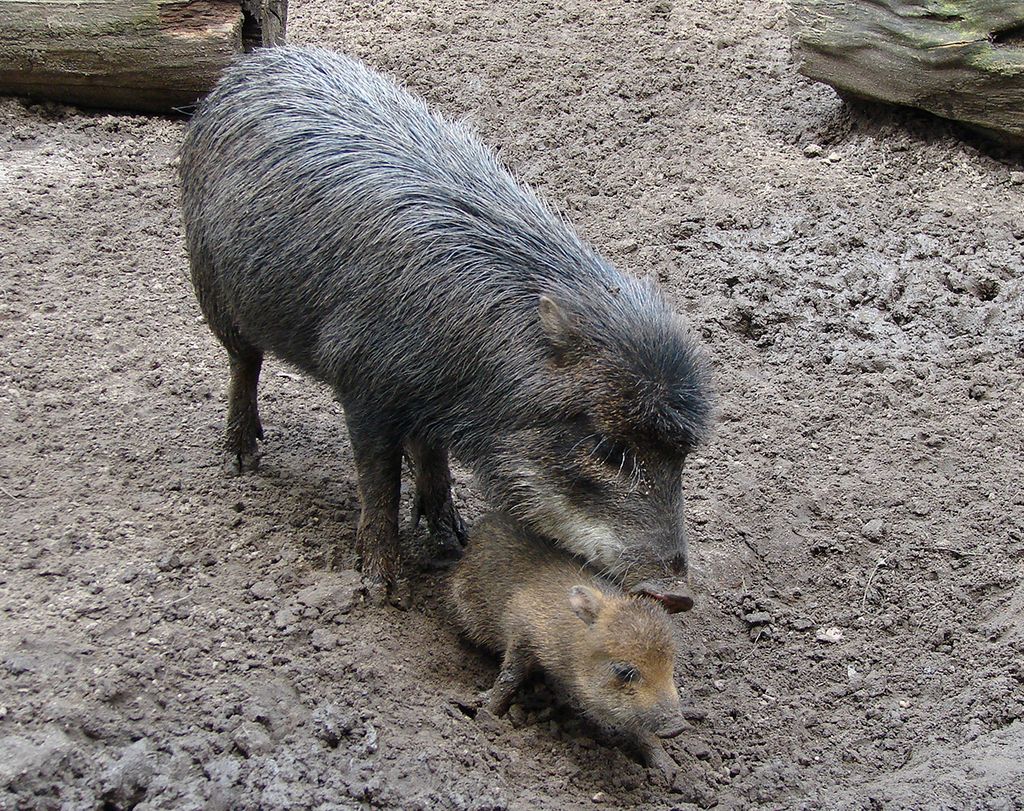
Peccaries are a family of superficially pig-like artiodactyls, sometimes erroneously called “wild pigs” or “New World pigs”. Both pigs (Suidae) and peccaries (Tayassuidae) have relatively large heads with a cartilaginous disc at the tip of the rostrum and tough, leathery skin covering the nose and snout for protection during foraging.

Pigs look like peccaries and peccaries look like pigs, but their similarities evolved independently (this is a lovely example of convergent evolution where a different group may evolve similar solutions). There are a number of important anatomical and behavioural differences that differentiate the two (for a full list comparing and contrasting the two, click here). Peccaries are highly social and diurnal animals that can be found in a variety of habitats including arid deserts, dense forests, and open scrublands. All have a stiff bristly coat with an erectile mane running from the back of the head to the rump. A scent gland is located on the rump just above the tail used in mutual grooming and scent marking. They are mostly herbivorous and have a complex two-chambered stomach.

The first of these creatures are known from Europe around 33 million years ago (during the early Oligocene) and spread to Africa and North America. After the Miocene (about 5 million years ago), however, they could only be found in the New World. Their disappearance from the Old World appears to coincide with the diversification of terrestrial primates (the ancestors of today’s baboons and macaques). North America remained a stronghold for these pig-like beasts, and they would advance down to invade South America when the Panamanian Land Bridge formed around 3 million years ago. During the Pleistocene, several types of extinct peccaries coexisted with those species still alive today.

One of the species of peccary arond today, the White-lipped Peccary (). (Image from here)

One of the species of peccary arond today, the White-lipped Peccary (Tayassu pecari). (Image from here)

There are three well-known extant species spread across the Americas; the Collared Peccary (Pecari tajacu), White-lipped Peccary (Tayassu pecari), and Chacoan Peccary (Catagonus wagneri). A fourth species, the Giant Peccary (Pecari maximus), was discovered in the Amazon rainforest in 2000. Although its status as a distinct species remains a topic of debate, a study of the mitochondrial DNA reveals that the Giant Peccary diverged from the Collared Peccary between 1.2 million and 860,000 years ago during the late Pleistocene. This ‘new’ peccary also differs from the Collared Peccary in a number of physical and behavioural traits.

The Chacoan Peccary was first described in 1930 from Pleistocene-age fossils and was thought to be long extinct. In 1972 an expedition to the Gran Chaco in Paraguay, led by Dr. Ralph Wetzel,  3 local peccary species were identified that had been recognized by the natives for thousands of years: the Collared Peccary, the White-lipped Peccary, and a larger third species unknown to science at the time but known locally as the “Tagua”. Examination of the animal’s bones revealed it to be the “extinct” peccary which had identified 42 years earlier!

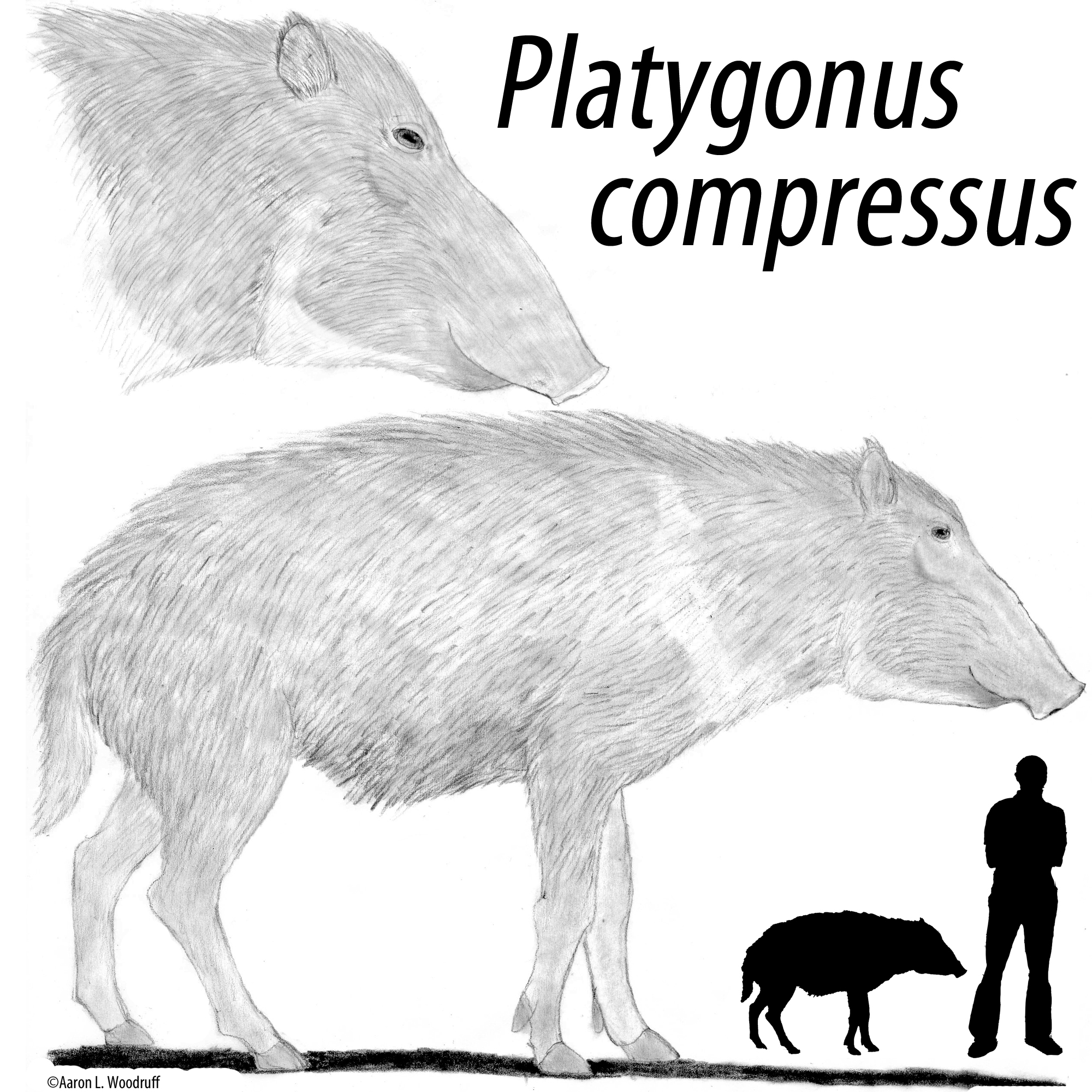
The pretty flat headed peccary, Platygonus compressus.

The pretty flat headed peccary, Platygonus compressus. (Art by Aaron Woodruff)

The newly-dubbed Chacoan Peccary was found to be the closest living relative of the extinct Flat-headed Peccary (Platygonus compressus), which lived in North America during the Pleistocene and early Holocene. Indeed, the two are sometimes placed under the same genus. Both of these beasts were specialists, with many features pointing to evolving to life on the open grasslands. They evolved longer, more slender legs for sprinting on open ground with narrow feet for making high-speed turns on rough terrain: these limbs were more like those of a gazelle. They have just two toes on the hindfeet instead of the more conventional three seen in other peccaries. Their long-range vision is more acute, and the eyes are set higher up on the skull, which is  extremely useful when they are feeding from the ground, they can also keep a look out for predators. The teeth are relatively high-crowned to handle the tougher vegetation encountered in dry, open habitats. The snout is deeper to house enlarged sinuses for coping with dry, dusty air.

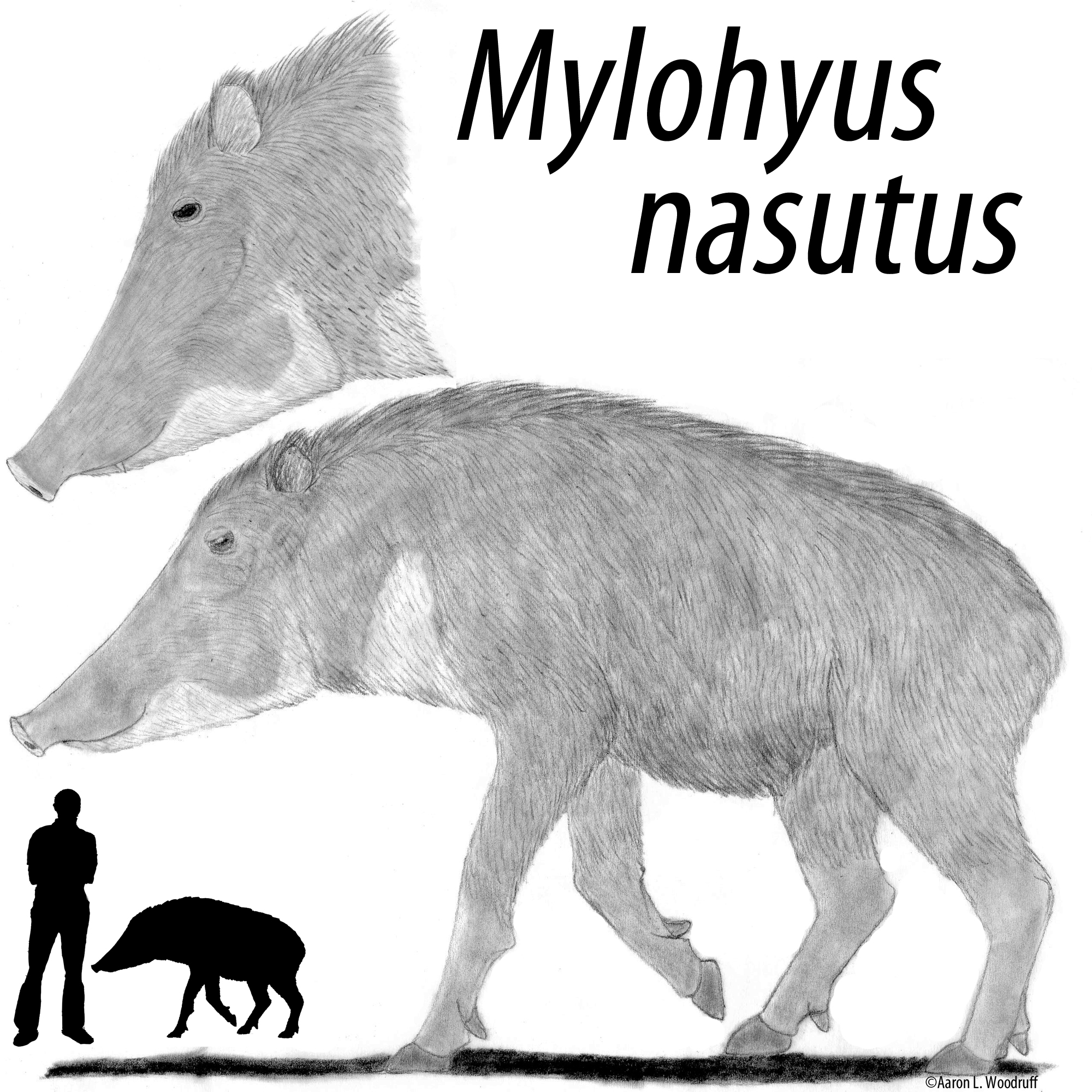
The longer snouted peccary, Mylohyus nasutus. (Art by Aaron Woodruff)

The longer snouted peccary, Mylohyus nasutus. (Art by Aaron Woodruff)

Living at the same time as the Flat-headed Peccary, the Long-nosed Peccary (Mylohyus nasutus) was a giant by peccary standards, weighing about the same as a sheep. As its common name suggests, its most distinguishing feature was its long, narrow skull which made up over one-third of its total length. Severe lengthening of the snout was achieved by a wide gap between the canines and the premolars. Its legs were very long and it retained four digits on the forefeet and three on the hindfeet.

Flat-headed and Long-nosed Peccaries both lived throughout North America, from New York to California east-to-west and from Canada to Central America north-to-south. Despite their shared range the two seem to have favoured different habitat types; the Flat-headed Peccary occurring in grassland and savannah habitats with suitable bush cover, while Long-nosed Peccaries tended to live in more wooded or forested areas. These habitat preferences are reflected in the teeth and diets of these two species. The strong jaws and robust teeth of the Flat-headed Peccary were designed to process tougher foods found at ground level. Much of its diet would have consisted of grasses, forbs, fruits, and seeds, possibly consuming animal foods on occasion such as insects, small vertebrates, and scavenged meat. Long-nosed Peccaries, meanwhile, has shorter teeth with more rounded cusps, best suited to grinding leaves, flowers, fruits, and twigs. High shoulders, an elongated face, and a flexible neck were adapted to browsing on higher, softer vegetation from overhanging shrubs and trees.

The complete remains of both species are frequently recovered from Pleistocene caves throughout North America, providing much insight into their lives. Given the diurnal nature of today’s peccaries, these caves were most likely used as communal night-time shelters in which individuals would occasionally die of natural causes or be killed by predators. Some baboon troops in Africa will utilize caves in the same way. The presence of Jaguar (Panthera onca) inside many of these peccary caves suggests that, as in modern ecosystems, the fossil peccaries were a favoured prey item for the big cat. Long-nosed Peccary fossils tend to be rarer than those of Flat-headed Peccaries, suggesting that the former lived in smaller social groups while the latter lived in larger communities.

Human artefacts have also been found alongside the peccary fossils at Sheridan Cave in Ohio. This suggests that humans and peccaries were, at times, utilizing the same caves or even competed directly for shelter. Though the relationship that humans may have had with the peccaries is unclear, Pleistocene peccaries would have been well-known to early Americans and these people may have recognized that they shared many traits in common. Like them, these were intensely social, diurnal animals that formed monogamous pairs.

Written by Aaron Woodruff (@CenozoicKing)

Edited by Jan Freedman (@janfreedman)

Further Reading:

Nye, A. S, (2007), “Pleistocene Peccaries from Guy Wilson Cave, Sullivan County, Tennessee”, Electronic Theses and Dissertations. Paper 2115. [Full article]

Roosmalen, M.G.M, et al, (2007), “A New Species of Living Peccary (Mammalia: Tayassuidae) from the Brazilian Amazon”. Bonner zoologische Beitrage 55(2): 105–112. [Abstract only]

Hoare, R, D, et al, (1964), “Pleistocene Peccary Platygonus compressus Leconte from Sandusky County, Ohio”. Ohio Journal of Science: Volume 64, Issue 3: 207-214. [Full article]

Slaughter, B. H ,(1966), “Platygonus compressus and Associated Fauna from the Laubach Cave of Texas”. American Midland Naturalist, Vol. 75, No. 2, 475-494. [Full article]

Wagner, G, (1903), “Observations on Platygonus compressus Leconte”, The Journal of Geology, Vol. 11, No. 8, pp. 777-782. [Full article]

Posted in Peccary | Tagged , , , , , , , , , , , , , , , , , , | 9 Comments

Crazy cute Ice Age animal you’ve never heard of

The beautiful, enigmatic Great Jerboa (Allactaga major) hopping around. (Image from here)

The beautiful, enigmatic Great Jerboa (Allactaga major) hopping around. (Image from here)

Owl sick is full of exciting surprises. Many birds of prey (owls, kestrels and sparrow hawks for example) will cough up fur balls full of bones. These silent predators struggle to digest the hard parts of the little creatures they feast upon, so they cough them up. Today, as in the past, owls often use caves as their base resulting in the cave floor covered with regurgitated tiny bones of their recent meals. This, for a Quaternary scientist, reveals a lost world of little furry mammals that lived within close proximity to the cave sites. Excavated cave sediments can contain hundreds of thousands of tiny bones and teeth, which can be identified often to the species level. And these can provide clues to some of the more unfamiliar Twilight Beasts.

Owl pellets hold the clues to the awesome little creatures living around the owls home. (Image from here)

Owl pellets hold the clues to the awesome little creatures living around the owl’s home. (Image from here)

Often the smallest animals are left on the sidelines. Ignored and perhaps forgotten, their diminutive size does not take away any of their awesomeness. And freaky awesome the Great Jerboa is.

Sitting comfortably in the palm of your hand, this furry little creature looks like a miniature kangaroo with enormous ears and belongs to the unusual family of jumping rodents (Dipodidae). Today Dipodidae are a pretty successful little group, with 33 different species, found through northern Africa, and across Asia. Hoping around on three elongated toes on their hind legs, they are at home in very cold or very hot desert environments. These nocturnal little creatures scurry around in the dark, digging for insects and bulbs to eat. Some species hibernate in colder periods, sometimes together in small groups to keep each other warm.

The Great Jerboa (Allactaga major) is the largest of the Dipodidae. Today, it can be found in Russia and a few countries just to the south. Towards the late Pleistocene, however, this cute little mammal had a much larger range towards the west in Europe. Twice these little hopping rodents have spread westward, to newer lands; once around 150,000 years ago to have vanished a few thousand years later, only to return again around 30,000 years ago. The colder climate helped with their success through Eastern Europe, as this little furry beast likes to hop around in the steppe like deserts, coming out at night time to feed.

Fossils of this small beast have been discovered as far west from Russian towards the Rhine in Germany. Great Jerboas were living happily in Europe! While many of the larger familiar beasts were migrating across the steppes, the little Jerboa  would have been hiding in its burrows, feeling the earth shake from the herds of the giants above. As yet, there is no evidence that humans interacted with them, but no doubt odd little hopping fur balls could have been spotted in the moon light.

Fossil leg bones from a Great Jerboa from Germany. On display at (Image from here)

Fossil leg bones of a Great Jerboa from Germany. On display at Staatliches Museum fur Naturkunde Stutgart. (Image from here)

So far no Great Jerboa specimens have been discovered in sites in France or Britain. But this does not mean that they didn’t hop their way across western Europe or across the Channel (which was more like a small river back then). Many museums holding Pleistocene collections do have lots of small mammal teeth and bones. Frogs and bird bones are pretty easy to spot. Teeth and jaws of shrews and voles have their own tell-tale signs and can be picked out easily. Bags and boxes of these bones are often left in museum store rooms, untouched; it takes time to go through and identify them. Hidden away inside there may be just be a bone, or even a tooth, of a Great Jerboa waiting to be discovered which could rewrite the textbooks of their awesome twilight distribution.

Written by Jan Freedman (@janfreedman)

There was not a lot of information around on the Pleistocene Great Jerboa. Get in touch if you know more!! twilightbeasts[at]gmail[dot]com

Further Reading:

Kurtén, B, (1968), ‘Pleistocene Mammals of Europe’, Transaction Publishers. [Book]

Tesakov A. S. (2001), ‘New data on Plio-Pleistocene jerboas of the genus Plioscirtopoda from Eastern Europe (Mammalia, Dipodidae)’, Zoosystematica Rossica, 9, 237-244. [Abstract only]

Posted in Jerboa | Tagged , , , | 1 Comment

To worship the lion

Sketch of a pride of Cave lions. Note the lack of manes on the big standing male. (Art by Tabitha Paterson)

Sketch of a pride of Cave lions. Note the lack of manes on the big standing male. (Art by Tabitha Paterson)

We think of lions, today, as African animals. This is mostly true. However, there is still a tiny refugium of non-African lions, isolated in the Kathiawar peninsula of India, and centred on the Gir forest reserve. Here, 400 or so Asian lions eke out an existence, beset on all sides by people and farmland, the last remnants of an empire that once spread from Tunisia via Turkey to the Tigris and beyond.  But, even this is only a fraction of the range that lions once held.

During the Pleistocene, highly differentiated lion subspecies (or perhaps separate species, opinion is divided) roamed from Spain to Siberia, through the steppes of Beringia, and into the Americas as far south as Mexico. Their fossils are surprisingly common in Britain too. In fact, excavation of the site of Trafalgar square uncovered a number of lion fossils where now their equally impressive bronze cousins lie today. The cave lion (Panthera spelaea) occupied all of Eurasia and Beringia. The closely related American lion (Panthera atrox) was found over the contiguous lower 48 states.

Range of lions since the Pleistocene. Image by Ross Barnett

Range of lions since the Pleistocene. Image by Ross Barnett

Cave lions were around 30% larger than modern African lions. (Image by Jan Freedman)

Cave lions were around 30% larger than modern African lions. (Image by Jan Freedman)

The cave lion is, and was, a pretty special felid. Considerably larger than modern lions, it was the apex predator of the Pleistocene food web (with perhaps some competition from Homotherium).  As it lived in Europe at the same time as anatomically modern humans, it has been depicted in numerous pieces of parietal and portable art. The cave walls of Chauvet and Lascaux contain brilliantly realistic images of this extinct animal, showing that it lived in prides, and that males were maneless. We know this because in a few images, the adult male scrotum is obvious, and the mane is absent.

Pride of cave lions from Chauvet cave. Public domain image.

Pride of cave lions from Chauvet cave. Public domain image.

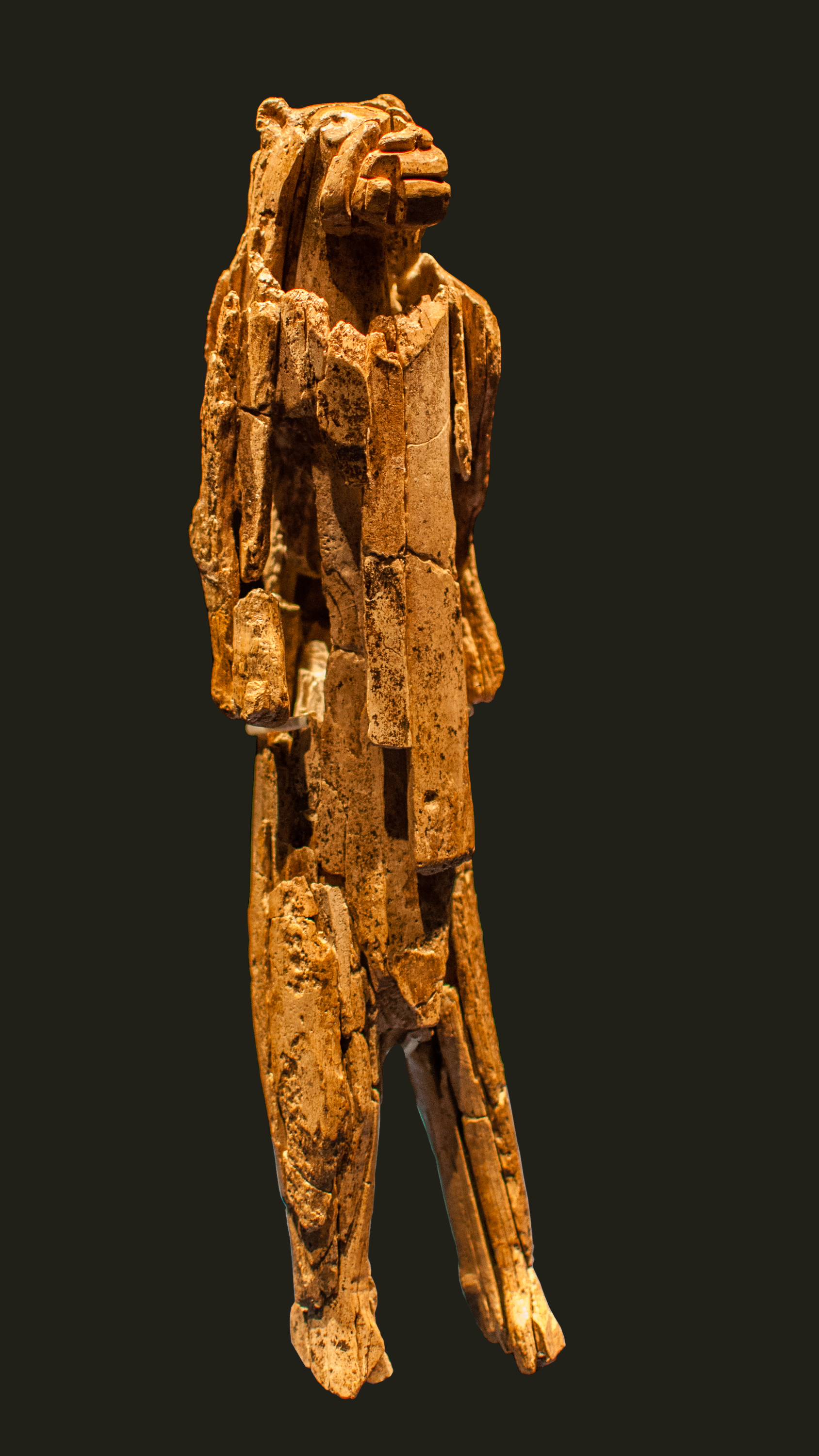
It also seems that early Europeans had some kind of cultural affinity for the cave lion. One of the most amazing pieces of art to come from this period, exquisitely crafted from mammoth ivory, shows a half-lion, half-human chimera. This löwenmensch, as it is known in german, testifies to some kind of ritual or mythic importance for the cave lion in the culture of the time. Like the venus figurines, löwenmensch, have been found at multiple sites, showing that the idea was not just an isolated one but shared amongst communities.

Löwenmensch from Hohlenstein-Stadel. Image by Dagmar Hollmann via Wikimedia Commons. License: CC BY-SA 3.0

Löwenmensch from Hohlenstein-Stadel. Image by Dagmar Hollmann via Wikimedia Commons. License: CC BY-SA 3.0


Written by Ross Barnett (@DeepFriedDNA)

Art by Tabitha Paterson (@TabithaPaterson)

Further reading:

Nice piece by the Telegraph, featuring our very own Ross Barnett: ‘Super-sized lions’ roamed UK in Ice Age.

Barnett, R., et al. (2014), ‘Revealing the maternal deomgraphic history of Panthera leo using ancient DNA and a spatially explicit genealogical analysis’, BMC Evolutionary Biology, 14, 70. [Full Article]

Barnett, R., et al. (2009), ‘Phylogeography of lions (Panthera leo ssp.) reveals three distinct taxa and late Pleistocene reduction in genetic diversity’, Molecular Ecology, 18 (8), 1668-77. [Abstract]

Conard, N. J. (2003), ‘Palaeolithic ivory sculptures from southwestern Germany and the origins of figurative art’, Nature, 426 (6968), 830-32. [Abstract]

Franks, J. W. (1960), ‘Interglacial deposits at Trafalgar Square’, The New Phytologist, 59, 145-150Montellano-Ballesteros, M. and Carbot-Chanona, G. (2009), ‘Panthera leo atrox (Mammalia: Carnivora: Felidae) in Chiapas, Mexico’, The Southwestern Naturalist, 54 (2), 217-22. [Abstract]

Montellano-Ballesteros, M., and G. Carbot-Chanona (2009). ‘Panthera Leo Atrox (Mammalia: Carnivora: Felidae) in Chiapas, Mexico.’ The Southwestern Naturalist 54, no. 2 , 217-22. [Abstract]

Packer, C. and Clotte, J. (2000), ‘When Lions Ruled France’, Natural History, 109, 52-57. [Full Article]


Posted in Cave Lion | Tagged , , , , , , , , | 11 Comments