We are made of star stuff

“The nitrogen in our DNA, the calcium in our teeth, the iron in our blood, the carbon in our apple pies, were made in the interiors of collapsing stars. We are made of star stuff.” (Carl Sagan, Cosmos)

New hominin species are a rare and unique find. Just weeks after paleoanthropologists were discussing some pruning to what has become the progressively gnarled bush representing the Homo lineage, a newly announced discovery has added yet another branch. The remains of at least 15 individuals belonging to a new species, Homo naledi, have been recovered from deep within the Rising Star cave system just outside of Johannesburg, South Africa. The species name “naledi” refers to the finds within the Rising Star Cave, and means “star” in Sesotho, one of South Africa’s 11 official languages.

Naledi: A beautiful name for one of paleoanthropology's rising stars. (Image by K Lindsay Hunter)

Naledi: A beautiful name for one of paleoanthropology’s rising stars. (Image by K Lindsay Hunter)

The site itself lies within a well-traveled and much explored area. Rising Star is actually a popular destination for the local caving club (Speleological Exploration Club, SEC), and if you have gone on such a trip in the last 50 years, there is a good chance that you have been there. The cave system is less than a mile from two other very important hominin-bearing sites: Swartkrans and Sterkfontein. The first fossil finds of early hominins in South Africa, Australopithicus africanus, were discovered at Swartkrans, while more examples of Au. africanus, and possible fossils belonging to Homo, were found at the rich site of Sterkfontein. With sites such as these, and these newly discovered fossils, you can see why the area is called the Cradle of Humankind.

Serendipity played its part in the discovery, as it always does, but so did fortuitous outreach from the local university. In late 2013, Professor Lee Berger of the University of Witwatersrand had recently realized that he had neglected exploration in the wake of his successful discovery of the Au. sediba site of Malapa. To remedy this, he asked his colleague Pedro Boshoff, a caver, to let his friends know to keep their eyes open for possible hominin fossils as they went about their more routine cave exploring.

The actual discovery was made by two recreational cavers and SEC members, Rick Hunter and Steven Tucker, on a very lucky Friday the 13th, 2013 while pushing the cave for a possible extension. The part of the cave that Rick and Steven meant to ‘push’ was a spectacular disappointment, leading to an area only about the size of table. As they still had much of the night ahead of them, Rick asked Steven to do some climbing in an area of the cave known as “the Dragon’s Back.” This colorful name refers to a large formation that had fallen from the ceiling sometime in the distant past, providing a challenging climb as though along the beast’s back toward its outstretched head. Once tackled, Rick decided to film some formations using his GoPro, and found Steven was in his way. To dodge the camera, Steven fitted himself into a tiny slot in the floor of a small antechamber.
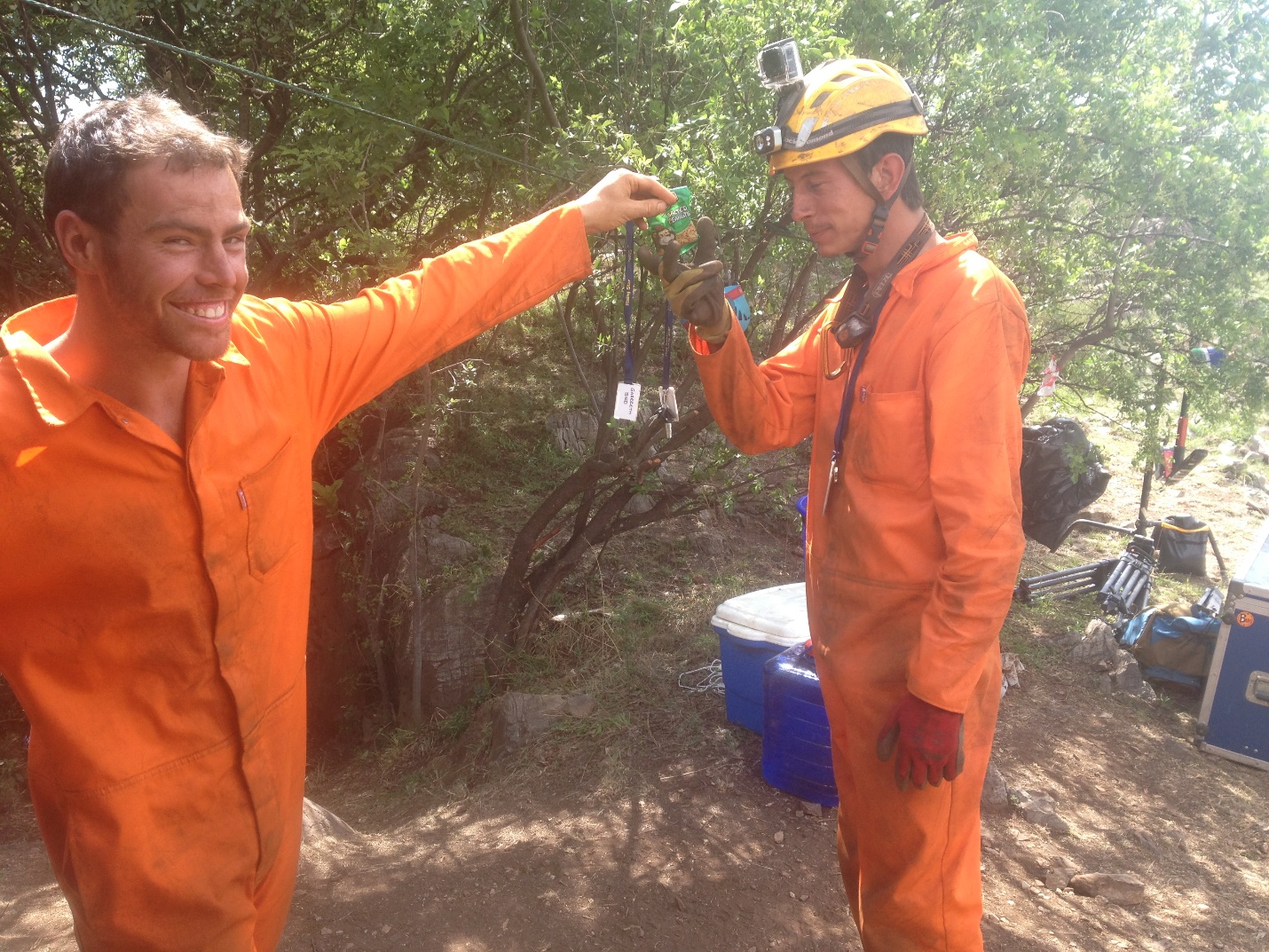
The Steven and Rick Show: Steven Tucker hands Rick Hunter a bag of peanuts after first dingling him in the face with them during the expedition. (Image by K Lindsay Hunter)

The Steven and Rick Show: Steven Tucker hands Rick Hunter a bag of peanuts after first dingling him in the face with them during the expedition. (Image by K Lindsay Hunter)

Because he’s a caver, and such people have notoriously high energy levels and short attention spans when faced with unknown spaces, Steven decided to wriggle down feet first and see if his resting space went anywhere. A few moments later, he found his feet dangling 4 meters in space above another chamber completely obscured from the top. He quickly yelled up to Rick the words that every caver loves to hear: “It goes,” which is to say, the cave extends, and there is more to explore. Not needing to be told twice, Rick quickly squirmed down the 12 m chute (20–25 cm on average, with an ~18 cm pinch point), and joined Steven at the bottom. As they made their way around the small antechamber and into what is now known as “the Dinaledi Chamber” (“the Chamber of Stars”), they saw what looked like human bones littered along the floor. One in particular caught their attention, a mandibular fragment (lower jaw) with teeth attached. The thought went through their minds that this was the last caver to have entered the area, but not having made it back out, this would seem to explain why the chamber wasn’t found on any survey map (this despite the fact that a survey marker could be seen on the wall of the chamber). They put this thought from their minds and carried on looking for any possible extensions to their new playground. Finding none, they resolved themselves to looking about at their long dead companions. The idea began to dawn on them that perhaps they had stumbled upon fossils like those they had been asked to alert Pedro to, but having neither specialist knowledge, nor camera batteries by this point, further progress on the subject was left until the following week.

"Cartoon illustrating the geological and taphonomic context and distribution of fossils, sediments and flowstones within the Dinaledi Chamber" by Paul H. G. M. Dirks et al - http://elifesciences.org/content/4/e09561. Licensed under CC BY 4.0 via Commons - https://commons.wikimedia.org/wiki/File:Cartoon_illustrating_the_geological_and_taphonomic_context_and_distribution_of_fossils,_sediments_and_flowstones_within_the_Dinaledi_Chamber.jpg#/media/File:Cartoon_illustrating_the_geological_and_taphonomic_context_and_distribution_of_fossils,_sediments_and_flowstones_within_the_Dinaledi_Chamber.jpg

The Dinaledi chamber, showing the distribrution of the fossils on the cave floor. (Image from Dirks, et al 2015. From here)

September 19, the two returned and took photos for a very excited Pedro (who viewed them on October 1—honestly, cavemen are useless with comms!), who then quickly delivered them in person to an astonished Lee. Following another round of photos (this time with a metric scale and taken by Lee’s teenage son, Matthew (discoverer of Australopithecus sediba), Berger knew it was time to act.

Now, the process of funding and mounting a paleoanthropological expedition is usually a long and tedious exercise in bureaucracy and money-wrangling. Very fortunately, in the case of Rising Star, Lee was able to prevail upon his position as a National Geographic Explorer-in-Residence and parlayed the confidence the foundation had in him, his skill, and his judgment into a 21-day expedition to kick off at the beginning of November 2013.

To crew this expedition, Lee turned to social media. He knew from conversations with those who had been within the Dinaledi Chamber that he was too large to pass through the entrance chute. With some regret, he knew that he would have to trust the expertise of experienced paleoanthropologists/paleontologists/archaeologists whose body frames, skills, and athleticism would permit them to pass into an area that he could not. In the recent PBS Documentary, Dawn of Humanity, Lee says he expected maybe a handful of responses to a post he made on Facebook. He received almost 60 qualified and eager applicants. Of this number, 6 were ultimately selected, all women, who fit this demanding criteria. We arrived in South Africa on or near the 5th of November, not even two months since the discovery.
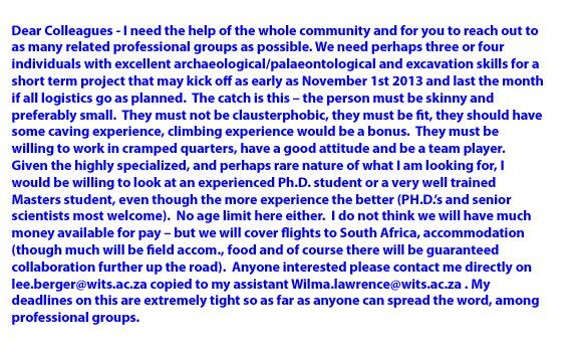
Rising Star Expedition Facebook ad posted on social media by Lee Berger around October 7 2013. (Credit: Facebook, Lee R. Berger)

Rising Star Expedition Facebook ad posted on social media by Lee Berger around October 7 2013. (Credit: Facebook, Lee R. Berger)

I say “we,” because I was fortunate to be selected as a member of these so-called “Underground Astronauts” (or Advance Underground Scientists or Advance Speleological Archaeologists, as we were known on site). I am also now married to one of the original co-discoverers, Rick Hunter, so I am in, perhaps, an unique, if not entirely unbiased, position to shed light on the goings on within, as well as the occupants of this Chamber of Paleo-Secrets (no longer).

The Rising Star Expedition in 2013 formed a small, but lively and tight-knit community of scientists, local cavers (mostly SEC members), Nat Geo crew, and support staff. Ensconced with a roommate in military tents, we were baked awake around 5:30 AM, to stumble to the mess tent for our caffeinated beverage of choice. Following the morning briefing, we divided into shifts of two or three advance underground scientists to begin what could be as long as 8 hours of excavation. This was all performed under the watchful eye of both cavers within the system and scientists top-side in the Command Tent.
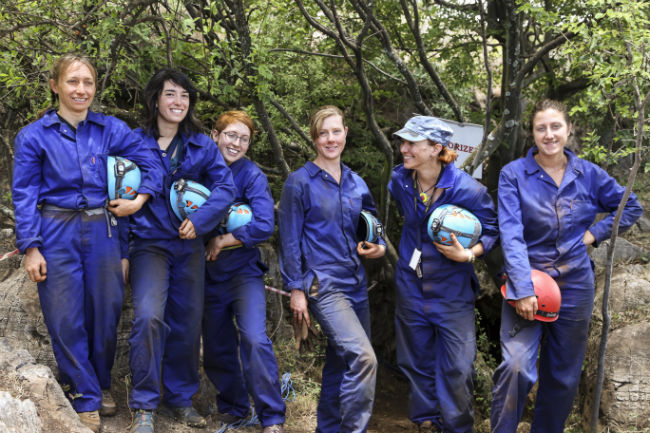
The original team of 6

The original team of 6 underground astronauts. This is the Rising Star team who crawled in the cave and excavated the incredible fossils. From left to right: Becca Peixotto, Alia Gurtov, Elen Feuerriegel, Marina Elliott, K Lindsey Eaves, and Hannah Morris. (Image credit University of the Witwatersrand)

For, one unique aspect of the Rising Star Expedition was the technological innovation applied to communications within a remote environment. SEC cavers helped string cable throughout the cave and into the Dinaledi Chamber, enabling phone intercom communication at the top and base of the chute, as well as within the chamber (all linked to the Command Tent). Additionally, security cameras were placed along the 90m route at significant points to monitor progress on and off site. Within the chamber, no fewer than 3 cameras (including one that was easily movable) allowed those above to observe the careful recovery of fossil remains. These measures served for safety, as well as to allow instant communication with colleagues unable to reach the site in person. The usual process of dropping by one another’s pits while excavating to check progress and offer advice, was facilitated by way of virtual “tours” using the roving camera conveyed to a split-screen monitor in the Command Tent. These cameras and the attendant intermittent audio allowed for those above to post progress to social media, such as Twitter, to keep students, armchair paleoanthropologists, scientists, and curiosity seekers abreast of the goings-on below ground.
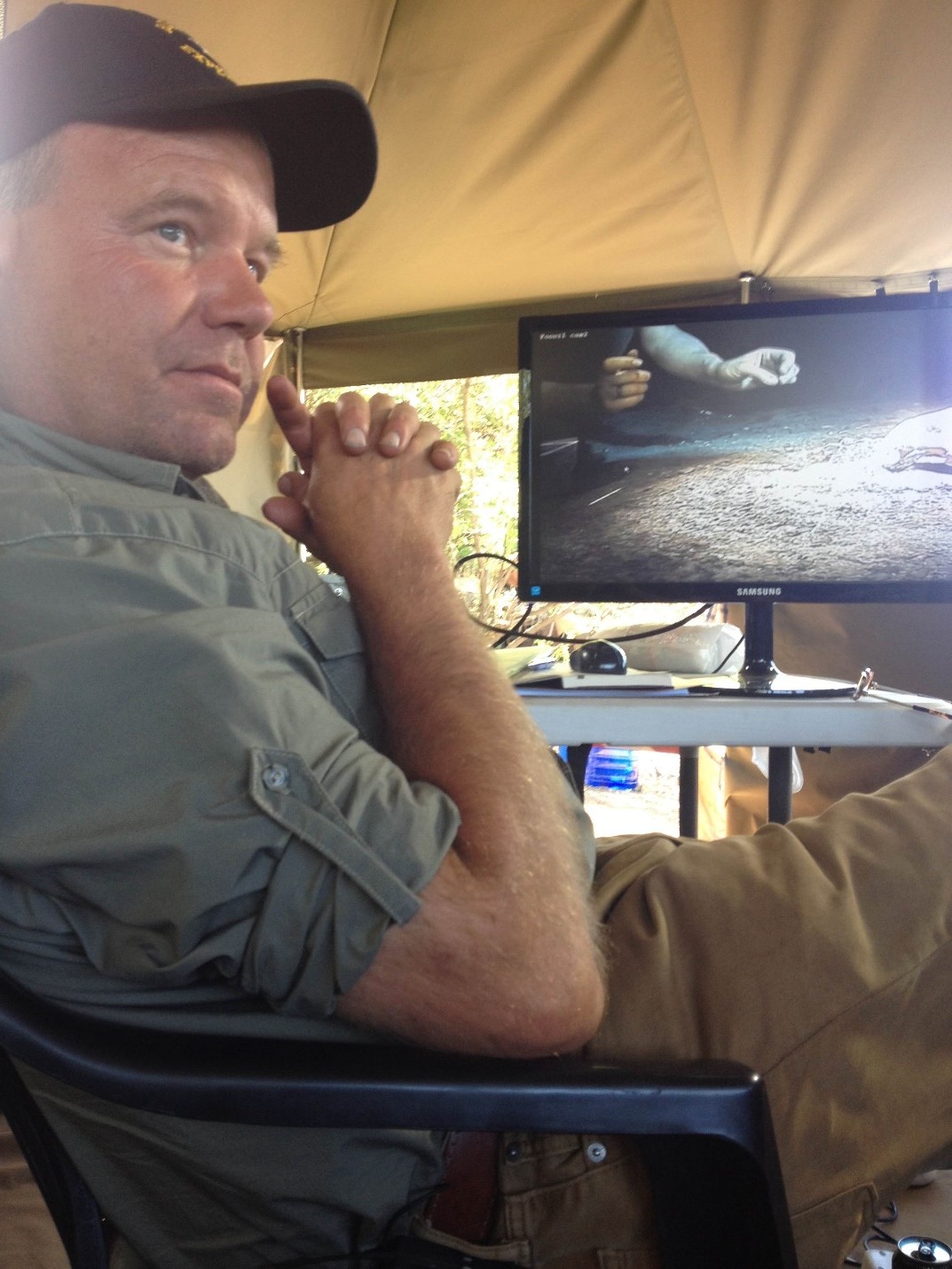
Advance underground scientists excavate the Dinaledi Chamber under the watchful eye of Lee Berger in the Command Tent. (Image by K Lindsay Hunter)

Advance underground scientists excavate the Dinaledi Chamber under the watchful eye of Lee Berger in the Command Tent. (Image by K Lindsay Hunter)

Meanwhile, in the chamber, team members first undertook a careful surface documentation and collection process to clear space to work. We quickly found that the clay-dirt floor was not only strewn with bones, but that they often lay just below the surface. We moved to a barefoot protocol and only with great trouble were able to clear a kind of path to an area towards the rear that seemed to have a particularly dense accumulation that included the outline of a cranium seen in what appeared to be sagittal view. This area came to be the focus of our work and was dubbed “the Puzzle Box,” as the bones closest to the surface were somewhat jumbled like puzzle pieces or interlaced like Jenga or Pick-up Stix. It lay under a low overhang of rock in a small space that then opened into the back of the chamber. It was often joked, “What idiot put the fossils in the passageway?!” It was within this tiny space that we would crouch day in and day out, using toothpicks (occasionally cave porcupine quills) and tiny paint brushes to uncover the remains within an approximately meter by meter square pit. Sediment was carefully collected using small plastic spoons.
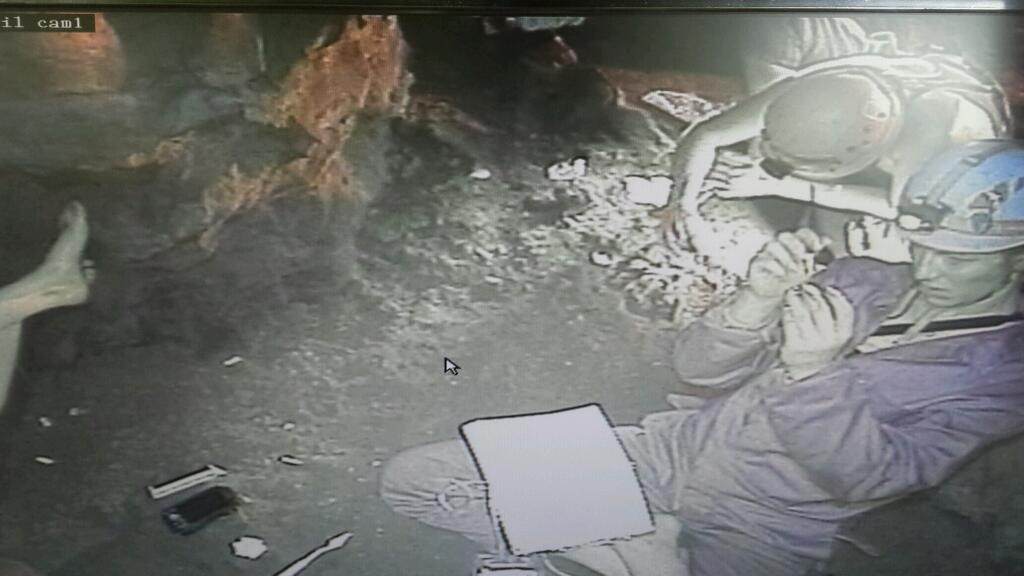
Me taking a hard look at a fossil just excavated. (Image Credit: Rising Star Expedition)

Me taking a hard look at a fossil just excavated. (Image Credit: Rising Star Expedition)

Using methods modified for this unusual environment, mapping of the bones was accomplished using a handheld, 3D white light strobe scanner and standard documentation before extraction using a forensic camera and scale. Many of the bones were roughly the consistency of damp chalk and had to be carefully bagged before they were re-bagged with identification slips and then packed in bubble-wrap before being place in plastic containers that were re-packed in more bubble wrap and bundled in caving gear bags. These were then carefully hauled up the chute using a pulley system before being conveyed to the surface and then ultimately to the Science Tent for photographing, more detailed identification (something you don’t want to ask people using only headlamps to do), and preservation.

Peter Schmid documents fossils in the Science Tent, while John Hawks looks on. (Image K Lindsay Hunter)

Peter Schmid documents fossils in the Science Tent, while John Hawks looks on. (Image K Lindsay Hunter)

For 21 days we carried on this intense routine, extracting more and more precious remains, far exceeding our original estimates of perhaps one skeleton. As the bones began to accrue in the Science Tent, so did a feeling that we were not dealing with a familiar species and that they had come to rest within the Dinaledi Chamber in an extraordinary way. Meal time and campfire chatter was dominated by speculation regarding these subjects, but everyone was hesitant to voice what was on all of our minds, and what ultimately was borne out by two years of research with a team of over 50 international scientists: in three weeks’ time, we had recovered more than 1200 remains (a 10 day excavation in March of 2014 increased the balance to over 1550 specimens) of a new species of Homo. A species that seemingly had come to be deposited within the chamber by intentional means, namely deliberate disposal by other hominins.

A revolutionary workshop was launched in May 2014, also advertised by social media, for early career researchers, who collaborated with over 30 colleagues from around the globe to describe the Dinaledi remains and place them in context. The two resulting primary papers Berger et al. and Dirks et al. were published in the open access journal eLife. These form the forward guard of scientific information on Homo naledi and are soon to be followed by a series of specialist papers on the various regions of the body, now under review. Armed with both a description and species diagnosis, as well as a thorough analysis of the geological context and taphonomy and preservation circumstances of the remains, Lee and the team formally introduced Homo naledi to the world on September 10, 2015 (almost 2 years to the day from the discovery) via a live-streamed press conference at Maropeng, the official visitor centre for the Cradle of Humankind World Heritage Site.
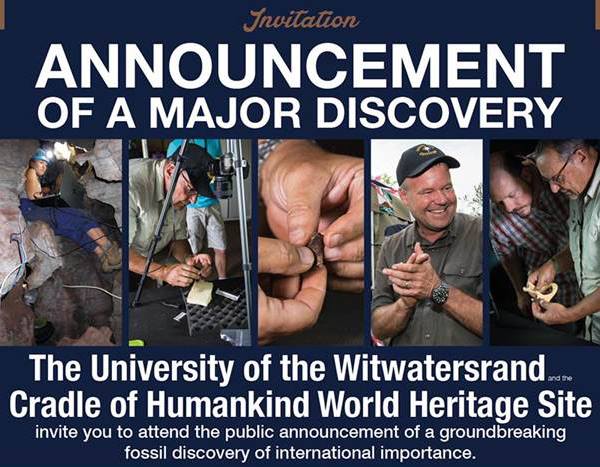
The announcement of the Homo naledi fossils took place at Maropeng under much fanfare. (Image Credit: University of the Witwatersrand)

The announcement of the Homo naledi fossils took place at Maropeng under much fanfare. (Image Credit: University of the Witwatersrand)

The announcement and related papers gave the public and the scientific community at large its first glimpse of where this new species of Homo might swing from the branches of our extended family tree. Despite the plethora of material, however, our view on evolutionary placement is still somewhat unclear. Traditional methods of dating associated materials have been frustrated either by lack of availability or unsuitability of sediments, leaving the only recourse to date the bones directly, often a destructive enterprise. This has left Homo naledi without solid, radiometric dates for the time being, as scientists evaluate appropriate dating methods that produce the least damage to these valuable fossils. However, despite this, comparisons with known and well-dated species have led Berger et al. to hypothesize that the lineage to which these fossils belong may be quite old, possibly 2 to 2.5 million years in age. Depending on the ultimate dates, interpretation may change, though no matter how old they are, the Dinaledi remains have opened our eyes to the great diversity of hominin adaptation, even within the genus Homo.

It is quite apparent from the material that we are looking at a creature with a uniquely mosaic suite of characteristics. When we compare the H. naledi specimens to other hominin species, we see fascinating similarities, but also striking differences. In fact, one thing this material has shown us is how misleading species diagnoses based on very fragmentary material might be. If only a few portions of Homo naledi had been recovered and not in association, it would have been easy to mistake them for known species. However, taken as a whole, and across a wide spectrum of skeletal elements belonging to both sexes and all ages, we can see clearly that this is like nothing we have seen before.
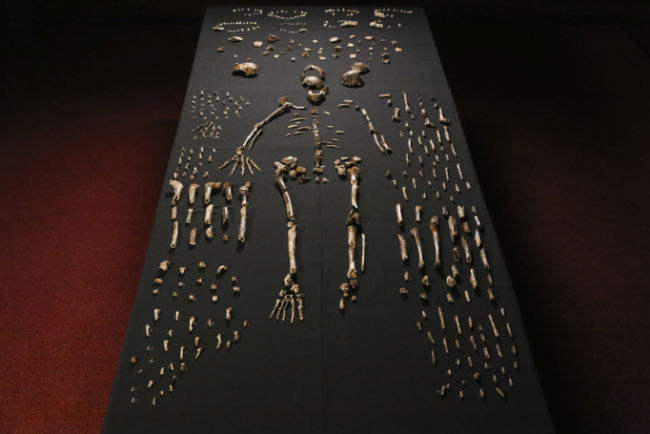
cOMPOSITE SKELETON OF

The incredible fossils of Homo naledi, including a composite skeleton.(Image credit John Hawks, University of the Witwatersrand)

Were you to pass Homo naledi on the street, you would not confuse it for a fellow human. Though the shape of the skull is more rounded like ours, the very small brain is more in line with that of  Australopithecus, an early relative. The long and slender legs, as well, are similar to Homo, terminating in feet that are all but indistinguishable from yours or mine. However, added to this are unique features from both the shoulder and the hand that suggest Naledi was a proficient climber. The long, curved fingers, in particular, are reminiscent of those seen in arboreal, climbing nonhuman primates or australopithecines. The torso would have been bell-shaped or wider at the bottom to fit its flaring hips, giving it a more ape-like appearance. All of this begs the question: do the Dinaledi fossils occupy some intermediate space between the australopithecines and early Homo? And if so, do they lie along the path that led to us or to our extinct relatives? Only more time and more fossils will shed light on Naledi’s place within our increasingly convoluted evolutionary history.

"Comparison of skull features of Homo naledi and other early human species" by Chris Stringer, Natural History Museum, United Kingdom - Stringer, Chris (10 September 2015). "The many mysteries of Homo naledi". eLife 4: e10627. DOI:10.7554/eLife.10627. PMC: 4559885. ISSN 2050-084X.. Licensed under CC BY 4.0 via Commons - https://commons.wikimedia.org/wiki/File:Comparison_of_skull_features_of_Homo_naledi_and_other_early_human_species.jpg#/media/File:Comparison_of_skull_features_of_Homo_naledi_and_other_early_human_species.jpg

Looking at the skulls of some of our own Genus shows the similarities, adn diferences. (Image by Chris Stringer. Public Domain)

With the announcement and the dissemination of these shocking findings, a powder keg of interest and criticism ignited (it’s only just now that I am able to take a breath and reflect a bit on what has come to pass). Scientific criticism (quickly documented in the press) immediately zeroed in on the assignment of a new species of Homo, the lack of solid dates, as well as the potentially humanlike behavior of deliberate disposal of its dead. This is completely to be expected. These are the most provocative and therefore, potentially vulnerable parts of the scientific argument carefully laid out in the two eLife papers. They are also some of the first areas that the scientists that have described them tackled: what do we have, how old is it, how did it get there? They are the first questions I would ask were I not a member of the scientific team. Each new taxa described must undergo this process of scrutiny, and behavioral interpretations in paleoanthropology are always met with no small amount of skepticism.

Rising Star and me on the news! (Credit NBC Nightly News, photo inset credit Elen Feuerriegel)

Rising Star and me on the news! (Credit NBC Nightly News, photo inset credit Elen Feuerriegel)

Not savoring the role of Dinaledi apologist, what must be understood, is that this same skepticism was the initial position of the Rising Star team members. No scientist wants to make an erroneous pronouncement that is quickly overturned or Flying Spaghetti Monster-forbid, a grossly inaccurate analysis that lands them on Retraction Watch. It makes absolutely no sense to rush and over-hype a find in the media to be torn to pieces by the scientific community. Remember, part of the initial success in funding came from Lee’s credibility and reputation for doing good science. Therefore, each aspect of the Homo naledi description and context was carefully scrutinized by scores of scientists, countless analytic comparisons made with the known hominin fossil record, and scenario after scenario examined and rejected. The Rising Star team has now put forward its best hypotheses given the data available to date, and it is placed at the feet not only of scholars, but anyone with an internet connection and a 3D printer.

Go ahead, examine the evidence yourself. The articles are free, as are 3D shapefiles for the attendant data. You can not only read the interpretations of our team, you can print it and touch it. If you are lucky enough to live in the Cradle area, you can visit Maropeng and see the original fossils lying in state, as well as speak to those (including me) who are related to the discovery. Draw your own conclusions, but please, do as we have done and examine all of the evidence first before a rush to judgment.
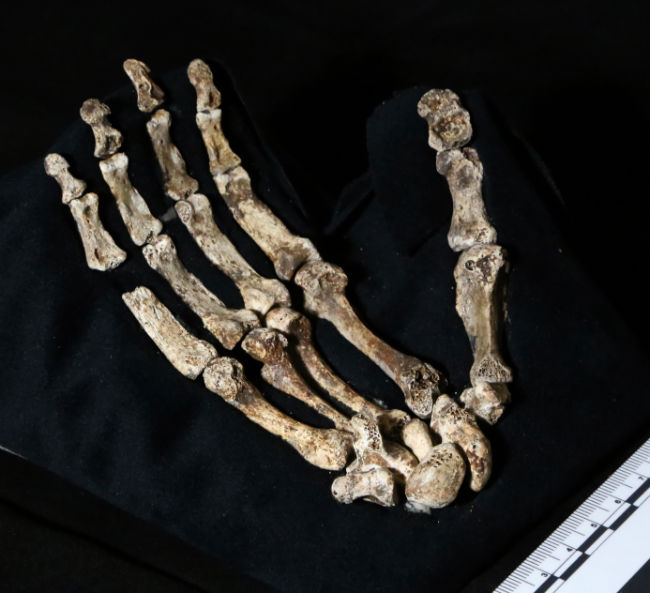
THE HAKNSDFKS

The beautiful hand of Homo naledi, with those long, grasping fingers. (Image credit John Hawks, University of the Witwatersrand)

As a member of the Rising Star team, I am proud of the work we have accomplished in just two years. We have shown that solid science can be performed in a relatively short period of time if one is able to cut through the bureaucracy and ego that normally bogs our field down. In many ways, Rising Star has been a practice in disruptive science, not only with regards to the phenomenal discoveries, but by consciously placing historically disadvantaged groups within the field in positions of power and responsibility: the primary excavation team was made up entirely of female scientists; the workshop and fossil analysis/description was performed largely by early career researchers of both sexes; the exploration team is composed of native South Africans from mixed ethnicities and educational backgrounds; and the primary articles were published open access in the journal eLife.

In this way, Homo naledi more resembles a comet than a star, “importing change of times and states” (Henry VI, Part 1, act 1, scene 1), but unlike a comet, expect this symbol of disruptive science in paleoanthropology to burn bright for some time to come.

Written by K. Lindsay Hunter (@Paleo_Bonegirl)

Edited by Jan Freedman (@JanFreedman)

Further reading:

Berger, L. R., et al, (2015), ‘Homo naledi, a new species of the genus Homo from the Dinaledi Chamber, South Africa’, eLife, 4:e09560. [Full article]

Dirks, L. R., et al, (2015), ‘Geological and taphonomic context for the new hominin species Homo naledi from the Dinaledi Chamber, South Africa’, eLife, 4:e09561. [Full article]

The Rising Star Team:

K Lindsey Hunter

Marina Elliott

Elen Feuerriegel

Alia Gurtov

Hannah Morris

Becca Peixotto

Criticisms to Homo naledi as a separate species:

More reading on hominins:

Antón, S. C. 2003. ‘Natural history of Homo erectus.’. American Journal of Physical Anthropology. 122: pp.126–170. [Abstract only]

Berger, L. R., et al. 2010. ‘Austrlopithecus sedbia: a new species of Homo-like austraopith from South Africa.’ Science. 328 (5975) pp.195-204. [Abstract only]

Dirks, P. H. et al. (2010). ‘Geological setting and age of Australopithecus sediba from Southern Africa.’ Science. 328 (5975). pp.205-208. [Abstract only]

Ferring, R et al. 2011. ‘Earliest human occupations at Dmanisi (Georgian Caucasus) dated to 1.85-1.78 Ma.’ Proceedings of the National Academy of Sciences 108 (26): 10432. [Full article]

Kivell, T. L. et al. 2011. ‘Australopithecus sediba hand demonstrates mosaic evolution of locomotor and manipulative abilities.’ Science.  333 (6048). Pp.1411-1417. [Abstract only]

Schwartz, J., Tattersall, I. (2015). ‘Defining the genus Homo.’ Science. 349. pp.931-932. [Abstract only] DOI: 10.1126/science.aac6182

Skinner N, M, et al. (2015).’Human-like hand use in Australopithecus africanus.Science. 347 (6220) pp.395-399. [Abstract only]

Spoor, F., et al. 2007. ‘Implications of new early Homo fossils from Ileret, east of Lake Turkana, Kenya.’ Nature 448 (7154): pp.688–691. [Abstract only]

Suwa G, et al. 2007. ‘Early Pleistocene Homo erectus fossils from Konso, southern Ethiopia.’ Anthropological Science. 115 (2): pp.133. [Abstract only]
Posted in Homo naledi | Tagged , , , , , , , , , , , , , , , | 10 Comments

The Lynx effect

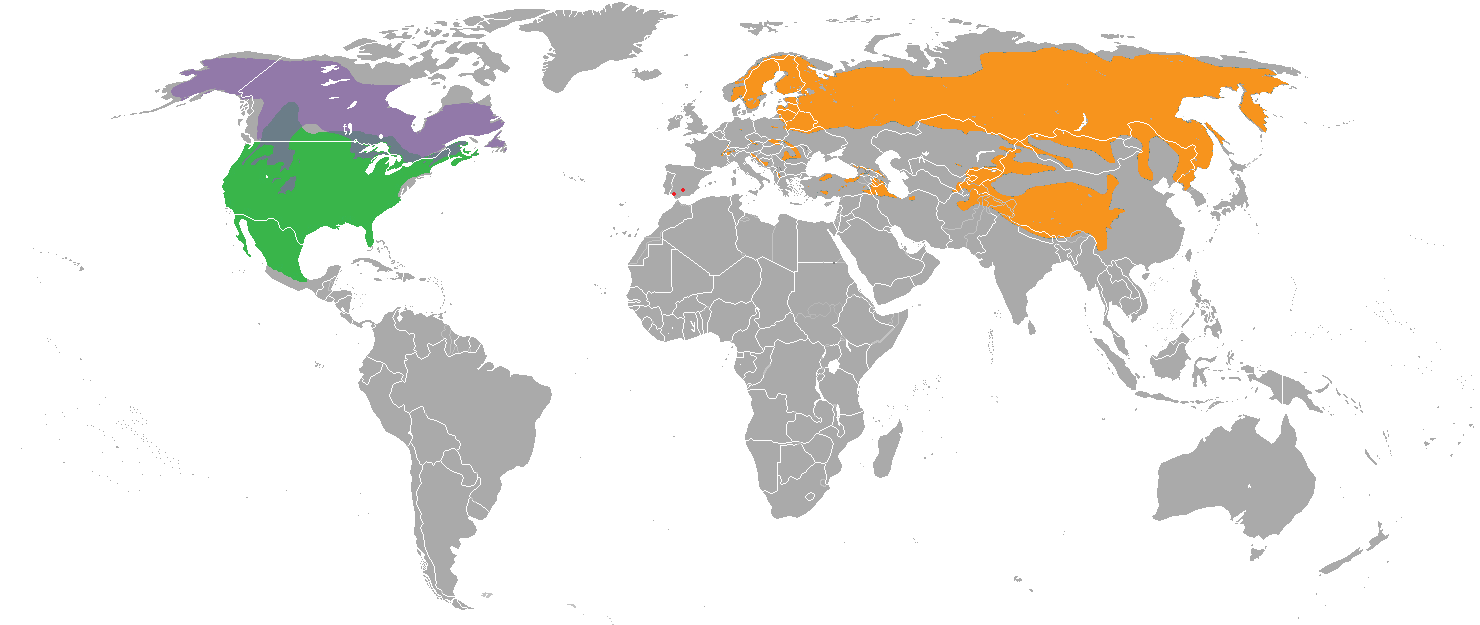
Distribution of lynx species. Orange=Northern; Red=Iberian; Purple=Canadian; Green=Bobcat

Distribution of lynx species. Orange=Northern; Red=Iberian; Purple=Canadian; Green=Bobcat Image via Wikimedia Commons

Here at TwilightBeasts we like to focus on the Pleistocene. That magic time when everything was bigger, badder, and weirder than now. But it’s a simple fact that every species now extant must have had an ancestor during the Pleistocene. That fact is true for us, and its true for lynx. The four species of the Lynx genus are an interesting bunch. Smallest, and the basal member of the group, is the north American bobcat (Lynx rufus), a medium-sized felid slightly bigger than a housecat and renowned for its ferocity. Although this doesn’t seem to have stopped them being kept as pets by some native americans. Not available on eBay.

Next in the group is the Canadian lynx (Lynx canadensis), famous for its supposed dependence on the snowshoe hare, and cyclical population growth. It’s also turned up in some weird places.

Lynx are big! This Canadian lynx is not even a record breaker. Public domain image.

Lynx are big! This Canadian lynx is not even a record breaker. Public domain image.

In Europe we are blessed with two distinct species, the largest of the quartet: the wide-ranging Northern lynx (Lynx lynx) and the Iberian lynx (Lynx pardinus).

Thanks to human persecution, myxomatosis, and land-use changes the only felid species endemic to Europe is also the most critically endangered of the entire family. Iberian lynx currently number only about 300 individuals spread between conservation centres, one national park (coto doñana), and perhaps a few other isolated spots. Many lynx are still killed each year on the roads that hem them into the park. On the other hand the Northern lynx is doing very well, with contiguous populations found all over Northern Europe and Northern Asia as far East as Siberia. In fact there have been considerable successes around the reintroduction of Northern lynx into their former territories in the Alps, Dinarics, and some other spots. There has also been recent talk of reintroducing the Northern lynx into Britain after new work showed that it could be found in Yorkshire up until medieval times.

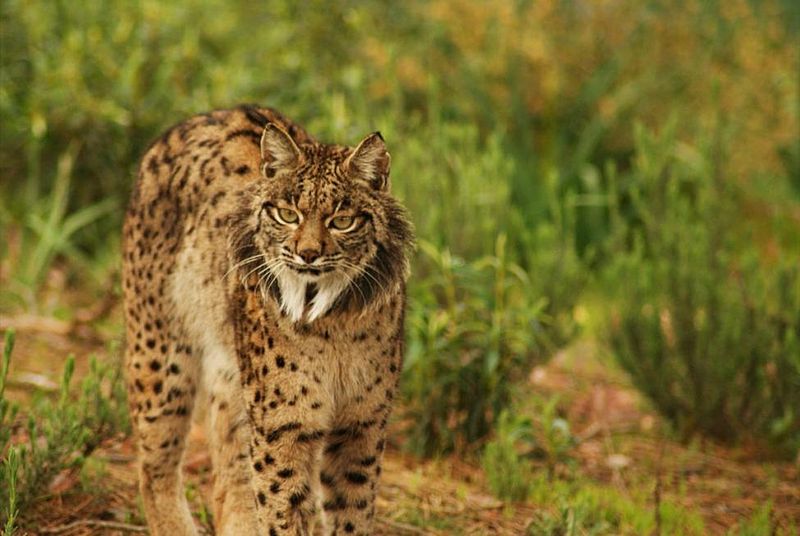
A beautifully ruffed Iberian lynx. Image by manedwolf via Wikimedia Commons

A beautifully ruffed Iberian lynx. Image by manedwolf via Wikimedia Commons

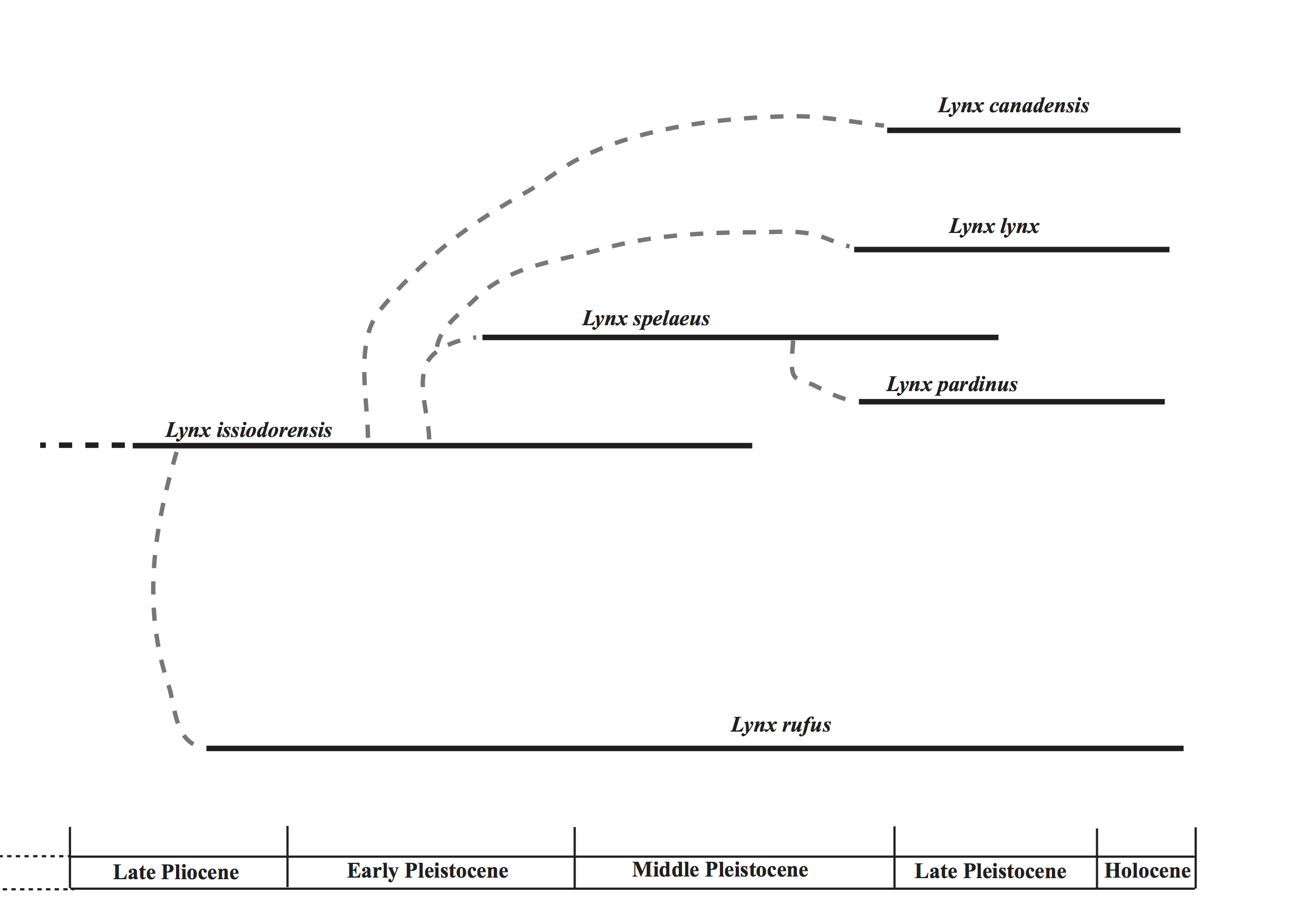
Apart from some small buffer zones (and some confirmed hybrids) between the ranges of the bobcat and Canadian lynx, the current distribution of the four members of the genus is generally non-overlapping. This kind of distribution practically screams out “allopatric speciation”! And indeed this appears to be the case from the genetic and fossil evidence we have.

Phylogeny of lynx. Dashed grey lines=phylogenetic relationships. Black lines=approximate fossil longevity

Phylogeny of lynx. Dashed grey lines=phylogenetic relationships. Black lines=approximate fossil longevity

Somewhat surprisingly some of the first lynx fossils are known from northern Africa- the one place where there are currently no lynx species. (Unless you count the desert lynx, another name for the Caracal, Caracal caracal, which although it has some natty ear tufts, is not closely related to the true lynx at all.) These Pliocene remains belong to the sensuously named Issoire lynx (Lynx issiodorensis). A cosmopolitan species known from many fossil sites all over the old world, it is almost certainly the direct ancestor of all four modern Lynx species. American lynx are therefore the result of two invasions; one earlier (Pliocene) that gave rise to the bobcat, and one later (Pleistocene) that gave rise to the Canadian lynx. [EDIT All-round carnivore expert and lynx specialist Lars Werdelin, kindly popped in to the comments to tell us that the earliest lynx fossils are actually North American, but undescribed as of yet]

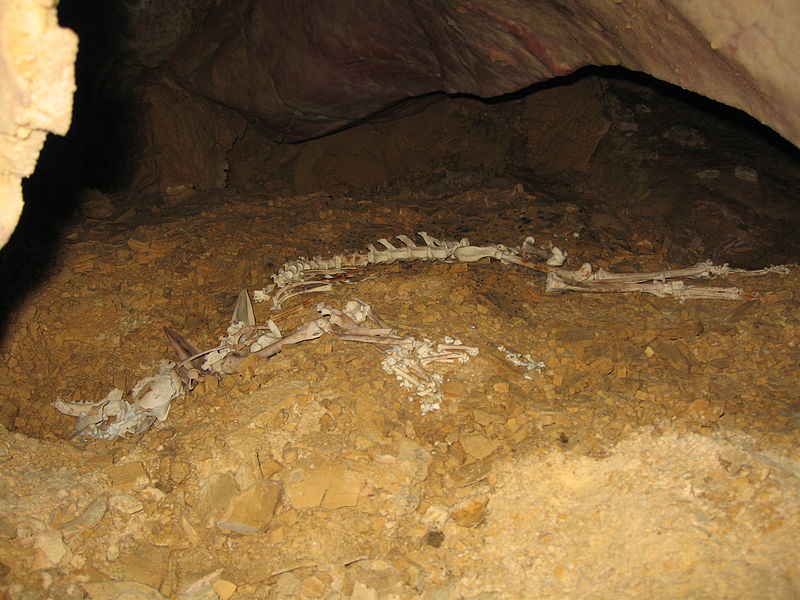
The relationship between the Iberian lynx and Northern lynx is slightly more complex. The Iberian peninsula is well known as a mammalian refugium. A stable temperate outpost when most of the Northern hemisphere is freezing during glacial conditions. Acting as a “safe-house” for some mammals during the glacial advance, a combination of selective forces and genetic drift likely steered the ancestors of the Iberian lynx along their distinctive trajectory. We even have fossils of some of the intermediate forms between Issoire and Iberian. The cave lynx (Lynx [pardinus] spelaeus) is known from sites in Spain, France, and Italy. Larger than the modern Iberian lynx, it shows the classic trend of decreasing size through time that we also see in lions, jaguars, puma, and other cats.

Fossil skeleton of Lynx pardinus from Sima del Huesos (Cave of bones), Murcia, Spain via Wikimedia Commons

Fossil skeleton of Lynx [pardinus] spelaeus from Sima del Pulpo (Cave of the Octopus), Murcia, Spain via Wikimedia Commons

But what are these fossils doing in France and Italy? Isn’t the Iberian lynx, well, an Iberian lynx? Yes and no. Like all good species, the Iberian lynx has been able to leave its native home when conditions were favourable, and colonise new territory. We’ve found fossils of Iberian lynx and Northern lynx together at a Pleistocene site in Italy (Arene Candide), showing that these are species that remain distinct even when their ranges are occasionally sympatric. It’s really just an accident of climate that Iberian lynx are only found in Spain (and latterly Portugal) today.

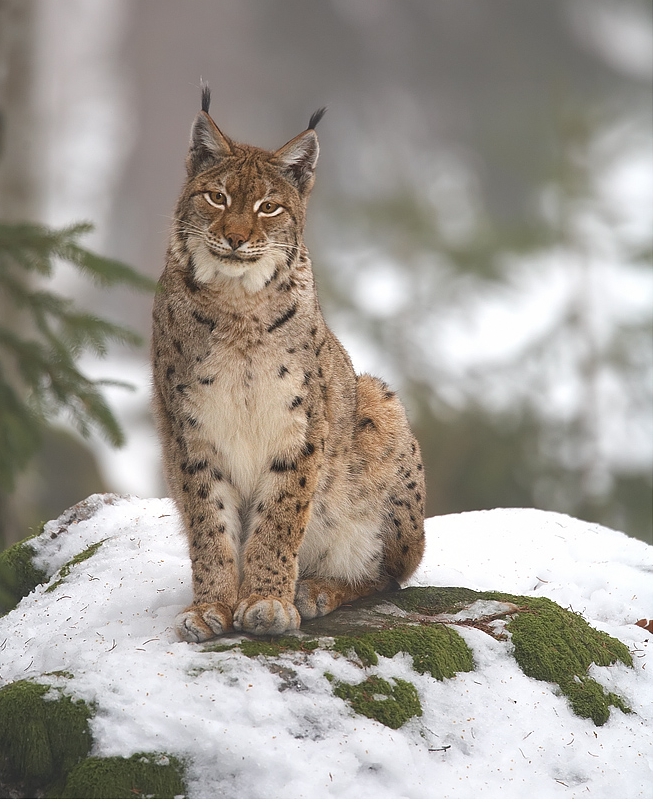
Northern lynx in Nationalpark Bayerischer Wald, Germany. Image by Martin Mecnarowski via Wikimedia Commons

Northern lynx in Nationalpark Bayerischer Wald, Germany. Image by Martin Mecnarowski via Wikimedia Commons

Northern lynx are supremely adaptable cats. The breadth of their range from Sweden to Siberia shows this to be the case. These are large animals, easily the size of a Labrador, and able to take down Roe deer (Capreolus capreolus) with ease (they sometimes also take Red deer, Cervus elaphus). It used to be thought that Northern lynx stayed, well, Northern, and never made it past the Pyrenees. A new paper by Rodríguez-Varela et al. overturns this notion and shows that L. lynx could be found in Northern Spain up until the 16th century. So, you have Northern lynx in Iberia, Iberian lynx in Northern Italy. Sometimes names are just there to confuse you!

Written by Ross Barnett (@deepfriedDNA)

Glossary:

Allopatric speciation; relating to the distribution of species where they are non-overlapping in range and derive from one wide-ranging ancestor that encountered semi-permeable barriers to geneflow.

Sympatric; relating to the distribution of species where they are overlapping in range.

Further Reading:

Blake, M., D. Naish, G. Larson, C. L. King, G. Nowell, M. Sakomoto, and R. Barnett. “Multidisciplinary Investigation of a ‘British Big Cat’: A Lynx Killed in Southern England C.1903.” Historical Biology 26, no. 4 (2014): 441-48. [Full Text]

Ghezzo, E., A. Boscaini, J. Madurell-Malapeira, and L. Rook. “Lynx Remains from the Pleistocene of Valdemino Cave (Savona, Northwestern Italy), and the Oldest Occurrence of Lynx Spelaeus (Carnivora, Felidae).” Rend. Fis. Acc. Lincei 26 (2014): 87-95.[Full Text]

Hetherington, D. A., T. C. Lord, and R. M. Jacobi. “New Evidence for the Occurence of Eurasian Lynx (Lynx Lynx) in Medieval Britain.” Journal of Quaternary Science (2005).[Abstract]

Kurten, B. “Lynx from Etouaires, Lynx Issiodorensis (Croizet and Jobert), Late Pliocene.” [In English]. Annales Zoologici Fennici 15, no. 4 (1978): 314-22.[Full Text]

Lariviere, S., and L. R. Walton. “Lynx rufus.” Mammalian Species 563 (1997): 1-8.[Full Text]

Rodriguez-Varela, R., N. Garcia, C. Nores, D. Alvarez-Lao, R. Barnett, J. L. Arsuaga, and C. Valdiosera. “Ancient DNA Reveals the Past Existence of Eurasian Lynx in Spain.” Journal of Zoology in press (2015).[Full Text]

Rodriguez-Varela, R., A. Tagliacozzo, I. Ureña, N. Garcia, E. Cregut-Bonnoure, M. A. Mannino, J. L. Arsuaga, and C. Valdiosera. “Ancient DNA Evidence of Iberian Lynx Palaeoendemism.” Quaternary Science Reviews 112 (2015): 172-80.[Full Text]

Schwartz, M. K., K. L. Pilgrim, K. S. McKelvey, E. L. Lindquist, J. J. Claar, S. Loch, and L. F. Ruggiero. “Hybridization between Canada Lynx and Bobcats: Genetic Results and Management Implications.” [In English]. Conservation Genetics 5, no. 3 (Jun 2004): 349-55.[Full Text]

Werdelin, L. “The Evolution of Lynxes.” Annales Zoologici Fennici 18, no. 37-71 (1981).[Full Text]


Posted in Lynx | Tagged , , , , , , , , , , , , , , , , , , , , , , , | 8 Comments

The last squawk of the dodo

Extinction isn’t preordained. Species have no idea if they will vanish from the face of the Earth forever. Yet they do.

An animal’s daily life is a struggle for survival: find the next meal, avoid being eaten. Many individuals die. Rarely such circumstances alone lead to a loss of an entire species. For that to happen, stronger factors play a part; climatic changes, continental drift, even volcanic eruptions on a small island can wipe out whole ecosystems. A species isn’t more advanced or special because it survived an extinction event. Each of the thousands of millions of species that have lived on this planet have been perfectly suited to their environment. Luck plays a huge part. Well, luck used to play a part.

When an animal or plant is gone, it is gone. Forever. A unique organism, a unique result of 4 billion years of evolution, lost.

For me, the saddest thing about extinction is the thought of that last individual. For if a species is to vanish, there will always be just one left at the very end. One lonely individual. Just imagine the last dodo. It’s long, flat scale covered toes gently crunching down on top of dead leaves as it plods through the forest looking for fruits to eat. Perhaps a little ruffle of its feathers before it shuffles down to sleep. And it’s squawk echoing through the empty forest as it calls for a mate. Only the squawk is never answered. It lived it’s last days alone. And it died alone.

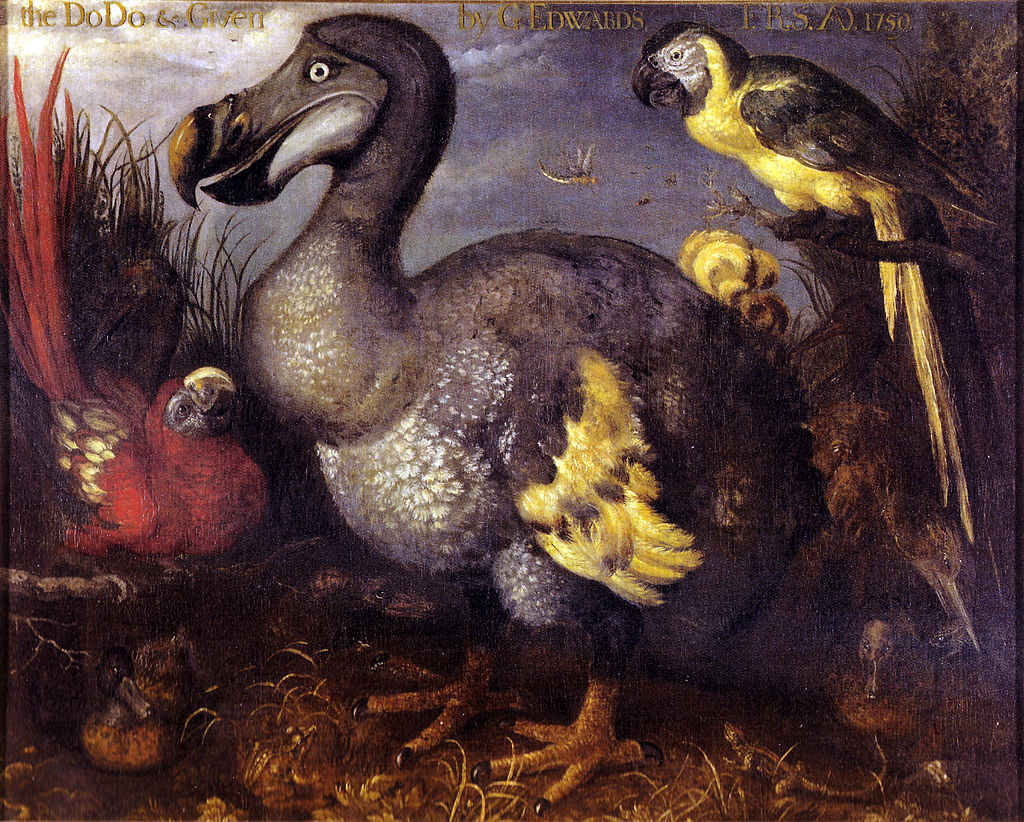
"Edwards' Dodo" by Roelant Savery - http://julianhume.co.uk/wp-content/uploads/2010/07/History-of-the-dodo-Hume.pdf. Licensed under Public Domain via Commons - https://commons.wikimedia.org/wiki/File:Edwards%27_Dodo.jpg#/media/File:Edwards%27_Dodo.jpg

Wonderful painting of “Edwards’ Dodo” by Roelant Savery, 1626. (Image Public Domain)

The common name of this beautiful bird is firmly rooted into our language in a negative way. We have all heard the phrases ‘as dead as a dodo’ or ‘going the way of the dodo’. (One I wasn’t aware of was the insult ‘you dodo’ which is used when calling someone stupid.) The birds even appeared in the wonderful animated Ice Age film, where they are not the brightest creatures, spectacularly falling to their deaths (and one makes a cameo appearance in Ice Age 2).

This iconic bird is the epitome of extinction. The very name is associated with stupidity. And illustrations of dodos do look wonderful, with their oversized bodies and large beak. It shouldn’t be hard to change how something is labelled, should it? I want to try.

The story of the dodo (Raphus cucullatus) begins not when they were first discovered, but way back to when Tyrannosaurs rex stalked the land. An enormous bubble of hot magma rose from the belly of the Earth, and erupted. 66 million years ago, the Earth bled. And it did so for tens of thousands of years. Several eruptions spewed out enough lava to completely cover Britain. Twice. Like layers of crusty, dried blood, the Deccan Traps in India are evidence of this massive eruption. This gigantic underground magma aquifer didn’t stop there. As the continental plates moved, the magma hot spot stayed put. It erupted again around 40 million years ago, and lay there quietly beneath the surface for the next 30 million years or so. In this time the continents had moved a lot, and the hot spot now lay waiting under the African Plate. Sometime around 10 million years ago, the hot spot erupted once more, slowly forming the Mascarene Islands.

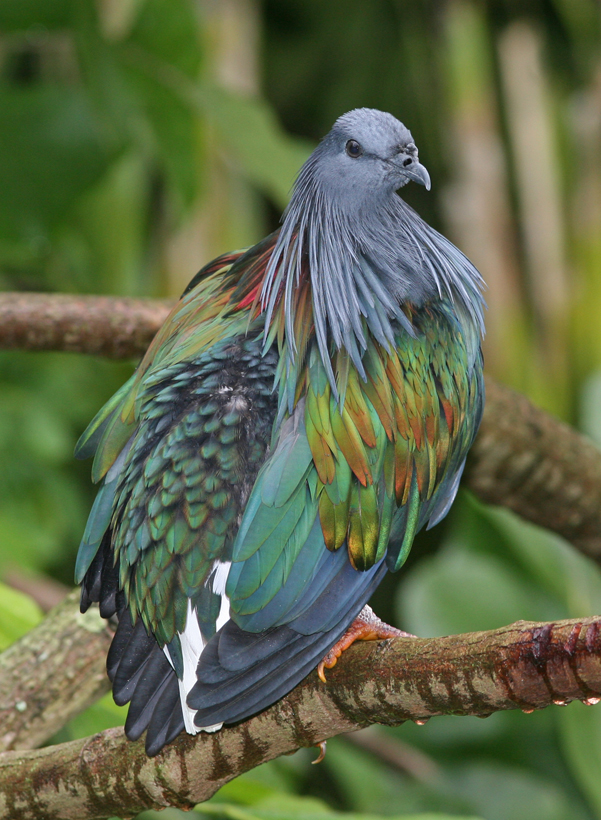
Just east of Madagascar, the small island of Mauritius was born. Seeds and mini-beasts were blown in the wind, some reptiles washed ashore on logs after storms, and birds, flew off track all ending up on this islands. Many would have died. But many did survive. What began as a bleak black igneous rock protruding out of the sea slowly began to change to a vibrant green, full of life. Genetic analysis has shown that the closest living relative to the dodo is the rather handsome Nicobar Pigeon (Caloenas nicobarica). The ancestors of the dodo, and the Nicobar Pigeon, likely ‘island hopped’ (or flew from island to island) eventually ending up on Mauritius.

"Nicobar Pigeon 820" by Tomfriedel - http://www.birdphotos.com - direct link. Licensed under CC BY 3.0 via Commons - https://commons.wikimedia.org/wiki/File:Nicobar_Pigeon_820.jpg#/media/File:Nicobar_Pigeon_820.jpg

The rather stunning Nicobar Pigeon, with incredible irridescent plumage. (Image Public Domain)

Once here, the bird was in an untouched environment. There were no mammals. There were no real predators. The dodo’s ancestor lost the ability to fly, and became adapted to live on the forest floor. It became a bigger bird, with a bigger beak; perfect for picking seeds, fruits, bulbs and roots. One Dutch account records a nest on the ground made of grass, where the dodo laid just one egg. There was no need for this beast to nest high in the trees, for there were no threats. This was no dumb animal. This was an animal perfectly suited to it’s environment.

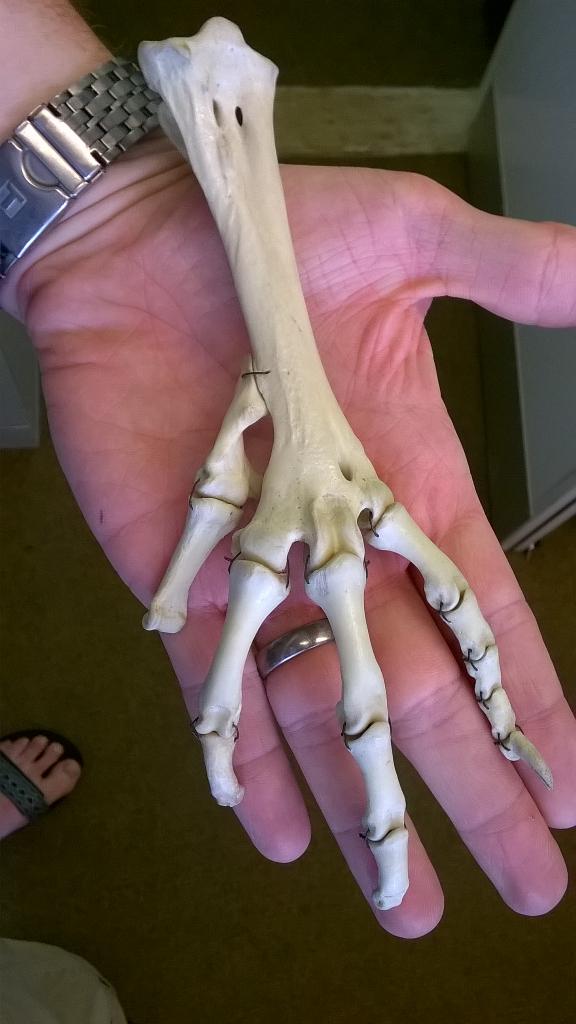
Mauritius was known to the Arab and Portuguese in the 13th to the 16th Centuries. But there are no records of the wildlife and the island was used only sporadically. The Dutch took control and made first contact with the island in 1598. And they made the first recorded sightings of the dodo. Despite being observed for many years, there are very few museum specimens of dodos from that time. A number of live specimens were transported back to Europe and Asia, but no one knows if they survived. A handful of remains from live dodos do exist: a dried head and skeleton foot at the Oxford University Museum of Natural History; a skull in the University of Copenhagen Zoological Museum; and an upper jaw and leg bones in the National Museum, Prague.

The author holidng the articulated skeltal dodo foot from teh Oxford University Museum of Natural History.

The author holding the articulated skeletal dodo foot from the Oxford University Museum of Natural History. This foot is around 400 years old. Beautiful. (Image by author)

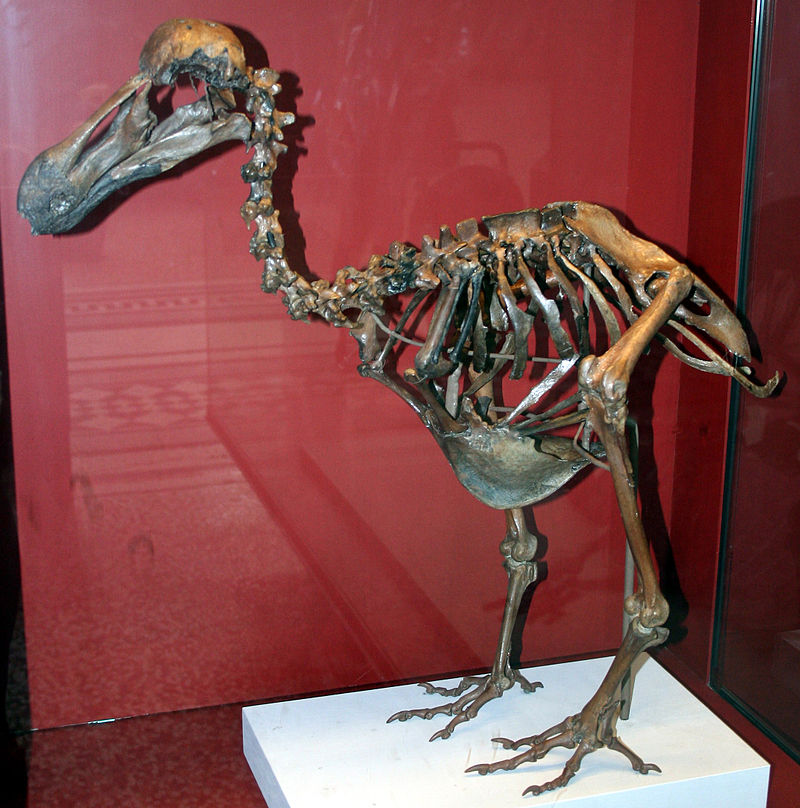
A few skeletons do exist. A unique site on Mauritius, Mare aux Songes is a swamp land that has preserved the bones of over 300 dodos. The skeletons were jumbled and incomplete. Fossils were sent to the Natural History Museum, London which were used to reconstruct a skeleton of the dodo using bones from many individuals. The Museum Naturalis in Leiden also used several fossilised bones to reconstruct a skeleton.

"Dodo-Skeleton Natural History Museum London England" by Heinz-Josef Lücking - Own work. Licensed under CC BY-SA 2.5 via Commons - https://commons.wikimedia.org/wiki/File:Dodo-Skeleton_Natural_History_Museum_London_England.jpg#/media/File:Dodo-Skeleton_Natural_History_Museum_London_England.jpg

A dodo skeleton at the Natural History Museum, London, reconstructed from the fossilised bones of several different individuals. (Image by Heinz-Josef Lücking. Public Domain)

Within just about 100 years of the dodo being first recorded, it was gone. A pretty quick extinction which appears to have happened only after humans arrived. Are we responsible for this wonderful looking bird’s disappearance?

In an indirect way, yes.

Studies at sites in Mauritius suggest that the dodo may have been undergoing some stress before humans arrived. Lots of individuals were killed by flash flooding, or getting tramped in swampy marsh areas. Sadly, they never got the chance to regain their numbers.

Dodos weren’t eaten to extinction. Sailors apparently were not too keen on the dodo meat – one of the early Dutch words for the bird was ‘walghvogel’ meaning ‘tasteless bird’ or ‘sickly bird’. With plenty of other birds and reptiles to feast on, they didn’t need to be fussy. So what happened to this big bird?

The settlers needed land, so they cleared a lot of the ebony and bamboo forests. With around just 100 people, they had created space to grow crops and to live. More ebony was chopped down to be sold. Within an incredibly short time, the home of the dodo was shrinking fast. (Mauritius is a small island, around the size of the Yorkshire Dales.) The killer blow came from the animals the settlers brought with them. More forest was cleared for cattle to graze. Goats and pigs roamed free, quickly having an impact on the botany of the island. Cats and hunting dogs roamed, often killing the local wildlife. And of course, sneaky rats made their way off ships and spread across the island. All of a sudden, the ground dwelling nests of this bird were incredibly vulnerable. The single egg was easily eaten by the rats and pigs, stopping the next generation in its tracks.

There was no time to adapt. No random genes that gave a dodo the edge. It was all too quick.

Many other animals and plants vanished along with the dodo. Several species of birds vanished, including an owl, a heron and a duck; all unique to Mauritius. Two species of giant tortoise and a giant skink also vanished. The destruction of the habitat not only had an effect on the dodo but on the ecosystem as a whole. It would never be the same again.


"View of the Mauritius roadstead - engraving" by Attributed to John Theodore and John Isreal De Bry, accompanying journal of Cornelis Jacob Van Neck[1] - Atlas of Mutual Heritage: page. Licensed under Public Domain via Commons - https://commons.wikimedia.org/wiki/File:View_of_the_Mauritius_roadstead_-_engraving.jpg#/media/File:View_of_the_Mauritius_roadstead_-_engraving.jpg

From the Journal of Cornelis Jacob Van Neck, an engraving of the “View of the Mauritius roadstead” by  John Theodore and John Isreal De Bry in 1601. Note the weird looking bird to the left of the picture. A very early illustration of a live dodo. (Image Public Domain)

Today Mauritius is a beautiful, sunny getaway for those who can afford it. Soft, fine white sand covers the beaches; the cleanest looking sand you ever did see. The crystal clear turquoise water invites all to jump in to splash and paddle. The main attraction for a holiday in Mauritius is to relax and be surrounded by unspoilt beauty. Sadly this is not natural beauty. It is a beauty that suits humans. The pristine beaches have a dark secret: in the early hours of the morning, workers scour the beaches picking up debris that washed up from the night before. 400 years ago Mauritius would have been truly unspoilt, with giant tortoises ambling along the edge of the forests, and dodo birds leaving their large footprints in the sand. What a wonderful sight that must have been.

Personally, I dislike beach holidays. I get itchy feet, bored. I want to be up, exploring ancient sites, or peering under fallen logs. I wonder how many of those sunbathers know that this island was once a unique ecosystem. Do they know that a dodo walked on the very beach they sun themselves on?

The dodo became extinct sometime around 1700, just a hundred years after it was first discovered. We don’t know how long that last individual was alone for. No one heard the last squawk of the dodo.

Written by Jan Freedman (@Jan Freedman)

Further Reading:

Cheke, A. S. (2006). ‘Establishing extinction dates – the curious case of the Dodo Raphus cucullatus and the Red Hen Aphanapteryx bonasia.’ Ibis 148: 155–158. [Abstract only]

Clark, G. (1866). ‘Account of the late Discovery of Dodos’ Remains in the Island of Mauritius.’ Ibis 8 (2): 141–146. [Abstract only]

Hershey, D. R. (2004). ‘The widespread misconception that the tambalacoque absolutely required the dodo for its seeds to germinate.’ Plant Science Bulletin. 50. pp.105-108. [Full article]

Hume, J. P., Martill, D. M., and Dewdney, C. (2004). ‘Palaeobiology: Dutch diaries and the demise of the dodo.’ Nature 429 (6992) [Abstract only]

Hume, J. P. (2012). ‘The Dodo: From extinction to the fossil record.’ Geology Today 28 (4): 147–151. [Abstract only]

Jango, A. (2005), ‘Discovery of isolated dodo bones (Raphus cucullatus(L.) Aes, Columbiformes) from Mauritius cave shelters highlights human predation, with a comment on the status of the family Raphidae Wtmore, 1930.’ Annales de Paleontologie. 91. pp.167-180. [Abstract only]

Kitchener, A. (1993) ‘On the external appearance of the dodo, Raphus cucullatus.’ Archives of Natural History. 20. pp.279-301. [Abstract only]

Kuntner, M., & Agnarsson, I. (2011). ‘Biogeography and diversification of hermit spiders on Indian Ocean islands (Nephilidae: Nephilengys).’ Molecular Phylogenetics and Evolution 59 (2): 477–488. [Abstract only]

Meijer, H. J. M. et al. (2012). ‘Dodo remains from an in situ context from Mare aux Songes, Mauritius.’ Naturwissenschaften. 99 (3): 177–184. [Abstract only]

Peters, N., et al. (2009) ‘Late 17th century AD faunal remains from the Dutch ‘Fort Frederick Hendrick’ at Mauritius (Indian Ocean).’ Archaeofauna. 18. pp.159-184. [Full article]

Pickering, J. (2010) ‘The Oxford Dodo. The sad story of the ungainly bird that became an Oxford icon.’ Oxford University Museum of Natural History. [Book]

Quammen, D. (1996) ‘The Song of the Dodo: Island Biogeography in an Age of Extinction.’ Touchstone, New York. [Book]

Rijsdijk, K. F., et al. (2009) ‘Mid-Holocene vertebrate bone Concentration-Lagerstatte on oceanic island Mauritius provides a window into the ecosystem of the dodo (Raphus cucullatus).’ Quaternary Science Reviews. 28. pp.14-24. [Abstract only]

Shapiro, B. et al. (2002). ‘Flight of the Dodo.’ Science. 295(5560). p.1683.[Full Text]

Posted in Dodo | Tagged , , , , , , , , , , , , , | 20 Comments

A striped wonder

If you haven’t already, take a few minutes to watch this YouTube video. Think about what you are watching. The animal in the grainy film is extinct. When the last member of its species died out, a significant branch of the tree of life was pruned. Yet, it happened so recently that we were able to film the anxious movements of one of the last individuals, confined to a primitive cage in its homeland.

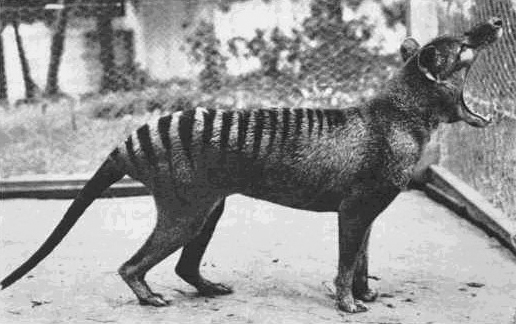
Picture of a Thylacine exhibiting its enormous gape, taken by the Zoologist David Fleay. The animal later bit him on the arse.

Photograph of a Thylacine exhibiting its enormous gape, taken by the Zoologist David Fleay. The animal later bit him on the arse.

One thing we like to stress here on TwilightBeasts, is that extinction is a process, and an ongoing one at that. Look at the Australian island state of Tasmania. Here, until very recently you could find the incomparable Thylacine (Thylacinus cynocephalus), melancholy star of the video above. The Tasmanian tiger, pouched wolf, or one of a dozen other synonyms was the largest and latest surviving marsupial carnivore of modern times. An uncanny mix of tiger-like stripes, stiff kangaroo tail, backwards wombat pouch, and lupine head, the Thylacine was and is an icon. Go to Hobart today and you can drink a Thylacine beer, while writing out your Thylacine postcard and then sticking a Thylacine stamp on it. It’s very changed days from 79 years before, when the last Tassie tiger died alone and exposed in a Hobart zoo. Many people at the time saw it as simply an inevitable side-effect of “progress”. The end of the Thylacine was set in motion by public opinion that it was a menace to the sheep farming essential to Tasmania’s economy. A bounty was placed on its head and the annual payouts paint a bleak picture of overharvesting and a slide into the abyss. Stark as a simple line on a graph.

Bounties paid on Thylacines

Bounties paid on Thylacines. Image from @David_Bressan’s blog

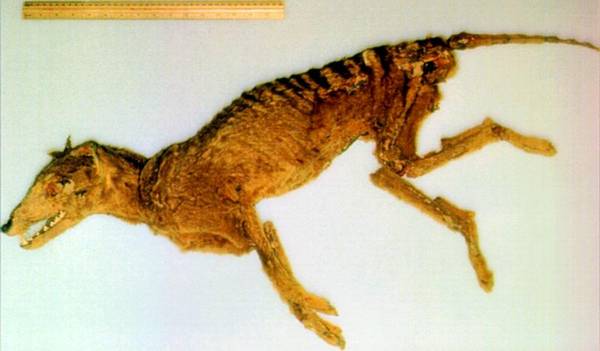
Mummy of a Thylacine, radiocarbon dated to the mid-Holocene, found in the Nullarbor plain

Mummy of a Thylacine, radiocarbon dated to the mid-Holocene, found in the Nullarbor plain, Western Australia (Image by the Western Australian Museum, from here)

It wasn’t always like this. The Thylacine came from a long and distinguished lineage of marsupial carnivores, distantly related to the extinct marsupial lion (Thylacoleo carnifex) and more closely related to the extant Tasmanian Devil (Sarcophilus harrisii). Many fossil Thylacines are also known including the large and imposing Thylacinus potens from near Alice Springs and the Miocene Thylacinus yorkellus. Like many of the megafauna, the Pleistocene was the Thylacine’s salad days. Then it was found not just in Tasmania, but all over Australia, and even in Papua New Guinea (since it is on the marsupial side of Wallace’s and Lydekker’s line, Papua has a fauna dominated by tree kangaroos, wallabies, and possums). The decline of the Thylacine outside Tasmania is generally thought to be due to competition with introduced dingoes (in Australia) and singing dogs (in New Guinea). The relatively recent introduction of the ancestor of the dingo to Australia by aboriginal people came after the formation of the Bass strait, so the dingo never made it to Tasmania. The long history of the Thylacine in mainland Australia is attested to by many examples of aboriginal rock art that show the strikingly striped animal. Perhaps the most potent reminder of the Thylacine’s recent survival in Australia comes from a fantastic find in the caves under the inhospitable Nullarbor plain in West Australia. Here, cavers found a Thylacine mummy, preserved down to the distinctive colours in its fur. And of course here is a good time to get to the question that always comes up when the Tasmanian tiger is discussed: is it still around? People are still reporting sightings of Thylacines in Tasmania (and more surprisingly, in mainland Australia too). Some of the sightings are undoubtedly mangy foxes and feral dogs, misidentified wild animals seen for a fraction of a second by unreliable witnesses. However, there are some sightings that cannot be easily dismissed. Sightings by trained park rangers, professional biologists, and other trustworthy individuals who are adamant that they know what they saw. Growing up beside Loch Ness means I am not easily convinced by what people think they see, but part of me longs for the Thylacine to have made it. Hiding from the sight of man, who was so instrumental in its decimation, surviving in the wild and untravelled bush. Certainly if the Thylacine were to be rediscovered it would be the zoological event of the century. But I think it may all just be so much wishful thinking. Our collective guilty conscience over the wanton destruction of this beautiful and unique species.

Bagged_thylacine

Mr. Weaver and his bagged Thylacine (1869). Public domain image.

Written by Ross Barnett (@DeepFriedDNA)

Further Reading:

The Thylacine Museum http://www.naturalworlds.org/thylacine/

Magnificent Survivor http://www.naturalworlds.org/tigerbook/

Krajewski, C., A. C. Driskell, P. R. Baverstock, and M. J. Braun. “Phylogenetic-Relationships of the Thylacine (Mammalia, Thylacinidae) among Dasyuroid Marsupials – Evidence from Cytochrome-B DNA-Sequences.” Proceedings of the Royal Society of London Series B-Biological Sciences 250, no. 1327 (Oct 22 1992): 19-27.[Abstract]

Miller, W., D. I. Drautz, J. E. Janecka, A. M. Lesk, A. Ratan, L. P. Tomsho, M. Packard, et al. “The Mitochondrial Genome Sequence of the Tasmanian Tiger (Thylacinus cynocephalus).” Genome Res 19, no. 2 (Feb 2009): 213-20.[Full Text]

van Deusen, H. M. “First New Guinea Record of Thylacinus.” Journal of Mammalogy 44, no. 2 (1963): 279-80.[Full Text]

Yates, A. M. “New Craniodental Remains of Thylacinus Potens (Dasyuromorphia: Thylacinidae), a Carnivorous Marsupial from the Late Miocene Alcoota Local Fauna of Central Australia.” PeerJ 2 (2014): e547.[Full Text]

Yates, A. M. “Thylacinus (Marsupialia: Thylacinidae) from the Mio-Pliocene Boundary and the Diversity of Late Neogene Thylacinids in Australia.” PeerJ 3 (2015): e931.[Full Text]

Posted in Thylacine | Tagged , , , , , , , , , , | 18 Comments

Seeking redemption

Extinction, they say, is forever. There’s the distressing aspect of poaching and trophy hunting (can you tell the difference any more? No, me neither) as highlighted by the senseless, savage deaths of rhinos, elephants, lions, tigers and many more creatures.  The one good thing about the senseless death of Oxford University’s behavioural study lion, Cecil, is that people are engaging in debate on conservation, environment and how to stop wanton slaughter. These animals are often already endangered because of their environments being either destroyed by human commercial activities or by the effects of climate change. The principle of ‘big game hunting’, to satisfy some sickness within the human ego by killing large animals you won’t ever eat, is bad enough – to kill rare creatures for pseudo-medicine is even worse.

These are the visible indications of pending extinction. They are preventable.  You, gentle reader, are part of the solution, as we all are. But sometimes, extinction means creatures that seemed so common-place leaving us unnoticed, on silent paws or hooves to the realm of books, photographs and memory.  This has been the case a couple of weeks ago, when the last of the descendants of the Conquistadores’ horses, the Abaco Barb, died unnoticed. There were so many of them, once, that surely they couldn’t ever become extinct… could they?

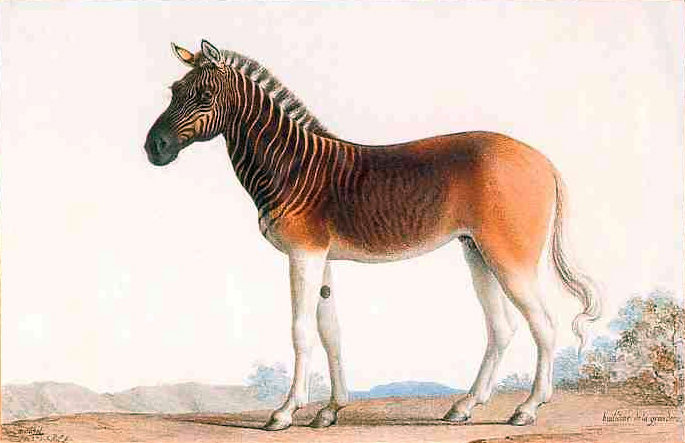
Not so long ago, huge herds of stunning-looking equids roamed the verdant lands of South Africa. Their name was Equus quagga quagga – the Quagga zebra, of South Africa. They are extinct, like so many now, because of human stupidity and greed. In appearance they were somewhere between a tarpan-type horse and a zebra, with brown striped fronts, tan or brown bodies and creamy-white legs, with striking brown and white striped hogged manes and a dorsal stripe right down their backs  – a sure sign of ancient bloodlines in any member of the horse family. Their tails were more horse-like than the little tassel of the donkey, although DNA studies in the 80s have shown they were a sub-species of the Plains Zebra.

"Quagga" by Nicolas Marechal - PD painting. Licensed under Public Domain via Commons - https://commons.wikimedia.org/wiki/File:Quagga.jpg#/media/File:Quagga.jpg

A beautiful painting of a Quagga by Nicolas Marechal. This proud beast was based on the stallion in Louis XVIs menagerie in 1793. (Image Public Domain)

Chronologically, the Quagga is very much a Pleistocene creature, made by changing climates and dividing glaciers. They likely gained their beautiful tawny colouring as a response to living in the drier part of Africa during the cold pulses of the Ice Age, around 120,000 years ago.  But climates changed, and South Africa became a region of varied vegetation and dramatically beautiful landscapes through the Holocene. Europeans who colonized South Africa during the 18th and 19th centuries exploited that beautiful country as its wealth of natural resources was seemingly endless. From diamond mines to big game hunting – everything made money, and money made power. The settlers had little care for the policies of conservation, and slaughtered the easiest targets. The Quagga was hunted unmercifully for meat, leather and trophies – the era of the Great White Hunter who killed because he/she was master of all they surveyed and could do whatever they liked.  By the time 19th century zoologists realised the herds were all but gone, and the animals needed protection, it was too late.

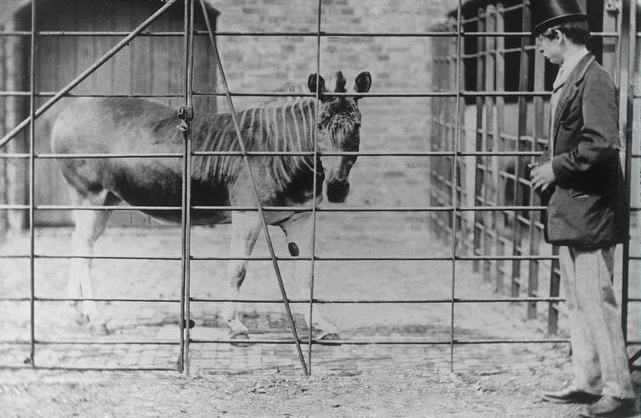
The remaining captured animals which had lived solitary lives in zoos were the last of their kind.  Their beautiful refined heads stare at us, mournfully, from Victorian photographs taken in zoos. I hate the pain in those photos – these animals should have been with companions – a breeding programme would have resulted in the preservation of the animals. Confining any equid to a solitary life behind bars is hellish for a herd animal. At any rate, the extinction clock was running extra fast.

In 1872 the London Zoo mare died.

In 1883, the last of Equus quagga quagga, a little aged mare, died in Amsterdam’s Natura Artis Magistra Zoo.

With her death, an entire sub-species perished.

Photo from ARKive of the Quagga (Equus quagga quagga) - http://www.arkive.org/quagga/equus-quagga-quagga/image-G1861.html

A rather poignant photogrpah of the female Quagge (Equus quagga quagga) at London Zoo taken in 1864. The rather well dressed zoo keeper looks on. (Image by Frank Haes. Public Domain)

The bloodline had been crossed occasionally with horses to create a hybrid.  George Douglas, Earl of Morton was a keen observer of what we would now call environmentalism and conservation, although we would balk at many of his methods today, he was a man of his time and place.  In 1821 he tried to preserve the Quagga by crossing a chestnut Arabian mare with a Quagga stallion. The offspring was a mare, and her offspring had the tawny stripes of its grandsire. This was so exciting for its time that Charles Darwin wrote of Morton’s mare in his 1844 notes which were the foundation of ‘Origin of the Species’ that “when the dam of one species has borne offspring to the male of another species, her succeeding offspring are sometimes stained (as in Lord Morton’s mare by the quagga, wonderful as the fact is) by this first cross”. He considered this as an indication of telegony, a classical principle of male inheritance being carried down bloodlines. We now know it was all about recessive genes and alleles.

The story possibly should end there, but it doesn’t. For every big-game hunter swaggering with his gun,there’s an idealistic science sister or mister who wants to make things right. In 1984, the first DNA sequences were analysed, taken from 19th century taxidermied Quagga specimens. The analysis of Quagga tissue, was ongoing through the later part of the 1980s and is worth a mention in this story as it effectively brought the infant science of palaeogenomics to the public eye – and the writers imagination. It created quite a storm among biologists with the realisation that DNA from extinct species could be fully charted, and was one of the inspirations for Michael Crichton’s famous ‘Jurassic Park’ book. What if we could bring them back….?

"Quagga exhibit Leiden" by Konstantin Kirilov - Own work. Licensed under CC BY-SA 3.0 via Commons - https://commons.wikimedia.org/wiki/File:Quagga_exhibit_Leiden.jpg#/media/File:Quagga_exhibit_Leiden.jpg

A taxidermy Quagga. The last known Quagga alive. On display at Leiden Museum Naturalis. Note the mounted Great Auk in the left of the photo. A strong message of extinction. And our part in it. (Image by Konstantin Kirilov. Public Domain)

As you’ll be aware if you follow Twilight Beasts on Twitter, rewilding, recreating and resurrecting species is something we talk a lot (and I mean a lot!) about!. The late Reinhold Rau, a natural historian and expert taxidermist, did a lot more than talk. He took the knowledge of the relationship between the modern Plains Zebra and decided to ‘breed back’ the Quagga through genetic selection. Could the black stripes of Equus quagga /burchelli be bred out to reintroduce the tawny amber colouring of the extinct Quagga? And if so, could there be a chance that humans could restore the wild equines of the Cape plains?

In 1987, 18 zebra mares were selected from a herd and brought to a conservation farm near Robertson, in the Cape. They were selectively bred to restore the colouring of the golden, partial striped extinct Ice Age deme.  This was the beginning of the Quagga Project.  It’s an exciting idea, and appears to have been successful, and the resultant animal is quite a tourist attraction, and often referred to as Rau’s Quagga. The scientific debate now, however is if a zebra is more than the colour of its stripes. Were there other differences which made E. quagga quagga different from its black striped relatives? The restored population of animals have different DNA than the extinct creatures, and perhaps are a sub-species themselves, unique from either black or brown striped ancestors.

Politically, there have been tumultuous changes in South Africa, as it changed from Boer colonial control into the sickness of apartheid and finally, democracy and self-determination under the late Nelson Mandela. There is a great awareness of the losses which colonialism and exploitation created.  This is what the Truth and Reconciliation Committee of South Africa was created for, in 1994, to oversee the restoration of as many cultural motifs as is possible. While we, as Europeans may love the creatures of bush and veldt, they are not ‘ours’to hunt, or exploit – the landscape and its animals are the heartbeat of the people of Africa; their heritage.  While the taxonomic debate continues if Rau’s Quagga is something old or new, those wild creatures represent the better, more enlightened part of humanity, the scientists who do peaceful battle every day, with microscope and petri dish, against those who think wanton killing of  the worlds wildlife is their due.

Written by Rena Maguire (@JustRena)

Further Reading:

The Quagga Project available here

The extinction of Nunki, the last Abaco Barb.  Available here.

Caro, T., Izzo, A., Reiner Jr, R. C., Walker, H., & Stankowich, T. (2014). ‘The function of zebra stripes’ Nature communications, 5. [Abstract only]

Darwin, F. (1909). The foundations of the origin of species: Two essays written in 1842 and 1844. Cambridge: Cambridge Univ. Press. pp 108. [Book]

Fletcher, A. L. (2014). ‘Bio-Identities: Cloning the Recently Extinct’. In Fletcher, A (ed) Mendel’s Ark. Amsterdam: Springer Netherlands. pp 67-88. [Book]

Harley, E. H., Lardner, C., Gregor, M., Wooding, B., & Knight, M. H. (2010). ‘The restoration of the quagga; 24 years of selective breeding.’ In Restoration of Endangered and Extinct Animals. Poznan: Poznan University of Life Sciences Press. [Book]

Heywood, P. (2013). ‘The quagga and science: what does the future hold for this extinct zebra?’  Perspectives in biology and medicine. 56.1. pp 53-64. [Abstract only]

Higuchi, R., Bowman, B., Freiberger, M., Ryder, O. A., & Wilson, A. C. (1984). ‘DNA sequences from the quagga, an extinct member of the horse family’. Nature 312. pp282-284. [Abstract only]

Higuchi, R. G., Wrischnik, L. A., Oakes, E., George, M., Tong, B., & Wilson, A. C. (1987). ‘Mitochondrial DNA of the extinct quagga: relatedness and extent of postmortem change’. Journal of Molecular Evolution.  25.  pp283-287. [Full article]

Klein, R. G., & Cruz-Uribe, K. (1999). ‘Craniometry of the genus Equus and the taxonomic affinities of the extinct South African quagga.’  South African Journal of Science 95. pp 81-86. [Abstract only]

Leonard, J. A., Rohland, N., Glaberman, S., Fleischer, R. C., Caccone, A., & Hofreiter, M. (2005). ‘A rapid loss of stripes: the evolutionary history of the extinct quagga’. Biology Letters 1. pp291-295. [Full article]

Lowenstein, J. M., & Ryder, O. A. (1985). ‘Immunological systematics of the extinct quagga (Equidae)’. Cellular and Molecular Life Sciences 41. pp.1192-1193. [Full article]

Martinelli, L., Oksanen, M., & Siipi, H. (2014.)  ‘De-extinction: a novel and remarkable case of bio-objectification’. Croatian Medical Journal. 55.4. pp 423. [Full article]

Morton, E. O. (1821).  ‘A communication of a singular fact in natural history’. Philos Trans R Soc London. 111: pp.20–22. [Full article]

Orlando, L., Metcalf, J. L., Alberdi, M. T., Telles-Antunes, M., Bonjean, D., Otte, M & Cooper, A. (2009). ‘Revising the recent evolutionary history of equids using ancient DNA.’ Proceedings of the National Academy of Sciences 106. pp 21754-21759. [Full article]

Seguin-Orlando, A., Schubert, M., Clary, J., Stagegaard, J., Alberdi, M. T., Prado, J. L., & Orlando, L. A. A. (2013). ‘Ligation bias in illumina next-generation DNA libraries: implications for sequencing ancient genomes’  PLoS One. [Full article]

Posted in Quagga | Tagged , , , , , | 8 Comments

Did humans wipe out the megafauna?

The wonderful thing about writing for Twilight Beasts is the chance to bring back some truly incredible creatures. Here we are allowed to be taken back to a time when the largest land lizard ever walked the Earth: Megalania. We can feel the heat of the Australian sun, as we watch this oversized komodo dragon stalk a marsupial the size of a VW Beetle, the wonderful Diprotodon. Or perhaps we enjoy imagining we are sitting on the edge of a rich lagoon, with enormous tank-like Glyptodon taking a drink, unaware of a pride of Smilodon in the bushes. Or for those who like a more chilly time, step back onto the cold Steppes of Eurasia to see herds of Mammoths lolloping across the grassy plains, as a lone woolly rhinoceros munches quietly on the low shrubs.

A quick hop across the globe just a few tens of thousands of years ago, and there would have been some incredible animals to see. The world as we know it would be completely different. Strange, but so beautiful. Los Angeles would have been an open landscape with Mastodons and dire wolves. The swampy marsh lands of Florida home to many giants, like Glyptodonts and giant sloths. Musk ox and Bison would have shuffled slowly through icy winds in Britain.

And then something happened. These beasts vanished.

"Ice age fauna of northern Spain - Mauricio Antón" by Mauricio Antón - http://www.plosbiology.org/article/slideshow.action?uri=info:doi/10.1371/journal.pbio.0060099&imageURI=info:doi/10.1371/journal.pbio.0060099.g001, from C. Sedwick (1 April 2008). "What Killed the Woolly Mammoth?". PLoS Biology 6 (4): e99. DOI:10.1371/journal.pbio.0060099.. Licensed under CC BY 2.5 via Wikimedia Commons - https://commons.wikimedia.org/wiki/File:Ice_age_fauna_of_northern_Spain_-_Mauricio_Ant%C3%B3n.jpg#/media/File:Ice_age_fauna_of_northern_Spain_-_Mauricio_Ant%C3%B3n.jpg

A typical scene in Late Pleistocene Europe around 30,000 years ago. (Image by Mauricio Antón. Public Domain)

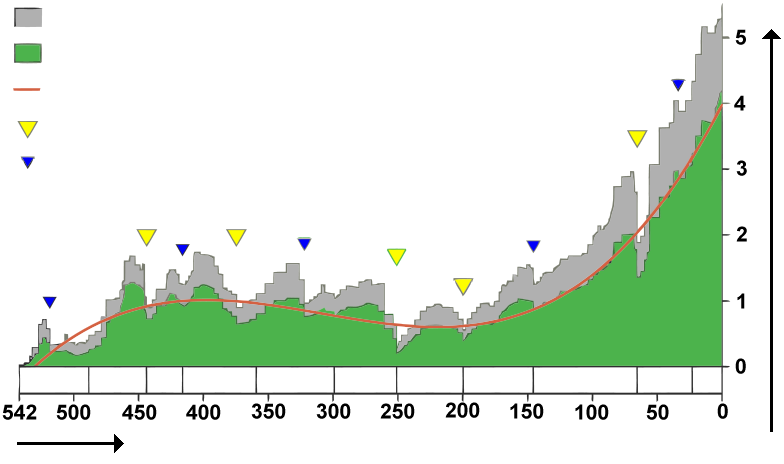
Giants across the globe disappeared forever. These wonderful creatures were just a whisker away from the present day. This was the great Pleistocene megafaunal extinction, which some scientists are beginning to call the 6th mass extinction. (Megafauna are animals weighing over 44kg, so something the size of a big Alsatian is classed as megafauna.) Extinctions have happened many times in the 4 billion years of life on Earth. Species come and go. Even mass extinctions happen. These are bigger, and more deadly than your average extinction.

A mass extinction is an event which shakes the foundations of ecosystems across the entire planet. The end of the non-avian dinosaurs is one of the more familiar mass extinction events, where species from across different Phyla died out. At the end of the Permian Era, there was an enormous mass extinction which wiped out many plants, vertebrates and invertebrates. One of the saddest losses in this extinction was the enigmatic group of arthropods: the Trilobites. Extinctions can not only wipe out species, but also whole Classes of animals.

"Phanerozoic biodiversity blank 01" by Philcha (talk) 13:39, 10 January 2009 (UTC) - Image:Phanerozoic Biodiversity.svg by Albert Mestre. Licensed under CC BY-SA 3.0 via Wikipedia - https://en.wikipedia.org/wiki/File:Phanerozoic_biodiversity_blank_01.png#/media/File:Phanerozoic_biodiversity_blank_01.png

From the beginning of the ‘big bang of animals’, the five mass extinction events (shown with the inverted yellow triangles). (Image by Albert Mestre. Public Domain).

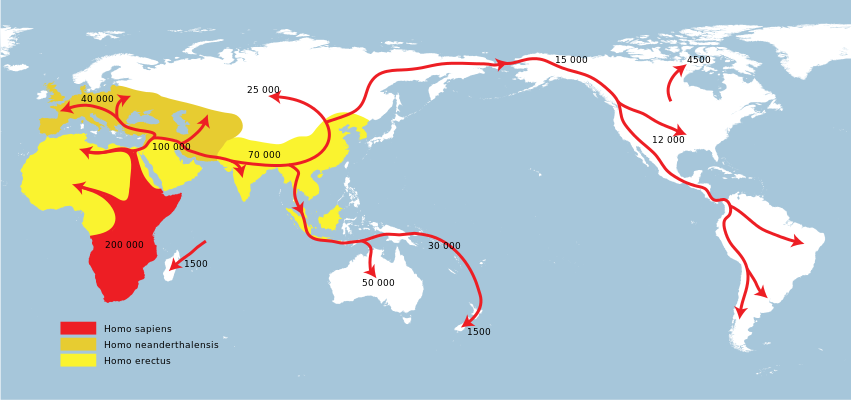
The extinction of the Pleistocene megafauna was a little different. There was another variable thrown into the mix. A predator that spread across the globe to colonise almost every continent- Homo sapiens.

Humans as the main driver for megafaunal extinction was advocated by the late Paul Martin for over 5 decades. Martin saw correlation in the extinction of megafauna with the arrival of humans, and proposed his theory of ‘Overkill’. Australian giants like the Diprotodon and Giant Echidna vanished around 50,000-55,000 years ago – around the same time that the earliest evidence of human arrival. The enormous Megatherium and other American giants vanished around 12,000-10,000 years ago – again at around the same time we find evidence for human arrival. Martin proposed quite a picture of humans sweeping across the globe, slaughtering all the mega-fauna in their path.

Some scientists disagreed that little humans could wipe out entire species, genera even, in such a short space of time. Coinciding with the arrival of humans in Australia, American, and even parts of Europe were dramatic changes in the climate. (Indeed these climatic changes may have allowed humans to travel as far as they did so quickly). With changing environments comes extinction of those not able to adapt quickly enough. And a lot of the megafauna were well adapted to their little niche and couldn’t adapt fast enough. For decades there have been two schools of thought: overkill and climate.

From analysing the Oxygen isotope ratios recorded in the foram tests, we can see many warm and cold stages throughout the past. (Image by Hannes Grobe Public Domain)

The dramatic climatic variations during the Late Pleistocene. From extreme warm periods (interglacials) to much colder periods (glacials). (Image by Hannes Grobe. Public Domain)

Lewis Bartlett and colleagues have recently published their latest research in Ecography which may have the answer. In a prehistoric case of ‘who dun it’, the team have examined the main culprits in incredible detail. They wanted to see if there was a correlation between megafaunal extinction and climate and /or humans. They started by looking at 14 regions across the world and the megafauna that went extinct in these regions. This alone was pretty alarming: 54 out of the 69 Genera of megafauna in South America have become extinct.

Then the hard work began. For each region they gathered an enormous amount of data. Starting at 80,000 years ago, they trawled through the published articles for the latest radiocarbon dates of megafauna. They reconstructed the climate of the past based on latest research in orbital variations, atmospheric gas concentrations, ice sheet extent and sea level change. The arrival of humans was more tricky to pin point in some regions than in others, so the team produced 8 different scenarios based on dates in the literature. (For some regions this date stayed the same for each scenario as the dates were well researched. For others, like Australia and Asia, the dates varied.)

Here’s the sexy science bit. By choosing extinction dates randomly from the publications, they generated 1000 different extinction scenarios. They tested these with different variables to show the results were not just randomly generated. The results were pretty cool. Each of the 1000 scenarios gave a probability. The variable with the highest confidence in the probability was the ‘human arrival and climate lagged’ variable. In short, the simulations with three well researched sets of data across the globe show a strong correlation with the arrival of humans and the extinction of the megafauna. The ‘climate lagged’ is where the climate changed shortly after the arrival of humans, and the researchers acknowledge that climate would have played a part too.

"Spreading homo sapiens la" by NordNordWest - File:Spreading homo sapiens ru.svg by Urutseg. Licensed under Public Domain via Wikimedia Commons - https://commons.wikimedia.org/wiki/File:Spreading_homo_sapiens_la.svg#/media/File:Spreading_homo_sapiens_la.svg

The global spread of Homo sapiens. Compared to other hominin species, humans managed to colonise almost every continent. (Image by NordNordWest. Public Domain)

Is this the nail on the coffin for the debate? Probably not. This is a cool piece of research as it looked at a number of variables, with an enormous amount of data published. The future will bring even more detailed analysis to the table, and the results may well flip. What we do know is that humans did arrive and shortly after many of the big giants became extinct. I personally doubt it was solely down to Martin’s ‘overkill’, but a combination of hunting, climate change, and human made environmental changes.

We admire these Twilight Beasts for their magnificent size (like the iconic mammoth), or their killer instinct (think of Smilodon). Sadly, I think we admire them more because they are gone. Often we forget how beautiful the animals that are still with us are. The splendour of a pride of lions. The elegance of a hippopotamus swimming. The majesty of an eagle soaring high above. We also forget that these amazing animals are survivors of the Pleistocene. Let’s make sure no more megafauna go extinct.

Written by Jan Freedman (@JanFreedman)

Further reading:

Bartlett , L. J., et al. (2015). ‘Robustness despite uncertainty: regional climate data reveal the dominant role of humans in explaining global extinctions of Late Quaternary megafauna.’ Ecography. 38. pp.1-10. [Abstract only]

Helgen, K. M, et al, (2012), ‘Twentieth century occurrence of the Long-Beaked Echidna Zaglossus bruijnii in the Kimberly region of Australia’, ZooKeys, 255, 103-132. [Full article]

Jacobi, R. M. et al. (2009), ‘Revised radiocarbon ages on woolly rhinoceros (Coelodonta antiquitatis) from western central Scotland: significance for timing the extinction of woolly rhinoceros in Britain and the onset on the LGM in Central Scotland’, Quaternary Science Reviews. 28. 2551-56. [Abstract only]

Markoca, A. K. et al. (2013), ‘New data on changes in the European distribution of the mammoth and the woolly rhinoceros during the second half of the Late Pleistocene and the early Holocene’, Quaternary International. 292. 4-14. [Full article]

Martin, P. S. (2005), ‘Twilight of the Mammoths: Ice Age Extinctions and the Rewilding of America’, University of California Press. [Book]

Price, G. (2012), ‘Plio-Pleistocene climate and faunal change in central eastern Australia.’ Episodes-Newsmagazine of the InternationalUnion of Geological Sciences 35. 1  160.

Stuart, A. J. et al. (2002), ‘The latest woolly mammoths (Mammuthus primigenius Blumenbach) in Europe and Asia: a review of the current evidence’, Quaternary Science Reviews. 21. 1559-69. [Full article]

Stuart, A. (2005), ‘The extinction of woolly mammoth (Mammuthus primigenius) and straight-tusked elephant (Palaeoloxodon antiquus) in Europe’, Quaternary International. 126. 171-7. [Abstract only]

Stuart, A.J., Kosintsev, P.A., Higham, T.F.G., Lister, A.M., (2004). ‘Pleistocene to Holocene extinction dynamics in giant deer and woolly mammoth’. Nature 431. 684-689. [Abstract only]

Posted in Extinction | Tagged , , , , , , , , , , , , , | 8 Comments

The silent hunter

“Those who have never seen a leopard under favourable conditions in his natural surroundings can have no conception of the grace of movement, and beauty of colouring, of this the most graceful and the most beautiful of all animals in our Indian jungles.”  (Jim Corbett. 1944)

Leopards are beautiful creatures. Their sleek, slender bodies move with an elegance that is matched only by the most skilled ballet dancer. They appear to move effortlessly, with their big soft paws almost gliding from the ground to the air with each step. They move with grace. And in pure silence. All felids are supreme ambush predators. Leopards are the top cat.

I was inspired to write this post by an intriguing enquiry a couple of years ago. Working in a museum, I am lucky to have fascinating specimens brought in for identification. And they are wonderful fun as I never know what I am going to get. Even if it is something familiar, or ‘common’, for the person who has brought it in, it is special: they found it. Nothing is greater than sharing the excitement with a member of the public and their discovery.

This particular enquiry was extremely exciting, as it had hints of being a Pleistocene leopard tooth. Working with the enquirer, and Jane Evans at the British Geological Survey, we did some chemical analysis to find out where it was from. I won’t spoil the surprise. You can read the full article here for free.

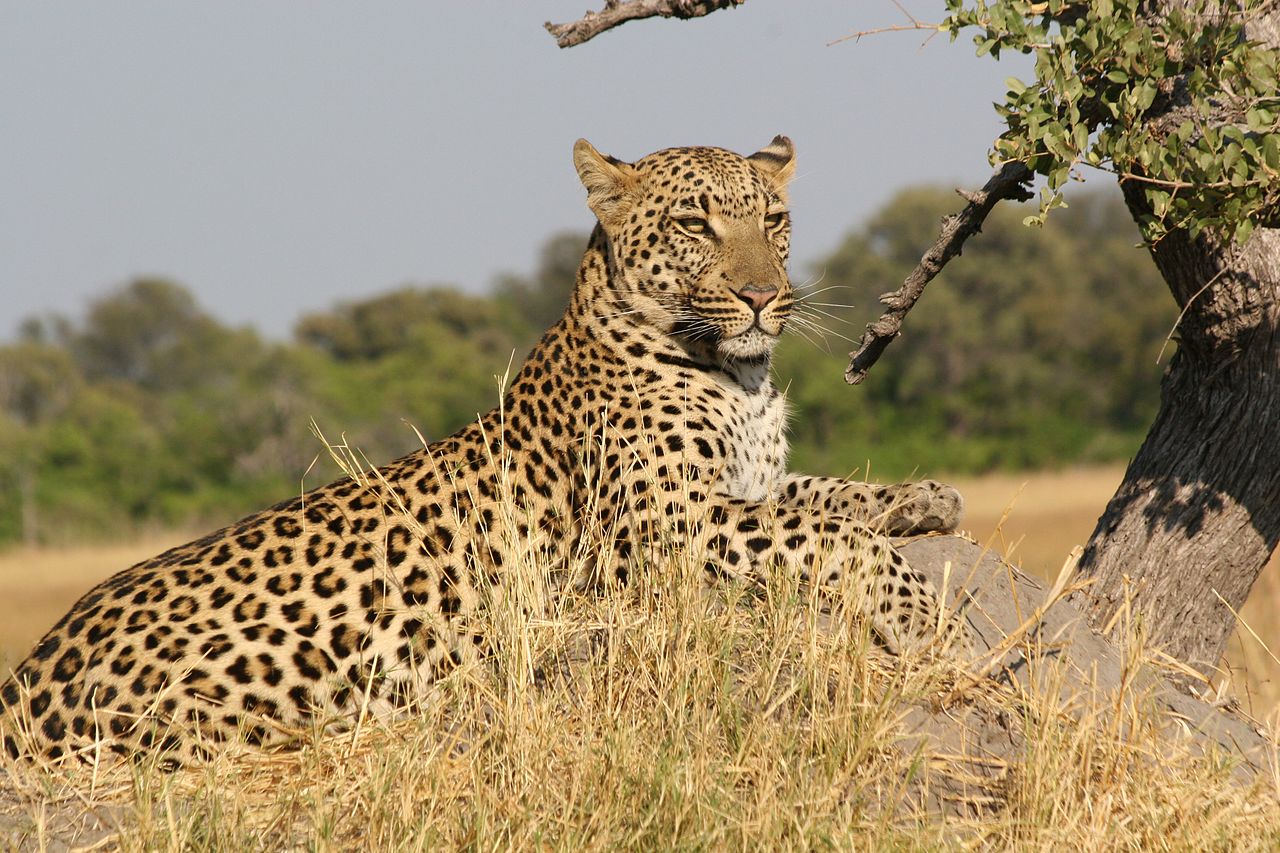
A magnificent, proud African leopard (Panth pardus) (Image Public Domain)

A magnificent, proud African leopard (Panthera pardus pardus) casually keeping an eye out in the Moremi Game Reserve. (Image Public Domain)

Today leopards have a fairly wide-range across the African and Asian continents. With ten sub-species, this magnificent cat is endangered through habitat destruction and human hunting. Each individual sub-species is just as beautiful as the next. The gloriously proud African leopard (Panthera pardus pardus) is more familiar to most of us. An expert stalker in the long dry grass of the scrub, this silent hunter has a fairly opportunistic appetite from rodents to birds, to bigger antelopes. The critically endangered Javan leopard (Panthera pardus melas) is found only on the island of Java. Some individuals of the Javan leopard have been seen with a pure black coat, similar to a jaguar.

Illustration "Leopard distribution2" by Tommyknocker - Originally created and uploaded to the English Wikipeda by Tommyknocker. Licensed under Public Domain via Wikimedia Commons - https://commons.wikimedia.org/wiki/File:Leopard_distribution2.gif#/media/File:Leopard_distribution2.gif

Map of Africa and Asia illustrating the range of teh leopard. (Image Public Domain)

During the Late Pleistocene, these slender felines were very well established across most of Europe. With over 70 European sites including Germany, Italy, France, Switzerland and Bosnia, yielding remains of the Pleistocene leopard, Panthera pardus spelaea, this was a successful beast.

The leopard has a long history in Europe, and it appears that a few sub-species migrated in and were replaced by later groups. Around 600,000 years ago an enigmatic leopard that lived during the warm interglacial, P. p. sickenbergi, is known from sites in Germany, France and the Czech Republic. The fossil record of this leopard is not great, with a few skull remains and a scatter of postcranial remains. Not a great sample, but distinct enough to be recognised as a sub-species. A second migration of these cats from Africa of another sub-species, P. p. antiqua appears around 300,000 years ago during another warm phase. These guys radiated out across Europe around 160,000 years ago taking advantage of the warming climate.

Our beast, P. p. spelaea appears in Europe around 120,000 years ago, and was a very successful animal. Spread so far across Europe it was adapted to a variety of environments. From the Mammoth Steppe to mixed forests to treeless mountains, the cave leopard was a survivor. It’s extinction in Europe was likely due to the extreme climatic changes at the end of the Pleistocene, which pushed the leopard into smaller pockets. It may be that these pockets were already occupied by humans, so additional competition was too much on these highly stressed populations.

We know humans saw cave leopards. They have been recorded in the stunning cave art in the Chauvet Cave, in southern France.

"20,000 Year Old Cave Paintings Hyena" by Carla Hufstedler - originally posted to Flickr as 20,000 Year Old Cave Paintings: Hyena. Licensed under CC BY-SA 2.0 via Wikimedia Commons - https://commons.wikimedia.org/wiki/File:20,000_Year_Old_Cave_Paintings_Hyena.png#/media/File:20,000_Year_Old_Cave_Paintings_Hyena.png

Here, in this painting which is around 30,000 years old, is a typical outline of a hyena, and underneath a smaller carnivore: the cave leopard. (Image by Carla Hufstedler. Public Domain)

But what about Britain? If leopards were so widely distributed across Europe, surely they must have been present in Britain?

There have been two confirmed localities where a leopard tooth at each has been found: Bleadon in Somerset, and Pontnewydd Cave, in South Wales. Intriguingly, an article written in 1940 mentions 5 other sites where leopards have been found: Newbon, Essex; Spritsail Tor, Gower; Banwell, Somerset; Hutton/Sandford Hill, Somerset; and Cresswell Crags, Derbyshire. The specimen from Banwell has been classed as actually coming from Bleadon. The whereabouts of the specimens from the other four sites are unknown, so should be treated with caution.

The distribrution of recorded Late Pleistocene leopard specimens from Britain. (Image from Freedman & Evans, 2015)

The distribrution of recorded Late Pleistocene leopard specimens from Britain. The two confirmed specimens are from Bleadon, Somerset (the green leopard) and Ponynewydd Cave, Wales (the dark ornge leopard). The remaining specimens remain tentative. (Image from Freedman & Evans, 2015)

Late Pleistocene leopards appear to have been fairly rare in British records. This could be due to the enormous glacier that covered much of Great Britain around 20,000 years ago, pushing its way as far south as the Thames. Carnivores are not as numerous as herbivores, so it may be that the cave leopard in Britain was just not very abundant. There may be another reason.

Examining the chemicals in the teeth of the British sabre tooth cat, Homotherium latidens, two researchers suggest that the chemical signature doesn’t actually correspond with the British record. The only explanation: the teeth were brought into Britain from humans travelling from Europe. Perhaps humans were keeping teeth of this incredible sabre-tooth as trophies. Could the same be true for leopards? Possibly. With abundant European sites, it may be that the British leopards are not actually British. Future work on these specimens will shed more light.

I like to imagine this silent hunter, crouched, hiding unseen by other animals and humans. A time when forest tundra covered much of Europe instead of concrete cities. A time when this magnificent feline was at its height of sucess, and sprung into action bringing down its next meal.

Written by Jan Freedman (@JanFreedman)

Further reading:

Buckland, W. (1823), ‘Reliquiae Diluvianae’, John Murray, London. [Book]

Corbett, J. (1944), ‘Man-eaters of Kumaon.’ Oxford University Press. [Book]

Currant, A. P. (1984), ‘The Mammalian Remains’. In: Green, H. S. (Ed). Pontnewydd Cave. A Lower Palaeolithic hominid site in Wales. National Museum of Wales, Cardiff. pp.171-180. [Book]

Currant, A, & Jacobi, R. (2001). ‘A formal mammalian biostratigraphy for the Late Pleistocene of Britain’ Quaternary Science Reviews. 20. pp.1707-1716. [Full article]

Currant, A. (2004), ‘The Quaternary mammal collections at the Somerset County Museum in Taunton’, In: Schreeve, D. C. (Ed) The Quaternary Mammals of Southern and Eastern England. Field Guide. pp.101-109. [Book]

Diedrich, C, G. (2013), ‘Late Pleistocene leopards across Europe – northernmost European German population, highest elevated records in the Swiss Alps, complete skeletons in the Bosnic Herzegowina Dinairds and comparison to the Ice Age Cave Art’, Quaternary Science Reviews. 76. pp. 167-193. [Abstract only]

Freedman, J. & Evans, J. (2015), ‘Working with the Public: How an unusual museum enquiry turned into travels through space and time.’ Open Quaternary. 1(8). pp.1-14. [Full article]

McFarlane, D A. & Lundberg, J. (2013), ‘On the occurrence of the scimitat-tooth cat, Homotherium latidens (Carnivora; Felidae), at Kent’s Cavern, England’ Journal of Archaeological Science. 40. pp.1629-1635. [Full article]

Nowell, K. & Jackson, P. (1996) ‘Wild Cats: Status Survey and Conservation Action Plan.’ IUCN/SSC Cat Specialist Group. IUCN, Gland, Switzerland. [Full article]

Schmid, E. (1940). Variationsstatistische Untersuchungen am Gebis pleistozäner und rezenter Leoparden und anderer Feliden. Zeitschrist für Säugetierkunde. 15. pp.1-179.

Stuart, A J. (1982), Pleistocene Vertebrates in the British Isles. Longman Group Ltd. [Book]

Posted in Leopard | Tagged , , , , , , , , , , , , , , | 9 Comments

From the bones of giants

One day in 1443, a mason chiselled the letters “A. E. I. O. U.” on a giant bone which hung from the gates of the bustling city of Vienna.

The mason was not making sure they never forgot their vowels (although it is a pretty snazzy way of remembering). These letters were the motto of Emperor of Austria, Fredrick III: “All Earth is our [Austria’s] Underlying”. What greater statement than to inscribe the great Emperor’s motto onto a leg bone of a humungous being. This enormous bone, thought to have once belonged to a giant, was discovered when building St Stephen’s Cathedral in Vienna. It was hung on the city gates, known as ‘Giants Gates’.

This was of course not the leg bone of a giant. It was a mammoth femur. For centuries bones of mammoths (and other beasts) have been used in rather creative ways with their true identity remaining a mystery. In Germany a mammoth bone hung from Erfurt Cathedral’s entrance to warn away evil. One of my favourites goes back to 1603. An enormous mammoth tusk was discovered in Southern Germany, and hung from St Michael’s Church. Alongside the tusk was written, “Now say, my friend, what I may be.”

Ever since fossils of mammoths have been found, they have been used in wonderful ways. They have been hung on buildings as harbingers of good luck to worn off evil, or to create stories of fantastical giants. A monk even had a mammoth tooth on his desk for many years which, oblivious to what it actually was, he used as a paperweight.

Creative use of mammoth bones is much older than you may think.

"Sleeping Reindeer 3 2918856445 7d66cc4796 o" by Herb Neufeld (London - the British Museum). Licensed under CC BY 2.0 via Wikimedia Commons - https://commons.wikimedia.org/wiki/File:Sleeping_Reindeer_3_2918856445_7d66cc4796_o.jpg#/media/File:Sleeping_Reindeer_3_2918856445_7d66cc4796_o.jpg

Beautiful male and female reindeer carved out of mammoth ivory, 13,000 years ago in France. The detail of thie gorgeous work of art is incredible. (Image by Herb Neufeld. Public Domain)

While the magnificent woolly mammoth was alive, their fresh tusks were used for some of the earliest human art to have been discovered. Going back 40,000 years, incredibly detailed carved sculptures of horses, reindeer and bison have been recovered from caves in Germany and France. These objects are stunning. Not just because they look beautiful. Nor because they are so old. They were carved, from Mammoth ivory with flint. No drills, chisels, or steel knives, but thin blades of flint.

Stone tools are incredible. These are pieces of stone (often a specific type of stone) that has been purposefully shaped to do a task. And they go back a long, long way. What’s more, they were not unique to Homo sapiens. The earliest stone tools so far discovered date to around 2.6 million years ago, the very beginning of the Pleistocene. These early stone tools, found in Africa, were designed for smashing up bones or chopping roots. Through time, the tools got more complex. Around 1.7 million years ago a more sophisticated stone tool emerged, known as the ‘Acheulean Industry’. This is a much more complex way of shaping the stone: hitting off large flakes off to get the shape, and then user a slightly softer ‘hammer’ (like a piece of bone), to be more refined and precise. The discarded flakes could be used for other things like slicing or scrapping. Shaping a stone like this is known as knapping.

"Hand axe spanish" by José-Manuel Benito - Own work. Licensed under Public Domain via Wikimedia Commons - https://commons.wikimedia.org/wiki/File:Hand_axe_spanish.gif#/media/File:Hand_axe_spanish.gif

A beautiful Spanish hand axe typical of the Acheulean Industry. Notice the amount of flakes removed to form such a beautiful hand axe. (Image by José-Manuel Benito. Public Domain)

I knew about flint blades and the ‘tool kit’ that people could get from a flint core they carried around with them. Mostly, I had learned from Jondalar; Jean Auel’s perfect flint knapper, bewitched by the true hero of her saga, Ayla. (Herself an excellent flint knapper, Ayla had learnt from the Neanderthals she grew up with, but not to the sophistication of Jondalar.)

Flint can slice flesh. It can scrape leather. Even pierce leather. I never really appreciated how difficult it is to knapp flint into the shape you wanted. That was until I had a go at knapping myself. I thought it would be pretty easy. A little tap here. A gentle bang there. Voila! A nice flint axe head. Boy was I wrong. There is a huge amount of skill in striking a flint nodule at exactly the right place, with exactly the right force. Holding the large heavy light grey flint nodule in my left hand, I brought down a much harder rounded grey limestone pebble to bash away an edge. I flinched as I missed the flint. Another go, I missed again. The third time, the limestone pebble hit it in the wrong place and caused the flint nodule to vibrate in my weaker left hand and I almost dropped it. I eventually managed to chip a slither off my big chunk. I hit a few more, not in any of the places where I wanted, before passing over to the expert. I was in awe at the precision and the skill with each strike hitting just where they wanted it to go, and removing just the bits he wanted.

Although strikingly similar to Jondalar in many ways, I realised I would need a little more practice at flint knapping.

Flint is also extremely sharp. Stupidly, I ran my index finger along the edge of a freshly made hand axe saying ‘wow, it looks so sharp’. Blood trickled down the fresh slice on my finger.

Axes can be used to smash things, cut down things and hunt things. The thin flakes can be used to sliced into with ease. Tendons can cut from the bones, or cut into wood. Delicately thin blades of flint can be used to shave off bits of ivory to shape the most beautiful creature from a blank piece of mammoth tusk.

"Speerschleuder LaMadeleine" by Klaus D. Peter, Wiehl, Germany - Own work. Licensed under CC BY 3.0 de via Wikimedia Commons - https://commons.wikimedia.org/wiki/File:Speerschleuder_LaMadeleine.jpg#/media/File:Speerschleuder_LaMadeleine.jpg

An extremely fragile sculpted hyena from Mammoth tusk, from Abri de la Madeleine in France. This peice is around 20,000 years old. (Image by Peter Klaus. Public Domain)

We don’t know the true use of the majority of this incredible art work. But what we do know is that the artists were extremely skilled in capturing the essence of the animal they visualised. Transforming this onto a piece of mammoth ivory, with a few flakes of fine flint is astonishing. These amazingly detailed rare sculptures have one more magical glimpse for us: the artist  actually saw these animals. Mammoths, hyena, bison, reindeer and more were real, and a part of our environment. They were captured in cave paintings on many sites. Perhaps more amazingly, these have been preserved for tens of thousands of years: real, life-like sculptures capturing these animals in astonishing detail.

One of the most wonderful, and most enigmatic, sculptures is that of the ‘lion man’. Known as Löwenmensch, meaning ‘lion human’, this spectacular one has been found in a cave in Germany, dating to around 40,000 years old. Figurines of women have been found at some sites (the famous ‘Venus figurines’), but the ‘lion man’ tells us something else. The artist, or the group of humans, created a half-lion half-human creature, with a ritual or spiritual significance. Others have been found at sites across Europe.

Löwenmensch from Hohlenstein-Stadel. Image by Dagmar Hollmann via Wikimedia Commons. License: CC BY-SA 3.0

The lionman, Löwenmensch from Hohlenstein-Stadel, Germany. (Image by Dagmar Hollmann. Public Domain)

Looking at these incredible pieces, we see more than just a work of art. We see the focused mind of the artist, how they held the image of the beast in their head and was able to transfer it onto a piece of mammoth tusk by delicately carving away slithers of ivory. Their masterpieces provide a glimpse into a different world. A time where small communities of Homo sapiens sat in and around caves watching the wonder of the world around them.

Written by Jan Freedman (@JanFreedman)

Further reading:

For more information and images on Pleistocene art, visit the Bradshaw Foundation site.

Cook, J. (2013). Ice Age Art: the arrival of the modern mind. The British Museum. [Book]

Harmand, S, et al. (2015). ‘3.3million year old stone tools from Lomekwi 3. West Turkana, Kenya.’ Nature 521 (7552): pp.310–315. [Abstract only]

Semaw, S. M. J. et al. (2003). “2.6-Million-year-old stone tools and associated bones from OGS-6 and OGS-7, Gona, Afar, Ethiopia”. Journal of Human Evolution 45: pp.169–177. [Full article]

Sillitoe, P. & K. Hardy. (2003), ‘Living lithics: ethnoarchaeology in highland Papua New Guinea.’ Antiquity 77: pp.555-566. [Abstract only]

Wendt, H. (1956). Before the Deluge. Paladin. [Book]

Posted in Cave art | Tagged , , , , , , , , , , , , | 6 Comments

The ancients of the forest

Most of our posts have been about the giant mammals of the Pleistocene – creatures of legend, and folklore which people have wondered at for thousands of years. Yet we can’t forget they existed in landscapes very different from our own. Many times these creatures and their predecessors had existed and evolved in regions, which had known no anthropogenic influences whatsoever – and it has been shown, unfortunately, humans have had a pretty negative influence when they decide to take over environments.

This blog is a bit different from our others. It’s still an Ice Age beast of sorts, and it’s most certainly a living thing, but it’s not a mammal, bird or reptile. It’s the super-sized Agathis australis tree, often now known as the kauri, a living fossil from the most ancient of times. It had (and still has) a special place in the balance of nature in the southern hemisphere, and as such, it’s a vital factor to consider in Pleistocene landscapes, which were home to so many weird and wonderful creatures of that epoch.

They are stunning trees, by their sheer size alone.  These native New Zealanders regularly attain girths of over 20meters, grow to almost 50m tall and live for well over 1000 years. Older specimens are not unheard of.  It is perhaps not surprising that individual trees are named, just as people are, for they are, in many ways, the age-old spirits of the ancient forest systems of New Zealand. One of the oldest was known as the ‘Father of the Forest’, and was felled in the mid 19th century. The oldest we know of today is “Tane Mahuta” or “Te Mahuta” (the king of the forest) in  the Waipoua protected woodland. This tree is 1500 years old and over 51 meters tall.

The oldest of them all, Te Matua. ("Kauri Te Matua Ngahere". Licensed under CC BY-SA 3.0 via Wikimedia Commons - https://commons.wikimedia.org/wiki/File:Kauri_Te_Matua_Ngahere.jpg#/media/File:Kauri_Te_Matua_Ngahere.jpg

The oldest of them all, Te Matua. This magnificent kauri truley is the king of the forest. And it is 1500 years old! (Image Public Domain)

Humans have depredated the  forests quite severely, due to the sheer beauty of the wood. And it is indeed beautiful – golden, with shimmering, ‘white bait’ patterns and whorls in their growth rings. I have a guitar which has inserts of this wood, and you would seldom hear such a sweet thing (if played properly – not by me!). But being the incurable romantic that I am, I love the fact I have a tiny piece of a primeval forest in my hands, although I am also glad it is a wood which is increasingly protected from being used for such frivolous things.

Kauri trees thrive in temperate, slightly humid climates, and are often classified as a species which defines a forests soil structure. The ample amounts of litter it produces is unusual in that the leaves don’t decompose terribly fast like the sludgy leaves of the deciduous forests so many of us are familiar with in the northern hemisphere. It can also be up to 2m deep! The result is, it doesn’t release nitrogen back into the earth very quickly and produces a dry, leached soil which is gritty and lacking in the nutrients needed for agricultural use (known in the farming business as podsol). This is pretty acidic and not very fertile. It’s an ingenious environmental response, as A. australis basically starves out any competitors for space and light, only allowing smaller plants in its shade.

The relationship of forest floor plants and the taller trees whose shade they live in are part of a complex dance of nature, which influences the kinds of creatures – think of the specialized diet of the panda and bamboos, or the koala and the euclayptus. The low fertility of A. australis tends to allow only more exotic varieties of Ericaceae like the spiderwood (Dracophyllum latifolium) to flourish. These plants are sometimes known as ‘Dr Seuss trees’, because they look like the rather wacky trees illustrated in those great kids books! Humans have used these plants to weave baskets and occasionally clothes with, while the seeds are eaten by birds and the leaves much loved by ungulates such as goats and deer. You can imagine the graceful early Pleistocene forests of kauri, dappled sunlight filtering through the canopy of leaves far above, and long-extinct grazing creatures sheltering from heat of the southern sun. The soil may be infertile, but dispersal still happens because of the animals the vegetation attracts!

Some have theorized that the plants which tolerate the soils created by the massive kauri adapted to become almost indestructible, be it from grazing Moa birds or the climate fluctuations of the Ice Age – which remember, affected the southern hemisphere too!

A double whammy! (

A double whammy! An enormous ‘Siamese Kauri’ not a true siamese. Two seeds grew seperately, but as they grew, and spread outwards, they grew into each other. (Image by Alexander Carroll. Public Domain)

Unlike the forest floor plants with which it shared a peculiar symbiotic relationship with, A. australis could not – and cannot – survive temperatures dipping much lower than 17oC. This makes the tree into a powerful and accurate climate proxy, and increases our understanding of the inexorable southwards spread of the great glaciers of the Ice Age. It’s believed that the mighty trees were widespread across New Zealand before the big chill of the Ice Age. As the cold spread, the trees retreated to small, isolated refugial zones.

Terrible and unknown cataclysmic  events,  between 60,000 and 10,000 years ago felled many of these trees which slumped into wetlands and were preserved there, in a similar manner to the bog oak of the northern hemisphere. We have no real way of knowing if these deposits, which run for a line of about 300km in northern New Zealand, were the result of a sudden biting cold killing off the trees, huge storms and hurricanes, or sea level changes, but as the trees have been analysed, a dramatic use has been found for these wetland subfossils.

Like all trees, the kauri produces tree rings, which tell their own stories of deep time and climate, year by year.  Each year, a tree ring tells of what affected its growth – rainfall, drought, lack of sunlight from perhaps a volcanic cloud. It’s all there, year by year, natures own diary.  This dating method is known as dendrochronology. In archaeology, the dendrochronological record of oak trees in Ireland has been pioneered by Professor Mike Baillie and David Brown, both of QUB Belfast (my university, of course, and by the way, they are both the coolest dudes you’d ever want to meet). This tree-ring record extends back the better part of 8000 years and link up with the German oak record, offering absolute dates for certain climate events.

Despite the antiquity of these European oak records, the potential of the bog kauri is even more spectacular. I’ve mentioned the girth of these trees, and their preference for warmer climate conditions, which offers a pretty good marker of when the last glacial event gripped the southern hemisphere. These ancient bog kauri were old even when they were destroyed and cast into the wetlands. Now, think of the story those tree rings could tell of what happened before the Ice Age….

The potential for a long, and very ancient chronological template is a bit of a palaeoenvironmental Holy Grail, so the new developments on this project  of analyzing kauri tree rings can open so many exciting possibilities in absolute dating!

Research has been carried out by  the University of Exeter and it’s expected it’s only the start of a long and fascinating journey back to the most ancient landscapes of the southern hemisphere, to understand the landscape and climate of the Twilight Beasts themselves.

Written by Rena Maguire (@JustRena)

Further Reading:

More on indigenous peoples use of plants here.

For more info on preserved forests in New Zealand click here.

Ahmed, M. & Ogden, J. (1987). ‘Population dynamics of the emergent conifer Agathis australis (D. Don) Lindl. (kauri) in New Zealand. 1. Population structures and tree growth rates in mature stands’. New Zealand Journal of Botany. 25. pp 217–229. [Full article]

Allan H. H. (1961). Flora of New Zealand.  R.E. Owen: Wellington. [Book]

Baillie, M.G. (2009). ‘The radiocarbon calibration from an Irish oak perspective.’ Radiocarbon. 51.1. pp 361-371. [Full article]

Barbier S., Gosselin F. & Balandier P. (2008). ‘Influence of tree species on understory vegetation diversity and mechanisms involved – a critical review for temperate and boreal forests’. Forest. Ecology Management. 254. pp1-51. [Abstract only]

Biffin, E., Hill, R. S., & Lowe, A. J. (2010). ‘Did kauri (Agathis: Araucariaceae) really survive the Oligocene drowning of New Zealand?’ Systematic Biology. 59.5. pp 594-602. [Abstract only]

D’Costa, D. M., et al. (2009). ‘Stratigraphy, pollen and 14C dating of Johnston’s Gum Hole, a late Quaternary fossil kauri (Agathis australis) site, Northland, New Zealand’. Journal of Quaternary Science. 24.1. pp47-59. [Abstract only]

Hogg, A. G., et al. (2013). ‘The New Zealand kauri (Agathis australis) research project: a radiocarbon dating intercomparison of Younger Dryas wood and implications for IntCal13’. Radiocarbon. 55 (4). [Full article]

Jongkind, A. G., Velthorst, E. & Buurman, P. (2007). ‘Soil chemical properties under kauri (Agathis australis) in The Waitakere Ranges, New Zealand’. Geoderma 141. pp. 320–331. [Abstract only]

Ogden, J., et al. (1992). ‘The late Quaternary history of kauri (Agathis australis) in New Zealand and its climatic significance.’ Journal of Biogeography. pp. 611-622. [Abstract only]

Palmer, J. G., et al. (2015). ‘Progress in refining the global radiocarbon calibration curve using New Zealand kauri (Agathis australis) tree-ring series from Oxygen Isotope Stage 3’.  Quaternary Geochronology. 27. Pp. 158-163. [Abstract only]

Thorsen, M. J. Dickinson, K. J. M., & Seddon, P. J. 2009. ‘Seed dispersal systems in the New Zealand flora’. Perspectives in Plant Ecology, Evolution and Systematics 11. pp. 285-309. [Full article]

Turney, C. S.,et al. (2010). ‘The potential of New Zealand kauri (Agathis australis) for testing the synchronicity of abrupt climate change during the Last Glacial Interval (60,000–11,700 years ago)’.  Quaternary Science Reviews. 29.27. pp 3677-3682. [Full article]

Wardle P. (1991). Vegetation of New Zealand.  Cambridge: Cambridge University Press. [Book]

Wyse, S. V., et al. (2014). ‘Distinctive vegetation communities are associated with the long‐lived conifer Agathis australis (New Zealand kauri, Araucariaceae) in New Zealand rainforests’. Australian Ecology. 39.4. pp. 388-400. [Abstract only]

Wyse, S. V., & Burns, B. R. (2013). ‘Effects of Agathis australis (New Zealand kauri) leaf litter on germination and seedling growth differs among plant species. New Zealand Journal of Ecology. pp 178-183. [Full article]


Posted in Kauri tree | Tagged , , , , , , | 9 Comments

The beauty in the beasts

Nature is beautiful. Look around at the green leaves flashing brightly as the sun bounces off them. Look closer and you spot a flash of yellow as a goldfinch nips by. Shake a branch gently and you will be rewarded with dozen of mini-beasts dropping onto your hand: orb web spiders with their stunningly green oversized abdomens; dark brown leaf hoppers staying still hoping they are still camouflaged; dozens of flies a little dazzled by being disturbed as they circle slowly up of your hand; and a parasitic wasp or two, looking suspiciously like a little ant with little wings. At first there was just a tree. As you looked closer you unveiled a rich, vibrant ecosystem.

Our fascination and wonder with animals and plants around us is innate. Children can spend afternoons digging in gardens, watching worms wriggle or caterpillars crawl. For many adults, we may watch our children and smile remembering back to when we shared such a fascination a long time ago, in an age of innocence when we were allowed to watch the long spindly legs of a harvestman wobble with each step. And for all adults that inner child is still with us. Our wonder and curiosity at nature is still there given the opportunity. This is why natural history programmes are so popular. And this is why when I bring fossils out of the museum to talk to people there are as many surprised and excited faces from the parents as there are from the children. I love witnessing that inner child come out of so many people and they suddenly forget themselves and ask the most wonderful questions about the fossil they are holding. We all really do see the beauty within.

Humans have seen the beauty of animals for thousands of years. Nothing shows this more beautifully than the dazzling art that has been preserved inside caves. This art captures the souls of the magnificent beasts of the Pleistocene. Our ancestors saw the real beauty in the beasts.

Abea

A beautifully busy painting on the cave walls at Lascaux, France. Here Aurochs, horse and deer dance in the darkness. (Image by Prof. Saxx. Public Domain)

From an ancient time when male woolly rhinoceros would clash to win the girl, and prides of lions ambushed giant deer, there are spectacularly preserved paintings on many cave walls. Paintings of the incredible creatures that hackled in the distance, or stomped across the Steppes. These animals have been captured with their movement, their posture, their life transported onto the cave walls. Several caves show some incredible scenes of many animals, such as that above from the Lascaux Caves in France dating to around 17,000 years ago. Around Lascaux are fossil remains of extinct mega-fauna, like the giant deer and bison but the cave paintings show us something else: the essence of these animals when they were alive. These artists observed the wild animals, watched how they moved, fed and fought and preserved this in their paintings.

Some cave art was more abstract, like the 40,000 year old red ochre handprint stencils at the caves at Maros, Indonesia, or the 40,000 year old hand stencils at the Cave of El Castillo, Spain. From around 35,000 years numerous cave art depict the local animals. Not the mini-beasts that lay hidden, but the big beasts that would have been a part of the daily lives of the people. Deep inside Chauvet Cave, in Southern France, aided by the flicker of a fire, many artists came and left their own interpretations of the animals they saw. Here lions, bears and hyenas are painted along with the giant mammoths, horses and bison. Cave walls would be cleaned and smoothed down before any animal was painted. As in most of the other caves, there are no illustrations of humans: perhaps capturing the spirit of a friend or relative was a little too much.

"20,000 Year Old Cave Paintings Hyena" by Carla Hufstedler - originally posted to Flickr as 20,000 Year Old Cave Paintings: Hyena. Licensed under CC BY-SA 2.0 via Wikimedia Commons - https://commons.wikimedia.org/wiki/File:20,000_Year_Old_Cave_Paintings_Hyena.png#/media/File:20,000_Year_Old_Cave_Paintings_Hyena.png

One of my favorite cave paintings from the walls at Chauvet Cave, France, dating to around 30,000 years ago. The typical posture of the hyena is captured beautifully. Below appears to be a leopard, which were common in Pleistocene Europe. (Image by Carla Hufstedler. Public Domain)

Painting may go back over 100,000 years (or even further) as scraps of ochre found on sea shells in a cave in South Africa indicate. Whether this ochre was used for body decoration or for painting pictures is not known. What is incredible is that so many cave paintings are preserved on the walls from so long ago. Some of the most spectacular are in France and Spain: Cave of Altamira, and the Cave of La Pasiega, both in Spain date to around 35,000 years ago. The French caves, Grotte de Cussac, Pech Merle cave, and Font-de-Gaume, are from around 25,000 years ago. La Marche cave, in France, depicts cave lions without manes, bears slouched over, and other animals from 15,,000 years ago. There are more recent ones dating to around 11,000- 10,000 years ago: Les Combarelles and the Cave of Niaux, both in France. Here, the writing is on the wall. A lack of fossils does not show that these animals were absent: we know they were there because of the beautiful illustrates.

A gorgeous red Bison

A gorgeous red Bison painted in incredible detail at the Cave of Altamira, Spain. (Image Public Domain)

Ancient cave art of Twilight Beasts is not restricted to just Europe. There are several sites across the world. The Khoit Tsenkher Cave in Mongolia is home to wonderful illustrations of many animals, including ostriches, elephants, bison, deer, lions and others, with many images overlapping. In Australia, Africa, and India, there are numerous caves that act as photo albums of the past.

What is fascinating about these sites with cave art is that they were not living spaces. There is no evidence of humans setting camp in these chambers, and many of them are not easy to access. These were special places. Some researchers suggest they were used to call the spirit of the animals by the group’s shaman. We will never know. What we do know is that the artists were inspired by the incredible animals that they shared the land with.

Today, we are often so busy with our lives that we rarely get a chance to stop and really look. When we do, we are amazed at the real beauty of nature. The next time you walk past a tree, take a moment to look at that tree. 35,000 years ago some people really looked at the animals around them with curiosity and they wanted to capture the majestic creatures. They saw the true beauty in the beasts. 

Written by Jan Freedman (@Jan Freedman)

Further Reading:

Clottes, J, (October 2002). ‘Chauvet Cave (ca.30,000 BC)’, Heilbrunn Timeline of Art History. New York: The Metropolitan Museum of Art. [Web]

Heyd, T, & Clegg, J, eds. (2005). Aesthetics and Rock Art. Ashgate Publishing. [Book]

Lewis-Williams, D, (2004). The Mind in the Cave: Consciousness and the Origins of Art. Thames and Hudson. [Book]

Pettitt, P, (2008), ‘Art and the Middle-to-Upper Paleolithic transition in Europe: Comments on the archaeological arguments for an early Upper Paleolithic antiquity of the Grotte Chauvet art’, Journal of Human Evolution 55 (5): 908–917. [Abstract only]

Valladas, H, (2003).’Direct radiocarbon dating of prehistoric cave paintings by accelerator mass spectrometry’, Measurement Science and Technology 14 (9): 1487–1492. [Abstract only]

Posted in Cave art | Tagged , , , , , , , , , , , , , , , , , , | 9 Comments