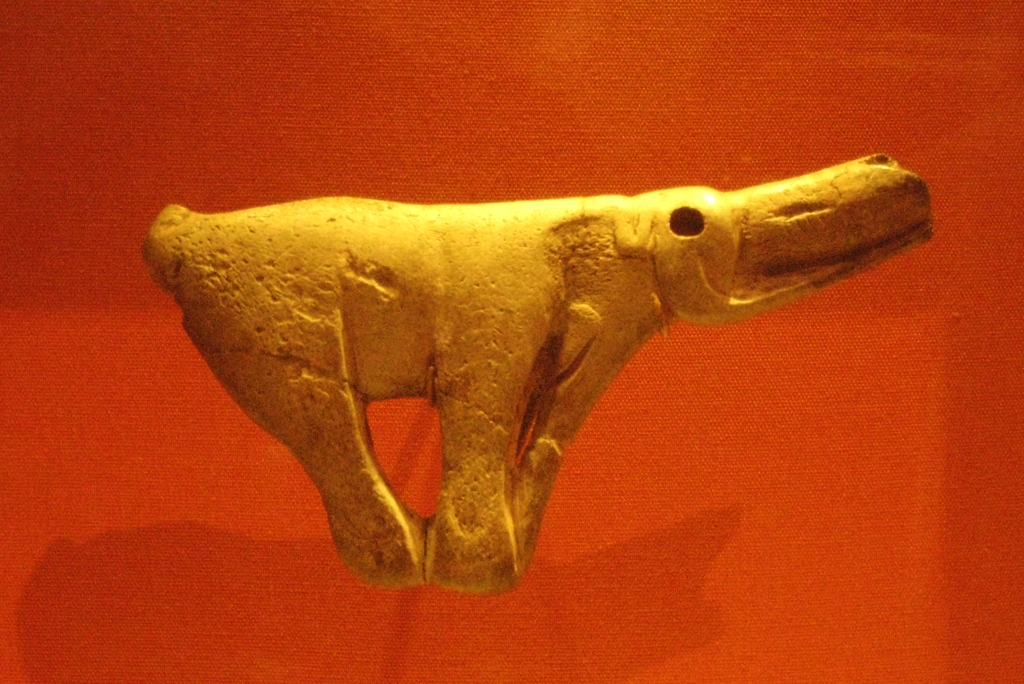
Time capsules from the Ice Age

It is late August, and the weather is turning cold. Very cold. A little chubby arctic ground squirrel bounds at surprising speed across the prairie. It pauses briefly, standing on those two short little back legs. Ears twitching, listening. There are other things out on the prairie; bigger things. Swift foxes, silent eagles, ferocious wolverines, and even grizzly bears all of which will happily guzzle one of these fuzzy critters down for a snack. Not a peep. She moves on swiftly to luscious vegetation, the patches of her silvery fur shimmering in the mid-day sun. She stuffs seeds and flowers in her mouth and grabs some grass before bouncing back to her underground home. Here, her home is at the end of a small tunnel she has dug out of the soft earth herself. It is welcoming: packed full of comfy moss and grass to sleep on, and plenty of seeds to feed on. What she has brought back isn’t enough. She needs more, so scurries out to collect more, and more and more until the winter begins. The cold winds and icy rain tell the little creature that winter is coming. Quickly she darts inside the safety of her burrow. She snuggles up in her nest of the softest lichen, moss and grass, and drifts to sleep.

20,000 years later, she is found. Mummified in her nest, still curled up, eternally asleep. This arctic ground squirrel never woke up from her hibernation.

"Squirrel Mummy" by Ryan Somma - Squirrel MummyUploaded by FunkMonk. Licensed under CC BY-SA 2.0 via Commons - https://commons.wikimedia.org/wiki/File:Squirrel_Mummy.jpg#/media/File:Squirrel_Mummy.jpg

A mummified Arctic Ground Squirrel from Alaska. 20,000 years ago this squirrel curled up and went to sleep. But never woke up. (Image by Ryan Somma, Public Domain)

Arctic ground squirrels (Spermophilus parryii) are still around today, and it is more than likely you have seen them on a nature documentary. They are gorgeous little creatures, always busy, constantly gathering bits of the landscape to make their nests or to store in their larder for when they wake from their hibernation. They look out for each other on the open prairie, and give little growls or high pitch squeaks to warn others of approaching predators. Their soft, fluffy fur is light brown with soft red spots on in the summer, which changes to silver spots in the winter.

These are really cool little things. As their name suggests, these gopher-like animals that live in the cold northern environments (Siberia, North Canada, Alaska, and the Arctic Circle). Because they live in places where it is so far north that the sun never sets in the summer, their brains don’t have a body clock. Waking late in the morning and sleeping early in the afternoon means that they are more energy efficient when it is ‘warmest’ during the middle of the day (looking for a mate, or gathering food early or later in the day uses up more energy to stay warm because it is colder). Inside their small self-made nests, not very deep underground, they spend the freezing Alaskan winters hibernating. Here temperatures can fall to well below freezing. What is incredible is that they can lower their body temperatures from around 37oC to around -2oC while they hibernate.
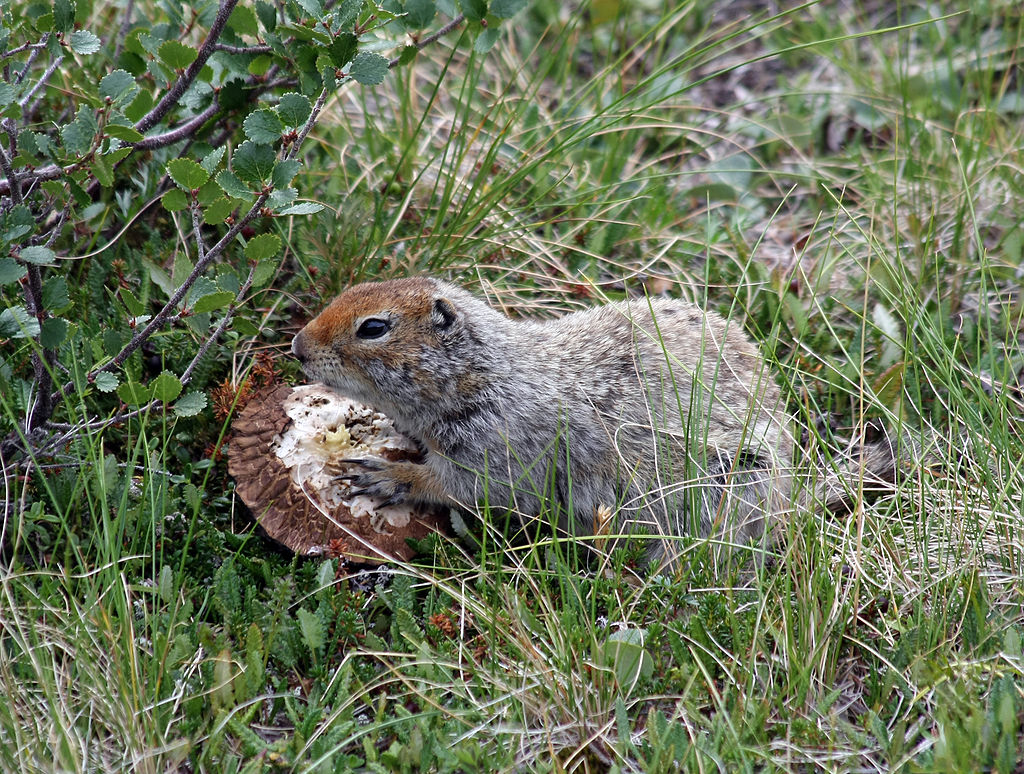
"Spermophilus parryii (eating mushroom)" by Ianaré Sévi - Own work. Licensed under CC BY-SA 3.0 via Commons - https://commons.wikimedia.org/wiki/File:Spermophilus_parryii_(eating_mushroom).jpg#/media/File:Spermophilus_parryii_(eating_mushroom).jpg

The adorable Arctic Ground Squirrel (Spermophilus parryii), here nibbling on a mushroom. (Image by Ianaré Sévi, Public Domain)

These guys are nature’s true collectors. Their nests are full of twigs, grasses, seeds, and flowers of their immediate environment. And this is very exciting because they have been doing this for tens of thousands of years. Their great-great-great (x 20) grandparents were scooting beneath the feet of Woolly Mammoths, Bison and other Ice Age beasts. An added bonus (for palaeontologists) of building homes underground is that these extremely fragile nests are preserved.  These are true time capsules from the Ice age. Canada’s northern territory, the Yukon, along with central Alaska, has been a hot spot for arctic ground squirrel research. Not only have fossils dating back around 47,000 years been found, but huge numbers of their nests have been recovered.

Some sites have dozens of nests exposed at certain layers; all that’s left of an ancient colony. And nests can be found in different layers too; giving a nice glimpse into different periods of the past. What gets me so excited about arctic ground squirrel nests is what we can find inside them.
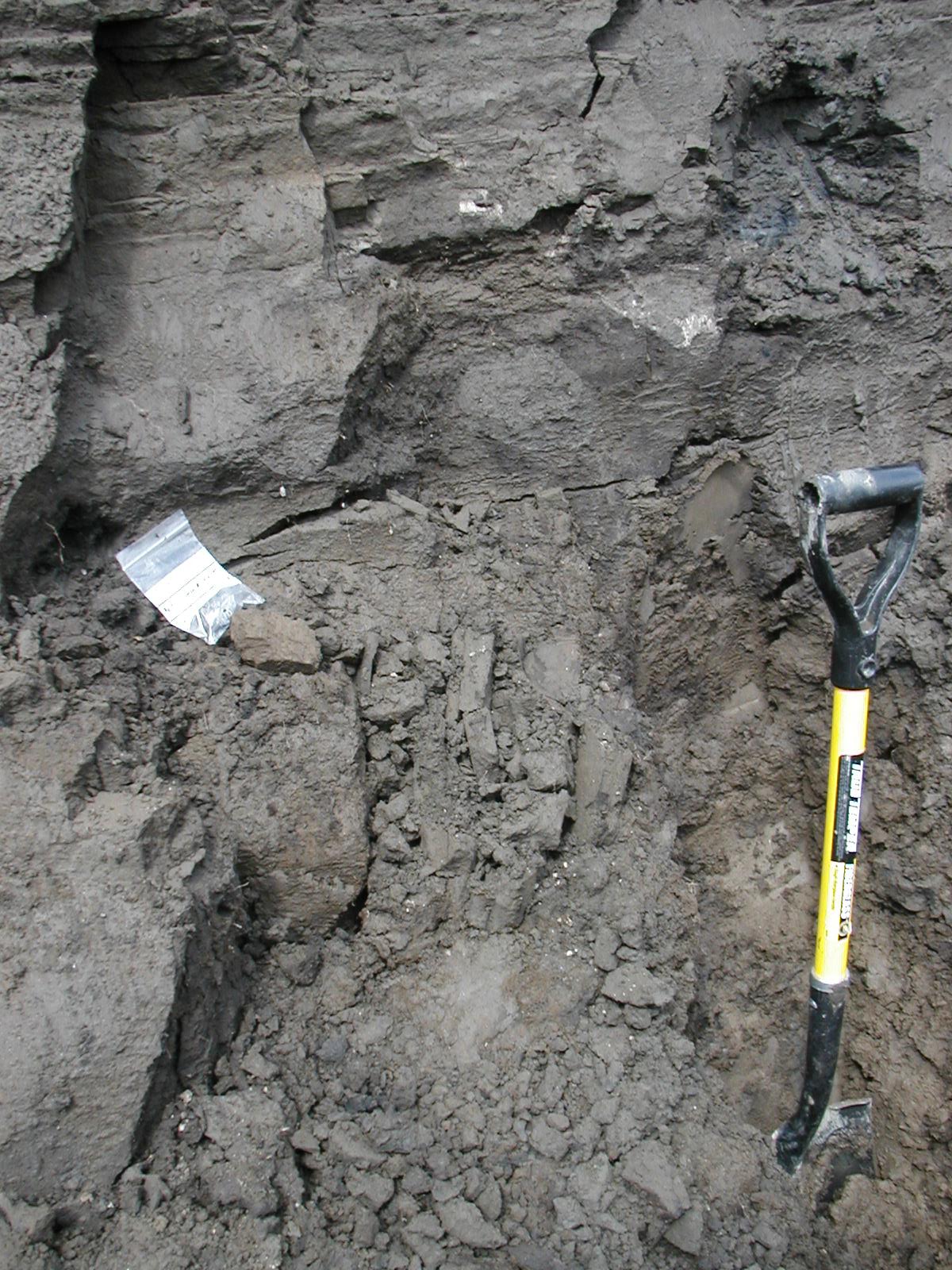
Images of ground squirrel bones found in tunnel near Dawson City, 2003. (Image ©Grant Zazula/Duane Froese)

This may look like at picture of mud, but it is actually super sexy. Look in the middle of the picture, just to the left of the zip-lock back, and you can spy a twig poking out of the soft mud: this is the nest of an arctic ground squirrel! And the nest contained bones!! (Image ©Grant Zazula/Duane Froese 2003)

In the Yukon and central Alaska, between 47,000 and 11,000 years ago nests are full of buttercups, poppy seeds, wild rye grasses, dwarf shrubs, and very few trees. Wonderful you may think. It really is, when you throw in that Mammoths were lolloping in the Yukon at the same time! So from these time capsules we know what the environment was like. It was cold, but dry. There were few trees around, and this formed part of the Mammoth Steppe which stretched all across the northern hemisphere. And what we can see from the nests is that there was plenty of food for the Mammoths to feast on.

As well as being a vital part to today’s ecosystem, arctic ground squirrels are key to understanding prehistoric ecosystems. Being such obsessive collectors, they create natural time capsules when provide details about time long gone.

Written by Jan Freedman(@JanFreedman)

Further Reading:

Barnes, B. M. (1989). ‘Freeze avoidance in a mammal: body temperatures below 0oC in an arctic hibernator.’ Science (American Association for the Advancement of Science). 244. pp.1593-1595. [Full article]

Batzli, G. O. & Sobaski, S. T. (1980). ‘Distribution, abundance and foraging patterns of ground squirrels near Atkasook, Alaska.’ Arctic and Alpine Research. 12. pp.501–510. [Abstract only]

Betancourt, J. L., Van Devender, T. R., & Martin, P. S. (1990). ‘Packrat Middens: The last 40,000 years of biotic change.’ University of Arizona Press, Tuscon, AZ. [Book]

Buck, C. L. et al. (2008). ‘Overwinter body temperature patterns in free-living Arctic Ground Squirrels (Spermophilus parryii).’ Hypometabolism in Animals: Hibernation, Torpor and Cryobiology: pp.317–326. [Full article]

Buck, C. L. & Barnes, B. M. (1999). ‘Annual cycle of body composition and hibernation in free-living arctic ground squirrels.’ Journal of Mammology 80 (2): pp.430–442. [Full article]

Elias, S.A. (2000). ‘Late Pleistocene climates of Beringia, based on fossil beetle analysis.’ Quaternary Research. 53. pp.229–235. [Abstract only]

Guthrie, R.D. (1990). ‘Frozen Fauna of the Mammoth Steppe: The Story of Blue Babe.’ University of Chicago Press, Chicago. [Book]

Guthrie, R. D. (2001). ‘Origin and causes of the mammoth steppe: a story of cloud cover, woolly mammal tooth pits, buckles, and inside-out Beringia.’ Quaternary Science Reviews. 20. pp.549–574. [Abstract only]

Liu Y, et al. (2010). ‘Genomic analysis of miRNAs in an extreme mammalian hibernator, the Arctic Ground Squirrel.’ Physiological Genomics. 42A. pp.39-51. [Full article]

Nadler, C. F. & Hoffmann, R. S. (1977). ‘Patterns of evolution and migration in the Arctic ground squirrel Spermophilus parryii (Richardson).’ Canadian Journal of Zoology. 55. pp.748–758. [Abstract only]

Zazula, G. D., et al. (2007). ‘Arctic ground squirrels of the mammoth-steppe: paleoecolgy of Late Pleistocene middens (24,000-29,450 14C yr BP), Yukon Territory, Canada.’ Quaternary Science Reviews. 26. pp.979-1003. [Full article]


Posted in Arctic Ground Squirrel | Tagged , , , | 6 Comments

2015: A review of the Beasts

At the end of each year, bloggers on WordPress.com are sent a short summary of activity on their blog. The whole report can be seen at the link at the end of this post if you like to scan through.

For us three who manage the Twilight Beast blog, this report is a perfect opportunity to once again thank readers for their comments, thoughts and support of the blog posts over the last year! We are really enjoying bringing familiar, and not so familiar, beasts alive.

A very christmassy Twilight Beasts logo. (Art by Tabitha Paterson)

A very christmassy Twilight Beasts logo. (Art by Tabitha Paterson)

2015 has been a great year for the Beasts. We have had two special weeks:

#ExtinctWeek was raising the profile of extinction, and the vulnerability of species today. The week saw three posts about iconic creatures which have only just become extinct: the Thylacine, the Quagga, and the Dodo.

#HomininWeek saw the first blog posts from us about our not too distant relatives, including the robust cousin, Paranthropus; the strange species with only a few fossils the mysterious Denisovans; and a hominin who has had a bad rap over the ages, our favorites the Neanderthals.

We have had excellent guest blog posts from some very talented people:

– The incredible artwork of @TedRechlin creates a very special comic book style post looking at the American Lion and the Giant Short-Faced Bear, in Just like the weather

– @ferwen takes us back to a time when ginormous Terror Birds stalked the land. These giants were around for over 60 million years! Read more about them in The long reign of terror.

@osteoconner takes a look at one of our often forgotten cousin, the vegetarian Paranthropus in Side by side with Homo

– Ancient DNA is adding more information to what we know about the recent past. And sometimes confuses things too. Meet they mysterious human species known as the Denisovans by @sunderdown: Who were the Denisovans anyway?

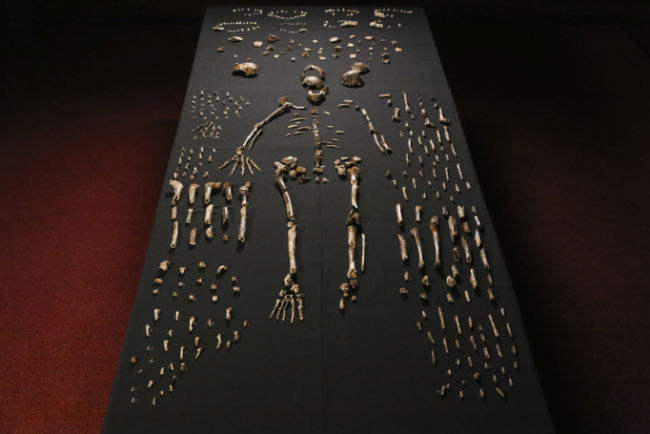
– We were very privileged to have a unique, first hand account of the incredible discovery of Homo naledi by one of the incredible underground astronauts @Paleo_Bonegirl: We are made of staff stuff

cOMPOSITE SKELETON OF

The beautiful fossils of Homo naledi discovered in 2015. (Image credit John Hawks, University of the Witwatersrand)


And here are our top five most viewed blog posts of 2015!

Number 5: Real vampires in South America. Not so long ago, there were giant vampire bats fluttering around the South American jungles!

Number 4: The long reign of terror. Co-written by a guest blogger, explore the world after the dinosaurs vanished. Well, most of them anyway.

Number 3: Paddingtons dangerous cousin. There were once meat- eating bears in South America. And they were big.

Number 2: Who were the Denisovans anyway? A guest blog written by @simonunderdown explores this mysterious species of human.

– Number 1: Neanderthals and us: we’re not so differenct. Neanderthals have been portrayed in a very negative way since they were first discovered. You will find out that we are actually very similar.

A complete skeleton of Neanderthal, with a model next to it. (Image "Skeleton and restoration model of Neanderthal La Ferrassie 1" by Photaro - Own work. Licensed under CC BY-SA 3.0 via Wikimedia Commons - http://commons.wikimedia.org/wiki/File:Skeleton_and_restoration_model_of_Neanderthal_La_Ferrassie_1.jpg#/media/File:Skeleton_and_restoration_model_of_Neanderthal_La_Ferrassie_1.jpg

A complete skeleton of Neanderthal, with a model next to it. (Image by Wiki member Photaro, Public Domain)

As with any ‘top read’ lists, there are also ‘least read’ lists. So, we give you our least read blog posts of 2015. Let’s show them a little love!

Number 5: America’s original razorbacks. Written in July 2014, this guest post by Aaron Woodruff (@CenozoicKing) looks at the cute little pig-like peccaries.

Number 4: A test of time. Discover how we know what the climate was like in the past by examiming a small little organism.

Number 3: An unexpected river horse. Hippos in Britain!

Number 2: Survivors. The wonderfully bizarre Saiga antelope were once widespread across Europe, including in Britain! They have had many hits to their numbers through time, but this resilient little mammal bounces back.

Number 1: The Beasts Within. This guest post was written by Jamie Wood (@larusnz) in July 2014. It hasn’t had much traffic this year. With giant sloth poo and parasites, what’s not to love!

We have new beasts and big plans for 2016! We hope you continue to enjoy our posts, and please get in touch if you want to write a guest post, or want to suggest a creature you want to see on here!

Happy new year to everyone! Enjoy being with family and friends, as we all know, time goes too quickly. From the Twilight Beasts team.

Click here to see the complete report.

megafauna, pleistocene, twilight beasts, thylacine, extinction

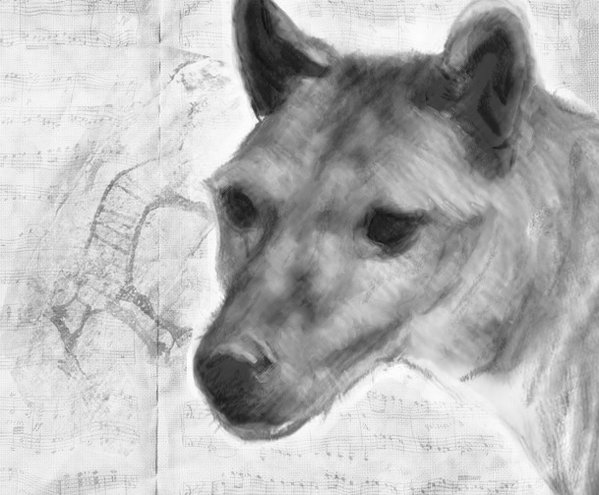
As a celebration of Twilight Beasts blog reaching 100,000 views, one of our readers, Beth Windle, drew this beautiful Thylacine to celebrate.

Posted in Celebrate! | 5 Comments

A Camel for Christmas

When I was a small child, it was traditional in rural Ireland to go round neighbouring churches and view their nativity cribs. The ones I was always more impressed by were the ones with huge plaster animals – the oxen, donkey, sheep, and tiny lambs in shepherds’ arms. One church outshone all of them. It had a set of life-sized plaster camels, decked in tassels and saddles, resting from the Magi’s long ride across the Levant. At five, that makes a pretty big impression on you. So, if I’m honest about it, I’ve been a fan of camels ever since. Love their attitude and endurance, and I do find them immensely beautiful creatures when you get up close – oh those big fluttery eyelashes!

Those plaster camels, and the subsequent real ones I’ve cantered across the sands of Egypt, Sudan and Tunisia would be dwarfed by the biggest camel of them all, an early Twilight Beast, Gigantocamelus spatulus. This early Pleistocene giant lumbered across the plains of North America up until about 300,000 years ago, although details are sketchy on that date at best. Single humped, at a height of over 3.5 metres, about 4 m in length and weighing up to 2500 kg, these were true megafauna similar in size to the familiar Woolly Mammoth.

fgslhdg

Gigantocamelus was just what the name suggests: a giant camel. Image by Roberto Diaz Sibaja

The evolution of Gigantocamelus straddles the late Pliocene era (around 4 million years ago) and the early climate fluctuations in North America, from the Nebraskan glacial phase around 700,000 BP to the warmer Yarmouth phase, around 300,000 BP. Because of the species’ survival through these early fluctuations of temperature, it’s likely these camels had thick, warm coats– think giant fluffy critters with a whole lot of ‘tude out on the openness of the great grass plains of pre-Ice Age landscapes.

What we can tell from bone deposits in Nebraska is that there was considerable sexual dimorphism in these perhaps-not-so-gentle-giants. The females were about 20% smaller than the males, which had rather large canines most likely used in rutting battles. (One journal suggests they were about the same size as a small Tyrannosaurus rex tooth!) They travelled in herds and they travelled fast – way out in the desert lands of Santa Fe, preserved hoof prints show an animal which was no slouch with speed.

The enormous head of Gigantocamelus, Upper Pliocene/Lower Pliocene, Garden Co., Nebraska, fossil (Head approximately 3 feet long!)

The enormous head of Gigantocamelus from the Upper Pliocene/Lower Pliocene, Garden Co., Nebraska, fossil. Those enormous canines are similar in size to the teeth of Tyrannosaurus rex! Photo © Phil Degginger

So, if you will, imagine we are walking across an early Pleistocene plain, somewhere in New Mexico, perhaps. We have our cameras (we brought them in our TARDIS) and hiking boots on. The air is cool, the grassland an ocean of earthy green. We catch sight  of a herd of G. spatulus grazing, but they’ve caught sight of us too – suddenly there’s a mob of irate,  3.5m (12ft) high camels, weighing in at over a ton each, snorting their rage (because even giant camels have short fuses) while running rapidly for us, fangs bared. Sorry, gentle reader, but it’s every man and woman for themselves on this one!

While we all acknowledge that nature is red in tooth and claw, so are palaeontologists when it comes to nomenclature and taxonomies. There’s been a somewhat prolonged discussion about whether the equally massive camel Titanotylopus and our friend Gigantocamelus were really the same critter. The first Gigantocamelus were discovered at the end of the 19th century, and categorised into a genus in the 1930s. But, palaeontologists (just like archaeologists) love a good decades long ‘debate’. It’s really not so long ago that it was finally decided they were actually two very similar, but different camels. This was all based on those teeth. Gigantocamelus’s teeth were hypsodontic, meaning that its long teeth had enamel beyond the gum line to allow for wear and tear while eating rough and gritty vegetation, very similar to grazing of horses and cattle. Now, before anyone jumps to the conclusion of climate=grasslands=hypsodontic evolution, don’t. Stop right there! That theory was tested and it looks as though these grazing animals just need a little grit in their bellies. This actually has a name; the ‘Grit, Not Grass Hypothesis’. Sometimes, I swear, I love palaeontology and palaeoenvironmentalism!

These giant camel genera developed through the late Pliocene some 4 million years ago. Grasslands flourished at this time, although just as the Pliocene was reaching its end, ice caps in Greenland were getting bigger, and glaciation events were waiting in the wings to start changing the face of the earth as it was known. The Pleistocene Big Freeze was arriving, with all the associated changes….

The extent of the glaciaers in Northern America.

The extent of the glaciers in Northern America. Image © Encyclopaedia Brittanica

Although they survived for over 2 million years from the late Pliocene into the Pleistocene, this hugely variable Epoch may have the beginning of the end of the giant camels of North America.  This is one of the rare extinctions in which humans almost certainly had no part. The Kansan glacial event, which pretty much coincides with the UK’s Anglian equivalent, around 480,000 to 230,000 BP. While the regions of North America inhabited by the giant camels – Nebraska, New Mexico, Kansas and others – were not covered in ice, vegetation would have been likely depleted due to the changes in climate. Very recent research has shown that Gigantocamelus was a leaf browser, but most likely of smaller shrubs and bushes, in keeping with those long teeth. All it would take would be one prime species of shrub or bush to decline and populations would suffer. There again, we are currently witnessing the decimation of the Saiga, due to bacterial imbalances, possibly caused by a lethal combination of pollutants and climate change. Populations could have been on the slide from the climate shifts at the end of the Pliocene into the Pleistocene. There’s simply insufficient evidence to offer conclusive reasons as to what brought the reign of the giant camel to an end, yet allowed their smaller cousins to continue for another 200,000 years.

To the best of our knowledge, humans never got to witness these creatures; there are no petroglyphs carved on cavern walls, no images painted in ochre – in fairness, we aren’t even quite sure when they become extinct, the date of around 300,000 being an estimate simply because no later bone assemblages have been found – yet. That caveat of ‘yet’ being the thing each scholar of the past literally lives for. Most fossils have been found around the Lisco bone beds of Nebraska, with a few at Clovis and El Paso, New Mexico, and these particular specimens have been presumed to date to the middle of the Pleistocene. It may be that the mighty camels survived later into the Pleistocene. The truth, as they used to say in the 90s, is out there!

So, as the Festive Season is almost upon us I’m going to re- imagine those cribs of childhood, only with a menagerie of Twilight Beasts. Magi on Gigantocamelus, shepherds with Myotragus tucked under their arms and Hippidion instead of donkeys, side by side with sleepy aurochs. It’s a stretch of imagination (and almost certainly heresy) to suggest the angels in attendance– perhaps one called Jan, another Ross and… well, I might need some R and R from writing to flap my wings and keep an eye on all those animals!

From me, to you, whatever way you celebrate this winter holiday, have a wonderful one – keep safe, be kind, and we shall look forward to finding more wonderful creatures for you in 2016. Peace.

Written by Rena Maguire (@JustRena)

Further Reading:

Breyer, J. (1976). ‘Titanotylopus (= Gigantocamelus) from the Great Plains Cenozoic.’ Journal of Paleontology. 50 (5). pp 783-788. [Full article]

Farmer, G. T., & Cook, J. (2013). ‘Pleistocene glaciations’. In Climate Change Science: A Modern Synthesis Springer Netherlands.  pp 407-427. [Book]

Harrison, J. (1985). ‘Giant camels from the Cenezoic of North America.’ Smithsonian Contribrutions to Paleobiology. [Full article]

Jardine, P.E., et al. (2012). ‘Grit not grass: Concordant patterns of early origin of hypsodonty in Great Plains ungulates and Glires’. Palaeogeography, Palaeoclimatology, Palaeoecology. 365-366. pp1-10. [Abstract only]

Kukla, G. (1978).  ‘The classical European glacial stages: correlation with deep-sea sediments’ University of Nerbraska – Lincoln. [Full article]

Mendoza, M. & Palmqvist, P. (2008).  ‘Hypsodonty in ungulates: an adaptation for grass consumption or for foraging in open habitat?” Journal of Zoology 274 .2: pp.134–142. [Abstract only]

Railsback, L. B., et al. (2015). ‘An optimized scheme of lettered marine isotope substages for the last 1.0 million years, and the climatostratigraphic nature of isotope stages and substages’. Quaternary Science Reviews.111: 94-106. [Full article]

Rybczynski, N., et al. (2013). ‘Mid-Pliocene warm-period deposits in the High Arctic yield insight into camel evolution’. Nature communications. 4. pp.1550. [Full article]

Semprebon, G & Rivals, F. 2(010). ‘Trends in the paleodietary habits of fossil camels from the Tertiary and Quaternary of North America’ Palaeogeography, Palaeoclimatology, Palaeoecology, 295. pp 131-145. [Full article]

Strömberg, C.E. (2006). ‘Evolution of hypsodonty in equids: testing a hypothesis of adaptation.’ Paleobiology. 32:  pp 236–258. [Full article]

Thompson, M. E., White, R. S., & Morgan, G. S. (2007). ‘Pace versus trot: can medium speed gait be determined from fossil trackways.’ In Spielmann L and Lockley MG (eds), Cenozoic Vertebrate Tracks and Traces. New Mexico Museum of Natural History and Science, Bulletin42: pp 309-314.

Tucker, S. T., et al. (2014). ‘The geology and paleontology of Ashfall Fossil Beds, a late Miocene (Clarendonian) mass-death assemblage, Antelope County and adjacent Knox County, Nebraska, USA’. Field Guides. 36:  pp 1-22. [Abstract only]

Warnica, J. M. (1966). ‘New discoveries at the Clovis site’. American Antiquity. pp 345-357.

Waters, M. R., et al. (2015). ‘Late Pleistocene horse and camel hunting at the southern margin of the ice-free corridor: Reassessing the age of Wally’s Beach, Canada. Proceedings of the National Academy of Sciences112.14: pp 4263-4267. [Full article]

Posted in Gigantocamelus | Tagged , , , , , | 2 Comments

100,000 Thank Yous….

We have achieved 100,000 views of the blog. To each and every reader, thank you. We hope you enjoy our exploration of the Pleistocene as much as we enjoy the researching and writing. It’s been a remarkable adventure, and we have encountered immense fun and kindness.

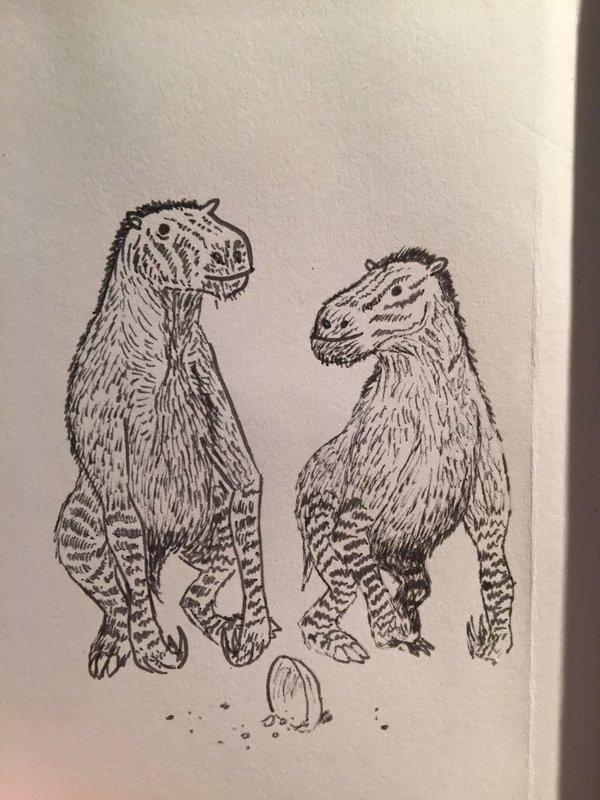
To celebrate the event, two of our Twitter followers gifted us these original pieces of art. Nathan Redland (@nathanredland) envisioned two naughty wee Chalicotheres smashing their bowl of drink in celebration…

megafauna, pleistocene, twilight beasts

…while Beth Windle, a remarkably talented illustrator (@WindleBeth and gallery/ website) gave us the beautiful Thylacine entitled ‘Ghost’, with the comment that he may be the last ghost our species creates from our non-human inhabitants of this planet.

megafauna, pleistocene, twilight beasts, thylacine, extinction

So, we had to share with you all. Because it’s your blog too.

Thank you all again – it’s a pleasure, and here’s to the next 100,000!!

The Twilight Beast Team.


Posted in Celebrate! | Tagged , , , | 5 Comments

Survivors

One of the wonderful reasons Twilight Beasts are so dear to us is because most are just downright weird. The peculiar llama with a trunk, dogs with teeth as strong as a hyena, and an armadillo that looked like an igloo were just a few of the odd creatures that roamed during the Pleistocene. The mammals ruled, but it was these funny looking ones that stay in our imagination. Cave Bears, sabretooth cats, and giant deer capture headlines, while equally magnificent, but maybe more average-looking creatures like the weird Madagascan aardvark might not.

Reconsturction of Glyptotherium sp. by Sergiodlarosa

Reconstruction of Glyptotherium sp. by Sergiodlarosa via Wikimedia Commons

Something that makes these animals even more fascinating is that many of them were tantalisingly close to being with us today. The Woolly Mammoth was still on the planet while the pyramids were being built, 4000 years ago. Cave lions were perhaps stalking on the Siberian tundra just 10,000 years ago. These wonderful beasts were just a hair’s breadth away from the present day. But they vanished.

Not all Twilight Beasts disappeared though. Every animal alive today is a survivor from the Pleistocene. I guess that sounds pretty strange? Probably because we think of the Pleistocene as a different time, a time covered by ice and giants. It is also pretty difficult to see animals familiar to us today living amongst such different beasts. In reality this fascinating Epoch only ended around 12,000 years ago. Although many animals vanished, many, many more survived. We are one of those survivors. Hippopotamus are another. The list goes on. There is one incredible beast alive today that you could pick up and plop straight into any Ice Age scene and it would look quite at home.

With its beautifully bizarre nose, the saiga antelope (Saiga tatarica) is a true survivor of the Pleistocene. A small antelope that would reach just above my hips, being around 3ft tall, they have a very striking feature: an exceedingly large and somewhat comical schnozzle. An over-sized nose is very good at breathing efficiently – cold air is warmed when breathing in, and less water is lost when breathing out. This gives the saiga an incredibly distinct character, especially with its large bulging eyes.

The gorgeous saiga antelope (

The gorgeous saiga antelope (Saiga tatarica) with its wonderfully oversized nose, and slightly bulging eyes. Only the males have horns, which they use when competing for a female. A sucessful male can have over 40 females to himself. (Image Public Domain)

Perfectly adapted for the cold, they live today as they did in the past; on open plains staying away from the dense woodlands. (Although in tougher times they are resourceful and will forage in woodlands.) When they migrate, small groups join up and can eventually form enormous herds of tens of thousands running across the landscape. What’s really awesome is that during the Late Pleistocene, saiga were stampeding across the Mammoth Steppe in enormous herds. Fossil saiga have been found across Europe in Poland, the Czech Republic, Austria, Denmark, and Belgium. Dated specimens from France (14,500 yrs ago) and Germany (12,500 years ago) indicate two late cold periods where they thrived. And fossils from Britain also support this.

Yes, saiga were in Britain.

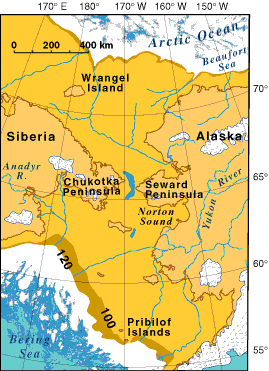
In the late 1800s, a skull cap with horns of a male saiga were found in the Thames Gravel. This was the only British evidence until the 1980s. Researchers re-examined four sites in Somerset, discovering that they held the remains of saiga teeth and bones. While the Mammoth Steppe extended across Europe and into southern Britain, so did the range of the saiga. Fossils dating to around 13,000 years ago have also been found in Yukon, Canada, showing the extent of the Pleistocene geographic range. With water trapped in the ice at the poles, sea levels were lower allowing Siberia and Alaska to be connected by the Bering Land Bridge, creating a new subcontinent known as Beringia. Here, many animals migrated across the continent, including cave lions, mammoths, and humans. The saiga didn’t survive in North America, but their numbers held in Eurasia.

fagasfgasdf

The Beringia subcontinent. Here, around 20,000 years ago sea levels were much lower than today, exposing more land. Siberia was joined to Alaska, allowing many species to freely migrate to and fro. (Image Public Domain)

This Gonzo of the antelope family is a true ice age survivor. Just 300 years ago herds roamed far eastern Europe (Turkey, Bulgaria, Romania, Ukraine and Russia) and China and Mongolia. Today their numbers are dramatically low, and can only be found in one area of Russia, and a few spots in Kazakhstan. Overhunting for food and human habitation were a huge part of their decline, nearly causing their extinction. Chinese medicines were another threat: male saiga were prized for their horns used in ‘cooling water’ to bring down temperatures and fevers (which led to their extinction in China).

In recent decades an invisible killer has been set loose in the herds of saiga, killing tens of thousands. Populations have recovered after these die-offs. However, recently, in May 2015, there was a mass die-off of an estimated 150,000 of these wonderful little animals. No one knows why. Massive die outs do happen in herds, but this was on an enormous scale. It seems too fast for a pathogen: normally when a deadly disease hits a herd many die, but there are some survivors – with this die-off in May, all the individuals in the herd died. One online article suggests that it may have been due to a bacteria which lies dormant in the saiga’s throats and then suddenly became toxic. Normally inactive, this bacteria, Pasteurella sp., can release toxins in the body causing fatal disease. If this was the culprit, then what caused it to simultaneously ‘wake up’ in the throats of over 150,000 saiga?

These incredible little creatures have bounced back from near extinction in the past. Almost hunted to extinction, the herds recovered. Hundreds of thousands have died in the last few decades from an unknown cause, but they have continued to replenish their numbers. These antelope are a critically endangered species. In the last year, their numbers have been reduced to dramatically. But I have hope. These are true survivors, and I have a strong feeling they will be around for a long time yet.

Written by Jan Freedman (@JanFreedman)

Further Reading:

You can find out more about conservation of the saiga at the Saiga Conservation Alliance.

Several blog posts about the recent mass-deaths of the saiga:

Catastrophic collapse of Saiga Antelopes in Central Asia. May 2015.

Endangered saiga antelope mysteriously dying in vast numbers in Kazakhstan. May 2015.

134,000 saiga antelope dead in two weeks. What is the probable cause? June 2015.

Scientists probe mysterious wave of antelope deaths. June 2015.

Mysterious die-off sparks race to save saiga antelope. June 2015.

Currant, A. P. (1986). ‘The Late glacial mammal fauna of Gough’s Cave, Cheddar, Somerset.’ Proceedings of Bristol University Speleology Society. 17(3). pp.286-304. [Full article]

Currant, A. P. (1987). ‘Late Pleistocene saiga antelope (Saiga tatarica) on the Mendip.’ Proceedings of Bristol University Speleology Society. 18(1). pp.74-80. [Full article]

Harington, C. R. (1980). ‘Radiocarbon dates on some Quaternary mammals and artefacts from Northern North America.’ Arctic. 33(4). pp.815-832. [Full article]

Harington, C. R, & Cinq-Mars, J. (1995). ‘Radiocarbon dates on saiga antelope (Saiga tatarica) fossils from Yukon and the Northwest Territories.’ Arctic. 48(4). pp.1-7. [Full article]

Kholodova, M.V., et al. (2006). ‘Mitochondrial DNA variation and population structure of the Critically Endangered saiga antelope Saiga tatarica.’ Oryx. 40: pp.103–107. [Abstract only]

Kurtén, B. (1968), ‘Pleistocene mammals of Europe.’ Transaction Publishers. [Book]

Kurtén, B. ‘The Pleistocene lion of Beringia.’ Annales Zooloici Fennici. 22(1). pp.117-121. [Full article]

Povolny, D. (1966). ‘The fauna of central Europe: Its Origin and Evolution.’ Systematic Zoology. 15(1). pp.46-53. [Full article]

Singh, N. J., et al. (2010). ‘Tracking greenery in Central Asia: The migration of the saiga antelope.’ Diversity and Distributions. 16 (4). pp.663–675. [Abstract only]

Smith Woodward, A. (1890. ‘Note on the occurrence of the saiga antelope in the Pleistocene deposit of the Thames Valley.’ Proceedings of the Zoological Society of London. p.613. [Full article]

Posted in Saiga antelope | Tagged , , , , , , , , , , , , , , , | 6 Comments

The moo of the wild

In a sense, Pleistocene megafauna are still with us even in post-industrial England. It may not seem like it but the humble heifer is probably the most successful species of megafauna on the planet, outnumbering all the elephants, rhinos, whales, lions, tigers, and hippos put together! The simple cow (1.5 billion and counting), shaped by millennia of domestication into a (mostly) docile and manageable creature is a direct descendant of something so fearsome, and so deadly, that Julius Caesar (himself no slouch in the bellicosity department) described them as “a little below the elephant in size and of the appearance, colour, and shape of a bull. Their strength and speed are extraordinary. They spare neither man nor wild beast which they have espied.”

A beast that terrified the legendary Caesar must have been impressive indeed.

This is the aurochs (Bos taurus primigenius), the wild ancestor of our domestic cattle.

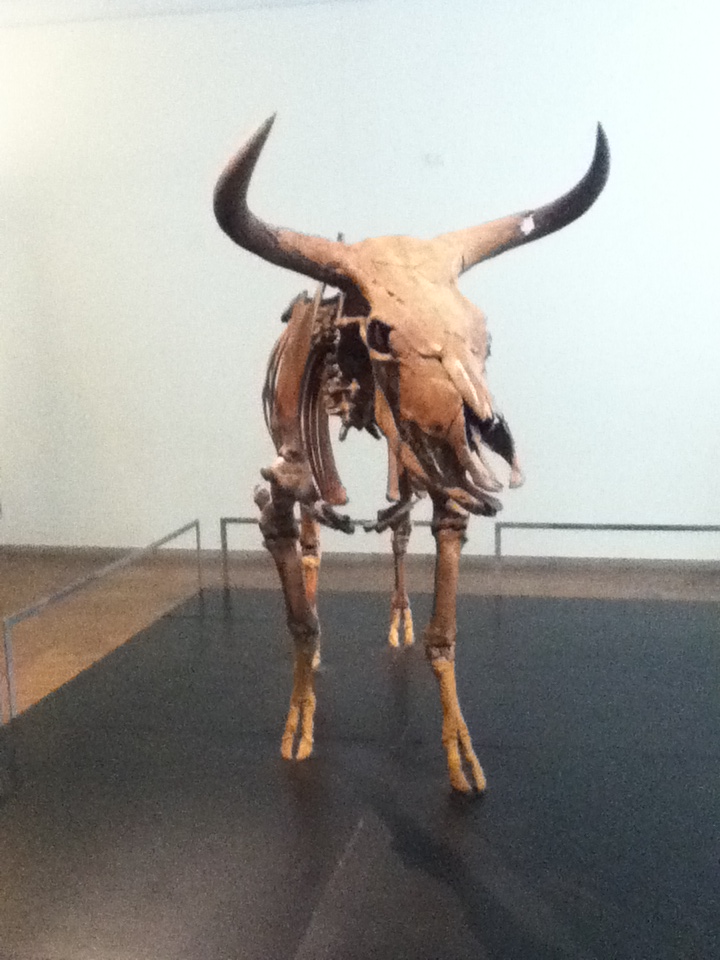
Danish Aurochs (Bos primigenius) in the National Museum of Denmark. Image author's own.

Danish Aurochs (Bos primigenius) in the National Museum of Denmark. Image author’s own.

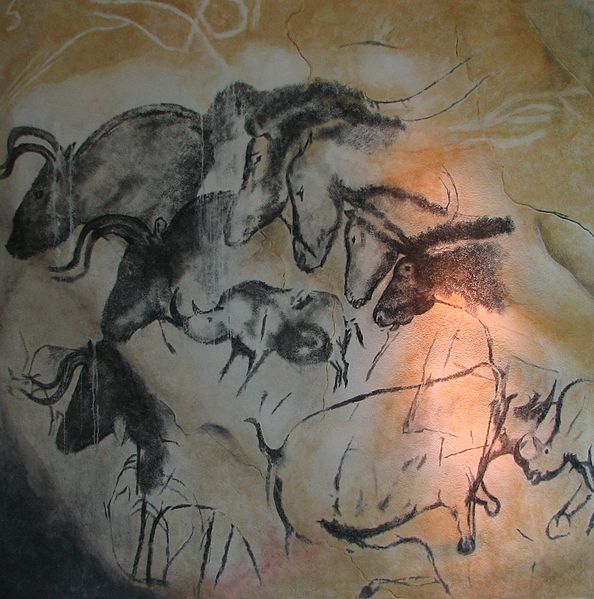
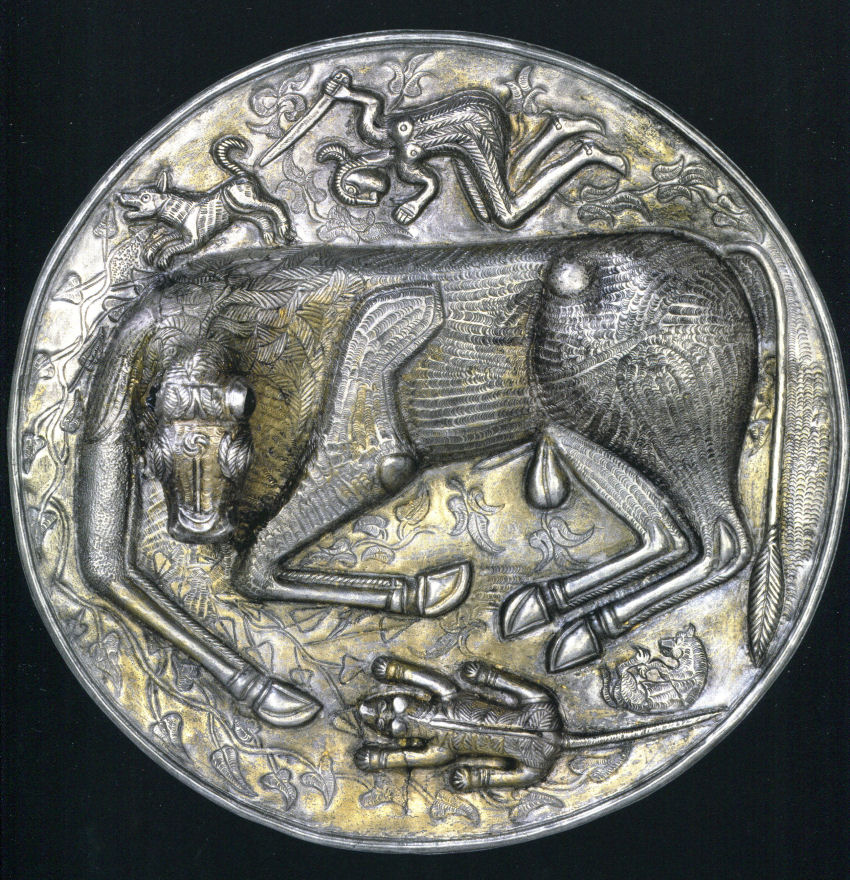
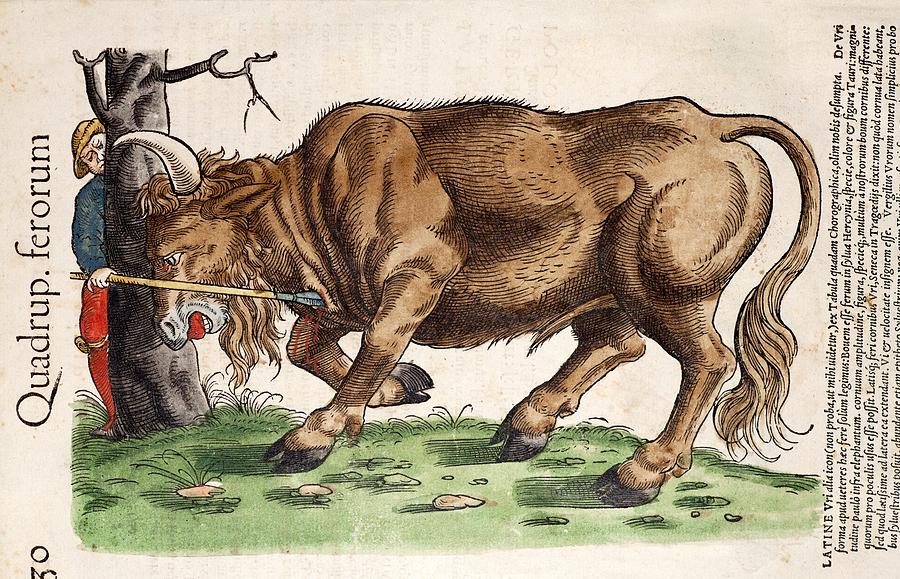
We know a fair bit about the aurochs. Obviously it’s possible to extrapolate a lot from the modern cow, but there are other lines of evidence too. Aurochs are common in cave art, which show them as active, formidable creatures with sinuous forward-pointing horns and muscled bodies. Sexually dimorphic colour is suggested in these paintings with black bulls and reddy-brown cows. Fossil evidence has aurochs a component of Palaeolithic and later diets, with cutmarked bones found at many sites. Complete skeletons are known, with large males standing up to six feet tall and females only slightly smaller. Unlike the mammoth, woolly rhino, or Irish elk, the aurochs survived into the historical period and so we also have written accounts and woodcuts done by people who knew the living animal. Herodotus, the old testament, and Caesar, all talk about living aurochs. The Iron Age Gundestrup cauldron has a beautifully pictured scene with a dead aurochs surrounded by exhausted hunting dogs and a swordswoman. The very last wild aurochs lived in the Jaktorów forest in Poland before its death in 1627. These animals were kept in a royal hunting preserve (the conservation program of its day) where poaching was punishable by death.

Paintings_from_the_Chauvet_cave_(museum_replica) T0jY3H7

Bottom: Section of the Gundestrup Cauldron showing aftermath of Aurochs hunt. Public Domain. Top: 16th century engraving of an aurochs from Conrad Gesner's Icones Animalium. Public Domain

Top: Cave art of three aurochs with horses and rhino from Chauvet cave, France. Public Domain Middle: Section of the Gundestrup Cauldron showing aftermath of aurochs hunt. Public Domain. Bottom: 16th century engraving of an aurochs from Conrad Gesner’s Icones Animalium. Public Domain

It’s no surprise given the immense economic and cultural significance of the cow in the modern world that its extinct ancestor has been the subject of many ancient DNA studies. In fact (although I may be biased), some of the most interesting things we know about the aurochs come from genetic analysis of their remains. We’ve learned something about Neolithic husbandry practises from aurochs DNA.  They were first domesticated in the near east and imported into Europe, but once in Europe the early domesticated cattle were crossed with local bull aurochs (something similar was also done with domestic pigs). Essentially, once the domesticated animals were transported, the first farmers thought “we can do this at home for nothing”! We have mitochondrial genomes of aurochs, and recently the first nuclear genome was sequenced too (from a Derbyshire aurochs!). By comparing the aurochs genome to modern cow genomes we can see that artificial selection has had a major effect on genes responsible for growth and disease resistance: both of prime importance to the farmer.

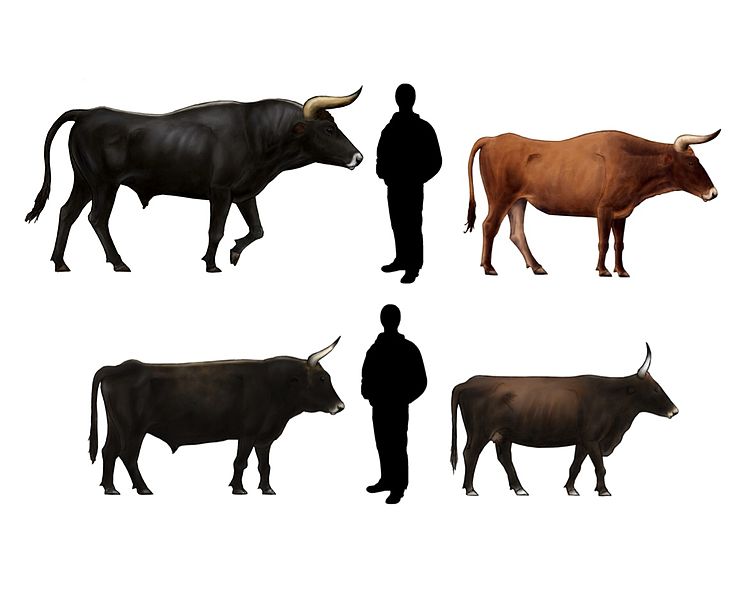
One other region that shows signs of selection in the aurochs genome has to do with neurobiology. Possibly as a result of breeding for tameness and trying to pacify the wild species ferocious nature. It may be a truism that more people are killed each year by cows than sharks, but that hasn’t stopped people actually trying to recreate the savage aurochs. Perhaps the best known attempt was instigated by Herman Goering, via two zoologist brothers: Lutz and Heinz Heck. The story of the Heck cattle is fascinating and the parallels between a misguided project to recreate a mythical German Ur-cow, and the atrocities of the Nazi war machine when they applied this thinking to humans are all too obvious. The brothers took a range of modern cattle breeds (including Highland cows, Spanish bullfighting bulls) and bred them together to create something that bore a passable resemblance to an aurochs. They are still around today, where you can see them in zoos and wildlife parks. Me, I’d rather just hang out at the farm.

Comparison of life appearance of aurochs and Heck cattle. Image by

Comparison of life appearance of aurochs (top) and Heck cattle (below). Image by DFoidl via Wikimedia Commons

Written by Ross Barnett (@DeepFriedDNA)

Further Reading:

Achilli, A., A. Oliveiri, M. Pellecchia, C. Uboldi, L. Colli, N. Al-Zahery, M. Accetturo, et al. “Mitochondrial Genomes of Extinct Aurochs Survive in Domestic Cattle.” Current Biology 18, no. 4 (2008): R157-R58. [Abstract]

Caesar, Julius, Carolyn Hammond, and Aulus Hirtius. Seven Commentaries on the Gallic War. The World’s Classics. Oxford ; New York: Oxford University Press, 2008.[Book]

Edwards, C. J., D. A. Magee, S. D. Park, P. A. McGettigan, A. J. Lohan, A. Murphy, E. K. Finlay, et al. “A Complete Mitochondrial Genome Sequence from a Mesolithic Wild Aurochs (Bos primigenius).” PLoS One 5, no. 2 (2010): e9255.[Full Text]

Gotherstrom, A., C. Anderung, L. Hellborg, R. Elburg, C. Smith, D. G. Bradley, and H. Ellegren. “Cattle Domestication in the near East Was Followed by Hybridization with Aurochs Bulls in Europe.” Proceedings of the Royal Society of London: Series B 272 (2005): 2345-50.[Full Text]

Orlando, L. “The First Aurochs Genome Reveals the Breeding History of British and European Cattle.” Genome Biol 16 (2015): 225.[Full Text]

Park, S. D., D. A. Magee, P. A. McGettigan, M. D. Teasdale, C. J. Edwards, A. J. Lohan, A. Murphy, et al. “Genome Sequencing of the Extinct Eurasian Wild Aurochs, Bos Primigenius, Illuminates the Phylogeography and Evolution of Cattle.” Genome Biol 16 (2015): 234.[Full Text]

Zeyland, J., L. Wolko, J. Bocianowski, M. Szalata, R. Slomski, A. M. Dzieduszycki, M. Ryba, H. Przystalowska, and D. Lipinski. “Complete Mitochondrial Genome of Wild Aurochs (Bos Primigenius) Reconstructed from Ancient DNA.” Pol J Vet Sci 16, no. 2 (2013): 265-73.[Full Text]


Posted in Aurochs | Tagged , , , , , , , , , , , , , | 12 Comments

Big find in little China

Charles Darwin wrote 502 pages outlining his groundbreaking theory of evolution by natural selection. In it he provides incredible evidence of natural selection he gathered over 20 years, using many different species of animals, from humans breeding dogs to the wonderfully long tongues of moths. One species was conspicuously missing: Homo sapiens. Darwin gives just one tantalising line, writing:

“Light will be thrown on the origin of man and his history.”

[Clearly he meant ‘humans’ and ‘our’ history. I suspect the publisher’s deadlines were quite tough and this slipped passed Darwin.]

There was only one answer for the origin of humans in 1859: God, of course.

Darwin’s sentence may have been small, but it was incredibly powerful. Although it doesn’t specifically say, the theory of evolution by natural selection would not discount humans. There were similarities with the great apes and humans, but there were no hominin fossils then known. Although the first Neanderthal fossils were found in 1856, it would be another 8 years before it was recognised as a new species. In fairness, Darwin did boldly address the issue of the descent of humans in his 1871 book, The Descent of Man, and Selection in Relation to Sex. Here he suggests that humans evolved in Africa, where he writes:

“In each great region of the world the living mammals are closely related to the extinct species of the same region. It is, therefore, probably that Africa was formerly inhabited by extinct apes closely allied to the gorilla and chimpanzee; and as these two species are now man’s nearest allies, it is somewhat more probable that our early progenitors lived on the African continent than elsewhere.”

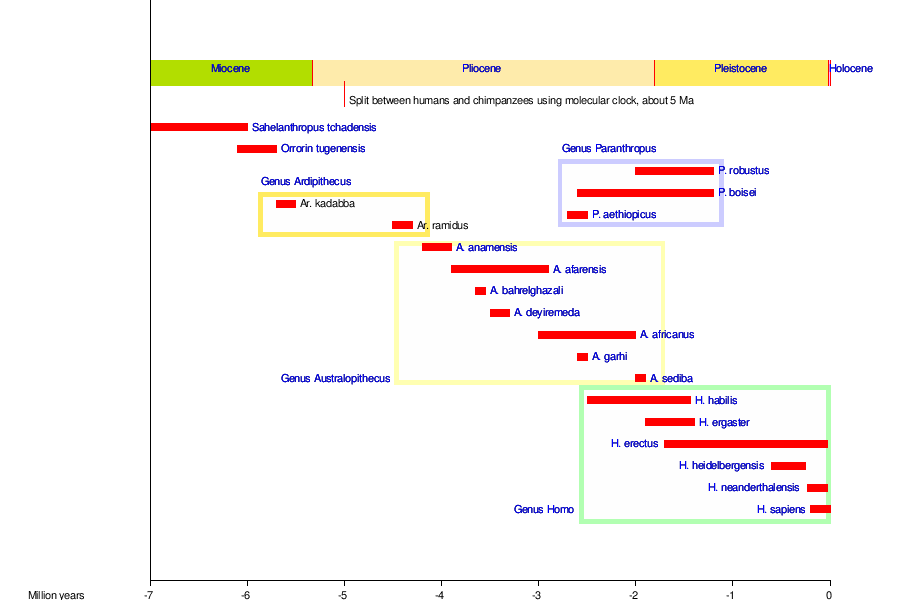
That Neanderthal fossil was just the beginning. Light would indeed be thrown. In fact, like the rays of dappled light through the canopy in an afternoon stroll through the woods, light would be scattered. Dozens of fossil finds over the next century would show how complicated human evolution was. Families, as we all know, are never simple: the hominin family is no exception. From the strange root munching ‘robust australopithecines’ to the enigmatic recent Homo naledi, our human family history was enormous with several cousins and second cousins. With a rich, varying environment, the African landscape allowed for a diverse range of specialist hominins to evolve. In the past there were a number of hominins living at the same time. Today we are the only upright ape left on the planet.

Meet the family. (Image Public Domain)

Meet the family. The many species of hominins and how long they were on the planet. Notice that several species were around at the same time. (Image Public Domain)

It was not a straight step by step evolution to Homo sapiens. It was a huge, bushy tree with many branches. Some species split off and died off without leaving any descendents, like the Neanderthals who split from our common ancestor around 500,000 years ago. Other species changed. We should say that just because a species became extinct and left no descents doesn’t mean that it was not successful – all the hominins we have discovered so far were perfect fro their particular niche.

What these incredible fossils have shown us is that the origins of our species was in Africa.

Next to the muddy, life giving waters of the Omo River in Southern Ethiopia, in the late 60s and early 70s, hominin bones were discovered in the sun cracked sediment. The skull fragments, legbones and numerous teeth were described as belonging to Homo sapiens. What makes these specimens so important is that they are the earliest remains of anatomically modern humans discovered so far. More fossil finds at the same layer in 2008 allowed them to be dated at around 200,000 years old.

"Homo-Stammbaum, Version Stringer-en" by Homo-Stammbaum, Version Stringer.jpg: Chris Stringerderivative work: Conquistador - This file was derived from  Homo-Stammbaum, Version Stringer.jpg:. Licensed under CC BY-SA 3.0 de via Commons - https://commons.wikimedia.org/wiki/File:Homo-Stammbaum,_Version_Stringer-en.svg#/media/File:Homo-Stammbaum,_Version_Stringer-en.svg

Not a simple road leading to the evolution of Homo sapiens.  One version of H. sapiens evolution based on fossil finds and distribrution. Note how H. sapiens blend with Neanderthals and the Denisovans. The story of us is not clear and simple. (Image Public Domain)

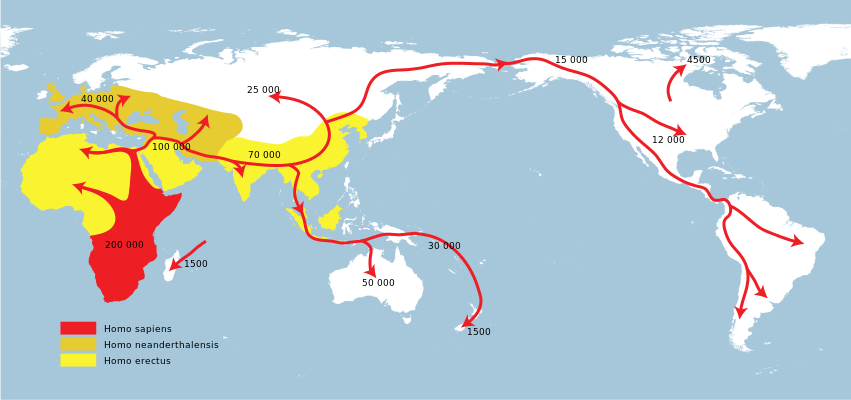
One of the key things you will notice on the diagram above is that our species, Homo sapiens was not the only hominin to leave Africa. The very successful species, Homo erectushas been found in Georgia, and as far East as Java and China. Neanderthals of course, were a very successful species across Europe. And then there was the enigmatic little hominin species, Homo floresiensis, which lived on the small Island of Flores.

Our species seems to have been the one that spread furthest, not just across the land, but across water too. Pin pointing when and where groups travelled was never going to be easy. Based on some fossils finds, and more recently with additional work from genetics, the commonly held view is that Homo sapiens left Africa around 75,000 years ago, reaching Asia around 70,000-50,000 years ago, and a ‘small’ hop to Australia around 50,000 – 46,000 years ago. Simple, clean and easy. Surely we know by now that things are never this simple? Some fossil evidence shows there were attempts by some groups of Homo sapiens to leave Africa much earlier, around 125,000 years ago. It was thought that they either died out, or retreated back to Africa because there are not other fossils in Asia and Europe that are nowhere near as old. It is likely that there were several attempts at moving further into Asia by several independent groups, but left no trace.

"Spreading homo sapiens la" by NordNordWest - File:Spreading homo sapiens ru.svg by Urutseg. Licensed under Public Domain via Commons - https://commons.wikimedia.org/wiki/File:Spreading_homo_sapiens_la.svg#/media/File:Spreading_homo_sapiens_la.svg

An illustration of the migration of three human species. Only Homo sapiens travelled to Australia and the Americas. (Image Public Domain)

Theories are put forward based on all the available evidence. When new finds are made, the theories are changed accordingly. With rare open air sites preserving early H. sapiens fossils, palaeontologists turn the caves. Shielded from the outside world, and being crunched to nothing by scavengers, bones in caves have a stronger chance of fossilisation. This is one of the main reasons for the lack of Homo sapiens remains: preservation is rare and the area they lived in was pretty big. But fossils do turn up. And sometimes these completely change entire views altogether. And it does happen.

A new publication in Nature tips this conventional view of the migration of Homo sapiens on its head. In an extensive cave system in the Daoxian County, Southern China, palaeontologists have found one cave with some incredible finds. Within the layered sediment in the Fuyan Caves, 47 human teeth have been excavated. 47 teeth belonging to Homo sapiens. Detailed analysis of the size, cusp patterns and root shapes compared to other species of Homo from Africa Europe and Asia (NeanderthalsHomo erectus, and H. sapiens) show that these teeth belonged to H. sapiens. The authors showed they were not a locally evolved H. erectus population. This detail is important because of the age of the layer they were found in.

The site in Fuyan Cave have four layers: the bottom (oldest) layer was a silt with breccia; the third layer was a sandy gravel; the second layer contained the human teeth and mammal fossils; the top layer was a hard calcite flowstone. Using Uranium/Thorium dating, staligmite within the second layer was dated to between 120,000 – 80,000 years ago. This correlates to the Late Pleistocene mammals found in this layer, including the giant extinct Elephantidae, Stegodon orientalis, and an extinct hyena Crocuta ultima. This is a special site, because the excavation and stratigraphy has been recorded in such detail. We know exactly where each fossil came from. And we also know that the human teeth were not washed in from  a younger deposit, because the second layer is capped by a hard calcium flowstone: everything below that flowstone was deposited around the same time.

The Daoxian fossils show that Homo sapiens were in Asia much earlier than originally thought: at least 30,000 years earlier. There are still dozens of questions which need answering, and the discovery has several implications, as well as new possible areas to look for human remains. This may have been a population that survived from the first phase out of Africa 125,000 years ago; or they may have been a completely seperate exodus. The group may have died leaving no descendents; or they could have continued their travels, making new homes on the way, all the way to Australia.

The history of our species is not a straightforward walk across a continent. Some groups may well have travelled, but they may have stayed and other groups travelled past them to new areas through different routes. Fossils do not necessarily show a clear migration route. What is fascinating about our history is that the more evidence we discover, the more incredible the journey to where we are today becomes.

Written by Jan Freedman (@JanFreedman)

Postscript: Interestingly, in The Descent of Man, and Selection in Relation to Sex Darwin devotes just a few chapters to the origin of humans, but several more outlining his second theory of evolution by sexual selection. Fascinatingly we are looking at how sexual selection has worked on the evolution of our own species from big eyes to big lips. There has been a large amount of study into the human penis, which is larger (on average) for our size than other apes. Focus, however, may be beginning to be shifted from the penis and towards the ‘large vagina’ as anthropologist Holly Dunsworth discusses in her wonderful post ‘Why is the human vagina so big?’ Perhaps in the ‘large’ penis evolved in response to the large vagina: females controlling the selection?

Further reading:

Read about the incredible discovery of Homo naledi in our post written by one of the excavators: We are made of star stuff.

Read about the lost branch of Paranthropus in Side by side with Homo.

Discover how Neanderthals and us are pretty similar in Neanderthals and us: we’re not so different.

Read Holly Dunsworth’s wonderful post on the evolution and the human vagina: Why is the human vagina so big?

Darwin, C. (1859). ‘On the origin of species by means of natural selection, or the preservation of favoured races in the struggle for life.’ London: John Murray. [Full Book]

Darwin, C. (1871). ‘The descent of man, and selection in relation to sex.’ John Murray. [Volume 1, Volume 2]

Fagan, B.M. (1996). The Oxford Companion to Archaeology. Oxford, UK: Oxford University Press. [Book]

Finlayson, C. (2005). ‘Biogeography and evolution of the genus Homo.’ Trends in Ecology & Evolution. 20. (8). pp. 457-463. [Abstract only]

Fleagle, J. G., et al. (2008). ‘Paleoanthropology of the Kibish Formation, southern Ethiopia: Introduction.’  Journal of Human Evolution 55 (3): 360–365. [Abstract only]

Garcia, T., et al. (2010). ‘Earliest human remains in Eurasia: New 40Ar/39Ar dating of the Dmanisi hominid-bearing levels, Georgia.’ Quaternary Geochronology5 (4): 443–451. [Full article]

Ian McDougall, I, Brown, F. H., & Fleagle, J. G. (2008). Sapropels and the age of hominins Omo I and II, Kibish, Ethiopia. Journal of Human Evolution 55: 3, pp. 409-20. [Full article]

Lawler, A. (2011). ‘Did Modern Humans Travel Out of Africa Via Arabia?’. Science 331 (6016): pp.387. [Abstract only]

Pearson, O. et al. (Sep 2008). ‘Further new hominin fossils from the Kibish Formation, southwestern Ethiopia.’ Journal of Human Evolution. 55 (3): pp.444–7. [Abstract only]

Shena, G. et al. (2002). “U-Series dating of Liujiang hominid site in Guangxi, Southern China.’ Journal of Human Evolution 43 (6): pp.817–829. [Abstract only]

Stringer, C. (2012). ‘What makes a modern human.’ Nature 485 (7396): 33–35. [Abstract only]

Trinkaus, E. (2005). “Early modern humans.’ Annual Review of Anthropology 34 (1): 207–30. [Abstract only]

Wu Liu, et al., (2010) ‘Human remains from Zhirendong, South China, and modern human emergence in East Asia.’ Proceedings of the National Academy of Sciences. [Full article]

Wu, L., et al. (2015) ‘The earliest unequivocally modern humans in southern China.’. Nature. 526. pp.696-699. [Abstract only]

Posted in Homo sapiens | Tagged , , , , , , , , , , , , , | 6 Comments

Baby’s got quack

Who could actually resist a news headline about a giant Pleistocene Japanese duck? Not me, I’m afraid. Kaiju films are one of my favourite things, alongside disaster movies. From Godzilla to Pacific Rim, I love ‘em all. Add the word Pleistocene and that’s it – it’s a paper I need to read! The very recent article by Junya Watanabe and Hiroshige Matsuoka in the Journal of Vertebrate Biology was immediately placed on my list of ‘need-to-read’ papers!

Some time back I had researched and presented the story of the extinct giant Hawaiian duck, the Moa Nalo. Keeping that info at the back of my mind, I plunged into the paper, which, although brief, is quite technical for someone who is not in any way an expert on bird bones. Yet it tells a fascinating tale of painstaking, methodical research and detective work, and just how the reassessment of old material is always utterly necessary.

But let’s start at the very beginning; the ‘new’ duck Shiriyanetta hasegawai isn’t really so new. The bones had been found over a span of time, from the 1950s to the 1980s, mostly from areas of Shiriya, in north-eastern Japan, which had once been marine terraces back in Pleistocene times. Hence its name – Shiriya for the area and Hasegawa the first scientist to wonder what the bones actually belonged to, back in the 1950s. The assemblages of skull fragments, limbs and pectoral bones were never fully identified. It was just another lost creature of the Ice Age, presumed to be some sort of Mergini, or seaduck species. But that was before the Duck Detectives, Watanabe and Matsuoka, got started on the analysis of those bones!

eflksa "Location TsugaruPeninsulaJp". Licensed under Public Domain via Commons - https://commons.wikimedia.org/wiki/File:Location_TsugaruPeninsulaJp.jpg#/media/File:Location_TsugaruPeninsulaJp.jpg

Shiriya is located at the norther tip of Japan’s largest island. Around 20,000 years ago the islands were connected by landbridges with the lower global sea levels. (Image Public Domain)

It became pretty evident that S. hasegawai belonged to the Anatidae family, and was as flightless as those other Pacific giants, the Moa Nalo, and goose species Branta rhuax and Branta hylobadistes. I’m a bit disappointed that there’s no reconstruction of what the bird would have looked like – I for one want to see how similar or different it was to other ancient or modern species We do know, however, it was quite a large duck, about the size of the modern Muscovy Duck (Cairina moscata) or Steamer Duck (Tachyeres patachanicus), weighing in around 7kg, so not a giant, but a rather large bird of its type. If it resembled anything else in that primeval world of ice and refugia, it was the Californian Chendytes, a large goose-like sea duck which became extinct within recent prehistory.

Detailed analysis showed that the skeletal structure of S. hasegawai incorporated airspace within the bones (technically called the skeletal pneumaticity), indicating a powerful diving bird; those airspaces are necessary for buoyancy and surfacing again after plunging into water after tasty fish! The ridge on the shoulder blade bones (margo caudalis) was also typical of a flightless bird. The sturdy leg bones also suggested they were made to support a creature of larger than average body mass, which again pointed to lack of flight – the higher bone density, along with large body size gives quite a competitive edge in underwater diving. The price for that diving advantage is lack of flight.

"Chendytes lawi" by The original uploader was Apokryltaros at English Wikipedia - Transferred from en.wikipedia to Commons.. Licensed under CC BY 2.5 via Commons - https://commons.wikimedia.org/wiki/File:Chendytes_lawi.jpg#/media/File:Chendytes_lawi.jpg

There are currently no images of the Giant Japanese Duck. Did it look a little similar to Chendytes lawi? (Image by Stanton F Fink. Public Domain)

So, the upshot is that the previously unnamed seaduck, now known as S. hasegawai was probably a very successful creature in cool climates, adept at diving for food, not unlike its nearest modern ‘cousins’ the Eider duck. It would appear that they occupied a very specific niche environment for which they were perfectly adapted, just like their ‘cousins’, Chendytes, across the Pacific Ocean on the West Coast of the USA. Living right on the seafront, these birds had little need to seek food supplies elsewhere. Seasonal migration would be unnecessary when all the fish in the sea are yours for the taking. It’s likely that like the modern Eider, these Pacific ducks would have conserved body heat with soft, warm plumage. Within such a stable environment, flight was simply a waste of energy which could be better used in foraging.

The world these birds lived in was considerably different from today – the Japanese archipelago we know is the result of regular and dramatic sea level changes from the Ice Age onwards. While Japan escaped the great ice sheets, the landscape of Ice Age Japan was covered in deep coniferous forests with smatterings of Fagus (beech) and Quercus (oak) groves on the southern coasts of Kyushu. Temperatures were cool, ranging between 8oC and 6oC, which was decidedly balmy compared to the big freeze in Europe and North America of 20,000 years ago. Land bridges connected all four main islands. There was a connection to Korea via the southern island of Kyushu and the northern island of Hokkaido was likely joined to Siberia, right up to the end of the Ice Age, around 15,000 years ago, when the meltwaters flooded the region and created the islands we know now. The Japanese fauna included mammoths, of course, but also the beautiful Sinomegaceros yabei, Palaeoloxodon, and numerous smaller mammals. Placing our large, fluffy ducks in this time, and environment, there was indeed little need for flight. They dodged the icy bullet of the glaciers which affected parts of California and even Hawaii of the Last Glacial Maximum, and likely knew no serious danger until the arrival of humans, via those landbridges. It’s speculated that the first humans arrived in Japan around 30,000 years ago, a story told by both human remains and animal traps , discovered across the island. We also know they were voracious hunters, and many species succumbed to unsustainable hunting.

"Japan glaciation" by Davison A, Chiba S, Barton NH, Clarke B. - Davison A, Chiba S, Barton NH, Clarke B. (2005) "Speciation and Gene Flow between Snails of Opposite Chirality" (in English). PLoS Biology 3 (9, e282). doi:10.1371/journal.pbio.0030282 [1]. Licensed under CC BY 2.5 via Commons - https://commons.wikimedia.org/wiki/File:Japan_glaciation.gif#/media/File:Japan_glaciation.gif

Around 20,000 years ago Japan was one large island. The mountains formed the base for glaciers to grow. (Image by Davison A, Chiba S, Barton NH, & Clarke B. Public Domain)

At this moment in time, nobody knows exactly when S. hasegawai became extinct; it’s early days for research yet, and there’s no speculation on extinction dates within the paper. The series of unfortunate events brought on by the end of the Ice Age created rapid changes in temperature, sea level and vegetation, often irrevocably altering the environment for niche species. At the same time, milder temperatures and lack of ice allowed humans to go on the move, bringing with them overkill and human alteration to landscapes. The factors are likely best looked at as a combination which was not conducive to the preservation of Pleistocene species. A flightless, large plump duck with warm feathers was likely easy hunting for early humans, making S. hasegawai another statistical casualty of the march of Homo sapiens across the Holocene world.

However, something rather odd has been spotted in Japanese waters….. giant ducks bobbing about in Osaka harbour, large enough to scare off any human hunter. You could be forgiven for imagining this kawaii kaiju as the result of nuclear mutation, as all the best movies start that way, of course! Duckzilla? We await the movie of this!

Written by Rena Maguire (@JustRena)

Further reading:

Giant rubber ducks in Osaka! Read about the giant inflatable duck here!

An excellent article on Japanese Palaeolithic archaeology, by Suzuki, H and Tanabe, G. Available here.

Campbell, K. E., Jr., & Marcus, L. (1992). ‘The relationship of hindlimb bone dimensions to body weight in birds’ in K. E. Campbell Jr. (ed.), Papers in Avian Paleontology Honoring Pierce Brodkorb. Natural History Museum of Los Angeles County, Science Series 36. pp. 395–412. [Book]

Davison, A, et al. (2005). ‘Speciation and gene flow between snails of opposite chirality. PLOS BIOLOGY. DIO:10.1371/Journal.pbio.0030282

Feduccia, A. (1999). The Origin and Evolution of Birds, second edition. New Haven: Yale University Press. [Book]

Fulton, T. L., Letts, B & Shapiro, B. (2012). ‘Multiple losses of flight and recent speciation in steamer ducks’. Proceedings of the Royal Society of London B: Biological Sciences 279. pp. 2239–2346. [Abstract only]

Gutzwiller, S. C., Su, A., & O’Connor, P. M., (2013). ‘Postcranial pneumaticity and bone structure in two clades of neognath birds’. The Anatomical Record 296. pp 867–876. [Full article]

Livezey, B. C. (1993). ‘Morphology of flightlessness in Chendytes, fossil seaducks (Anatidae: Mergini) of coastal California’. Journal of Vertebrate Paleontology 13. pp 185–199. [Abstract only]

Nakajima, Z. (1958). ‘On the occurrence of the Quaternary mammalian fauna from the limestone fissures near Shiriya-zaki, Shimokita Peninsula, Aomori Prefecture, Japan (No. 2)’. Miscellaneous Reports of the Research Institute for National Resources. 46/47. pp 37–39. [Japanese with English summary]

Norton, C, Kondo, Y, Ono, A, Zhang, Y, & Diab, M. (2010). ‘’The nature of megafaunal extinctions during the MIS 3–2 transition in Japan’ Quaternary International. 211. pp133-122. [Full text]

Ogino, S, Otsuka, H, & Harunari, H. (2009). ‘The Middle Pleistocene Matsugae Fauna, Northern Kyushu, West Japan’. Paleontological Research 13.4. pp 367-384. [Abstract only]

Olson, S. L. (1985). ‘The fossil records of birds’ in D. S. Farner, J. R. King, and K. C. Parkers (eds.), Avian Biology, Volume 8. New York: Academic Press. pp. 79–238. [Book]

Pelletier, D., Guillemette, M, Grandbois, J., & Butler, P. J. 2008. ‘To fly or not to fly: high flight costs in a large sea duck do not imply an expensive lifestyle’. Proceedings of the Royal Society of London B: Biological Sciences 275. pp 2117–2124. [Full article]

Stuart, A. J & Lister, A. M. (2012). ‘Extinction chronology of the woolly rhinoceros Coelodonta antiquitatis in the context of late Quaternary megafaunal extinctions in northern Eurasia’. Quaternary Science Reviews51, pp 1-17. [Full article]

Surovell, T, Waguespack, N, & Brantingham, P.J. (2005). ‘Global archaeological evidence for proboscidean overkill’ [Full article]

Tsukadaa, M. (1983). ‘Vegetation and climate during the last glacial maximum in Japan’. Quaternary Research. 19.2. pp 212–235. [Full article]

Watanabe, J & Matsuoka, H. (2015). ‘Flightless diving duck (Aves, Anatidae) from the Pleistocene of Shiriya, Northeast Japan’. Journal of Vertebrate Paleontology. [Abstract only]

Posted in Uncategorized | Tagged , , , , , , , , , , , , , , | 7 Comments

Clovis hunting an African elephant

Clovis points from the Rummells-Maske Site, 13CD15, Cedar County, Iowa. Image by Bill Whttaker from Wikimedia Commons

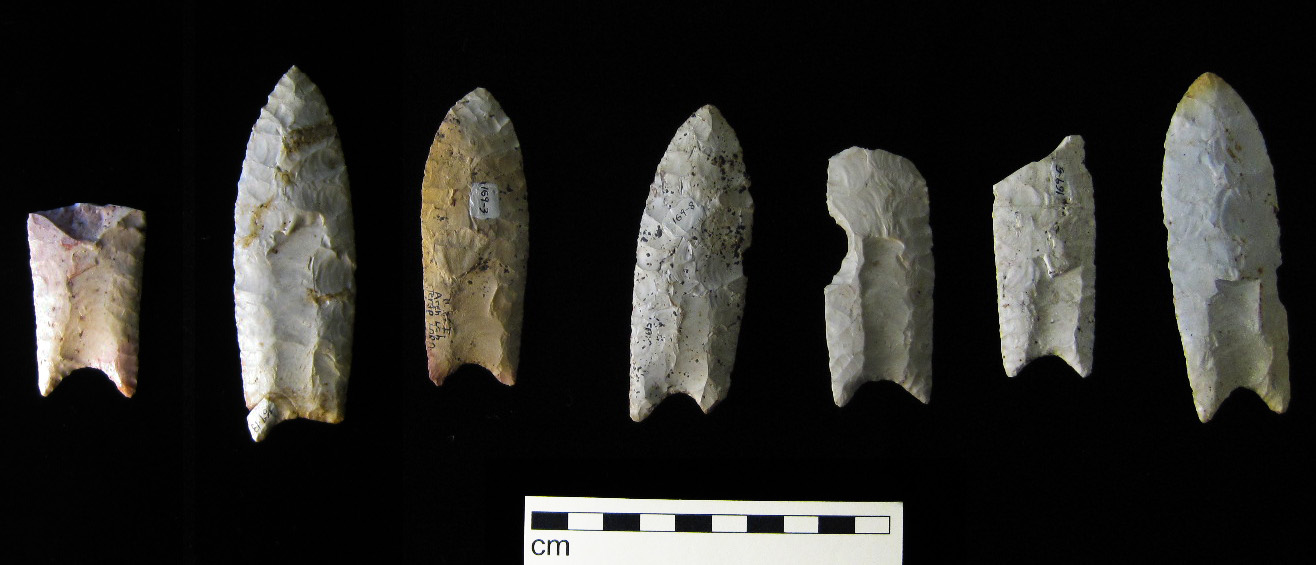
Clovis points from the Rummells-Maske Site, 13CD15, Cedar County, Iowa. Image by Bill Whittaker from Wikimedia Commons

One of the advantages of having entered academia after the internet revolution is that the majority of my library is virtual. My laptop PDF paper collection is currently at 6,554 items (and there are another 1,500 or so waiting to be sorted in my download folder). I generally download anything that interests me on a theme of ancient DNA, felids, Pleistocene mammals, extinction, archaeology etc. and everything is renamed by first author surname to be easily searchable. There is too much awesome science!

I was flicking through some of the papers the other day when I came across an article by George C. Frison from American Antiquity titled “Experimental Use of Clovis Weaponry and Tools on African Elephants” vol.54 p.766

It is like no paper I’ve ever seen before and a riveting read.

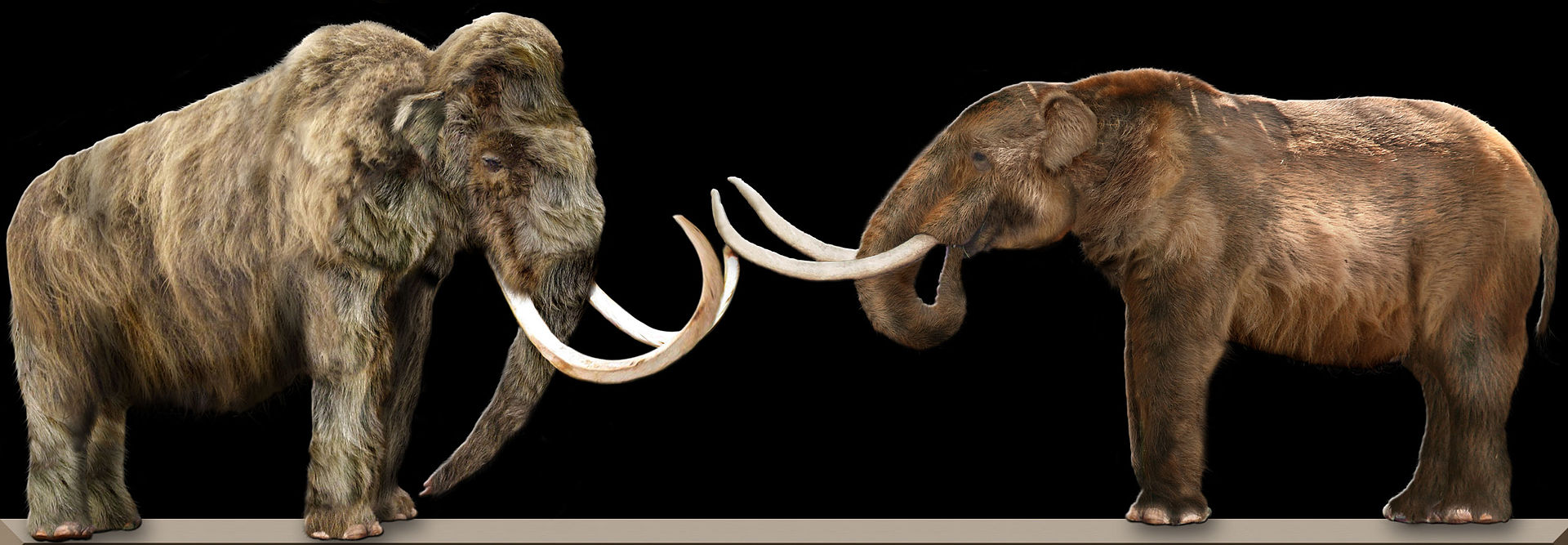
In it the author recounts his use of replica Clovis points during collaboration with Hwange National Park in Zimbabwe to cull African savannah elephants (Loxodonta africana). The elephants are deemed a suitable substitute for the woolly mammoths (Mammuthus primigenius), Columbian mammoths (Mammuthus columbi) and mastodon (Mammut americanum) of the Nearctic late Pleistocene, known to the Clovis culture.

"MammothVsMastodon" by Dantheman9758 at the English language Wikipedia. Licensed under CC BY-SA 3.0 via Commons.

Two of the big giants in North America, the Woolly Mammoth (left) and the Mastodon (right). There is evidence that both these beasts have been hunted by humans. (Image Public Domain).

Frison seems to have been slightly obsessed with the notion of “true hunters” – hunters who would only select mature, healthy individuals to kill. To me this seems a slightly romantic notion and I am sure that palaeoindians, cro-magnons, and other modern human groups that encountered and hunted mammoth in difficult conditions would not have taken so noble a path. (In reality, carnivores kill more old or injured individuals than those in their prime. Simply because they are easier to catch.)

He created replica socketed thrusting spears and throwing spears (using a spear thrower, known as an atlatl). Atlatl are ingenious inventions that almost effortlessly add incredible speed and force to a spear; more than a human arm could achieve. ‘Effortlessly’ is a slightly underplayed adverb, because they may be fast and powerful but it takes intensive practice to throw a spear with an atlatl and hit a target. Around 21,000 years ago, in what is now France, paleolithic people were practicing with spear throwers made from mammoth ivory and reindeer antler.

"Mammoth Spear Thrower" by Sara Branch from Cymru / Wales (Spear thrower carved as a mammoth). Licensed under CC BY 2.0 via Commons - https://commons.wikimedia.org/wiki/File:Mammoth_Spear_Thrower.jpg#/media/File:Mammoth_Spear_Thrower.jpg

An amazing spear thrower made from reindeer antler. This has been carved into the shape of a mammoth, from 12,5000 years ago in France. (Image by Sara Branch. Public Domain)

The study began with 7 Clovis points. One was accidentally broken before any use. One shattered on impact with an elephant rib on its first use. Five others survived the experiments (and one of those five broke on the last day of use). Quite an incredible attrition rate for serious chunks of stone. Almost all the tips broke off and the points had to be reshaped (something that paleolithic hunters would have done themselves if they retrieved their spears).

In the paper Frison recounts using his Clovis points on elephants that had been “mortally wounded or killed” during culling operations. He used his atlatl to hit elephants from a distance of 15m, 17m, 20m. He achieved penetration of the stomach, the lung, and various muscled parts, easily penetrating the thick skin and producing woulds that would have been lethal in living animals. He also brought large biface-reduction flakes for experiments in skinning the animals. Apparently one of these Clovis tools was lost while the group was chasing a herd of elephants. Frison mischievously comments “This may someday come as more than a small surprise to someone, because there are no known artefacts of this nature in this part of Africa”.

Written by Ross Barnett (@DeepFriedDNA)

[This post was originally from @DeepFriedDNA’s personal blog]

Further Reading:

Frison, G. C. “Experimental Use of Clovis Weaponry and Tools on African Elephants.” American Antiquity 54, no. 4 (1989): 766-84.[Abstract]

Surovell, T. A. , and N. M. Waguespack. “How Many Elephant Kills Are 14? Clovis Mammoth and Mastodon Kills in Context.” Quaternary International 191, no. 1 (2007): 82-97. [Full Text]

Waters, M. R., T. W. Stafford, Jr., H. G. McDonald, C. Gustafson, M. Rasmussen, E. Cappellini, J. V. Olsen, et al. “Pre-Clovis Mastodon Hunting 13,800 Years Ago at the Manis Site, Washington.” Science 334 (2011): 351-53.[Full Text]

Woodman, N., and N. B. Athfield. “Post-Clovis Survival of American Mastodon in the Southern Great Lakes Region of North America.” Quaternary Science Reviews (2009).[Full Text]


Posted in Clovis hunters | Tagged , , , , , , , , , , | 6 Comments

The first Mammoth of the Steppes

Four men stood beneath the wooden frame of this enormous proboscidean. On the front left leg, the man slowly raises his own left leg, bringing up with it the leg of the beast. Slowly, the skeletal leg lifted from the ground, moved forward a few feet, then rested on the soft sand. Suddenly, the other three men began lifting their appropriate legs in a well organised dance, making this gigantic structure start ‘walking’. Audible gasps from the crowd of over 700 people could be heard along this normally desolate Norfolk beach.

This is not the scene from some weird 21st century Wickerman-style cult, with the hope of a good harvest. The wonderful wooden creature is based on an extraordinary beast that walked on real, fleshy padded feed around 600,000 years ago: the Steppe Mammoth (Mammuthus trogontherii).

A huge creature, the Steppe Mammoth may have been the largest species of  elephant to have existed, rivalling the giant African Deinotherium. Calculations based on fossils place this standing much taller than a double decker bus. Fossil teeth reveal a lot about its diet. It had between 18-20 ridges on tough flat molars (its descendent, the Woolly Mammoth Mammuthus primigenius, had around 26 ridges). These plates added strength to the teeth, allowing them to eat a range of tough vegetation. An increase in plates from its ancestor, the Southern Mammoth(Mammuthus meridionalis), allowed it to adapt to the drying Siberian environment. Rare finds of almost complete specimens even reveal clues to their lifestyle. Tusks in the males were thicker and larger than those in females, suggesting the bulls fought for dominance, like elephants do today.

Image Public Domain

The impressive family of Mammoths. From the awesomely sweet dwarf mammoth Mammuthus exilis (yellow), to the biggest, the Steppe Mammoth (black). (Image Public Domain)

This was quite the beast. Thick molars allowed it to take advantage of a new environment which was spreading. With the climatic shifts, and more ice in the ice caps, there was a newer, drier environment in northern Europe; the Steppe. Diverging from its smaller ancestor, the Southern Mammoth, somewhere around 700,000 years ago in Siberia, the Steppe Mammoth lolloped far and wide. Fossils have been found across Europe and Asia, and as far East as Japan.

Since its original discovery in 1857, the taxonomy of this beast has been very taxing. Fossils found in Europe were named Mammuthus trogontherii, while those found in Asia were named M. ameniacus. Another species was added to the mix in 1959, M. sungari, which ended up being a mixture of Steppe Mammoth and Woolly Mammoth bones. The reason for this species confusion? The simple answer is variation. Variation within a species is what makes each individual unique, and a key part of the evolution of species. Look around the next time you are on a train or a bus, everyone (barring your identical twins) is strikingly different: different eye colour, hair colour, skin colour, nose shape, face shape, height, and so on. Most, but obviously not all, of these differences are recorded in an individual’s skeleton. Compare my skeleton to yours and there will be clear differences. But there are more similarities which show you and I belong to the same species. We know we are all one species. But when we get to the bare bones it becomes a little more tricky. Our species sits within ranges of variation so everything inbetween is Homo sapiens. However, nature is never simple. Sometimes the variation within a species can blur into another.

This is what makes a palaeontologist’s job very difficult. With one or a small number of specimens, is the creature they are looking at a new species, or an individual that is just a variation within an already known species? Even after a very detailed look at those fossils named Mammuthus trogontherii and M. ameniacus we still don’t actually know if they are the same species. With variation distinct enough to cause confusion, there may have been various Steppe Mammoth sub-species living at the same time. (This isn’t as odd as it sounds. There are many sub-species we know of today. There are ten subspecies of leopards: still closely related enough to produce fertile offspring but distinct enough to warrant separation. A subspecies is witnessing a species changing. Whether or not that subspecies evolves into anything else or just vanishes is down to luck and natural selection.)

"Steppe mammoth" by Davide Meloni - Al tempo dei MammutUploaded by FunkMonk. Licensed under CC BY-SA 2.0 via Commons - https://commons.wikimedia.org/wiki/File:Steppe_mammoth.jpg#/media/File:Steppe_mammoth.jpg

The rather spectacular Steppe Mammoth, Mammuthus trogontherii. (Image by Davide Meloni, Public Domain)

There is a reason for that odd wooden elephant frame walking across the beach in Norfolk. Over a couple of years in the early 1990s, some very large bones were found exposed along the cliff on West Runton beach. Following the finds, the site was carefully excavated in 1995, resulting in the discovery of an almost complete skeleton of a Steppe Mammoth (subsequently called, the West Runton Elephant, but more accurately called the West Runton Mammoth). (A small display about the West Runton Mammoth is on display at Cromer Museum, and the Norfolk Museums Service have plans to create a 3D scan of the fossil bones. When this project is complete, they hope to mount the entire skeleton for public display!)

And because the excavation was fairly recent, and used modern excavation techniques, an amazing amount of information has been recorded about the time when this creature was alive. Around 85% of a male skeleton was found, only missing a few feet bones, ribs and the top of the skull. He was about 40 years old, and judging from a deformed right knee, probably walked with a limp. The West Runton Mammoth fell into a river bed, around 600,000 years ago, never to walk again.

An original photograph from the 1995 excavation of the West Runton Mammoth. (Image reproduced with kind permission from Norfolk Museum Service [Norwich Castle Museum & Art Gallery])

An original photograph from the 1995 excavation of the West Runton Mammoth. (Image copyright Norfolk Museum Service [Norwich Castle Museum & Art Gallery] and reproduced here with kind permission)

Fossils found in this river bed, called the West Runton Freshwater Bed, include snails, shrews, voles, deer, horse, rhinoceros, as well as the sabre tooth cat Homotherium latidens and the extinct rhinoceros Stephanorhinus hundsheimensis. Norfolk was very different 600,000 years ago than it is today.  As well as the animals, the landscape was very different. With so much ice trapped in glaciers to the north, the English Channel was not around, providing a dry land connection to Europe. Species came and went with the seasons. Pollen indicates that the temperature when the West Runton Mammoth lived was very similar to ours today.

We don’t know exactly when the Steppe Mammoth became extinct. It is thought to have vanished in Europe somewhere between 300,000 and 120,000 years ago towards the end of the Middle Pleistocene. From the specimens found so far, none show signs of cut marks by hominins. Increasingly drier temperatures put on more pressure and the Steppe Mammoth’s days were numbered. The smaller but hairier and fatter Woolly Mammoth was better adapted to life on the Mammoth Steppe, and this new age of the Late Pleistocene. However, it wasn’t pushed to extinction by the Woolly Mammoth. Although this incredible beast was outcompeted on the frozen steppe, the giant Mammuthus trogontherii lived on in China until at least 24,000 years ago. It may have vanished from the steppes forever, but this was a survivor of incredible times.

Written by Jan Freedman (@JanFreedman)

Further reading:

Lister, A. M, & Sher, A. V. (2001), ‘The origin and evolution of the Woolly Mammoth.’ Science. 294. pp.1094-1097. [Abstract only]

Lister, A. M. (2004), ‘The Impact of Quaternary ice Ages on Mammalian Evolution.’ Philosophical Transactions: Biological Sciences. 359 (1442). pp.221-241. [Abstract only]

Lister, A. M, et al. (2005). ‘The pattern and process of mammoth evolution in Eurasia.’ Quaternary International. 49. pp.126-128. [Abstract only]

Maglio, V. J. (1973), ‘Origin and evolution of the elephantidae.’ Transactions of the American Philosophical Society. 633. pp.1-149. [Full article]

Shashoni, J, & Tassy, P. (Eds) (1996), ‘The Proboscidea – evolution and palaeontology of elephants and their relatives.’ United Kingdom: Oxford University Press. [Book]

Tichonov, A, & Burlakov, Y. (2008), ‘Causes of Northern Giants’ extinction.’ Science in Russia. (Moscow: Nawka). 2. pp.48-53. [Abstract only]

Wei, G. B., et al. (2010), ‘New materials of the Steppe Mammoth, Mammuthus trogontherii, with discussion on the origin and evolutionary patterns of mammoths.’ Science China Earth Sciences. 53(7). pp.956-963. [Full article]

Posted in Steppe Mammoth | Tagged , , , , , , | 10 Comments