Meet Long Tusk

Some of you may have been lucky enough to see these incredible animals in the wild. Others may have felt a strong tug at your heart seeing one in a zoo. Most, if not all, of us have seen these magnificent creatures on amazing wildlife documentaries. And these are truly magnificent animals. Elephants are the heaviest land animals on the planet: weighing as much as five cars (yes, five cars!), the African elephant is the heaviest land animal on the planet!

When I see these enormous thick skinned, wrinkly mammals, I can easily imagine being face to face with a prehistoric animal. These are real survivors: with fossils of the ancestors of today’s elephants dating all the way back to the Pliocene. Elephants are the last of the true mega-fauna.
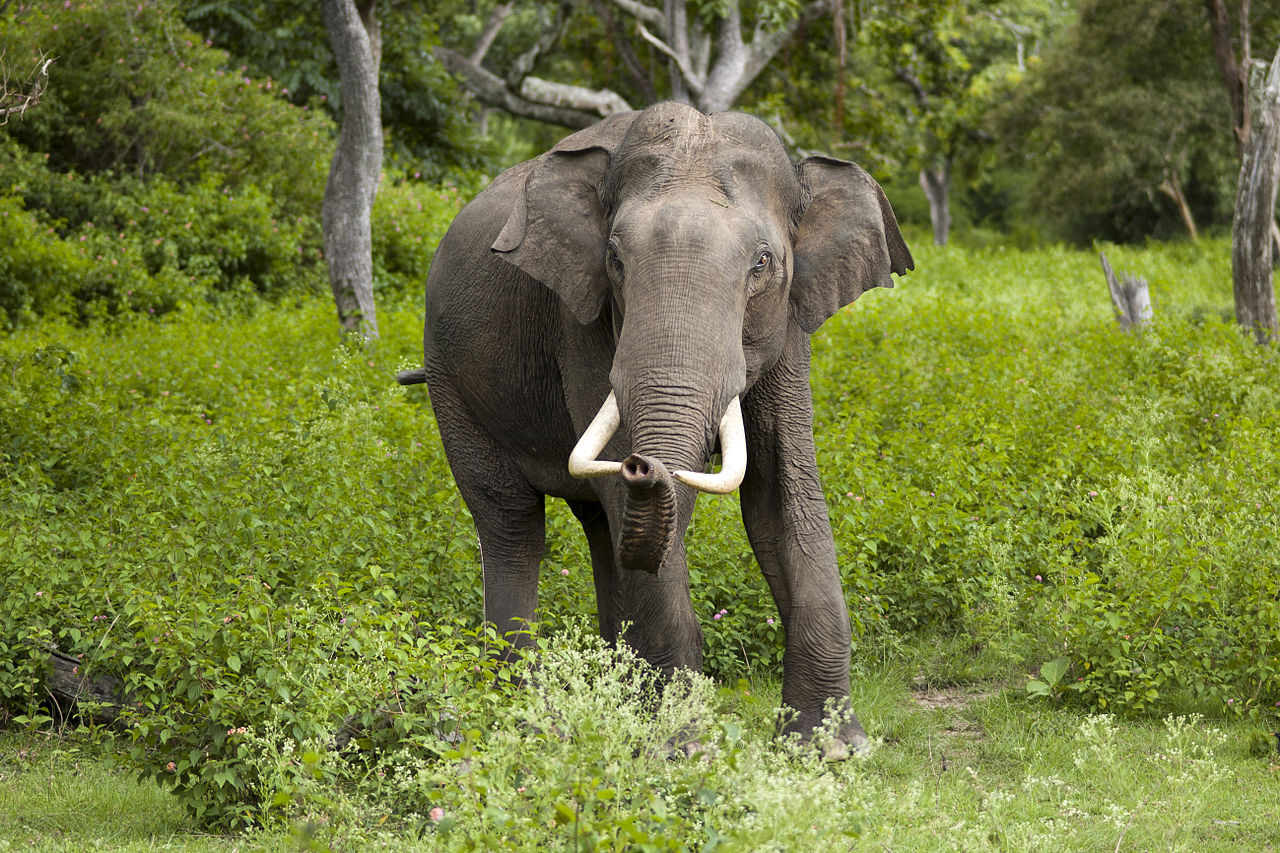
A beautiful Asian Elephant (Image by Yathin S Krishnappa, Public Domain)

A beautiful Asian Elephant (Image by Yathin Krishnappa, Public Domain)

There is a surprising amount of variety in these giants. There are two species of African elephants: Loxodonta africana (the African Bush Elephant) and Loxodonta cyclotis (the African Forest Elephant). As for their cousins, the Asian Elephant (easy to identify because of their smaller ears compared to the African elephant), there are three sub-species: Elephas maximus maximus; E. m. indicus; and E. m. sumatranus. Contrary to most of the wildlife documentaries showing elephants slowly trundling across the harsh, dry savannah, they are at home in some funkily diverse environments: savannah, deserts, forests, marshes, and even mountains. You would think big animals would be specialists suited to a particular environment. But elephants, it turns out, are fairly adaptable giants.

All elephants alive today belong to the Family Elephantidae. This Family is the last one surviving within the Order Proboscidea: since their origins around 30 million years ago, the other 9 proboscidean Families (with a whopping 177 species) are extinct. What survives today is just the trimmings of a once hugely diverse group of truly wonderful animals.

The variety of proboscideans (Artworks by Vladimir Nikolov. Editing and digital work by Docho Dochev.)

The variety of proboscideans since their origins around 60 million years ago. (Artworks by Vladimir Nikolov. Editing and digital work by Docho Dochev. Image from here)

And what a diverse group it was. There were giants, such as the enormous Steppe Mammoth and the Columbian Mammoth. There were pygmy mammoths off the coast of California and dwarf elephants living on Mediterranean Islands, as well as dwarf Stegodons on Flores. And some species in this Order were just weird, like Gomphotheres with their shovel-like mouths, and the gigantic Deinotherium with it’s downward facing tusks. There was one Pliocene proboscidean that had the longest tusks of any creature to have ever lived, and may have even rivalled Deinotherium in size.

Many proboscideans originated in Africa with some species spreading fairly quickly across the northern hemisphere. Perhaps one of the most successful was Zygolophodon (or, for a more informal name ‘Long Tusk’ for reasons you will see in a moment). Fossils of this incredible creature have been discovered in Northern and Southern America, Asia, Russia, and Europe.
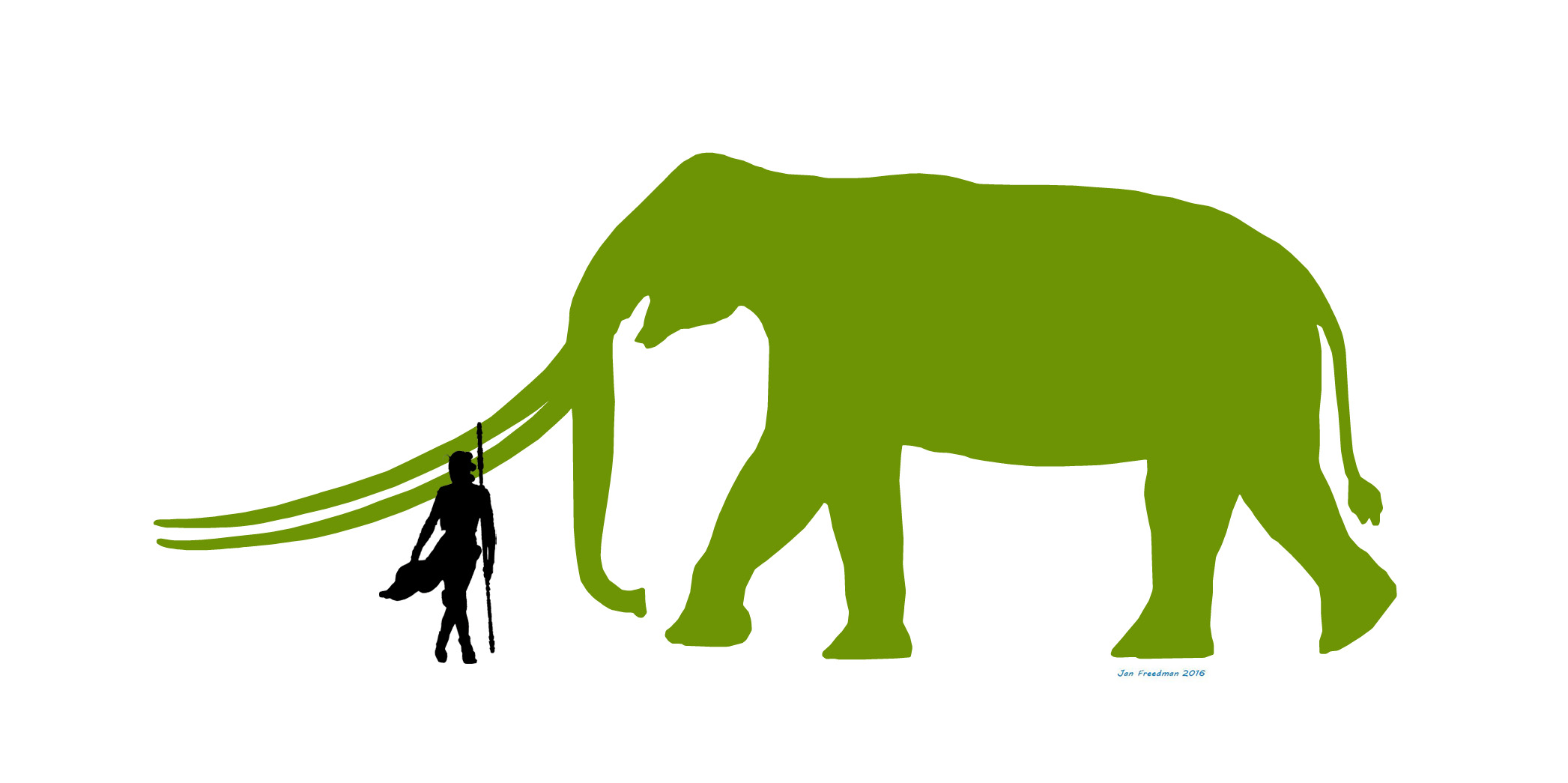
Meet Long Tusk. One of the largest land mammals, possibly boasting the largest tusks of any animal. Rey is dwarfed by it's size. (Image by Jan Freedman)

Meet Long Tusk. One of the largest land mammals, possibly boasting the largest tusks of any animal. Rey is dwarfed by it’s size. (Image by Jan Freedman)

The more robust teeth are the most frequent fossils of Zygolophodon, but some skulls have been found. And some tusks too. Some pretty enormous tusks. Lying down, the length of my body would not be as long as half the length of a tusk: hence my name for this giant. Not as curved as elephants alive today, or mammoths, we don’t really know why Long Tusk had such long tusks. There is evidence of sexual dimorphism Zygolophodon. Hard, bumpy teeth from France and America show size differences indicating that there were differences between the size of males and females. And looking at today’s elephants (along with good fossils of Woolly Mammoths, Mastodons and others) the males were larger than the females. Perhaps male Zyglophodon challenged other males over females. Although I find the clashing of such long, and frightfully delicate tusks impossible. Such a length would make them ever so easy to snap. Perhaps the sheer size was enough. One look and others knew.
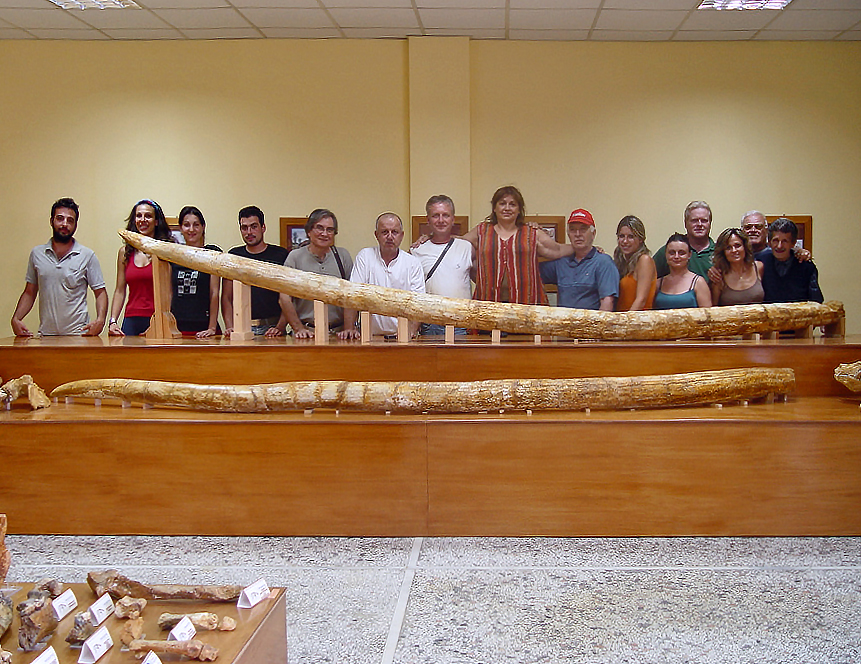
Two enormous tusks found in Greece

Two enormous tusks of Zygolophodon tapiroides found in Greece (Image Public Domain)

Zygolophodon belongs to the Family of proboscideans called the Mammutidae, which includes the familiar American Mastodon. Despite the name, the Mammutidae doesn’t include the Woolly Mammoths: these shaggy beasts are in the same family as elephants. Some researchers think that the American Mastodon was the descendent of Zygolophodon. The teeth pattern, and tusk shape are similar; just a scaled down version.

All over the world, at the end of the Pliocene our enormous tusked proboscidean vanished. Other species were coming out of Africa from the middle Miocene to Pliocene, and these may have been an extra competitor. Changes in the climate may have been a contributor, as the world was beginning to cool at the end of the Pliocene resulting in changing vegetation patterns.

We may never know what happened to Long Tusk. What we do know is that they were just one small Family in perhaps the most spectacular Orders of mammals. Today, just a handful of proboscideans are with us. From Africa to India, the elephants are all that remain. We need to make sure that this incredible group doesn’t vanish forever.

Written by Jan Freedman (@JanFreedman)

Further Reading:

Cooper, L. N., et al. (2014). “Anthracobunids from the Middle Eocene of India and Pakistan Are Stem Perissodactyls”. PLoS ONE 9 (10): e109232 [Full article]

Gheerbrant, E. (2009). ‘Paleocene emergence of elephant relatives and teh rapid radiation of African ungulates’. Proceedings of the National Academy of Sciences. 106 (26): pp.10717–10721. [Full article]

Larramendi, A. (2005). ‘Shoulder height, body mass and shape of poboscideans’, Acta Palaeontologica Polonica 60. [Full article]

Lofgren, D. L., & Rajsavis, A. (2011). ‘Partial skull of Zygolophodon (Mammalia, Proboscidae) from the Barstow Formation of California’. Journal of Vertebrate Paleontology. 31: 6. Pp.1392-1396. [Abstract only]

Madden, C. T. (1980). ‘Zygolophodon from Subsaharan Africa, with observations on thE systematics of Paleomastodontid Proboscideans’. Journal of Paleontology.54:1. pp.57-64.

Sanders, W. J. & Miller, E. R. (2002). ‘New Proboscideans from the Early Miocene of Wadi Moghara, Egypt’. Journal of Vertebrate Paleontology. 22:2. pp.388-404. [Full article]

Shoshani, J., & Tassy, P. (2005). ‘Advances in proboscidean taxonomy & classification, anatomy & physiology, and ecology & behavior.’ Quaternary International. 126-128. pp.5-20. [Abstract only]

Shoshani, J., et al. (2006). ‘A proboscidean from the late Oligocene of Eritrea, a “missing link” between early Elephantiformes and Elephantimorpha, and biogeographic implications’. PNAS 103 (46). [Abstract only]

Vergiev, S. & Markov, G. (2010). ‘A mandible of Deinotherium (Mammalia – Proboscidea) from Aksakovo near Varna, Northeast Bulgaria’. Palaeodiversity 3: pp.241–247. [Full article]
Posted in Deinotherium, Mastodon, Woolly Mammoth, Zygolophodon | Tagged , , , , , , , , , , , , , , , , , , , , , | 4 Comments

Small but mighty

Our planet’s climate fluctuations move to the slow, almost imperceptible dance steps of tilts in our axis and wobbles in our precession around the star we call the Sun. These movements which cause natural global-scale climate changes are known as the Milankovitch Cycles, and they take a long time in human terms – a brief warm interstadial followed by a big freeze every 100,000 years.

Before the Pleistocene, there were many epochs of warm, and cold, wet and dry. Some were cataclysmic to the animal and plant life of that period, creating mass extinctions and subsequently allowing niche species to replace them. So, before the first rays of icy sunlight shone upon the Pleistocene creatures usually hosted on Twilight Beasts, there were other animals, equally fascinating, which existed in the even stranger world of the Pliocene, which dates between 5.3 to 2.6 million years ago. It was a time of seasonally fluctuating polar ice caps until the icy wind of the Pleistocene issued in the ice age proper; it was a time when the Mediterranean Sea dried out to become a grassland, only to be flooded again and become the sea we know today – this is known as the Zanclean Flood. Although temperatures were slightly warmer than the present day, the Pliocene’s cooler, drier climate contributed to the globally proliferating grasslands. It was a time of beginnings, endings and changes…. and horned gophers.

Gentle reader, you read this correctly; A gopher, but no ordinary one – the Austin Powers, rodent of mystery. This rodent was, literally, horny ( Yeah baby – oh, behave!).

No kidding – it actually had a pair of little horns.

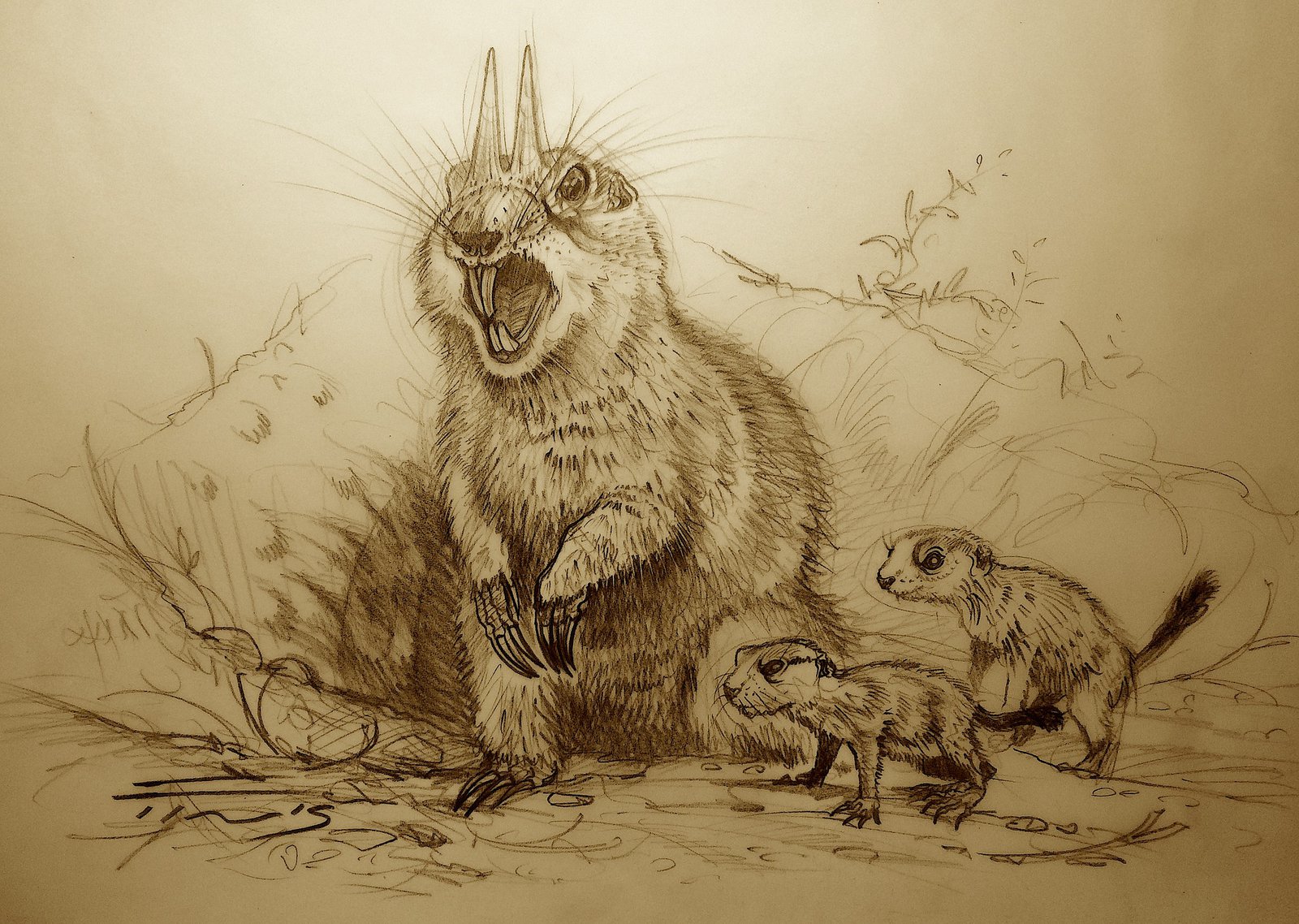
Image from PalaeoPastori on Deviant Art

Mummy Ceratogaulus with wee ones (Image from PalaeoPastori)

Let me introduce you to one of the real oddities of our extinct bestiary – Ceratogaulus. A gopher-like beastie, adorable as all little scurrying things are, but with slightly silly looking little devil horns on their noses, and quite a mysterious little beast in its own right.

Technically, they were closer to ground squirrels and marmots, being Sciuromorphs, of the Mylagaulidae clade, but as we know, things aren’t always named what they actually are (cough… cough… looking at Megaloceros and that pesky elk labelling!). They were not particularly large creatures, on average around 30cm in length, though some appear to have been larger, and they once scurried and scraped the Badlands of Nebraska in North America. There were four definite species of CeratogaulusC. rhinosauros, C. hatcheri, C. minor and C. anecdotus and a newly discovered one in 2013, which likely is the fifth, C. robustus, which has only been found at Skull Ridge, New Mexico so far. Sadly for us and the internet (for this rodent would be a star on Twitter, Instagram et al if it was around today) the entire clade are extinct. They were the smallest known mammals to ever have horns, and nobody is really quite sure why.

Image from http://www.ucmp.berkeley.edu/museum

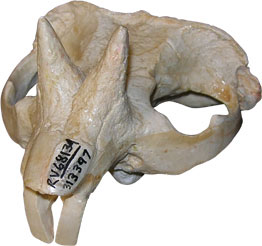
The thick horns can be seen clearly on this skull. (Image from http://www.ucmp.berkeley.edu/museum)

Way back in the early years of the 20th century, when the discovery of our ratty pal was still fresh in everyone’s minds from the 1890’s,  it was taken as accepted that those horns were needed for burrowing – dig that horn in, shake that stocky wee neck around, and – scoop! The earth moves! There was even a proposed theory that the fossilised Daimonelix tunnels found during excavations across Nebraska (sometimes known as ‘Devils Corkscrews’) were the remains of their underground lairs. Well, those twisting and convoluted burrows turned out to be the homes of totally different critters of the Miocene/Pliocene – Palaeocastor fossor, which was a giant ancient beaver – but that’s a story for a different day!

It all would have been a fine and likely theory if the horns were not positioned where they were (right on the nose) and pointing upwards. Any pressure applied from moving earth, or tunnelling would have broken those substantial horns. No, those well-developed rodent claws would have made quite good burrows with or without any protuberances on the schnozz.

Reasons why Ceratogaulus could not have been very successful at shifting earth with those horns - ouch! ( from Hopkins 2005)

Reasons why Ceratogaulus could not have been very successful at shifting earth with those horns – ouch! ( from Hopkins 2005)

Could those horns have been indicators of sexual dimorphism? Nope, the lady Ceratogaulus had them as well, so that theory doesn’t work. Could the horns have been some sort of sexual display, the way deer use their antlers? The fight for love between rival male Megaloceros would have been a phenomenal thing to see. Imagine the ermm, ‘terrifying’ crash of horns as passion-crazed horny gophers of the Pliocene slugged it out for damsels fair. Well, it’s possible, but would be a bit of an outlier for similar reasons to the digging hypothesis.

The answer most consider to be right in the present day (unless a new idea is put forward) is that basically, Ceratogaulus was too large to be underground all the time, and would have spent a fair bit of time scratching around for food. Rodents all too often are nature’s easy snack-pack for carnivores, and being roughly marmot-sized, with short legs and a chubby round body, our horny rodent wouldn’t have been able to run anywhere very fast, unlike a tiny wee mouse or a tree dwelling squirrel. Hence, perhaps those horns. A well-aimed head-butt with those formidable bony horns and a peckish predator would be pretty sore, and possibly deterred from pursuing a would-be lunch of rodent.

And they were a successful species, extending across the Miocene into the Pliocene, but there were changes afoot, and none of it, at this time, anything whatsoever to do with humans messing up. Climate changes, and attendant vegetation cover, were more likely the cause of Ceratogaulus not making it into the era of the Twilight Beasts, or beyond.

Small but deadly

Small but deadly, our little Ceratogaulus would have been a tough prey for many predators. (image Jan Freedman)

During the Miocene period, the prairies of North America gradually became more open and grassy, as a response to the cooling temperatures and decreased precipitation, and by the Pliocene period the balance tilted in favour of grazing animals rather than browsers, as woodland suffered in many areas. As bad luck would have it, one of the areas which succumbed to the loss of deciduous woodland was Nebraska and the Great Plains region of North America. Small creatures had increasingly less places to hide.

The Pliocene, as I said at the start, was a time of beginnings, endings and change – even the grasslands which now stretched across America photosynthesised differently, as C3 and C4 grasses react in very different ways to sunlight and carry different contents of nutrition as a result. As populations of small creatures like Ceratogaulus declined, so too did biodiversity, as these little ones are seed dispersal agents for nature, carrying seeds in their fur, or popping them out in their poo. Nature is balanced carefully with such debits and credits. When one factor goes wrong in an ecosystem, everything slips. The earth was gradually dipping into a cooler phase, making way for the lumbering glaciers of the Pleistocene.

As the changes of the late Pliocene were happening on the North American continent, in drought-parched Africa a little hominin was learning to stand up, use simple tools, and almost certainly wonder what lay beyond the parched horizon. The rise and evolution of that small creature would change the face of the Earth in the coming millennia arguably even more than the ice sheets gathering in the polar regions by the end of the Pliocene. Its children’s’ children and beyond would be responsible for exterminating many other creatures on the planet. But that was the future….

So, there you have it , a creature so fantastical it likely belongs more in an X-File, alongside jackalopes, than in a palaeo bestiary; a ground squirrel fluff-ball with little horns. No memory of these creatures passed into mythology or folklore, for no human ever witnessed their rotund little bodies mooching through for juicy herbs, roots, berries and bugs, or whatever else they loved to eat. Probably a good thing, too – sadly we know what humans are capable of. No cave art records their sunrise, or their sunset. We have just been left with wonder, wishing we could have petted those little heads, and maybe more than anything else – find out what those horns were actually for!

Written by Rena Maguire (@JustRena)

Further Reading:

Emlen, D. J. (2008). ‘The evolution of animal weapons’. Annual Review of Ecology, Evolution, and Systematics. pp.387-413. [Full article]

Hopkins, S. S. (2008). ‘Reassessing the mass of exceptionally large rodents using toothrow length and area as proxies for body mass’. Journal of Mammalogy, 89 (1), pp. 232-243. [Full text]

Hopkins, S. S. (2005). ‘The evolution of fossoriality and the adaptive role of horns in the Mylagaulidae (Mammalia: Rodentia)’. Proceedings of the Royal Society of London B: Biological Sciences, 272 (1573), pp. 1705-1713. [Full article]

Korth, W. W. (2013). ‘Mylagaulid Rodents (Mammalia: Rodentia: Mylagaulidae) from the Middle Miocene (Barstovian) of New Mexico’. Annals of Carnegie Museum. 81 (4). pp. 233-245. [Full article]

Meyer, R. (1999). ‘Helical burrows as a palaeoclimate response: Daimonelix by Palaeocastor’. Palaeogeography, Palaeoclimatology, Palaeoecology. 147. pp 291–298. [Full article]

Schmerge, J. D. (2015). ‘Interpretation of Euhapsine (Castoridae: Palaeocastorinae) Burrowing Behaviors Based on the Functional Anatomy of the Teeth and Skull with a Description of a New Species and Genus’. [Full article]

Strömberg, C &. McInerney, F. (2011). ‘The Neogene transition from C3 to C4 grasslands in North America: assemblage analysis of fossil phytoliths’, Paleobiology. 37 (1). pp 50-71. [Full article]

Stromberg, C. (2011). ‘Evolution of grasses and grassland systems’. Annual Review Earth and Planet Sciences. 39. pp. 517-544. [Abstract only]

Webb, S. D. (1966). ‘A relict species of the burrowing rodent, Mylagaulus, from the Pliocene of Florida’. Journal of Mammalogy, 47 (3) .pp. 401-412. [Abstract only]

Posted in Horned Gopher | Tagged , , , , , , , , , | 5 Comments

Doing the crawl?

The life aquatic has lured many animal groups back into its liquid embrace. Marine iguanas, penguins, whales and dolphins, sea-cows and manatees, seals and sea-lions all returned to the sea from land (and air!) adapted forms. It makes a lot of sense- the littoral is a pretty rich zone that surely tempted those that could take advantage of it. From there it is but a short evolutionary jump back into the blue. Many animals are already halfway there, with one hoof in each camp. Think of the hippo, the beaver, the desman, the otter. Given the wide variety of creatures that have done this, it can be fun to imagine future forms. Bat-penguins? River-antelopes? Water-wombats?

Flights of fancy like this have a long pedigree. Darwin himself, in The Origin mentions:

“In North America the black bear was seen by Hearne swimming for hours with widely open mouth, thus catching, like a whale, insects in the water. Even in so extreme a case as this, if the supply of insects were constant, and if better adapted competitors did not already exist in the country, I can see no difficulty in a race of bears being rendered, by natural selection, more and more aquatic in their structure and habits, with larger and larger mouths, till a creature was produced as monstrous as a whale.”

Sea-bears? Why not!

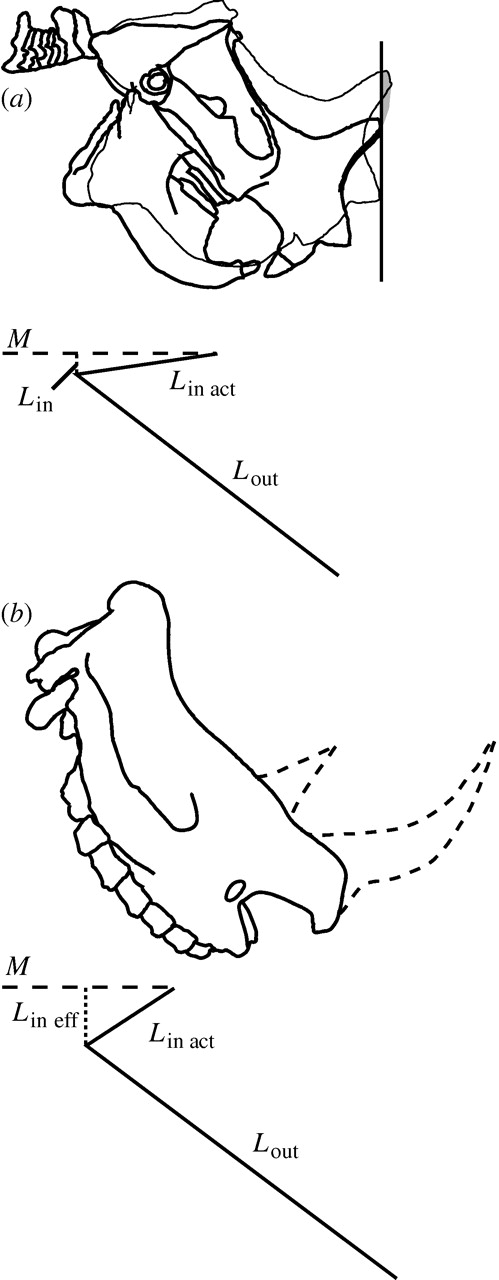
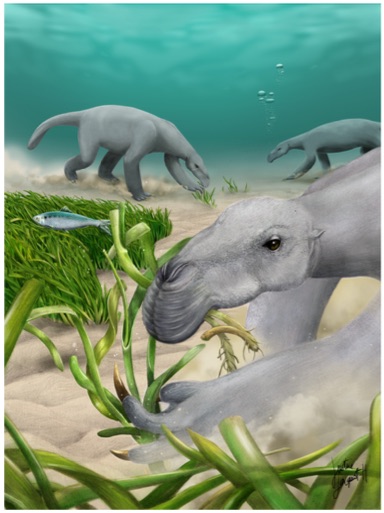
As usual, nature is not only weirder than we imagine, but weirder than we can imagine. Perhaps the most unlikely group ever to have flirted with the aquatic lifestyle was only recently recognised from Pliocene fossils: Thalassocnus sp. Thalassocnus is, and I can’t really believe this either, a giant marine sloth.

Thalassocnus

Thalassocnus yaucensis by Justine Jacquot-H, image from Amson et al. JME (22) p473-518

The first clues to this puzzle were due to some flukes of taphonomy. The Pisco Formation in Peru is a richly stratified Miocene and Pliocene site with amazing preservation of marine creatures including articulated whales, dolphins, crocodiles, fish, sharks, and dugongs. And giant sloths. Now, you don’t usually expect to find giant sloths in a strictly marine site. But these sloths were quickly identified as something pretty special indeed. Detailed study has shown that not only were these behemoths at home in a marine shore environment, they had picked up some pretty cool adaptations along the way.

The large, swimming, sloth

The giant, swimming, sloth, Thalassocnus. At home beneth the waves. (Image by Jan Freedman)

Neater still, the layers of the Pisco Formation contains thalassocnine sloths from multiple timepoints between the Miocene and Pliocene, showing how some of those characters changed through time. It seems that this shallow prehistoric sea was prone to occasional algal red blooms that regularly poisoned everything, leaving articulated skeletons behind. Through these fossils, you can actually see evolution happening. In the ribs and limbs you find a gradual thickening of the cortical bone; an increase in density that helped to counteract the natural buoyancy of an air-breathing mammal. There is also a gentle elongation of the premaxillae and mandible symphysis, creating a long and wide snout, better adapted to munching water-weeds. The earlier species of thalassocnine have lots and lots of striae on their weird, peg-like sloth teeth- indicating that they were taking in a lot of sand while they were feeding, probably due to wading in shallow water where any movement would stir up lots of sediment. The later species don’t have this. Suggesting that they were feeding further out to sea, where sand wasn’t an issue.

Time-calibrated Phylogeny

Time-calibrated phylogeny of some Xenarthra showing the relationship between thalassocnine sloths and cortical bone density, taken from Amson et al. Proc Roy Soc B v281

Mandibles

Mandibles of 5 species of Thalassocnus, from oldest to youngest LtoR, taken from de Muizon et al. JVP (24:2)p287-397

Premaxillae

Premaxillae of 5 species of Thalassocnus, from oldest to youngest LtoR, taken from de Muizon et al. JVP(22:2)p398-410

The thalassocnine sloths appear to have died out in the Pliocene. Thankfully, this is one extinction that had nothing to do with us! The Late Pliocene is when it seems the Isthmus of Panama finally closed, having major effects on ocean currents and water circulation. It seems likely that this major geological event would have had a catastrophic effect on the gentle swimmers, grazing on the nutritious sea-grasses and kelps off the coast of ancient Peru.

Written by Ross Barnett (@DeepFriedDNA)

Further Reading:

Amson, E., C. Argot, H. G. McDonald, and C. de Muizon. “Osteology and Functional Morphology of the Axial Postcranium of the Marine Sloth Thalassocnus (Mammlia, Tardigrada) with Paleobiological Implications.” Journal of Mammal Evolution 22 (2015): 473-518.[Full Article]

———. “Osteology and Functional Morphology of the Forelimb of the Marine Sloth Thalassocnus (Mammalia, Tardigrada).” Journal of Mammal Evolution 22 (2015): 169-242.[Full Article]

Amson, E., C. de Muizon, M. Laurin, C. Argot, and V. de Buffrenil. “Gradual Adaptation of Bone Structure to Aquatic Lifestyle in Extinct Sloths from Peru.” Proc Roy Soc B 281, no. 1782 (May 7 2014): 20140192.[Full Article]

Canto, J., R. Salas-Gismondi, M. Cozzuol, and J. Yañez. “The Aquatic Sloth Thalassocnus (Mammalia, Xenarthra) from the Late Miocene of Noeth-Central Chile: Biogeographic and Ecological Implications.” Journal of Vertebrate Paleontology 28, no. 3 (2008): 918-22.[Full Article]

Darwin, Charles. On the Origin of Species by Means of Natural Selection. London,: J. Murray, 1859.[Full Book]

de Muizon, C., H. G. McDonald, R. Salas, and M. Urbina. “The Evolution of Feeding Adaptations of the Aquatic Sloth Thalassocnus.” Journal of Vertebrate Paleontology 24, no. 2 (2004): 398-410.[Full Article]

———. “The Youngest Species of the Aquatic Sloth Thalassocnus and a Reassessment of the Relationships of the Nothrothere Sloths (Mammalia: Xenarthra).” Journal of Vertebrate Paleontology 24, no. 2 (2004): 387-97.[Full Article]

McDonald, H. G., and C. de Muizon. “The Cranial Anatomy of Thalassocnus (Xenarthra, Mammalia), a Derived Nothrothere from the Neogene of the Pisco Formation (Peru).” Journal of Vertebrate Paleontology 22, no. 2 (2002): 349-65.[Full Article]


Posted in Giant Swimming Sloth, Thalassocnus | Tagged , , , , , , , , | 5 Comments

Eye of the beholder

By looks alone there are many animals that do not win our hearts. People don’t coo over wasps; vultures are grotesque; don’t get me started on elephant seals. Sadly this is due to what we see as beautiful. David Hume, the 18th Century Scottish philosopher, got it spot on, when he wrote “beauty in things exist merely in the mind which contemplates them.”

Baby cheetahs look adorable because of those gorgeous little fluffy faces and big eyes. Baby seals have those lovely big, round eyes that seem to say ‘give me a cuddle’. Penguins waddle in an adorable, slightly human way. We like to see ourselves in animals (like the big eyes) giving them a high ‘squee’ factor. Anthropomorphising animals (and even rocks, or tree trunks) is something humans do unconsciously all the time. Sadly, if an animal doesnt fit our view of what we see as ‘cute’ this can have a hugely negative bias how we view some creatures.

There is one group of animals that we have given a pretty tough time: hyenas. They don’t have those big baby eyes, or ‘cute’ faces, and are (wrongly) conveyed as savage beasts, scavanging anything they can.

A spotted hyena

A spotted hyena (Crocuta croctua) on the Serengeti, with a zebra leg. (Image used with kind permision by Anne Hilborn)

My favourite, the spotted hyena, regularly features in the public eye. Not in a good way, though. Disney’s classic The Lion King featured three hyenas (Shenzi, Banzai and Ed) who were particularly nasty (and a little dumb). Spotted hyenas even make a little appearance in Bedknobs and Broomsticks. In Jean M Auel’s Clan of the Cave Bear the spotted hyena has a very bad run. The book’s heroine, the resourceful and intelligent Ayla, despises them. Set around 40,000 years ago in Europe, Ayla was adopted by a group of Neanderthals (the ‘Clan’) and, as one would imagine, she struggles to fit in. Her hatred of hyenas manifested when one tried to drag her Clan sisters baby off, resulting in Ayla killing it with her sling. If the clan didn’t forbid women to use weapons, then Ayla would be a hero. But the hyenas exposed her secret, and in each of the 6 books of this series, they are portrayed as vile creatures.

It appears that some animals are doomed to be labelled in human eyes.

Even though, really, hyenas are super cute. Just look at these…

A gorgeous spotted hyena just lying lazily in the sun.

A gorgeous spotted hyena just lying lazily in the sun. Just look at those sleepy eyes! (Image used with kind permission by Anne Hilborn)

A young spotted hyena.

A young spotted hyena. So fluffy. That is all. (Image used with kind permission by Anne Hilborn)

With four extant species (the spotted hyena, the striped hyena, the brown hyena and the aardwolf), this is a pretty diverse group of large carnivores in a relatively small range (their current geographical range is Africa and the Middle East). They have been an incredible group, around for over 20 million years, with one species even making its way over to America.

There was one ancient relative, which may not have been the prettiest, but it was the biggest of all the hyenas: the Giant Short Faced Hyena (Pachycrocuta brevirostris). Evolving in Africa around 3 million years ago, this species was on the planet for over two and a half million years. It was a successful carnivore throughout Africa, Europe, and as far East as China. And it was the largest of the hyena family. The spotted hyena measures around 80cm at the shoulder (close to my hips). The Giant Short Faced Hyena, stood taller, at around 100cm at the shoulder (reaching my stomach).

The enormous Giant Short Faced Hyena (in green)

The enormous Giant Short Faced Hyena (in green) in comparison to the spotted hyena (in black). Image by Jan Freedman.

This giant’s anatomy was a little different from the spotted hyena we are more familiar with. It had shorter, more muscular legs. As its name suggests, it had a short snout too. (The ‘Giant Short Faced’ title is a common theme for Pleistocene beasts. We have come across a couple before: the Giant Short Faced Bear, and the Giant Short Faced Kangaroo). This was undoubtedly an impressive creature. But what do we know about its hunting habits? Well, we may just have a few clues.

Zhoukoudian Cave in China reveals a rather morbid history. The cave was a hyena den, where these giants lived, and it would appear, where they also preyed on helpless animals that fell into the cave – including Homo erectus. Many of the fossils of the human species have teeth marks on them which fit the dental structure of the giant hyenas. What’s more, the skulls of the roughly 40 human individuals are all cracked and broken up. Broken for one purpose: to remove the brain. The most juiciest, nutritious meat from a human head is the brain (after the tongue, and cheek muscles), and Pachycrocuta knew this. The skulls have been shattered and crushed so the brain could be eaten.

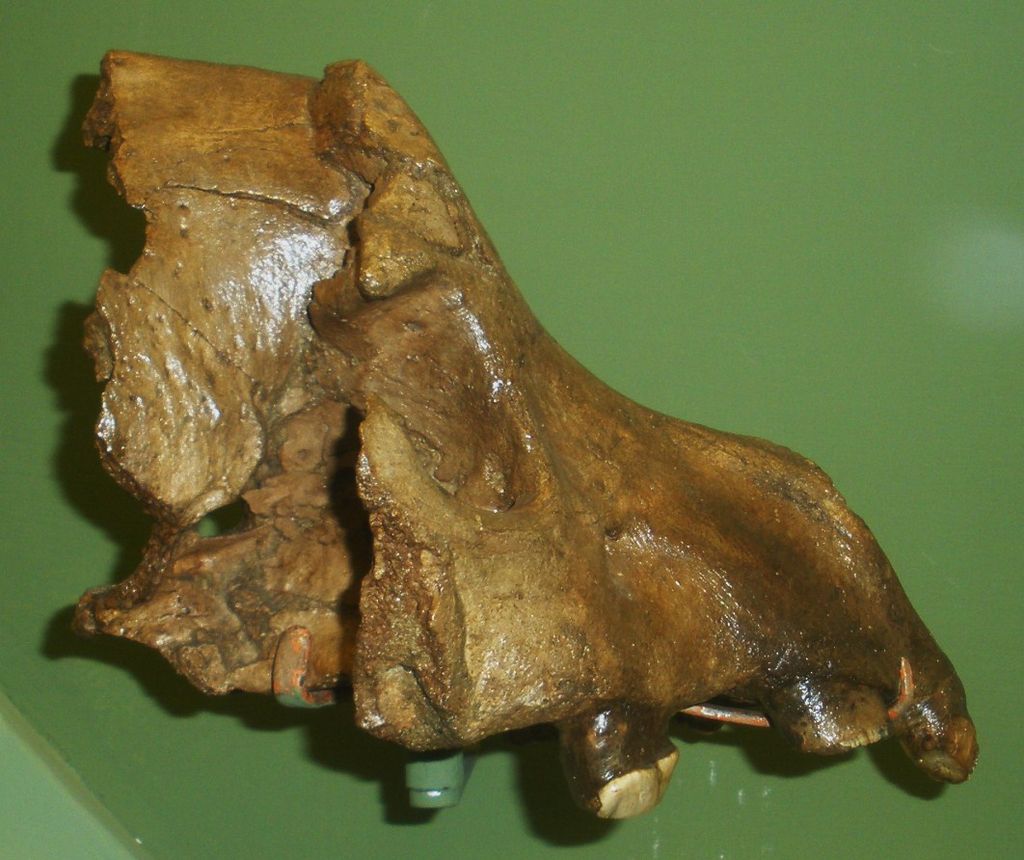
Pachycrocuta, as you now know, was much more stocky and muscular than the spotted hyena, with a similar to the build of the American sabretooth, Smilodon. And this hints at a certain lifestyle. With short, stocky build it wouldn’t have been able to chase prey over long distances, unlike the more agile spotted hyena. Huge teeth indicate that it was a bone cruncher just likes its relative. A closer look at the short muzzle show that their back teeth had a massive bone crushing bite. The front of the jaw, however, had a bite with much less force. Some researchers suggest that this shows the Giant Short Faced Hyena was a scavenger, and it was unlikely that a bite would be able to bring down prey.

A site in Southwest Spain tells a similar story. The majority of the bones excavated from a den of Pachycrocuta were horse, bison and deer. What’s more the large leg bones of these animals were cracked open to get the juicy bone marrow out (other bones, like ribs or feet bones, of the horses, bison and deer, were not cracked open). From this, researchers suggest that they scavenged animals, dragged them back to their cave and chomped on the big bones for their meals.

The thick skull, and short snout of (Image by Wiki member By Ghedoghedo - Own work, CC BY-SA 3.0, https://commons.wikimedia.org/w/index.php?curid=20542629

The thick skull, and short snout of Pachycrocuta brevirostris. (Image by Wiki member Ghedoghedo, Public Domain)

I think it is highly unlikely that this, the largest of all hyenas, was solely a scavenger. Wolves don’t have particularly strong bite forces (around 400 pounds, less than half that of a tiger). Wolves, however, are long distance runners, and can play the long chase: the Giant Short Faced Hyena was no marathon runner. It may have ambushed prey and, working in a pack, overpowered larger animals with their large size and strength. More research on the postcranial skeleton will shed some light. Like the spotted hyena, this giant could crunch bones with ease, but that alone doesnt indicate it was just a scavenger.

The disappearance of this giant, around half a million years ago remains a mystery. It may be that small, faster carnivores out-competed them. Or that the world was changing, and they couldn’t keep up. Of course, as with many of our Twilight Beasts, there are tales of survivors.  A huge, muscular carnivore is said to viscously attack humans. East Africans legends describe this beast as standing around four feet tall, with a long sloping back. The Nandi Bear has a particular liking for brains.

A sketch of the Nandi Bear (not from life). (Image from

A sketch of the Nandi Bear (not from life). (Image from cyrptid.ru Public Domain)

Look past the face of an animal and every single species is the end result of millions of years of evolution: animals that are magnificent because they are here. Some of us may not see some animals as cute, or pretty, but nature doesn’t care, and nor should it. Every species that has ever existed has lived because it was perfectly adapted for that environment. And each species around today is a unique survivor. Each individual species is just one piece in the 10 million (or so) piece jigsaw puzzle that makes up the history of life on Earth.

Written by Jan Freedman (@JanFreedman)

A note of thanks to the wonderful zoologist Anne Hilborn for allowing us to use the beautiful photographs she took of the spotted hyenas in this post. If you are on Twitter, do follow Anne – she is currently researching cheetahs (as well as being an amazing science communicator). Your timelines will be filled with the most wonderful photos of gorgeous wildlife on the serengeti!

Further Reading:

Boaz, N. T. et al. (2001). ‘The Scavenging of ‘Peking Man’,’ Natural History. 110. pp.46-52. [Abstract only]

Boaz, N. T., Ciochon, R. L., Xu, Q, & Lui, J. (2004). ‘Mapping and taphonomic analysis of teh Homo erectus loci at Locality 1 Zhoukoudian, China’. Journal of Human Evolution. 46 (5). pp.519-549. [Abstract only]

Goswami, A., Milne, N., & Wroe, S. (2011). ‘Biting through constraints: cranial morphology, disparity and convergence across living and fossil carnivorous mammals.’ Proceedings: Biological Sciences. 278 (1713). pp. 1831-1839. [Full article]

Hume, D. (1742). Essays, Moral, Political, and Literary. Insianapolis. [Full book]

Palmgvist, P., & Arribas, A. (2001). ‘Taphonomic decoding of teh paleobiological information locked in a Lower Pleistocene assemblage of large mammals.’ Paleobiology. 27 (3). pp.512-530. [Abstract only]

Palmqvist, P., et al. (2008). ‘Biogeochemical and Ecomorphological inferences on prey selection and resource partitioning among mammalian carnivores in an Early Pleistocene community.’ PALAIOS. 23 (11/12). pp. 724-737. [Abstract only]

Palmgvist, P., et al. (2011). ‘The giant hyena Pachycrocuta brevirostris: Modelling the bone cracking behavious of an extinct carnivore’, Quaternary International. 243 (1). pp.61-79. [Abstract only]

Turner, A & Mauricio, A. (1996). ‘The giant hyena, Pachycrocuta brevirostris (Mammalia, Carnivora, Hyaenidae).’ Geobios. 29 (4). pp.455-468. [Full article]

Posted in Hyena, Pachycrocuta | Tagged , , , , , , , , , , , , , , , | 3 Comments

The Bear from Clare – new evidence for an early human presence in late Pleistocene Ireland

Many people know at least something of the gradual flooding of the palaeolandscape of Doggerland, off the east coast of Britain. They have a pretty good idea of how the sea encroached on that early European land bridge from around 11000 BP until the final submergence between 8000 and 7500 BP, which cut Britain off from the Continent and made it the island we know today. In our labs we have bones of Pleistocene creatures which have been dredged from the modern sea floor, and as I have sailed over the expanse of water from Hull to the Netherlands, I’ve often imagined the lost lands of ancestors below the waves. If you are of a similar mind set, with your head in the future but your heart in the past, I bet you have too. There is a melancholy in thinking of those European hunter gatherers, living their lives on a landscape possibly not unlike modern day Norfolk, at a time when the great cold of the Ice Age was ending, yet all traces of their lives are beneath the sea. Those who settled on Island Britain would eventually issue in the Mesolithic period as we understand it from archaeological sites such as Star Carr.

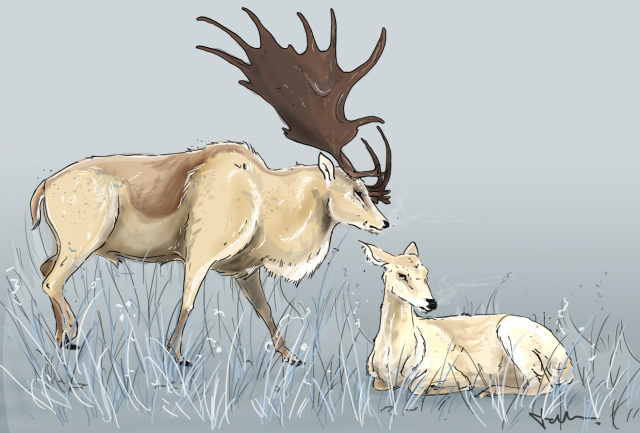
Yet little is known for certain of what was happening in Ireland at the same time. Arguments still rage over the possibility of a land bridge/s connecting Britain and Ireland which may account for the arrival of some of our faunal and floral species. However, it is generally accepted that if such a land mass did exist, it was in deep prehistory, and that Ireland has been an island for many thousands of years more than Britain. This early isolation accounts for the fact that there is not as wide a diversity of faunal or vegetation species in Ireland as Britain or Europe. What we do know is that between the retreat of the great glaciers of the Ice Age and the Younger Dryas, Ireland was inhabited by reindeer (Rangifer tarandus), the mighty Giant Irish Deer (Meglaoceros giganteus), arctic lemmings (Dicrostonyx torquatus) and…bears. Hold that thought – they’re going to be very, very important to this story!

The magnificent Irish Elk. Neither Irish, nor an elk, this giant was a common herbivore in Ireland until relatively recently. (Image by Tabitha Patterson)

The magnificent Irish Elk. Neither Irish, nor an elk, this giant was a common herbivore in Ireland until relatively recently. (Image by Tabitha Patterson)

Before we embark on this story,  we also have to make a quick note here about  using ‘cal’ and ‘uncal’ with reference to dates quoted! What comes out of an AMS (Accelerated Mass Spectrometer – the machine which counts those wee carbon atoms which are sampled for dates) is not an actual calendar date. The samples come out ‘uncalibrated’ – that is, presuming that the atmospheric radiocarbon percentages are the same as they are since 1950 (that’s the ‘BP’ you see used in science papers, for Before Present). But of course, since 1950s there is quite a difference in percentages from, say, 18,000 years ago. They had no nuclear testing, for one thing, and that makes a difference to carbon samples! Calibration is a complex process of calculations and adjustments to make ‘real’ date ranges, always allowing for a bit of error on either side of the presumed date. This calculation process uses probability to narrow the date range to the most likely span of time. There are two fine programmes, Oxcal and IntCal, which you can link to for much more information than we can fit in here. This was one of my ‘things’ at Masters, but I don’t want to bore anyone when there’s much more exciting things to mention here – because you want the bears, right?

It has always been accepted that the first people settled in Ireland around 10,290 to 9,790 cal BP. Their lives were uncovered, painstakingly by some of the finest Irish archaeologists and led by the superlative Prof Peter Woodman, at the Mount Sandel excavations between 1973 and 1977. These early Mesolithic settlers chose their homeland well – Mount Sandel was on the River Bann, close to Coleraine on the north coast of Ireland. There are other Irish Mesolithic sites, of course, mostly clutching the coasts and lakesides of the island – Lough Boora, Rockmarshall and its human bone placed with shells in a midden; there’s Moynagh Lough with its bear bones; and the cattle and human bones at Ferriters Cove: but all date to after Mount Sandel’s occupation – or at least, so current knowledge says.

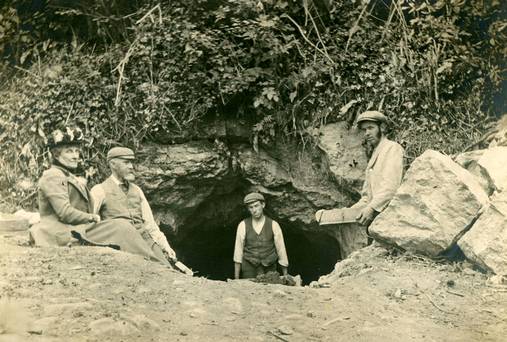
That was then, this is now. Back in 2011, Dr Ruth Carden (no stranger to regulars of the Twilight Beasts twitter account!) was re-examining bone assemblages from the Alice and Gwendoline Caves, near Ennis in County Clare. Found back in 1903 during cave excavations by Scharff, those bones are very much part of the national heritage of Ireland, carefully conserved by the good folks of the National Museum of Ireland (NMI).

BearBone3

An image from the Independant.ie of the original excavation of the Alice and Gwendoline Caves, 1903.

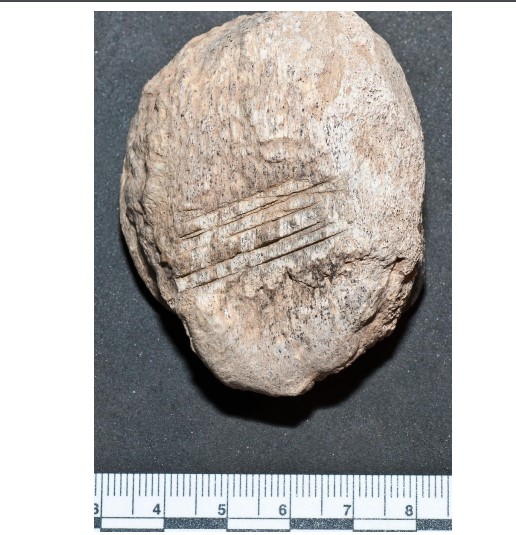
One of the bones, a knee cap (patella) of a bear showed signs of cutting and scraping by human hands. Dr Marion Dowd of Sligo I.T is a long term enthusiast and specialist of cave archaeology – so much so that her book, The Archaeology of Caves in Ireland, has been awarded Best Archaeology Book by the popular magazine, Current Archaeology. She suggested obtaining a date for the bone, as bear bones with modifications are pretty rare on this island; even the Moynagh Lough bear bones only suggest marrow extraction.

A very kind financial helping hand from the Royal Irish Academy for dating allowed samples of the patella to be sent  to both Oxford and Queens University Belfast radiocarbon facilities, and the results? Let’s just say in Clickbait-Land of the Internet, this is where I’d say  ‘What happens next is so shocking you won’t believe it!’
The dates returned by both laboratories tallied with remarkable precision.
When calibrated, they indicated a human being chopping a bear bone, between 12800 and 12600 BP.
……..2500 real, calibrated years before Mount Sandel.

This all seemed just too remarkable – could we really have gotten the dates of the first people in Ireland so wrong? Why did we not consider the arrival of humans at such an early stage an almost sure thing? After all, settlers from the west coast of England and Wales could negotiate the shallow seas to expand their own territories, and Ireland was not very far at all.

It was always possible that the bone was much older than the cut marks. The five cut marks were examined stringently by Ruth, and  then further opinions sought from Dr Terry O’Connor (again, no stranger to the antler-bedecked cyber halls of the Twilight Beasts!), Dr Jill Cook of the British Museum and Dr Alice Choyke. Numerous photographs were sent to two of the three specialists – Dr Cook actually got the ‘hands on’ experience of the bone – but with no details of the dates returned to avoid bias. The veteran zooarchaeologists were in agreement that the bone was likely not just some random bone used by a Neolithic sort to whet a flint. The cuts suggested a crushing action, such as those from a flint chopping at the surface around the actual time of bone exposure, i.e. death of the animal. There is weathering within the cuts on the patella too, and indications that the bone lay, likely discarded within sediment after the cuts were made. What we are left with would appear to be the story of a bear, slaughtered by humans, then butchered. The bones were discarded after stripped of meat and sinew, in a County Clare cave, almost 13,000 years ago. Does it indicate earlier Palaeolithic hunter gatherers? We genuinely don’t know. It’s going to take a lot of specialisation in zooarchaeology to create the platform for archaeologists then to look at interpretation.

The cuts are clearly visible here

The cuts on the patella are clearly visible here. Photo courtesy of Dr R Carden.

It’s a dramatic find, and accordingly, the boundaries of the Irish Mesolithic now must be looked at with fresh eyes because of the research of these two women, but hey, that’s how Irish archaeology rolls!

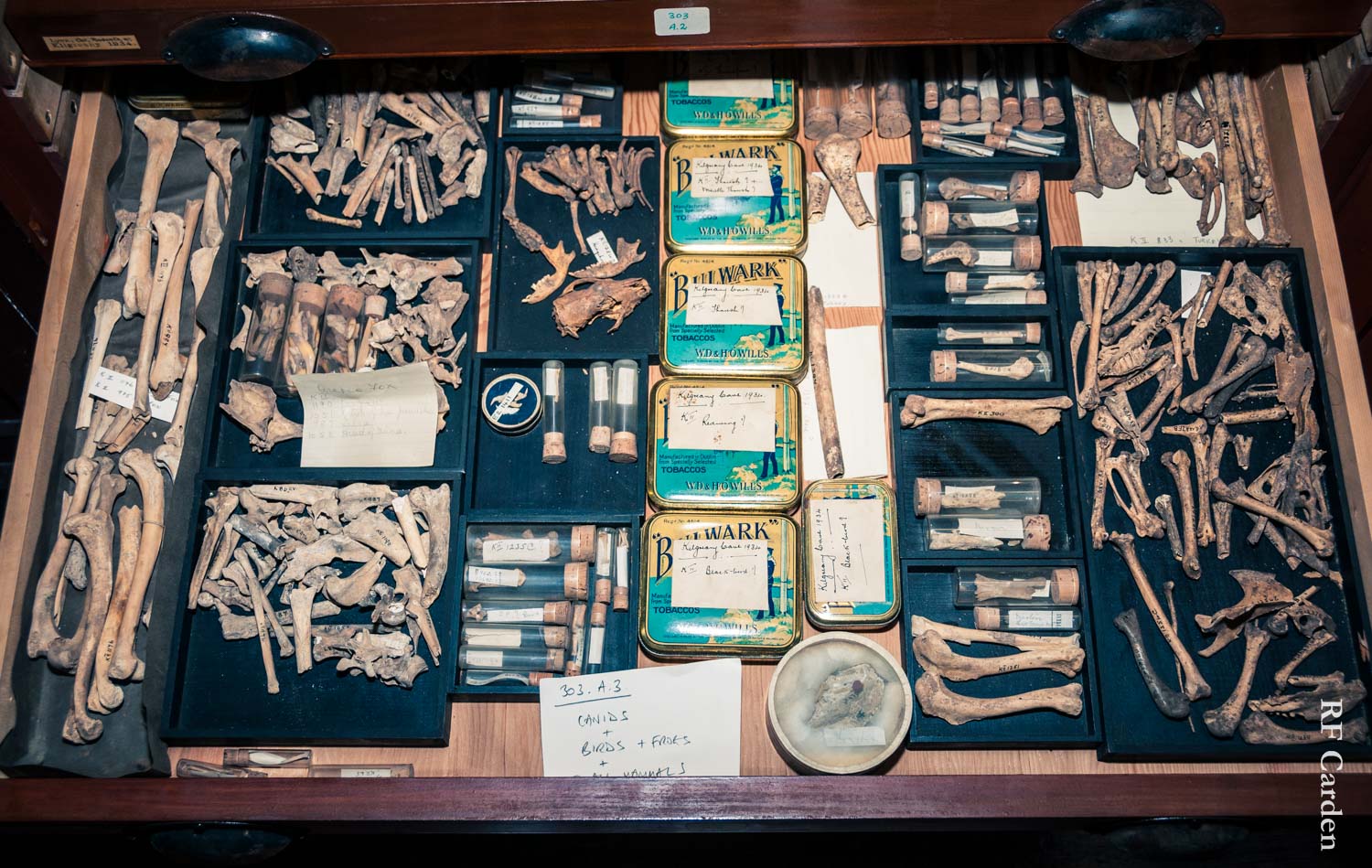
On this day, the start of Museum Week 2016, it’s important to consider that this discovery would never have been made without the re-examination and identification of faunal assemblages, found during the 19th and early 20th century held within the NMI and Natural History Museum of Ireland (also known as the ‘Dead Zoo’). Dr Ruth Carden took on the task of going through each bone collection held by the Dead Zoo in Dublin as a labour of love. She is at around 20,000 bones and there’s still so many more to be looked at. In this case, combined with Dowd’s complementary archaeological speciality, the research has yielded an entirely new area of investigation into the Palaeolithic/Mesolithic boundary of human  diffusion through Europe and England, ending in Ireland. The NMI and Dead Zoo, with their amazing staff of course are special to all Irish people, archaeologist and public alike – but all museums, worldwide, contain treasure, and not all treasure is gold or shiny. Sometimes it’s the kneecap of an ancient bear. Just one of the reasons all museums need to be protected, and cherished within communities as a whole.

Little boxes.. of hidden treasure!

Little boxes.. of hidden treasure! Photo courtesy of Dr Ruth Carden

You have no idea what’s waiting to be discovered; misidentified, unclassified, perhaps even forgotten – and that’s the most exciting thing about this business. Museums hold not just the past, but the future. This wee little box sat for 100 years, taken care of by the museum, and always available should anyone have the interest to look at it. If anything, this really highlights the importance of long term safe storage for ancient material. You just never know until your curiosity and passion is stirred enough to make that call or email…..

What are you going to find in your local museum that will change science and the world?

Written by Rena Maguire (@JustRena)

With special thanks to Dr Ruth Carden for the information provided for this post, and for use of the images.

Dowd, M., & Carden, R. F. (2016). ‘First evidence of Pleistocene human presence in Ireland’, Quaternary Science Reviews. [Abstract only]

Further Reading:

Bayliss, A., & Woodman, P. C. (2009). ‘A new Bayesian chronology for Mesolithic occupation at Mount Sandel, Northern Ireland’. Proc. of the Prehist. Soc. 75. pp 101-123. [Abstract only]

Carden, R.F., McDevitt, A.D., Zachos, F.E., Woodman, P.C., O’Toole, P., Rose, H., Monaghan, N.T., Campana, M.G., Bradley, D.G. &Edwards, C.J. (2012). ‘Phylogeographic, ancient DNA, fossil and morphometric analyses reveal ancient and modern introductions of a large mammal: the complex case of red deer (Cervus elaphus) in Ireland’. Quaternary Science Reviews. 42. pp.74-84. [Full Text]

Collins, A.E.P., 1983. ‘Excavations at Mount Sandel, Lower Site, Coleraine, County Londonderry’. Ulster Journal of Archaeology. 46. 3. pp 1-22. [Abstract only]

Conneller, C., Milner, N., Taylor, B. & Taylor, M. (2012). ‘Substantial settlement in the European Early Mesolithic: new research at Star Carr’. Antiquity, 86. 334 pp.1004-1020. [Abstract only]

Dowd, M. (2015). The Archaeology of Caves in Ireland. Oxford: Oxbow Books. [Book]

McCormick, F. (2004). ‘Hunting wild pig in the Late Mesolithic’, in Helen Roche, E. Grogan, J. Bradley, et al. (eds), From megaliths to metals: essays in honour of George Eogan. Oxford: Oxbow Books. p 15. [Book]

Montgomery, W.I., Provan, J., McCabe, A.M. &Yalden, D.W. (2014). Origin of British and Irish mammals: disparate post-glacial colonisation and species introductions. Quaternary Science Reviews. 98. pp.144-165. [Full Text]

Murray, E. (2007). ‘Molluscs and middens: the archaeology of ‘‘Ireland’s early savage race’’?’, in Murphy E and Whitehouse, N (eds), Environmental archaeology in Ireland. Oxford: Oxbow Books. [Book]

O’Sullivan, A. (2002). ‘Living with the Dead among Hunter Gatherers’. Archaeology Ireland. 16. 2. pp 10-12. [Full article]

Reimer, P. J., Bard, E., Bayliss, A., Beck, J. W., Blackwell, P. G., Bronk Ramsey, C. et al. (2013). ‘IntCal13 and Marine13 radiocarbon age calibration curves 0–50,000 years cal BP’. Radiocarbon 55 (4) pp 1869–1887.  [Full Text]

Scharff, R. F., Ussher, R. J., Cole, G. A. J., Newton, E. T., Dixon, A. F., & Westropp, T. J., (1906). ‘The exploration of the caves of County Clare’. Trans. of the RIA 33 pp  1-76.

Sturt, F., Garrow, D. &Bradley, S. (2013). ‘New models of North West European Holocene palaeogeography and inundation. Journal of Archaeological Science. 40. 11. pp 3963-3976. [Full Text]

Warren, G. (2015). ‘Mere food gatherers they, parasites upon nature…’: food and drink in the Mesolithic of Ireland. Proceedings of the Royal Irish Academy. Section C: Archaeology, Celtic Studies, History, Linguistics, Literature, 115. pp.1-26. [Full article]

Woodman, P; Anderson, E &Finlay, N. (1999). ‘Excavations at Ferriter’s Cove, 198395: last foragers, first farmers in the Dingle Peninsula’. Bray: Wordwell Books. [Book]

Woodman, P.C. (1985). ‘Excavations at Mount Sandel, 1973-77, County Londonderry (No. 2).’ HM Stationery Office. [Book]

Oxcal have a super explanation of what they do, and calibration right here.

As of course do my alma mater of Queens University Belfast with IntCal and CALIB, right here.

Posted in Brown Bear, Homo sapiens, Irish Elk, Mega-flood | Tagged , , , , , | 6 Comments

Going underground

South America is a place full of stories about mysterious beasts. Standing seven feet tall, with long red hair and big sharp claws, tales of the mapinguari, have been passed down in South American Indian folklore. An odd tapir/jaguar hybrid is also said to lurk in the deepest parts of the Amazonian rainforest. Although extremely fanciful, this hasn’t stopped explorers searching for strange creatures. Even explorers who also happened to be vice-presidents.

The principal author of the American Declaration of Independence, Thomas Jefferson had a strong interest in the sciences. He was a member of the American Philosophical Society for 35 years, and promoted the sciences widely. In 1796, when he was the vice president of the United States, a Colonel sent Jefferson some bones, including massive claws. He thought they belonged to an enormous lion, and, because the bones looked so fresh, thought that the lion was still out there. So he asked two explorers to keep an eye out for his giant lion.

Surprisingly, the explorers didn’t find anything. His giant lion, which he named Megalonyx, was in fact a giant ground sloth. Some years later it was named Megalonyx jeffersonii in Jefferson’s honor. However, there are some very strange things lurking in Southern Brazil and Argentina. Bizarre structures that would have made Jefferson venture into the jungles himself.

fasgsdgsdf

The impressive full skeleton of Megalonyx jeffersonii. (Image Public Domain)

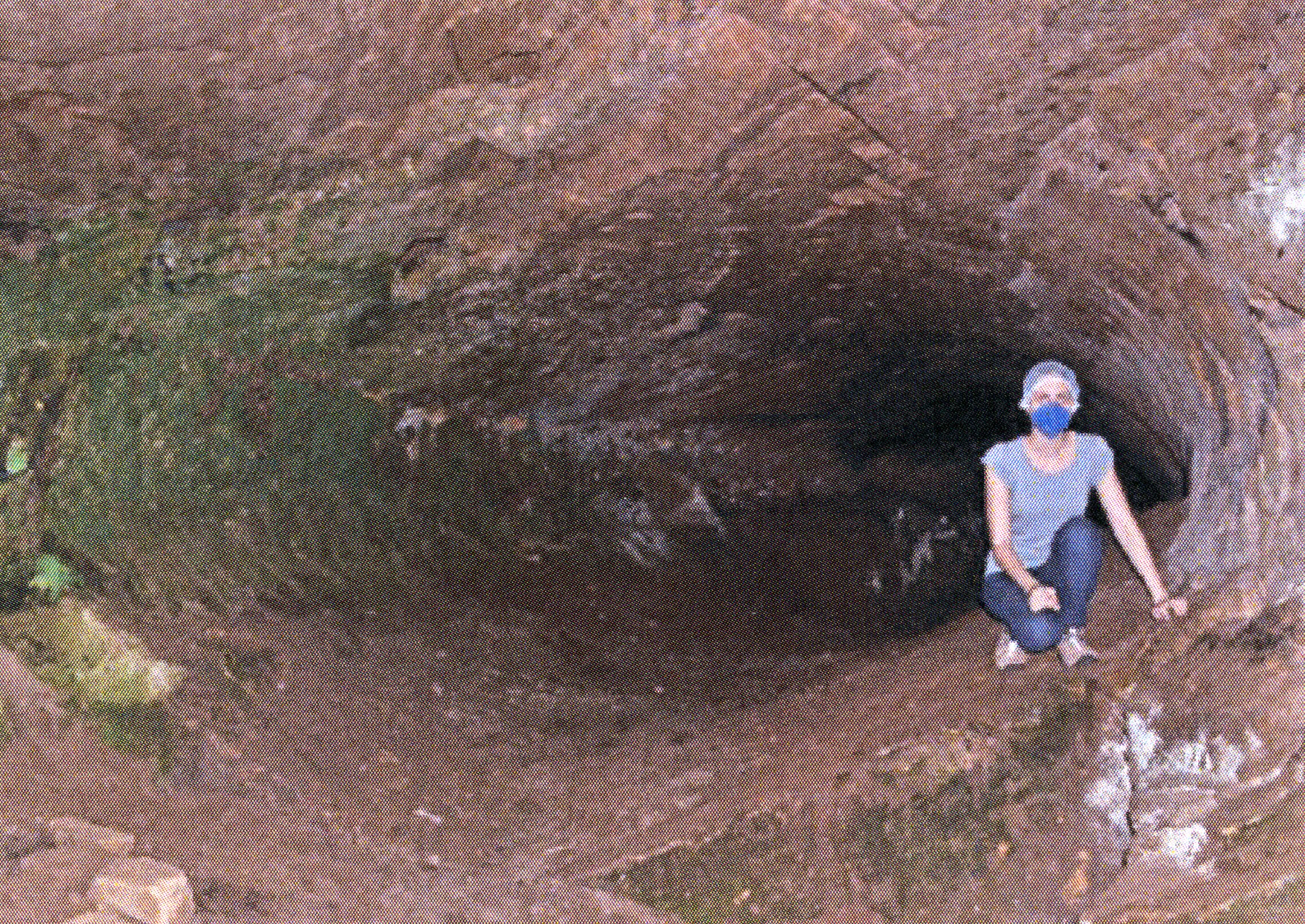
South America is riddled with burrows. Not your normal burrows from the lovely looking rodent, the paca, or the wonderful armadillos. These burrows are enormous. They range from about half a meter wide (large enough for me to crawl inside) to around 4m wide (large enough for a car to drive inside!). What’s even more amazing is these burrows are not in the soil; they have been dug into rock! Sedimentary rocks, with their relatively softer, looser grains seemed to be a popular choice, but burrows have also been found in weathered (so slightly softer) igneous and metamorphic rocks! Someone, or something, has been digging pretty big tunnels.

gsdfgsdgd

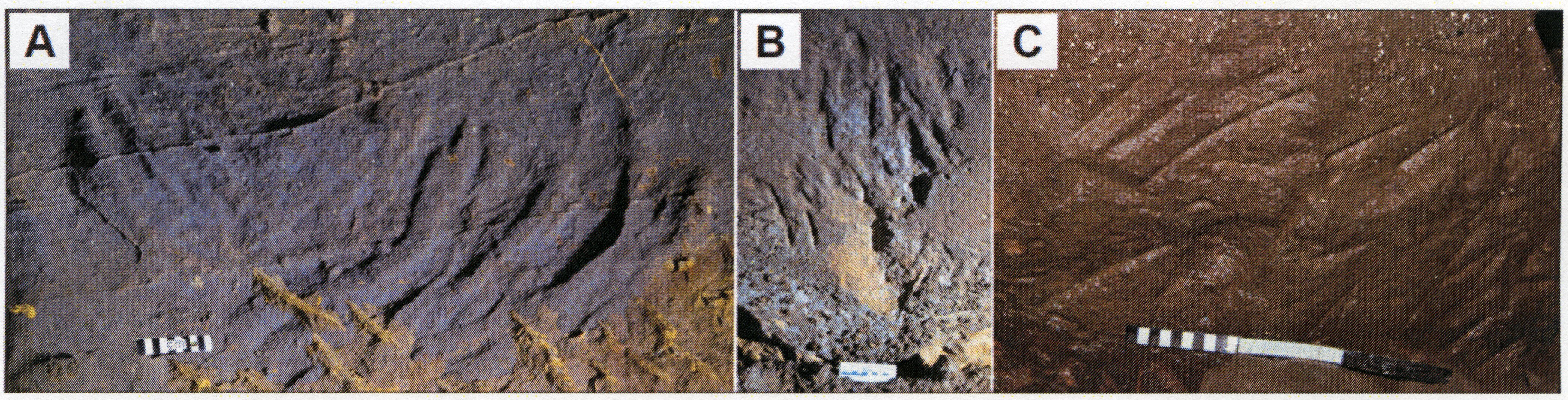
One of the tunnels from Brazil. Over 1000 of these tunnels have been discovered in Brazil and Argentina. (Image from Frank et al, 2013)

These giant tunnels have been known about for thousands of years: there is evidence of paleo-Indians using them in the past, and an inscription in one dates to 1878. Many burrows have had their entrances modified by humans (but interestingly not the insides of the tunnels). Amazingly, we can tell what marks are recent in these tunnels, because the walls of the burrows are coated with a thin mineral crust, or sometimes a thin clay. Marks made when the burrow was first dug have this coating covering them, more recent marks on the walls scratch off this layer, revealing the fresh looking rock beneath.

The makers were not humans. As the Spanish discovered very early to their advantage, South American Indians didn’t use metals, so digging into hard rock would have been very difficult. What’s more, the roofs are incredibly smooth. Very, very smooth. Unlikely that they were smoothed by human hands. But could they have been formed by water and in fact be natural caves?  There are some small gouges on the floor of some tunnels, formed by water leaking in through the roofs, but no evidence that these were formed by water running underground. The structure of these giant structures is all wrong compared to other water formed caves.

Some intriguing clues provide an answer to how these strange tunnels formed. The roofs are all very smooth, as you now know: a polish that could only have come about from something continually rubbing against the rock. Similar features in caves have been seen in Europe. In certain parts of the cave, generally where the passageways are fairly tight, the sides are unbelievably polished. This is known as Bärenschliffe, and is caused by thousands of generations of cave bears passing through and rubbing against the walls. With the roof of the tunnels polished, this indicates that something very big in South America was making and using these tunnels. Not to mention the claw marks discovered in some tunnels too.

fgsadgsd

A number of scratch marks from some tunnels in Brazil. (Image from Frank et al, 2013)

There were some big beasts in South America during the Pleistocene; the odd trunked litoptern, Macrauchenia, the chunky weird-looking Toxodon, some pretty big ground sloths (Megatherium, Glossotherium and Mylodon), and enormous armadillos (Glyptodon, Pampatherium, Holmesina, and Propraopus). Only the giant sloths and the armadillos had the anatomy for digging, with their big, sharp claws.

Animals digging burrows will remove enough sediment so their bodies will fit in. (A badger’s tunnel just fits the badger: removing more sediment than is needed wastes energy, and also opens it up to predators.) Some of the tunnels in South America which are around half a meter wide were dug by the giant armadillos, similar to armadillos digging today. (Interestingly, the enormous armadillo, Glyptodon, appears to have lacked the adaptations for burrowing, with it’s short, inflexible front limbs, and fused vertebra).

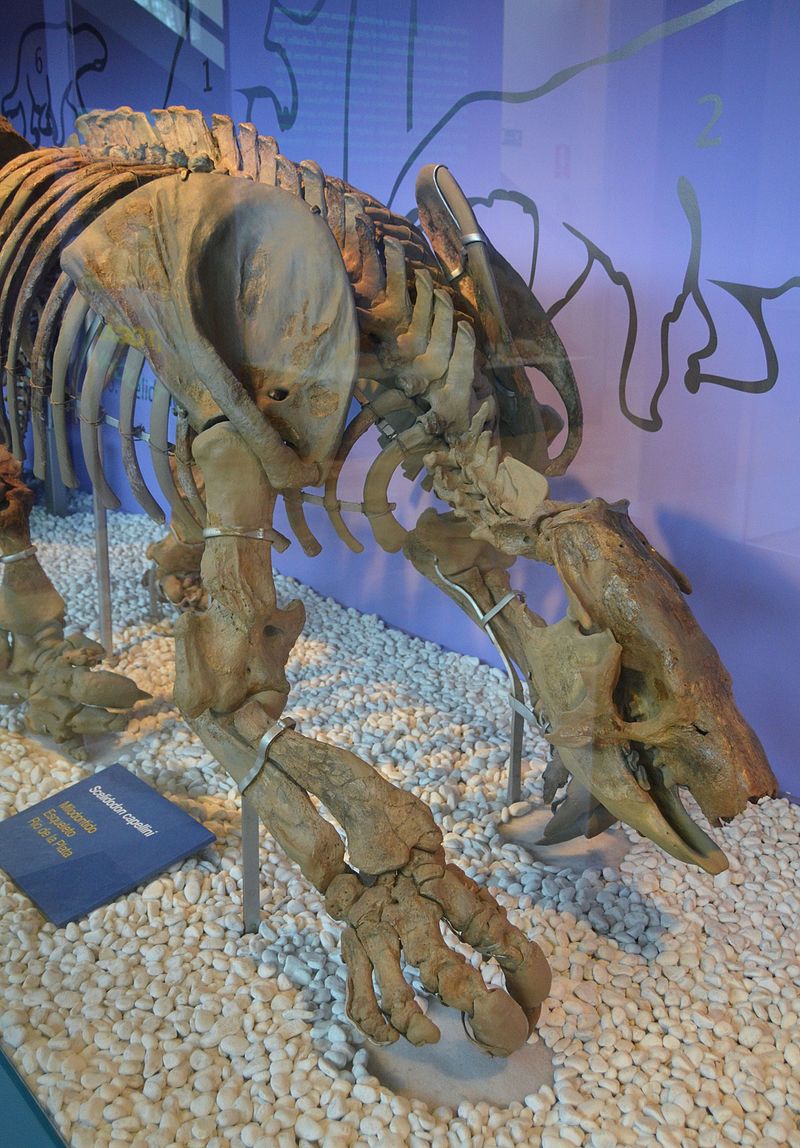
The size of the larger burrows indicates these were dug by giant ground sloths: Glossotherium and Scelidotherium in particular. Analysis on their arm bones show that these two species were well adapted to taking the strains of hard digging: short, robust bones. Initial examination of the enormous ground sloth, Megatherium americanum arm bones suggests that this giant couldn’t take the strains of digging. What’s more, Giant sloth claws were enormous! One claw is longer than my hand! If you grab a stick and scrape it on sandstone, you will notice grains will fall off. (Being soft, the stick itself will crumble pretty quickly). Now imagine if you had giant ground sloth claws!

Scelidodon capellini, milodòntid, Río de la Plata, Museu de Ciències Naturals de València.

The amazing ground sloth, Scelidodon capellini, on display at the Museu de Ciències Naturals de València. Note the huge front claws. (Image Public Domain)

With over 1,500 of these palaeovertebrate burrows documented so far, this was clearly an important part of the lives of some species of giant sloths. It turns out that they are more complex than just a little tunnel. Many have been found to connect with other burrows, and some have several openings, creating pretty impressive underground systems. With lengths of over 300 meters, they were not dug by one individual. They may have been dug by groups of sloths, or even extended by several generations digging a little bit more out in their lives.

Recently, some massive palaeovertebrate chambers were found in Brazil. And these were large, and complex, with several underground chambers. When we try to make sense of the past, nothing is ever clear cut as it first seems. It appears there were at least two styles of burrows: the tunnel based systems, and the chamber based systems. Both of which were very complex underground systems.

gsdgdg

To date, two different styles of tunneling systems have been discovered. The ‘Tunnel based system’ on the left are more circular shaped, and have one width the whole length of the tunnel. The ‘Chamber based tunnel’ is noticibly much wider, with clear chambers. (Image from Frank et al, 2015)

Oddly, we don’t know what the burrows were used for. All of them had their entrances close to waterways. Some researchers suggest they were to hide away from the big predators Smilodon and the short faced bear, Arctotherium. The entrances were much too big to prevent these creatures from sneaking inside. Others propose that the giants were using them during periods of cold or drought, which is likely, but the sloths wouldn’t have been able to dig them out in time to protect them. One suggestion by our very own Ross was that they were actually love tunnels, where the sloths used these tunnels in relative safety to mate. I quite like this idea. It fits nicely too, because all of the tunnels so far excavated lack any evidence of occupation: no dung, no debris from food, and no fossils. (Only one tunnel out of the 1500 or so discovered has a sloth skeleton trapped in volcanic ash).

Each new discovery of a fossil, or a trace fossil, adds so much to our knowledge of the complexities of species lives. Without knowing what has been lost, we struggle to appreciate how incredible each individual animal is today. And how fragile our world is.

Written by Jan Freedman (@JanFreedman)

***This post was updated on 8th March 2016 with the image of Scelidodon capellini and the description of digging into sandstone.*** 

Further Reading:

Bargo, M. S., et al. (2000) ‘Limb bone proportions, strength and digging in some Lujanian (Late Pleistocene-Early Holocene) mylodontid ground sloths (Mammalia, Xenarthra).’ Journal of Vertebrate Palaeontology. 20 (3). pp.601-610. [Abstract only]

Frank, H. T., et al. (2013) ‘Description and interpretation of Cenozoic vertebrate ichnofossils in Rio Grande do Sul State, Brazil,’ Rev. Bras. Paeontol. 16 (1). pp.83-96. [Full article]

Frank, H. T., et al. (2015) ‘Underground chamber systems excavated by Cenozoic ground sloths in the state of Rio Grande do Sul, Brazil,’ Rev. bras. Paleontol. 18 (2). pp.273-284. [Full article]

Srbek-Araujo, A. C., et al. (2009) ‘Records of the giant-armadillo Priodontes maximus (Cingulata: Dasypodidae) in the Atlantic Forest: are Minas Gerais and Espirito Santo the last strongholds of the species?’ ZOOLOGIA. 26 (3). pp. 461-468. [Full article]

Vizcaino, S. F., et al. (2001) ‘Pleistocene burrows in the Mar del Plata area (Argentina) and their probable builders,’ Acta Palaeontol. 46 (2). pp.289-301. [Abstract only]

Posted in Giant Ground Sloth | Tagged , , , , , , , , , , , , , , , , , , | 25 Comments

Ice Age Mammals in Batman’s House

During summer 2015 I was lucky enough to volunteer at the Nottingham Natural History Museum (NOTNH) at Wollaton Hall in the UK. Not only was Wollaton Hall the film location for Wayne Manor in the 2012 Batman film The Dark Knight Rises (hence the title), but the museum also contains over 40,000 fossils of organisms from across the Phanerozoic. However, you are here to read about Ice Age animals and during my time at the museum I was able to study the museum’s collection of Pleistocene mammals from Creswell Crags.

Creswell Crags is located on the Nottinghamshire-Derbyshire border and is comprised of a large gorge a third of a mile long with steep cliffs on either side. The gorge contains around 23 caves of various sizes which during the Pleistocene were used as shelters by many mammals, including early humans, during harsh winter storms. Unfortunately many animals met their untimely ends in these caves either from the cold or by ending up on the dinner plate of human hunters or cave hyaenas (Crocuta crocuta spelaea). This was the story of Creswell for much of the Ice Age and resulted in a lot of skeletons accumulating in these caves. A few bones from these caves have been dated to around 23,000-59,000 years before present, a time when many large mammals returned to Britain following the previous glacial maximum. Creswell Crags therefore represents a key snapshot in the continuous movement of animals with the constant expanding and retreating ice sheets.

3D Recreation of what Creswell Crags may have looked around 60,000 years ago, complete with cave hyaenas and mammoths Courtesy of Creswell Crags Heritage Trust (B) Creswell Crags today during a snowy winter. Courtesy of @JackBaddams

3D Recreation of what Creswell Crags may have looked around 60,000 years ago, complete with cave hyaenas and mammoths Courtesy of Creswell Crags Heritage Trust (B) Creswell Crags today during a snowy winter. (Courtesy of @JackBaddams)

The treasure trove of Ice Age fossils from Creswell was first discovered in the 1870s which led to numerous cave excavations shortly after. Of course, being Victorian palaeontologists, these excavators used dynamite, pickaxes, sledgehammers…you get the drift: not very specimen-friendly techniques. The excavations on the whole were rushed with little appreciation for correct species identifications and how individual bones may have fitted together. Many bones found during these original excavations ended up being donated or sold to the NOTNH (amongst many other institutions) where they have remained largely unstudied. That is where I came in as a volunteer; to help improve documentation of the NOTNH Creswell Crags collection to see how many different animals were present and in what proportions. I was able to spend many hours in the ‘Geology Tower’ (not a joke, a REAL tower!) examining and photographing many cool fossils, if you’ll excuse the pun. In a few cases I was even able to classify or correct some original specimen identifications which really made me feel like a professional palaeontologist.

Nottingham Natural History Museum, Wollaton Hall. The Creswell Crags fossils are currently stored in the ‘Geology Tower’. Photo Courtesy of @adamstuartsmith

Nottingham Natural History Museum, Wollaton Hall. The Creswell Crags fossils are currently stored in the ‘Geology Tower’. (Photo Courtesy of @adamstuartsmith)

There are 466 individual fossils from Creswell Crags held at the NOTNH. However, only 283 of these were reliably identified down to genus level, often because of their fragmentary nature. (This is typical of fossils from cave sites, as bones are broken up by being trampled on, or by being munched on.) From the identified fossils 17 different animals make up the collection in varying abundances. Nearly half of the identified collection consisted of woolly rhinoceros (Coelodonta antiquitatis; 25.5%) and wild horse (Equus ferus; 22%) alone. Many woolly rhino bones were of their pretty hefty limbs, whereas the most commonly observed type of horse specimen was their teeth with insanely large crowns and roots, which they would have used to grind up tough grass. Fossils of other grazing mammals in the collection include the teeth and ankle bones of giant Irish elk Megaloceros giganteus, although sadly none of the infamously huge antlers were present.

Some of my favourite Creswell Crags specimens whilst volunteering at the NOTNH. Including a (A) Megaloceros sp. molar (B) bear (Ursus sp.) canine, (C) woolly rhinoceros (Coelodonta sp.) molar, (D) wild horse (Equus sp.), (E) reindeer (Rangifer sp.) metacarpal. All scales bars 1cm. All photos adapted from Bestwick & Smith (2015).

Some of my favourite Creswell Crags specimens whilst volunteering at the NOTNH. Including a (A) Megaloceros sp. molar (B) bear (Ursus sp.) canine, (C) woolly rhinoceros (Coelodonta antiquitatis) molar, (D) wild horse (Equus sp.), (E) reindeer (Rangifer sp.) metacarpal. All scales bars 1cm. All photos adapted from Bestwick & Smith (2015).

The collection also contained several different carnivores, most notably cave hyaenas which make up 13% of the identified specimens. Regular Twilight Beast readers will already know how amazing hyaenas are, and the NOTNH contains several beautiful jaw fragments with huge pre-molars which they used for crushing the bones of their prey. There is also a rather peculiar upper jaw fragment with a tooth protruding in the wrong direction. Was this the result of a genetic abnormality? Weird preservation causing the tooth to warp? Outside opinion from Jane Ford, a PhD student examining Pleistocene UK hyaena distributions at the University of Sheffield believes the tooth is actually from a lower jaw that was shoved into an empty upper jaw socket, presumably by Victorian excavators. These specimens not only depicts the natural history of Ice Age animals, but is also a record of the excavation history of the site. Other carnivores include bears, foxes and even fragments attributed to the genus Canis, but it is unclear whether they belonged to wolves or domestic dogs.

Spotted hyaena (Crocuta sp.) upper jaw with a lower jaw tooth ‘shoved in’ from (A) side view (B) bottom view. Arrows denote the lower jaw tooth pointing in the wrong direction. Adapted Photos Courtesy of Jane Ford.

Spotted hyaena (Crocuta crocuta.) upper jaw with a lower jaw tooth ‘shoved in’ from (A) side view (B) bottom view. Arrows denote the lower jaw tooth pointing in the wrong direction. Adapted Photos Courtesy of Jane Ford.

Now I know what you’re thinking. All this talk of Pleistocene megafauna is all well and good, but what about the really exciting small furry critters like voles, lemmings and weasels that were alive at the same time as these giants? Granted, these guys may not excite the imagination in the same way as woolly rhinos or cave hyaenas, but the point is valid all the same. The smallest Creswell Crags mammal found at the NOTNH was the arctic hare (Lepus arcticus), which at up to 7kg in size is not exactly small (the average size of mammals today is 100g). So where are all the small mammals? Well, remember how I said Creswell Crags was originally excavated by Victorian palaeontologists? As well as possessing a certain fondness for dynamite, these guys were also nursing quite large egos. As such, the excavators felt the need for their finds to be as impressive as possible, thus many of their digs were biased towards collecting the iconic Pleistocene megafauna. Later, more thorough excavations in the 1920s did find an abundance of smaller mammals, but these finds ended up in other museums.

During my time volunteering at the NOTNH I was able to write up the results and publish the work in a recent volume of Geological Curator which came out in the middle of December. I was also able to present my work at the Palaeontological Association Annual Meeting in Cardiff in December 2015.

Myself (left) and the NOTNH curator of natural science Adam Smith (right) with our poster on our work on Creswell Crags at the Palaeontological Association Annual Meeting 2015 in Cardiff. (Photo Courtesy of @adamstuartsmith)

Myself (left) and the NOTNH curator of natural science Adam Smith (right) with our poster on our work on Creswell Crags at the Palaeontological Association Annual Meeting 2015 in Cardiff. (Photo Courtesy of @adamstuartsmith)

Currently only two Creswell Crags fossils are on display in the main NOTNH galleries: a hyaena lower jaw and a woolly rhino molar. However there are plans to bring more of these fossils to display which will hopefully encourage people visiting the museumto learn more about the Late Pleistocene.

Written by Jordan Bestwick (@JordanBestwick1)

Edited by Ross Barnett (@DeepFried DNA)

If you are interested to know more about the Creswell Crags collection at the NOTNH or would like to see any of the specimens for yourself, enquiries can be directed to Adam Smith (adam.smith@nottinghamcity.gov.uk) for more information.

Further Reading:

Bestwick, J. & Smith, A. S. (2015). ‘Creswell Crags fossil material at Nottingham Natural History Museum, Wollaton Hall, UK’. The Geological Curator, 10: pp.181-192. [Full article]

Charles, R, & Jacobi, R. M. (1994). ‘The Late glacial fauna from the Robin Hood cave, Creswell Crags: a re-assessment’, Oxford Journal of Archaeology, 13: pp.1-32. [Full article]

Jacobi, R. M, Higham T. F. G., & Ramsey, C. B. (2006), ‘AMS radiocarbon dating of Middle and Upper Palaeolithic bone in the British Isles: improved reliability using ultrafiltration.’ Journal of Quaternary Science, 21: pp.557-573. [Abstract only]

Mello, J. M. (1875), ‘On some bone-caves in Creswell Crags’, Quarterly Journal of the Geological Society of London. 31: pp.679-691. [Abstract only]

Mello, J. M. (1876), ‘The bone-caves of Creswell Crags’, – 2nd Paper. Quarterly Journal of the Geological Society of London. 32: pp.240-258. [Abstract only]

Mello, J. M. (1877), ‘The bone-caves of Creswell Crags’. -3rd Paper. Quarterly Journal of the Geological Society of London. 33: pp.579-588. [Abstract only]

Smith, A. S. (2015), ‘Behind the Scenes at the Museum, Fossils at the Nottingham Natural History Museum, Wollaton Hall, UK’, The Palaeontological Association Newsletter, 88: pp.35-38.

Turner, N. S. (1993), ‘Report on the Geological Collections of the Natural History Museum, Wollaton Hall, Nottingham.’ Mercian Geologist, 5: pp.49-64.

Turner, N. S. (2000), ‘Catalogue of the type, figured and cited fossils in the Nottingham Natural History Museum, Wollaton Hall, Nottingham, U.K’, The Geological Curator, 7: pp.111-121. [Full article]


Posted in Creswell Crags | Tagged , , , , , , , , , , , , , , , | 1 Comment

Mini-beasts, giants, and mega-floods

I have a little link to the time before the English Channel formed 450,000 years ago. Almost every day in the last academic year, a PhD student has been working in my office. He is investigating the environment and ecology of the West Runton Freshwater Bed, a fine-grained sediment laid down by a river, between 780,000 and 600,000 years ago. The post-graduate is using pollen, fungal spores, and beetles to work out an extremely detailed reconstruction of this place and time.

What would a PhD student researching ancient sediment in Norfolk, find at Plymouth City Museum and Art Gallery? The answer lies in what he is discovering in the sediment. He is looking for tiny fragments of beetle body parts: dozens of tiny wing parts, thoraces, and heads all turn up through very careful sieving. And by using our collection of British Beetles, he is beginning to identify species and shed light on ecosystems long gone. The West Runton Freshwater Bed contains not only mini-beasts, but also giants.

A sample formsfsfds

One little beetle fragment from a sample at West Runton Freshwater Beds. The PhD researcher is going through dozens of specimens like this, and managing to identify them – quite a skill! This specimen (just one millimeter long) is the head shield of Helophorus strigifrons. (Image by Francis Rowney, Plymouth University).

head shield of Helophorus strigifrons. (Image by Francis Rowney, Plymouth University).

The full specimen of Helophorus strigifrons in the collections at Plymouth City Museum and Art Gallery. Note the metallic head shield. (Image by Francis Rowney, Plymouth University).

I have been wanting to write a post on how the English Channel formed for quite a while, and luckily a perfect opportunity came up thanks to a recent documentary on Channel 4. Co-founder of the fantastic Trowelblazers, the wonderful Tori Herridge presented an awesome documentary about this very topic in Walking Through Time. Tori’s enthusiastic and natural presenting took us effortlessly across Norfolk and over to Kent, taking us on a journey back to when beetles scurried under the feet of the giant mammoths, and to an incredible event that separated Britain from Europe. (For tweets, and more links to information about the documentary, have a look at #WalkingThroughTime on Twitter.)

To set the scene for how the English Channel formed, we need to travel to the north coast of Norfolk, to the small green village of West Runton. Sat in an Area of Outstanding Beauty, lies a fine grained sediment formation known as the West Runton Freshwater Beds. This sediment was laid down around 780,000 years ago, when the area was a huge river estuary, with fine delta sediments building up. In these sediment are clues to the past. Tiny fragments of beetles give us temperatures and habitats, plant pollen provides us with details of the rich vegetation around, and fossils of larger animals show the ecosystem as a whole.

Norfolk was extremely different back then. There was no English Channel. Britain was joined to mainland Europe allowing animals to freely roam. Cave lions, sabretooth cats, lynx, hyenas, the extinct rhino Stephanorhinus hundsheimensis, jaguars, and giant deer all show how incredibly rich and diverse this environment was. Then in 1990, something much, much bigger was found. Just before Christmas, Margret Hems and her husband Harold, went on a spot of fossil hunting on West Runton beach. Excavations over the next few years revealed an almost complete skeleton of a Steppe Mammoth (Mammuthus trogontherii). It is the largest and most complete British Mammoth specimen, and the oldest, dating to around 600,000 years ago. (Full details on this awesome discovery are outlined by Trowelblazers).

An original photograph from the 1995 excavation of the West Runton Mammoth. (Image reproduced with kind permission from Norfolk Museum Service [Norwich Castle Museum & Art Gallery])

An original photograph from the 1995 excavation of the West Runton Mammoth. (Image reproduced with kind permission from Norfolk Museum Service [Norwich Castle Museum & Art Gallery])

Steppe Mammoths were amazing creatures. Evolving from the Southern Mammoth somewhere around 700,000 years ago, probably in Siberia, the enormous Steppe Mammoth spread far across Europe and Asia. One population of Steppe Mammoths evolved into the more familiar Woolly Mammoth, which were smaller and better adapted to the increasingly cold environments punctuating the late Middle Pleistocene. Taller than a double decker bus, the West Runton Mammoth (previously called the West Runton Elephant) was a huge beast. The size of the tusks, along with the pelvis suggests it was a male, and the teeth indicate it was around 40 years old. The skeleton provides answers to the death of this giant. An injury on the bottom-end of the thigh bone shows that it didn’t sit in the knee socket properly, so at some point this individual dislocated his knee. It seems as though he fell, or lay down, only never to get up again.

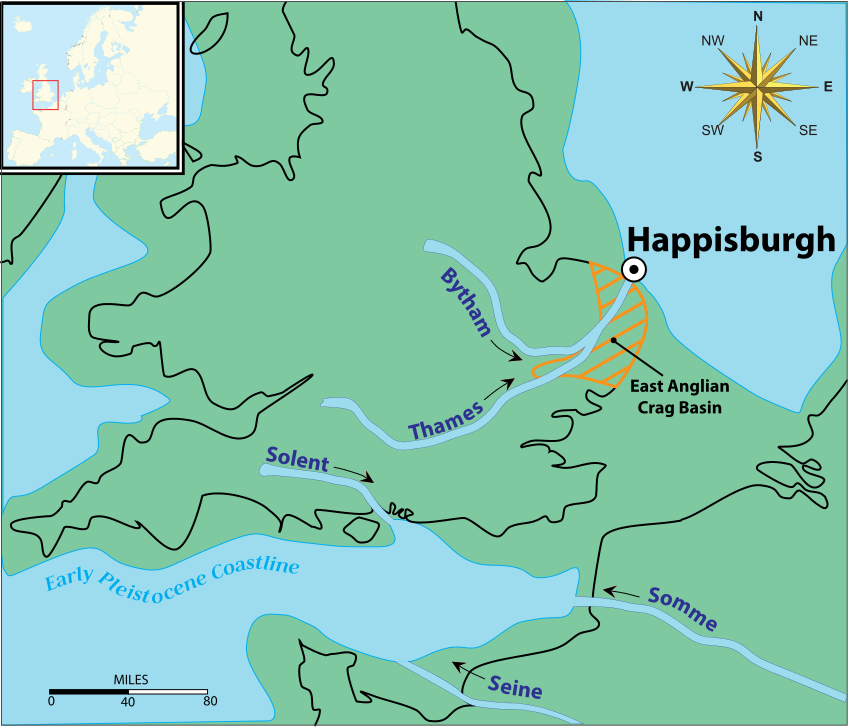
Around 800,000 years agoBritain was joined to mainland Europe. Happisburgh lay at the end of the ancient River Thames (which lay much more north than today). (Image by Wiki User, Phil88, Public Domain)

Around 800,000 years ago Britain was joined to mainland Europe. Happisburgh lay at the end of the ancient River Thames (which lay much more north than today). (Image by Wiki User, Phil88, Public Domain)

Tori then takes us 18 miles East along the Norfolk coast, to the gorgeous little village of Happisburgh. Here on the beach, exposed for just a few moments was one of the most important British archaeological discoveries of the century. In 2013, human footprints were revealed by the receding tide. These footprints were in ancient river sediment whicnah was around 900,000 years old – amazing to think the oldest human footprints outside of Africa are in Norfolk! It was a national effort, with staff from the Norfolk Museums Service, along with teams of scientists from the Natural History Museum, London, British Museum, Queen Mary University of London, University of Wales Trinity St David Lampeter, and University of St Andrews mapping, imaging and recording the footprints before they were washed away by the sea forever. Researchers from York University and Liverpool John Moores University carried out analysis of the information. Not only did 3D mapping of the footprints show that there were several individuals, but fascinatingly the larger prints of adults walked in a straight line, while the smaller prints of youngsters zig-zagged all over the place. Current thoughts are that these are the footprints left by Homo antecessor which lived from 1.2 million years ago to around 800,000 years ago. This was one of the early hominin species out of Africa and into Europe just after the more familiar Homo erectus.

Ancient footprints at Happisburgh shouldn’t have been a huge surprise. Just over 10 years earlier a beautiful flint hand axe was found in sediment from an ancient river bed. The flint itself can’t be dated, but the sediment it was found in can: it was dated to around 500,000 years old. This exquisite hand axe was carefully knapped by someone half a million years ago! The owner of the axe is likely to have belonged to Homo heidelbergensis which is a hominin species from this time. Fossils of H. heidelbergensis have been found in Spain and Germany, and at Boxgrove in Britain. The stunning hand axe is currently on display in the natural history gallery at Norwich Castle Museum and Art Gallery.

The gorgeous 500,000 year old hand axe found at Happisburgh. (Image from

The gorgeous 500,000 year old hand axe found at Happisburgh. The object is in the collections at Norwich Castle Museum and Art Gallery. (Image from the Portable Antiquities Scheme Public Domain)

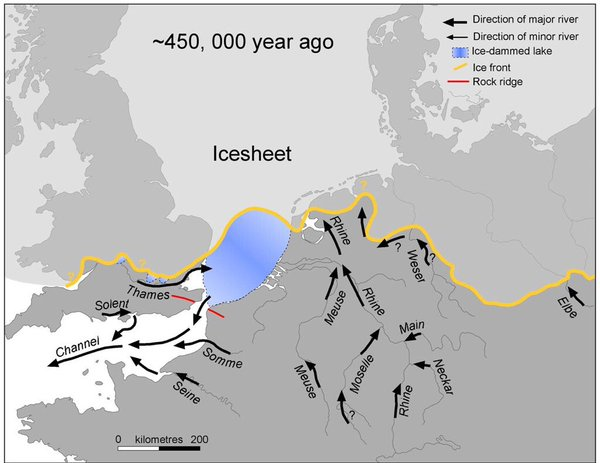
It is hard to imagine Norfolk full of exotic beasts joined to mainland Europe, with at least two species of humans visiting. For us today, it is hard to imagine what Britain would have been like without the English Channel: something, which is quite dearly British. However, the English Channel formed relatively recently, and it was something quite incredible. Around 450,000 years ago Britain was in the grip of possibly the coldest period in its recent history. This major glacial period, was so cold that an enormous glacier covered most of Britain, much of the North Sea, northern Germany, Denmark and Norway. This massive slab of ice was so far south in Britain, it pushed the River Thames south to it’s current position.

A wonderful illustration (Image reproduced with permission, adapted from Colliers et al 2015)

A wonderful illustration of the enormous meltwater lake just off Norfolk and Kent. The yeallow line shows how far south the massive glacier reached. (Image reproduced with permission, adapted from Collier, et al 2015)

Just off the coast of Norfolk, was an enormous lake. Fed by meltwater from the enormous glacier, this lake grew to be twice the size of Wales. The lake was dammed by a chalk ridge, stretching from Dover all the way across to northern France. Made from billions of tiny microscopic organisms drifting to the ocean floor, chalk is a pretty weak rock. It is thought that a small earthquake weakened the chalk ridge, and the lake broke through the dam, with a flow rate 300 times that of Niagara Falls: a mega-flood. That’s a pretty powerful force. So powerful, the force of it would rip a valley out of any rock beneath it. And that is exactly what Dr Jenny Collier and  researchers at Imperial College London discovered 40 meters below the waves. The force of huge amounts of water gouged out valleys on the floor of the English Channel. The mega-flood happened, and it would have been an incredible, if terrifying, sight.

Walking Through Time took us back to a time when the Steppe Mammoth plodded through Norfolk, and to the formation of the English Channel. This documentary brought some excellent science together, which may have otherwise been missed by non-specialists. New research will bring even more detail to this enigmatic time before and after the mega-flood. Today, more than ever before, science is being made more and more accessible. Allowing more and more people to walk though time.

Written by Jan Freedman (@JanFreedman)

Walking Through Time was a documentary aired on Channel 4 on 6th February 2016, presented by Tori Herridge (@ToriHerridge)

The West Runton Mammoth can be seen at Cromer Museum and Norwich Castle Museum.

Further Reading:

Ashton, N., et al. (2014). ‘Hominin footprints from Early Plesitocene Deposits at Happisburgh, UK.’ PLoS ONE. 9(2). [Full article]

Collier, J. S., et al. (2015). ‘Streamlined islands and the English Channel megaflood.’ Global and Planetary Change. 135. pp.190-206. [Full article]

Larkin, N. R., Alexander, J., & Lewis, M. D. (2000). ‘Using experimental studies of recent faecal material to examine hyena coprolites from the West Runton Freshwater Bed, Norfolk, UK.’ Journal of Archaeological Science. 27 (1). pp.19-31. [Full article]

Lister, A. M, & Sher, A. V. (2001), ‘The origin and evolution of the Woolly Mammoth.’ Science. 294. pp.1094-1097. [Abstract only]

Lister, A., & Stuart, A. J. (2010), ‘The West Runton Mammoth (Mammuthus trogontherii) and its evolutionary significance.’ Quaternary International.228 (1-2). pp.180-209. [Abstract only]

Lister, A. M, et al. (2005). ‘The pattern and process of mammoth evolution in Eurasia.’Quaternary International. 49. pp.126-128. [Abstract only]

Moncel, M. H., et al. (2015). ‘The early Achulian of north-western Europe.’ Journal of Anthropological Archaeology. [Abstract only]

Stuart, A. J. & Lister, A. M.  (2010). ‘The West Runton Freshwater Bed and the West Runton Mammoth: Summary and conclusions.’ Quaternary International, 228 (2010). Elsevier 241-248. [Full article]

Tichonov, A, & Burlakov, Y. (2008), ‘Causes of Northern Giants’ extinction.’ Science in Russia. (Moscow: Nawka). 2. pp.48-53. [Abstract only]

Wei, G. B., et al. (2010), ‘New materials of the Steppe Mammoth, Mammuthus trogontherii, with discussion on the origin and evolutionary patterns of mammoths.’ Science China Earth Sciences. 53(7). pp.956-963. [Full article]

Posted in Mega-flood | Tagged , , , , , , , , , , , , , , , , , , , , | 4 Comments

How do you weigh a Dodo?

Extinction is something as real today as it has always been. What makes it even more real, and for our particularly emotional species, extremely sad is that these animals and plants are gone forever. We will never feel a dozen trilobite legs tickle us as they scurry over our bare feet while we paddle in the warm seas. The time when birds with teeth swooped between trees snapping up insects is long gone. Fortunately we only have to be afraid of seagulls stealing our fish and chips, not bipedal crocodile relatives or enormous pterosaurs. These, and countless other organisms, have been alive on our planet at some point in the past. In fact, it is estimated that 99.9% of all organisms that have every lived are no longer here: and only a tiny percentage of those have been preserved as fossils. Our planet has been, and still is, full of life.

A pretty big (Image by FunkMonk on Wiki)

A pretty big bipedal relative of crocodiles, Postosuchus kirkpatricki. A beautiful animal that lived over 200 million years ago. (Image by FunkMonk on Wiki)

Trilobites were pretty cool arthropods. Birds with teeth must have been wonderful to witness. Bipedal crocodiles, well, these were very likely to be terrifying. Sadly, people don’t shed a tear for these vanished creatures. We should because these were real animals that really lived on the planet: but they lived too long ago. We have a few fossils and, even more recently, some awesome palaeoart which help bring them back to life, but these are still mysterious animals that lived millions of years ago (and millions of years is a very long time!).

We can relate to more recently extinct creatures, including many of our Twilight Beasts. We can relate because humans were around when they were alive. Our ancestors saw powerful Woolly Rhinoceros making its way across the steppes. Humans heard the giant Cuban Owl in the forests. They even witnessed the majestic Glyptodons shuffle through swamps in their enormous shells. Our Twilight Beasts in particular pluck the heart strings because they sang the song of life so close to the present day. Close enough that we can almost still hear them.

One of these animals to only very recently vanish is perhaps the symbol of extinction: the magnificent dodo. Portrayed as ‘stupid’ creatures who willingly waddled towards their own deaths, their name, wrongly, has negative connotations. On dictionary.com type in dodo and you are presented with these definitions:

– Any of the several clumsy, flightless extinct birds of the genera Raphus and Pezophaps, related to pigeons but about the size of a turkey, formerly inhabiting the islands of Mauritius, Réunion, and Rodriguez.

Slang. A dull-witted, slow reacting person.

– A person with old-fashioned, conservative, or outmoded ideas.

– A thing that is outmoded or obsolete.

I don’t think there could be a more derogatory description of any animal. Truth is, these were beautifully adapted animals for their island dwelling lives. They evolved to be pretty big and flightless, not because that’s a dumb thing to be, but because there were no natural predators. (More on the incredible dodos in our post the last squawk of the dodo.)

By Frederick William Frohawk (16 July 1861 - 10 December 1946), an English zoological artist and lepidopterist. - Transferred from Commons. Extinct birds : an attempt to unite in one volume a short account of those birds which have become extinct in historical times : that is, within the last six or seven hundred years : to which are added a few which still exist, but are on the verge of extinction. By Lionel Walter Rothschild, 2nd Baron Rothschild (8 February 1868 – 27 August 1937). (http://www.archive.org/details/extinctbirdsatte00roth), PD-US, $3

A gorgeous illustration of a dodo (Raphus cucullatus) by Frederick William Frohawk, 1907, in Extinct birds  by Lionel Walter Rothschild (Image Public Domain)

Despite a negative public view of these endearing birds, the mysteries of their lives still fascinate researchers (and funders). Ironically, new research published about dodos makes international press and members of the public are fascinated. Research has shown that although the dodo was eaten sometimes as a delicacy, the entire population wasn’t eaten to extinction: other animals that came to the island of Mauritius inadvertently killed them. Very recently there was some detailed research into their body mass.

We all visualise dodos are rather plump turkey like birds plodding along, like the painting above. However, some of the earliest illustrations of the dodo in life show quite a variety of sizes, with some pretty extremes.

By Creator:Joris Joostensz Laerle - Nationaal Archief, Den Haag, Archieven van de Compagnieën op Oost-Indië 1.04.01 inventorynumber 136, Public Domain, $3

One of the earliest illustrations of the dodo in 1601, showing a variety of life poses. (Scanned by Joris Joostensz Laerle, image held at the Nationaal Archief, Den Haag, Archieven van de Compagnieën op Oost-Indië 1.04.01 inventorynumber 136. Image Public Domain)

By Carolius Clusius, after van Neck - http://julianhume.co.uk/wp-content/uploads/2010/07/History-of-the-dodo-Hume.pdf, Public Domain, $3

An angry (and a little ferocious) looking dodo by Carolius Clusius, after van Neck (Image Public Domain)

By Pieter van den Broecke (d. 1640), ascribed to printmaker Adriaen Matham. Etching, engraving. - http://www.rijksmuseum.nl/collectie/RP-P-OB-75.463/verschillende-lokale-diersoorten-waaronder-een-dodo-1624, Public Domain, $3

Left to right: a pretty comical looking dodo, a one horned sheep and a red rail. By Pieter van den Broecke in 1617. (Image Public Domain)

Dodo among Indian birds, by Ustad Mansur, c. 1625; perhaps the most accura

The dodo surrounded by various Indian birds, illustrated by Ustad Mansur, around 1625 (Image Public Domian)

 1634 by Sir Thomas Herbert,

From left to right: a broad-tailed parrot, a red rail, and a dodo. Illustrated in 1634 by Sir Thomas Herbert. Notice how the Red Rail differs from the illustration in 1617. (Image Publc Domain)

Without cameras, sailors and artists sketched what they saw. And as you can see, this varied pretty dramatically. These illustrations from live animals show some slim birds and some much more well rounded ones. (This is more like to be a little artistic licence by the illustrator, although could represent male and females?) With such a large variety of depictions of the dodo, and written records of weight ranging from 22kg to 10kg, what was its true body mass?

The first question we should ask is why does it matter? Well, from the body mass of an animal it can give us clues and information about population sizes, metabolism, and the age of an animal. There have been attempts to calculate dodo body mass in the past. Using the equations calculating femur circumference to body size isn’t accurate because ground dwelling birds vary in their anatomy. Casts of the bones have been used to help mould muscles and tissue and work out weight, but this isn’t a very precise art. This new researched aimed to be more exact.

By calculating the ‘convex hull’ volume of the skeleton, it aimed to convert these volumes into body mass using examples from specimens where body mass is known. The convex hull is simply the points on the skeleton that can almost wrap around the skeleton: this is akin to wrapping cling film around the skeleton and a volume can be calculated. This method has been used on fossils to work out body mass estimations of creatures long ago vanished.

FROM bRASSEY ET AL, 2016

The convex hull on the skeletons. Points are plotted and these are joined together to give the convex hull volume. (Image is Figure 1 from Brassey et al. 2016)

Using 20 individual frozen birds from the same Columbiform family as the dodo, the group calculated the body mass of each. Using CT scanners, the skeletons of each of the 20 birds were digitised, and a programme calculated their convex hull. The relationship between the body mass and the convex hull volume was worked out. Three composite skeletons of dodos were scanned and their convex hull ration volume worked out.

With 20 precise measurements linking body mass to the CT scanned convex hull volumes, the researchers could calculate the dodo weight. The result was surprisingly light compared to what we imagine a dodo to look like: between 8kg and 10.8kg (that’s about the same weight as an adult fox). The three dodos used were skeletons made up from several individuals, so the results will not be exact. But what is really funky is the new technology used in this work: CT scanning, computer programs, and testing them out on extant species to test the working conversions work. It seems that as the dodo has been copied from earlier illustrations, their features have been accentuated a little, perhaps to reflect the ‘dumb’ character it was given.

It will be interesting to watch the future in this area, as it should answer even more questions about the life of the dodo. We know they only laid one egg, was this because too many would over populate Mauritius? How long between laying eggs? How long did they live for (a quick internet search returns results varying from 17 to 30 years old)?

Future work will be able to give us more of a glimpse into this truly enigmatic bird. You may think you know the dodo. Think again. The dodo, it would seem, still holds a few secrets.

Written by Jan Freedman (@JanFreedman)

Further reading:

Our post on the dodo provides a nice background introduction to this wonderful bird: The last squawk of the dodo.

Brassey, C. A., et al. (2016). Convex-hull mass estimates of the dodo (Raphus cucullatus): application of a CT-based mass estimation technique. PeerJ. doi: 10.7717/peerj.1432 [Full article]

Hume, J. P. (2006). ‘The history of the Dodo Raphus cucullatus and the penguin of Mauritius.’ Historical Biology. 18(2). pp.65-80. [Ful article]

Hume, J. P. (2012). ‘The Dodo: From extinction to the fossil record.’ Geology Today 28 (4): 147–151. [Abstract only]

Kitchener, A. (1993) ‘On the external appearance of the dodo, Raphus cucullatus.’Archives of Natural History. 20. pp.279-301. [Abstract only]

Pickering, J. (2010) ‘The Oxford Dodo. The sad story of the ungainly bird that became an Oxford icon.’ Oxford University Museum of Natural History. [Book]

Speakerman, J. R. (2005), ‘Body size, energy metabolism and lifespan.’ Journal of Experimental Biology. 208. pp.171-1703. [Full article]


Posted in Dodo | Tagged , , , , , , , , , | 6 Comments

Lost, as the moa is lost!

Every biologist has a gateway species. The taxon you had never heard of before that just looked so weird and unusual that you had to learn more. So, you looked up a few books, searched some library holdings, maybe photocopied a few journal articles (if you’re an old). From that small hook, a wider, more wonderful world opened up. You caught a glimpse of the tangled bank; the tapestry of life with its many threads that cross like warp and weft through space and time.

For me this was the moa. I remember it very clearly. I had read of recent attempts to generate ancient DNA from the extinct giant ratites of New Zealand and was instantly intrigued. I was in my third year of an undergraduate degree in biology and considered myself fairly au fait with the global biota. But these creatures were like nothing I’d encountered before. In reconstruction they were like fluffy pom-poms, with ten-foot necks, dragon legs, and tiny heads. An ostrich drawn by a two year old. The skeletons were just as impressive. Ribcages on legs with endless vertebrae. I think what blew my mind was that this whole family of birds (Dinornithiformes) had survived in their overlooked Eden until the time of William Wallace (very recent indeed, for a Scotsman), but had gone extinct due to overhunting and introduced predators. This was my first inkling of a fact that has become a lifelong theme: extinction is not a thing of the remote past of dinosaurs and mammoths, but is happening right now! Now! This very minute! It was a watershed moment for someone who until then had blindly believed in the ability of ecosystems to be self-regulating and stable, excepting meteors and ice ages. It was more like a coming of age. A realisation that if humans are going to claim dominion, then we have a fundamental responsibility towards our fellow species.

Dinornis_robustus,_South_Island_Giant_Moa_-_three_quarter_view_on_black_YORYM_2004_20

Reconstructed skeleton of a female South Island giant moa (Dinornis robustus) excavated from Tiger Hill in the Manuherikia Valley, Central Otago in 1864. Now in the Yorkshire Museum. Image courtesy of York Museums Trust, via Wikimedia Commons (CC-BY-SA-3.0)

Extinct_birds_-_an_attempt_to_unite_in_one_volume_a_short_account_of_those_birds_which_have_become_extinct_in_historical_times_-_that_is,_within_the_last_six_or_seven_hundred_years_-_to_which_are_(14727819136)

Reconstruction of an upland moa (Megalapteryx sp.) from Baron Rothschild’s book “Extinct Birds”. Public Domain Image from Wikimedia Commons

The moa (singular and plural, taken from Mãori) were an incredible family of birds. Part of the ratite group, familiar to us in the modern day ostrich (Struthio camelus), emu (Dromaius novaehollandiae), kiwi (Apteryx sp.), cassowaries (Casuarius sp.), and rhea (Rhea sp.), they are also kin to the extinct elephant birds (Aepyornithidae). When I first read about the moa, they had just been taxonomically culled from a couple dozen species down to a more manageable twelve or so. There were a complex bunch of genera and species: some turkey sized, others larger. The most impressive of the group were the Dinornis sp. which could be nearly two metres tall at the back, with a potential reach of up to four metres, thanks to their hosepipe necks. All fitted into the wide variety of New Zealand ecosystems: rainforest, alpine, coastal, plains. Since New Zealand, famously, has no native mammals, the moa had evolved into a broad spectrum of niches. Some were browsers, some grazers, some specialised, some catholic in their food choices. There is evidence that some of the native flora co-evolved with moa a unique form of browsing defence (“divaricating”) where the tender growing heart is protected by a mass of wide-angled branches and thorns. Like the Osage orange and Honey locust in the New World, the ghosts of evolution with megafauna are still around.

Since the New Zealand extinction event is so recent, the evidence it has left behind is much greater than that found in Australia, America, or Europe. Moa bones, eggshell and other detritus are everywhere. My PhD supervisor (a caver, and native Kiwi) told an amusing story about using a moa tibiotarsus to loop his rope around when exploring underground. The first moa bones to be identified had a very prominent place in 19th century geology: they were shipped over by Walter Mantell (son of the revered Gideon Mantell, finder of the first dinosaurs) and identified from the merest scrap by the nefarious Richard Owen. This set off a mad scramble for everything moa, with huge numbers of bones being uncovered by interested amateurs.

Richard Owen and a Dinornis moa. He holds in his hand the bone from which he first deduced the existence of moa in New Zealand. Public domain image via Wikimedia Commons

Richard Owen and a Dinornis sp. moa. He holds in his hand the bone from which he first deduced the existence of moa in New Zealand. Public Domain Image via Wikimedia Commons

Natural_History_Museum,_London,_moa_bone_fragment

Close up of the moa bone fragment that Richard Owen received. The honeycomb-like internal struts that are unique to birds are obvious. Image by John Cummings via Wikimedia Commons

Some Victorian New Zealanders "excavating" a moa swamp. The bones are piled all about. Public Domain Image via Wikimedia Commons

Some 19th Century New Zealanders “excavating” moa from Kapua swamp. The bones are piled all about. Public Domain Image via Wikimedia Commons

As the extinction was relatively recent, there are many remains of moa that speak more forcefully than bones ever could. There are mummies of some species of moa. Preserved in dry alpine caves, we can look at the face of an extinct giant and imagine what it would have been like when alive. We can admire the beautiful feathers. Soft and downy in muted browns and greens. Used in ceremonial robes and cloaks by Mãori leaders. Coprolites of moa have been found and studied and give an insight into diet and ecology. The enormous eggs (only slightly smaller than those of the Malagasy Elephant bird) have been recovered in archaeological contexts and abandoned nests. Even preserved footprints have been found, showing how the birds strode over the land they once owned. The Mãori even depicted them in art. As a complex and multifaceted society, the Polynesians who travelled to New Zealand and became the Mãori must have incorporated the many species of moa into their culture. At least until they became extinct. 19th century European ethnologists who quizzed Mãori elders about moa may have hopelessly contaminated their source with leading questions and nonsensical pet theories, but some scraps of genuine knowledge appear to have come through. Most poignant to me is a proverbial Mãori expression of loss and regret: “Ka ngaro i te ngaro o te moa”. This translates as “Lost, as the moa is lost”.

Mummified head

Mummified head of the Alpine moa Megalapteryx didinus, the type specimen, from Otago. Public Domain Image via Wikimedia Commons.

Mummified foot

Mummified foot of the Alpine moa Megalapteryx didinus. the type specimen, from Otago. Image by Ryan Baumann via Wikimedia Commons

Moa_footprints

Preserved footprints of a South Island giant moa (Dinornis robustus). Exposed in August 1911 when a flood in the Manawatū River swept away the blue clay that had covered and preserved them. They show that the moa had three strong front-pointing toes and, unlike most other ratites, a small rear toe. Public Domain Image via Wikimedia Commons

Moa rockshelter

Moa drawing, presumably from life, from the Canterbury region. Note the upright posture, round torso, and exaggerated foot claws. Public Domain Image

Moa have really come into their own as a subject of study with the advent of ancient DNA methods. Being large, extinct, unique, and not very old they were the perfect source of DNA. In fact the first genome from any extinct species was from a pair of moa (the study that started me out on my current trajectory…). Despite a century’s worth of work on skeletal morphology and how it related to moa taxonomy, the greatest revelation about living moa came from a fantastically elegant study conducted by my friend and mentor Professor Mike Bunce, all the way back in 2003. Here, genetic study of three putative species of moa uncovered conclusive evidence that the three different sizes of moa were actually two sexually dimorphic species. Basically, there were super-large, large, and medium animals on the North and South island of New Zealand. On the North Island, the large bones were identified as females and the medium bones as male. On the South Island, the super-large bones were the females and the medium bones were males. By sequencing DNA from the sex chromosomes Mike and colleagues were able to identify female moa (in contrast to mammals, bird sex chromosomes are heterogametic in the females, usually identified as ZW). Like ostriches, for moa the smaller males were probably in charge of egg care.

Unicode

Professor Mike Bunce with a female Dinornis robustus tibiotarsus, Pyramid Valley, February 2008. Image: Author’s Own

And so to their extinction. As an enormous, flightless bird with no natural predators (except perhaps the enormous Haast’s eagle, Harpagornis moorei), moa probably invested a lot of their effort into a few offspring, which took a long time to reach maturity. Juvenile moa may not have attained maturity until they were at least a decade old, according to growth rings recorded in their bones. This strategy, known as K-selection, is often found in large animals as the best method for reproductive success. Unfortunately, it also means that very little interference was needed to irrevocably condemn the moa to extinction. Numerous modelling studies have shown that from the arrival of the Polynesians in the first fleet to total extinction of the moa could have taken as little as 150 years. Up to 100,000 moa from 11 different species wiped out by hunting, land clearance, dogs and rats in a century and a half:

Ka ngaro i te ngaro o te moa.

Euryapteryx

A doleful looking broad-billed moa (Euryapteryx curtus). Image by FunkMonk via Wikimedia Commons

Written by Ross Barnett (@DeepFriedDNA)

Further Reading:

Allentoft, M. E., & N. J. Rawlence. (2012). “Moa’s Ark or Volant Ghosts of Gondwana? Insights from Nineteen Years of Ancient DNA Research on the Extinct Moa (Aves: Dinornithiformes) of New Zealand.” Ann Anat 194, no. 1: pp.36-51. [Abstract only]

Bunce, M., T. H. Worthy, T. Ford, W. Hoppitt, E. Willerslev, A. Drummond, and A. Cooper. (2003). “Extreme Reversed Sexual Size Dimorphism in the Extinct New Zealand Moa Dinornis.” Nature 425, no. 6954: pp.172-75. [Full article]

Bunce, M., T. H. Worthy, M. J. Phillips, R. N. Holdaway, E. Willerslev, J. Haile, B. Shapiro, et al. (2009). “The Evolutionary History of the Extinct Ratite Moa and New Zealand Neogene Paleogeography.” [In eng]. Proc Natl Acad Sci U S A 106, no. 49: pp.20646-51. [Full article]

Cooper, A., C. Lalueza-Fox, S. Anderson, A. Rambaut, J. Austin, and R. Ward. (2001). “Complete Mitochondrial Genome Sequences of Two Extinct Moas Clarify Ratitie Evolution.” Nature 409. pp.704-07. [Full paper]

Holdaway, R. N., M. E. Allentoft, C. Jacomb, C. L. Oskam, N. R. Beavan, and M. Bunce. (2014). “An Extremely Low-Density Human Population Exterminated New Zealand Moa.” Nat Commun 5. pp5436. [Abstract only]

Mitchell, K. J., B. Llamas, J. Soubrier, N. J. Rawlence, T. H. Worthy, J. Wood, M. S. Lee, and A. Cooper.(2014). “Ancient DNA Reveals Elephant Birds and Kiwi Are Sister Taxa and Clarifies Ratite Bird Evolution.” Science 344, no. 6186: pp.898-900. [Full article]

Oskam, C. L., J. Haile, E. McLay, P. Rigby, M. E. Allentoft, M. E. Olsen, C. Bengtsson, et al. (2010). “Fossil Avian Eggshell Preserves Ancient DNA.” Proceedings Of The Royal Society B-Biological Sciences 277, no. 1690: pp.1991-2000. [Full article]

Perry, G. L. W., A. B. Wheeler, J. R. Wood, and J. M. Wilmshurst. (2014). “A High-Precision Chronology for the Rapid Extinction of the New Zealand Moa (Aves, Dinornithiformes).” Quaternary Science Reviews 105: pp.126-35. [Abstract only]

Rawlence, N. J., J. R. Wood, K. N. Armstrong, and A. Cooper. (2009). “DNA Content and Distribution in Ancient Feathers and Potential to Reconstruct the Plumage of Extinct Avian Taxa.” Proceedings of the Royal Society of London: Series B. [Full article]

Rawlence, N. J., J. R. Wood, R. P. Scofield, C. Fraser, and A. J. D. Tennyson. “Soft-Tissue Specimens from Pre-European Extinct Birds of New Zealand.” Journal of the Royal Society of New Zealand (2012): 1-28.[Full Article]

Turvey, S. T., O. R. Green, and R. N. Holdaway. (2005). “Cortical Growth Marks Reveal Extended Juvenile Development in New Zealand Moa.” Nature 435, no. 7044: pp.940-3. [Abstract only]

Wood, J. R. (2008). “Moa (Aves: Dinornithiformes) Nesting Material from Rockshelters in the Semi-Arid Interior of South Island, New Zealand.” [In English]. Journal of the Royal Society of New Zealand 38, no. 3: pp.115-29. [Full article]

Wood, J. R., N. J. Rawlence, G. M. Rogers, J. J. Austin, T. H. Worthy, and A. Cooper. (2008). “Coprolite Deposits Reveal the Diet and Ecology of the Extinct New Zealand Megaherbivore Moa (Aves, Dinornithiformes).” Quaternary Science Reviews. [Abstract only]


Posted in moa | Tagged , , , , , , , , , , , , , , , , , , | 14 Comments