From Russia with love

In the frozen desolate lands of north eastern Russia, there is a unique mammoth graveyard. This graveyard is different than other fossil sites in the world. After being exposed for the first time in tens of thousands of years, the bodies are fresh: flesh is soft, the stench of death is overwhelming. Instead of the dead entombed in rock, they are trapped in frozen soil. When this soil starts to melt, it is mushy, sticky, messy. A little like a chocolate cake.

Frozen remains have been found across Siberia for centuries. Carcasses were so fresh that in the late 1700s they were thought to be giant underground rats: these behemoths used their enormous tusks to dig huge tunnels underground. They fed from the Earth. They also knew when they were going to die, for they dug out of the ground to die on the surface, which is why they are found half sticking out of the ground. It’s quite a marvellous idea, but sadly these were not giant underground rats. They were mammoths.

The Adams Mammoth, illustrated in the early 1800s before it was fully excavated. The trunk of this mammoth was scavenged and missing from the specimen. The pointing back tusks may be a nod to those giant underground rats. (Image Public Domain. From here)

Over the years hundreds of thousands of mammoths travelled in great herds across Siberia. Herds moving back and forth, following the seasonal changes, following the food. Many died on this journey. This harsh environment claimed the young as well as the old. The dead may stay dead, but they can speak of their time on Earth.

The most complete frozen mammoth, and arguably one of the most beautiful, was found relatively recently. She was small and exceptionally persevered. A few years ago, I was fortunate enough to see her on display at the Natural History Museum, London. Only once have I ever seen anything more beautiful.

About as long as my arm, she was almost perfect. Her small trunk curved down and in. The ear was nothing like the modern elephant’s: it was tiny. She wasn’t covered in fur like I expected, this had been lost, but there were two small patches of fur, giving a glimpse of the colour of this little mammoth. She was inches away from my face. Secure behind thick glass, positioned carefully in an environmentally controlled case, she sat silently as I, and hundreds of other visitors, looked at her with awe.

Her name is Lyuba. She is a very young woolly mammoth (Mammuthus primigenius). And she is a thing of rare beauty.

The beautiful baby mammoth, Lyuba. (Image Matt Howry. From here)

Today Lyuba is in the collections at the Shemsnovskiy Museum and Exhibition Centre. But she almost never made it to the public eye.

Astonishingly, she was discovered separately three times. Firstly she was seen in September 2006 by a reindeer herder Niklola Serotetto, but he didn’t report the find. The following year in May 2007, another Nenets reindeer breeder and hunter, Yuri Khudi, and his sons came across the small mammoth. Khudi travelled across land to find a friend to speak to about the discovery. When he returned, Lyuba wasn’t there. She was discovered by a third reindeer hunter and moved to the nearby village of Novyy Port. Here Lyuba was placed outside a shop, where dogs had chewed off an ear and most of her tail. She was reclaimed by Khudi, who made arrangements for her to go to the Shemsnovsdkiy Museum and Exhibition Centre.

In honour of her discoverer, and his tenacity at making sure this frozen mammoth was safe for future generations, she was named after Khudi’s wife: Lyuba. Which also means love. Perhaps there is no better name for this animal.

Despite being 41,000 years old, we have found out a surprising amount of information about Lyuba.

She was found lying on top of ice by the side of a river. This is pretty unusual for frozen specimens in Siberia: normally they are found half exposed, with other bits of them still frozen in the ground. Some carcasses are fully exposed, as the ice melts in the summer months, but these are partly eaten by scavengers. Lyuba was perfect, which was a bit of a mystery. After visiting the site, mammoth palaeontologist Dan Fisher along with a few colleagues soon discovered how she became to be lying there. During the warmer months, ice alongside the river melts and sometimes large chunks break off and float downstream. It is likely that Lyuba, possibly still enclosed by some ice, broke off and floated down the river. Luckily, she didn’t float too far, or stay in the water for too long. She became grounded at the side of the river, lying in silence with the high pitched whistle of the wind blowing over her.

She is the best preserved mammoth in the world. Missing an ear and parts of her tail from being chewed off by dogs, and missing her toenails, she is externally near complete. Only a few small patches of fur remain, showing she was (probably) light brown-orange colour when she was alive. A recent study shows that her internal tissues were incredibly well preserved. Strangely, these were very acidic whilst the collagen structures (like bone and cartilage) were broken down. This suggested that lactic-acid bacteria had colonised her body, preserving the internal organs perfectly, in a similar way to how museums preserve specimens in formaldehyde.

A CT scan of Lyuba, showing the incredible details of her insides. (Image Ford Motors, for the International Mammoth Committee)

With this incredible preservation of her insides, we have found out a lot about her short life. Some of her mother’s milk was found in her stomach, showing that she fed soon before she died. Scientists also found some mammoth dung in her intestines. This isn’t as strange as it sounds. Elephants today may eat their own dung, especially during tough times. For young calves, this is a good way of developing their digestive system ready for eating the tougher vegetation that they must when they wean off their mother’s milk.

Lyuba was small. And she was still getting milk from her mother. But do we know how old she was when she died? Incredibly, we do. Detailed studies of her teeth which looked at the neonatal growth lines, indicated she was only 30-35 days old when she died. Looking at the chemical isotopes in her teeth (which can provide clues to what vegetation was growing around the time of her death), we even know that she was born in the early spring.

Her body shows that she didn’t die of any broken bones and was a very healthy calf. Because her organs have been so well preserved, we know how she most likely died. Detailed CT scans show her oesophagus and trachea were all filled with mud, suggesting she suffocated. We would know more if she was found in the original place where she died, as the surrounding area would give more information. Based on what evidence there is, it appears Lyuba got stuck in mud at the side of a river. Her little body didn’t have enough power or strength to pull herself out, and she slowly sunk into the mud and suffocated.

Did mammoths mourn for their dead? Elephants have been seen to push a dead relative with their trunk and feet, and stay by their side for days. Both African and Asian elephants have been shown to carry out this behaviour: an awareness of their dead. Modern African and Asian elephants split around 7 million years ago, and the first mammoths split away from Asian elephants around 5 million years ago. It is very likely that they shared this behaviour.

It is not difficult to think of Lyuba’s mother, with her herd nearby, standing close to the river near the spot where she died. Perhaps trumpeting. Perhaps tentatively moving closer and then stepping back with those huge feet. For a day. Or maybe for a few days. Before the cold, icy Siberian winds blew through their thick fur, pushing them onwards.

Written by Jan Freedman (@JanFreedman)

Further reading:

Find out more about woolly mammoths in our post about them here.

We wrote about another find in Siberia, which lead to possible cloning hopes.

Discover all ten different species of mammoths in our post here.

Barnes,, I. B. et al. 2007. ‘Genetic structure and extinction of the woolly mammoth, Mammuthus primigenius.’ Current Biology. 17:1. pp.1072-1075. [Full article]

Fisher, D. et al. 2012. ‘Anatomy, death, and preservation of a woolly mammoth (Mammuthus primigenius) calf, Yamal Peninsula, northwest Siberia.’ Quaternary International. 255. pp. 94–105. [Full article]

Fisher, D., et al. 2014. ‘X-ray computed tomography of two mammoth calf mummies.’ Journal of Paleontology. 88 (4). pp.664–675. [Abstract only]

Kosintsev, P, et al. 2012. ‘Environmental reconstruction inferred from the intestinal contents of the Yamal baby mammoth Lyuba (Mammuthus primigenius Blumenbach, 1799).’ Quaternary International. 255. pp.231–238. [Full article]

Lazarev, P., Grigoriev, S., & Plotnikov, V. 2010. ‘Mammoth calves from the permafros of Yakutia. Quaternaire. Hors-Serie. 3. pp.56-57.

van Geel, B, et al. 2011. ‘Palaeo-environmental and dietary analysis of intestinal contents of a mammoth calf (Yamal Peninsula, northwest Siberia).’ Quaternary Science Reviews. 30(27-28). pp.3935–3946. [Abstract only]

Posted in Woolly Mammoth | Tagged , , , , , , , | 11 Comments

Under the boot of man

Working in a museum I come face to face with life’s extraordinary diversity every day. Specimens a few hundred years old tell us of the richness of life right beneath our feet. Older specimens provide a glimpse into amazing animals and plants of the past. I am extremely lucky to be able to discover and learn new things daily, and to be able to share this with the public. Individual species; individual specimens; individual collectors: they all have their own little stories. Stories that stop all museum collections from just being ‘in a dusty old store room’. Stories that make sure that millions of specimens do not remain silent in death.

There are dozens of different stories within museum collections. Of course there’s the ‘famous’ specimens from those well-known collectors, but there is much, much more. There’s examples of life’s biodiversity on your doorstep. There’s the curious characters of collectors and the strange motivations of collecting. There’s the evolutionary links between animals, and unique features. There’s millions of years of geological history in a few drawers of minerals. The story of life: museum collections are a record of life, life around us today, and life that has vanished. I could go on.

Perhaps the most poignant story in all museums across the world is extinction. Ancient fossils tell us of life that once was. Memento Mori! Even with modern specimens there are species that are now extremely rare or extinct. These modern extinctions are often the most striking and shocking: because humans definitely caused them. Some extinctions maybe indirectly as a result of humans. Woolly mammoth populations were already shrinking because of the warming climate, and human hunting was an additional pressure that these giants couldn’t save themselves from. The dodo is a classic example of extinction, although humans didn’t hunt them to extinction, it was the other animals that we brought to the island that caused their doom.

There are a number of more powerful examples of extinction. Steller’s sea cow, became extinct just 27 years after it was formally named as a species. It was hunted for its meat and no doubt the sailors had no idea the devastating impact they had. The thylacine is another infamous example of how easily a species can be exterminated forever: purposefully hunted because of their threat to livestock in Australia, these enigmatic marsupials were purposefully wiped out just 82 years ago.

There is one example of extinction caused by humans is the most brutal of all. Brutal. Shocking. Gut-wrenching. Thoughtless. Stupid. It is hard not to get emotional when reading accounts of the mass genocide of the Great Auk.

Differences in seasonal plumage and individual variation in egg patterning in great auks. Public Domain

Eggs of two great auks (their Danish name is Geirfugl, related to the English Garefowl), stored in Copenhagen museum. Image ©Ross Barnett

Pinguinus impennis, the great auk, was an impressive, large, flightless diving bird.  Similar in appearance to its close relative, the cute razorbill (Alca torda), only it was much larger, reaching almost a meter tall. An enormous, sharp, curved, black beak protruded proudly from it’s black feathered face. A beak perfect for catching slippery fish in the cold North Atlantic waters. And it was very agile in the water: small stubby, flipper like wings, propelled it through water with ease. A thick layer of fat kept it warm in the cold north (the scientific name Pinguinus means ‘plump’ referring to the somewhat chubby appearance of this bird). This was an impressive bird. Too impressive to have had such a bloody and brutal end.

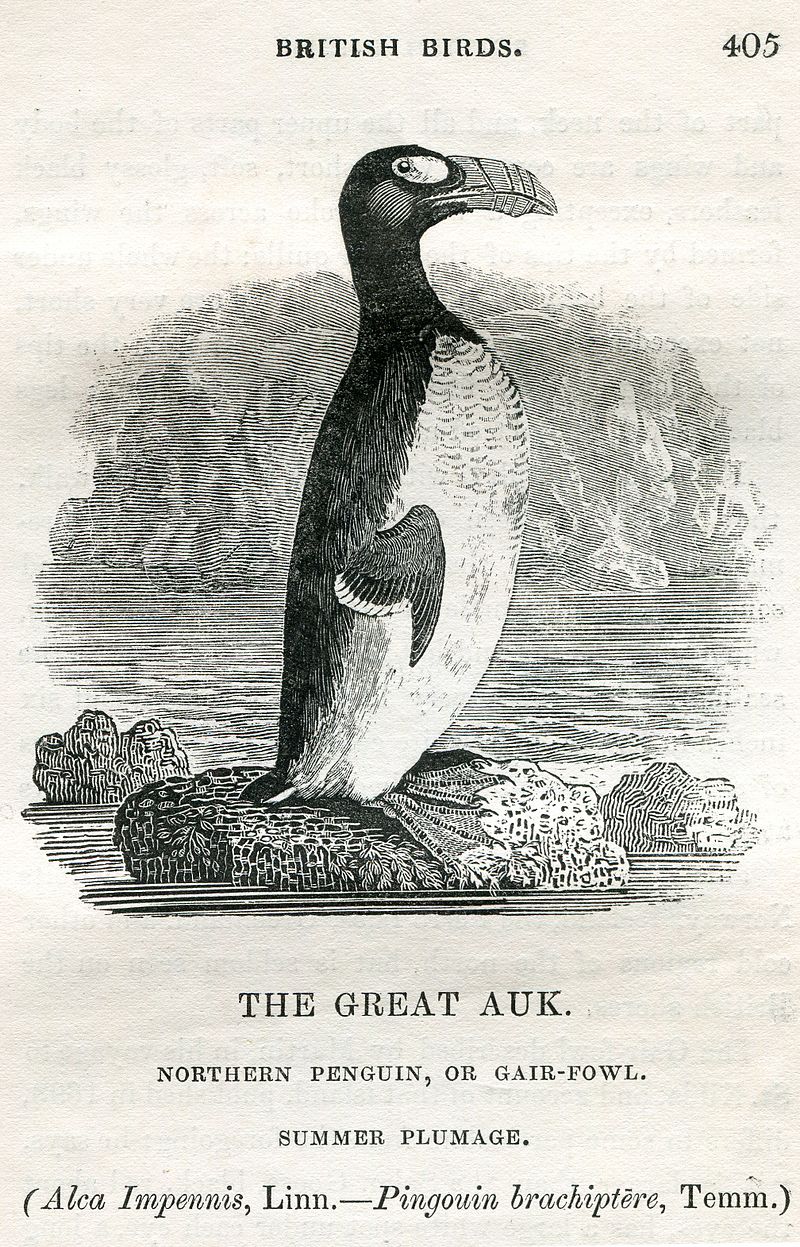
A gorgeous wood engraving of a Great Auk by Thomas Bewick. (From ‘A History of British Birds’, 1804) Image from here.

Living off the rich fishing grounds in the North Atlantic, the great auk was found along the coasts of Britain, Ireland, France, Greenland, Iceland, Norway, north east America and the Faroe Islands. This was once an incredibly widespread bird. Whilst spending most of the year in the open waters, they needed land for breeding. Great auks were quite specific about where they bred. Preferring islands that were very rocky, they also needed to have slopes for easy access to and from the sea: these birds were no ballerinas on land. The islands had to be at a good enough distance from the mainland so that polar bears couldn’t get there. Just seven breeding islands are known, although there were undoubtably more in the past. Hundreds of thousands of birds came to these islands once a year to meet their mate: the great auk had a single mate for life. Year after year they would return to the same spot, with the same partner, and spend their time on the island rearing just one egg.

Beautiful painting of great auks nesting. The painting is titled ‘The Great Auks at home’ by John Gerrard Keulemans. (Image Public Domain)

Great auk painting by John James Audubon. Public Domain

In a cruel twist, these islands that created life would become islands of death.

As with so many animals, the great auk had their natural predators. Killer whales (Orcinus orca) would hunt them when they were at sea. And whilst on land nesting, white tailed eagles (Haliaeetus albicilla), arctic wolves (Canis lupus), arctic foxes (Vulpes lagopus) and polar bears (Ursus maritimus) would hunt them. For around 100,000 years great auks had lived and survived with these predators.

Humans have hunted great auk as a source of food for tens of thousands of years. Bones from the incredible Neanderthal site at Gibraltar show that they were eaten around 100,000 years ago. For modern humans they have been captured in cave art around 35,000 years ago in Spain and again in France around 25,000 years ago. Sites across Europe and in North America have held bones of great auk, fascinatingly with many of these sites associated with human burials. One site in Newfoundland, dating to around 4000 years old, had over 200 beaks, suggesting the body was wrapped in a cloak decorated with the large beaks of this bird. There was certainly something that gave the great auk an air of respect to humans all those thousands of years ago.

It appears this admiration and reverence disappeared as Europeans began to set sail and explore the oceans in the 16th century. And it was this greed that catastrophically tipped the balance.

The breeding islands were well known by sailors as an important stop off to replenish their food supplies. The French explorer, Jaques Cartier, travelled across the Atlantic in 1534 to search for new rich lands. He was the first European to discover Canada, which he claimed for France. Before landing, his ship stopped at Iles-aux-Oiseaux to replenish stocks. Here they slaughtered over 1000 birds: the majority of which were great auks. Many sailors over the years exploited the breeding colonies for meat and eggs: one captain notes that 100,000 eggs were taken in a single day. 100,000!! For a bird that only produces one egg in a batch, this amount of eggs taken would have been utterly disastrous.

The known range of the Great Auk. The North Atlantic ocean was busy with sailors exploring new lands, which had a huge impact on their populations. (Public Domain image)

They were not only used for their meat. Their thick greasy oil which kept their feathers from getting wet, was used for fuel. Killed in their thousands, fisherman collected thousands of litres of oil. And this oil was good for burning fires too. The great auk breeding islands had no trees or vegetation that could be used to make fires. So the sailors made fires with bodies of the birds. Horrifically, these fires were used cook other great auks.

Fires fueled by the rich oils were also used to boil water that boiled great auks. Boiling the birds was one was of getting the feathers off. Their feathers were very sought after, and hundreds of thousands of these birds were killed to supply the huge feather industry in the late 1700s. Collecting feathers from the great auk was perhaps one of the most brutal ends of the great auk. If they were boiled, the featherless carcass was thrown over a cliff. Often the men didn’t even bother to boil them. Or even kill them first. This is from a 1794 diary extract:

“If you come for the feathers you do not give yourself the trouble of killing them, but lay hold of one and pluck the best of the feathers. You then turn the poor Penguin adrift, with his skin half naked and torn off, to perish at his leisure.”

Within just a few hundred years since they were first overexploited by Europeans in the 1500s, populations of this beautiful bird had plummeted. So much so that in 1794, Great Britain banned the killing of this bird (except for fishermen using their meat as bait). Bu it was already too late. Where there were once hundreds of thousands, there were now just dozens. Because they had become so rare, collectors were offering large sums of money for specimens. They vanished in Britain in 1840.

Island by island they were disappearing. Their last stand was on Eldey Island, off Iceland.

Great Auk statue on Iceland looking towards Eldey Island. Photo ©Ross Barnett

In 1844, fishermen killed the last two known great auks on Eldey Island to supply a museum collector. The birds tried to run from the attack, but not being very quick on land, their waddle only got them so far. Their necks were wrung. The pair had been sitting on the island with no others of their kind around. They were the last. Alone. But they were creating another. On the empty island, they sat on an egg. The last egg of an entire species. It was crushed under the boot of one of the fishermen.

The Great Auk met a bloody end. Today there are so many animals on the brink of extinction. Pangolins, the adorable scaly mammals, are exploited for trade. Rhinoceros and elephants too often meet horrific deaths by poachers. Tigers are hunted for their fur and bones for traditional medicines. These, and so many more animals, are terrifyingly close to vanishing forever. The story of extinction is not just in the past.

Surprisingly there are only a few specimens in museums today. Around 80 taxidermy specimens and a few dozen eggs worldwide can be seen on display: telling their story in death. And those last two poor individuals brutally killed? Their insides are preserved at the Natural History Museum of Denmark, and until very recently, their skins were lost. Genetic analysis of the preserved insides and testing of different skins matched one specimen at the Royal Belgian Institute of Natural Sciences, Brussels. Sadly the female skin is not yet found. For these birds that spend their lives finding each other every year to mate, it would be some kind of wonderful to be able to find the female and reunite them once again.

Soft tissue of the last two auks killed on Eldey. If you look closely you can see the label says “Alca impennis 1844”. Stored at Copenhagen Museum. Image ©Ross Barnett

Postscript: Have a look at #TheLostAuk tweets for lots of amazing images from museum collections around the world.

Written by Jan Freedman (@JanFreedman)

Further reading:

Bewick, T. (1847). ‘A History of British Birds. Volume 2: Water Birds.’ Newcastle. [Book]

Bourne, W. R. P. (1993). ‘The story of the Great Auk Pinguinis impennis.Archives of Natural History.20(2). pp.257-278.

Cokinos, C. (2003). ‘Hope is the thing with feathers: A personal chronicle of vanished birds.’ New York: Warner Books. [Book]

Crofford, E. (1989). ‘Gone forever: The Great Auk.’ New York: Crestwood House. [Book]

Fuller, E. (2003). ‘The Great Auk: The Extinction of the Original Penguin.’ Bunker Hill Publishing. [Book]

Gaskell, J. (2003). ‘Remarks on the terminology used to describe developmental behaviour among the auks (Alcidae), with particular reference to that of the Great Auk Pinguinus impennis.’ International Journal of Avian Science. 146(2). pp.231. [Abstract only]
Gill, A., & West, A. (2001). ‘Extinct’. Channel 4. [Book]

Meldegaard, M. (1988). ‘The Great Auk, Pinguinus impennis (L.) in Greenland.’ Historical Biology. 1(2). pp.145-178.

Moum, T., Ulfur, A., & Einar, A. (2002) ‘Mitochondrial DNA sequence evolution and phylogeny of the Altantic Alcidae, including the extinct Great Auk (Pinguinus impennis).’ Molecular Biology and Evolution. Oxford University Press. 19(9). pp.1434-1439. [Full article]

Stringer, C. B., et al. (2008). ‘Neanderthal exploitation of marine mammals at Gibraltar.’ PNAS. 105(38). 14319-14324. [Full article]

Thomas, J. E., et al. (2017). ‘An ‘Aukward’ tale: A genetic approach to discover the whereabouts of the Last Great Auks.’ Genes. 8(6). pp.164. [Full article]

Tuck, J. A. (1976). ‘Ancient peoples of Port au Choix: The excavation of an archaic Indian cemetery in Newfoundland.’ Newfoundland Social and Economic Studies. St John’s Institute of Social and Economic Research. Memorial University of Newfoundland. 17. p.261. [Full article]

Posted in great auk | Tagged , , , , , , | 3 Comments

Standing Proud

ALERT, THIS BLOG IS NOT SUITABLE FOR VERY LITTLE KIDS, AND PROBABLY IS RATED AROUND A PG12! 

There’s been a huge buzz about the early Mesolithic dates of the Shigir wooden figure, from Ural Russia, and it isn’t too often we can incorporate human activity into the Pleistocene in such a very direct way! This blog is a little step to the side for us, as we get to take you on a pretty wild and wacky journey from 9600 BC through to only 2000 years ago! 

There are stories from the deep past we won’t ever hear with our ears, but that’s not to say we cannot hear them. Archaeology tells those stories, the ones that I think matter.  The past I’m talking of is the one wrapped in skins and furs against the spiteful cold of the Younger Dryas. It has wise eyes and a hopeful heart; it knows what sustenance may still grow in snow and biting cold, and knows where the animals go to drink deep in parched summers. That past is carried in each and all of us, we are here because our ancestors survived the ice and cold with wisdom, courage and plain stubbornness. There’s times, however, something is found in bog, field or lake which beckons us to gather round in a circle, sit down, put the phone on silent, and listen to the past intently.

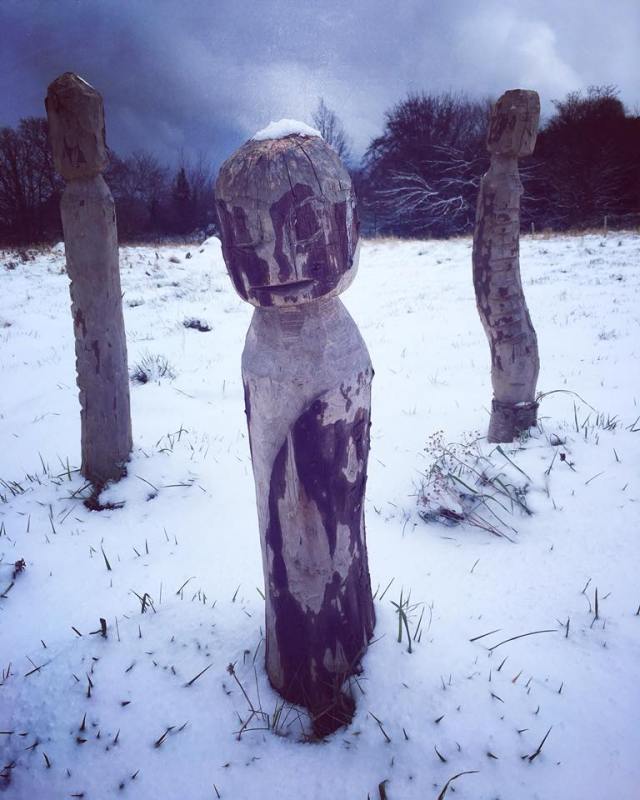
The Shigir wooden idol is one such object. It is an enigmatic wooden figure which, I admit, I could spend days just looking at, and ‘listening’ to, for it must have such a story to tell of the people who made it. It was found in a peat bog (all the best things are, imo) 100km north of Yekaterinburg, Russia, at the end of the 19th century. It stands head and shoulders (literally) above other objects of the past as it would have measured around 5 m  when complete, a tower of song, stories and memory set down some 11000 years ago. It is made of larch wood, and decorated with deep zig-zag lines on the torso, with 8 intriguing smaller faces carved as part of the design of the body. All the faces are unique and expressively stern.

Screenshot_15

The Shigir figure, from N.M. Chairkina , 2014, p85. Look at the little faces all along the body!

It’s likely that the cosmologies and foundation myths of these ancient, clever people intertwined with memory of group effort, celebrating those who made it through the ice. Think how delicious it is that when you look at these images on pixels made of light and colour on your computer, you may well be looking at remembered faces of tribal leaders, or of ancestors.

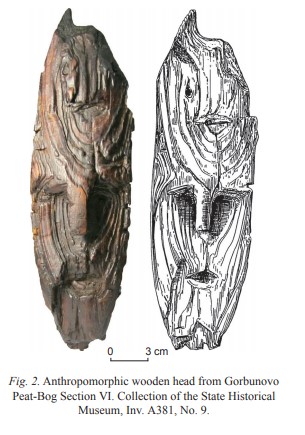
gorobuvno2

Is he Groot? A face from the deep past;one of the Gorbunovo wooden figures, from Chairkina, 2014.

Pollen samples taken from the Shigir peat bog show the presence of tall trees such as larch and pine through the last days of the Younger Dryas and the start of the Pre Boreal phase (11kya to 9.8kya BP), allowing some reconstruction of the site, showing that sometime around 9600 BC (cal.), someone, or a group of someone’s, made this massive and meaningful figure, as guardian or statement. There are others of this time, too; Shigir bog may have produced other figures, while the  Gorbunovo bog , also in the Urals, has an entire collection of wooden ‘people’, ranging in dates between the late 4th–early 2nd millenniums BC, firmly during the Eurasian ages of metal. There are also notable and wonderfully vital animal carvings; horses, deer and bison represented with flair and understanding.

p05206

The Red Man of Kilbeg, Ireland. From Stanley 2006

These Eurasian people were highly mobile hunter gatherers, following herds and living in balance with their environment. They say that this lifestyle allows more time for observation and understanding of the environment. This wisdom perhaps was cast aside to some extent during the Neolithic agricultural expansion, when humans were tamed by the crops they grew, to live in one settled place. We are not likely to know exact details of what beliefs were held. We might catch glimpses of it, though, through objects of the past, like the Star Carr stag tine head-dress, or the Sorcerer of the Cave of the Trois-Frères in France. Equally, we might catch reflections of it in surviving indigenous cultures, such as the Ugrian people of Eurasia.

The Shigir idol is the first known example of wooden ‘idol’ figures, which enjoyed a remarkable longevity of use and meaning (whatever the meaning actually was).  Somehow, they travelled westwards over time, along with metal use and horses and domesticated animals as a whole. They are found all over western Europe, often associated with toghers and trackways, the wooden paths across wetlands and bogs, suggesting they held some sort of guardian status for travellers.

The cheeky little grinning oak man from Houten, Willemstad, in the Netherlands, dates to the junction of the Mesolithic and Neolithic, around 6400 BC and seems to be the earliest in western Europe.  A serene dryad found in Pohjankuru , Finland, dates to around 3000 BC, with only the head having survived to the modern day.  The ash wood ‘God dolly’ found on a wooden track across the Bell Track in Somerset, England, is the (so far) earliest of the British Isles figures, dating between 2285 and 3340 BC (cal.). It’s a particularly interesting one, as despite the diminutive size, both breasts and phallus appear to be carved into it – it is the first obvious display of a recurring theme of emphasising genitalia on these later wooden figures.

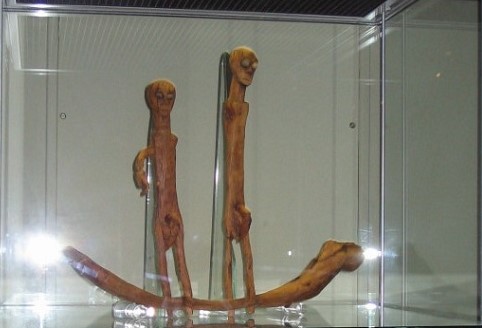
The Dagenham figure, from the London of 2250 BC (cal.), is made of Scots Pine, and has a bored hole in the pubic area, where an inserted peg could change it from being female to male. The stern faced yew-tree Ralaghan  figure (cal. 1200 BC) from a good County Cavan peat bog, shares this ambivalent sexual identity, whereas the oak Lagore  figure (cal. 2274 BC),  from the famous County Meath crannog, is void of facial features, but has a noticeable phallus. My favourites, and the most amusing to the modern eye, are the collection of small figures, around 30cm in height, found at Roos Carr, northern England. Made of pine, and dating between 770-400 BC, these little figures have quartz pebble eyes, stand in a snake-shaped boat and came with a little wooden box of detachable pegs which could be inserted into the bored holes in their pubic areas, and their little shields hung on top of those pegs! It’s a bad reflection of the 21st century that all I can think of nowadays with these chaps is Lonely Island’s eminently NSFW video, Dick in a box. I was even caught by a curator singing it to the figures in the Hull & East Riding Museum (sorry again for that, lads!), because that’s the kind of behaviour you expect from this member of Twilight Beasts!

Screenshot_14

Two of the Roos Carr figures. Worst boy band ever….?

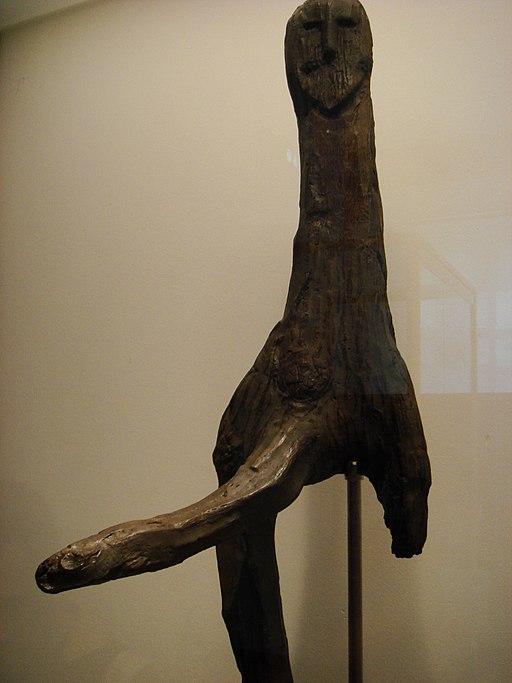
Equally amusing for his lop sided grin is the Danish Broddenbjerg Idol, one of the later figures, belonging to the Pre-Roman era of the Iron Age.  His phallus is made of a large protruding branch, which resembles other sexualised idols from the Braak Bog, in Schleswig Holstein, which also date to the 5th century BC. The craftspeople incorporated the natural shape of the wood to include sexual features within the figures. Faces are occasionally depicted on these Bronze and Iron Age specimens, but is not the primary focus of the objects. They can be male, female, and sometimes both, but they lack the human faces like those of the Mesolithic Shigir figure.

Nationalmuseet_-_Cophenaghne_-_Male_figure

Broddenbjerg figure, optimistically male, found near Viborg Denmark. On display at Danish National Museum, Copenhagen. Photo by Stephano Bolgnini Wikicommons Media Commons Licence.

We can suspect the western European figures are guardians of wetlands and soggy dangerous places, as so many have been found along trackways. Bogs and marshes are what archaeologists call liminal places, in that they are neither solid land nor bodies of water – just think of how Tolkien showed the Dead Marshes as places where life and death got a bit smudgy under the brackish water! Imagine dusk falling, and walking home across a bog trackway, sometime in the Bronze Age; the only noise is the wind soughing in the sedge, and the odd gurgle and plop of ‘something; in the water. They say that when darkness falls, strange lights flicker across the bog, which could lead you to your doom in the rusty-coloured waters – you don’t know yet that it’s methane from decaying vegetation. You just know danger is everywhere. You’d want as much protection as you can get from supernatural beings, to get you home.

All fine and dandy – but why does the ‘protection’ of these figures last from the Younger Dryas, 11000 years ago, right through to the expansion of the Roman Empire across western Europe? Do the later European ones mean the same as the Shigir idols? Does the symbolism even stay the same over those 9000 years?  Certainly, the sexual display aspect seems to be an addition of the Neolithic period , as the early Eurasian ones do not appear to exaggerate any genitals.  Could it be that the wooden figures , from the Neolithic onwards, tried to harness the wild and ancient spirits of the primeval, uncontrolled, un-humanised forests of the Mesolithic? After all, the hunter-gatherers of Shigir would have lived daily with the rawest expressions of nature, with little prudery. The primeval forests of the Mesolithic were part of a landscape which was important to life, providing food and wood for temporary shelters. Only with the concepts of land ownership – and human ownership – in the Neolithic, would deep forests become viewed as utterly fearful places, an arena where human control carried no power.

Could this be why the wooden idols were shown with very obvious genitalia, to represent the part of the human experience which often remains wild at heart, to match the wildness of uncontrolled nature in the Mesolithic?

There’s a fascinating remnant myth from Ireland of the ancestral demi-goddess Tailtu. According to the Lebor Gabála (Book of Invasions), Tailtu was a bit of a Paul Bunyan, several millennia early, as she single-handledly cleared the great ancient forests from Ireland, to allow agriculture to commence for new arrivals to the island. She collapsed, dead, on the hill which now bears her name (Teltown, in County Meath, an area with a wealth of archaeology and legend). She is, therefore, a de-wilding goddess, perhaps illustrating the discomfort of protohistoric peoples with deep, dark forests and trees with gnarled shapes which represented all the things a cattle and sheep farmer really didn’t want around, marking the difference between settled, farming societies and the ancient  hunter gatherer societies.

There is also the aspect of the woods the figures are made of. There’s magic in wood; you knock on it, to wake up the tree spirit, remember, even in the 21st century!   Alder bleeds a red sap, making figures look bloodied. It is a wood which has been used for shield making during the Late Bronze and Iron Ages as well – it bleeds, so you don’t have to. The Kilbeg wooden figure of the Irish Bronze Age (which looks like a slightly animated spine; quite creepy) would have looked quite frightening when fresh, just as the Scottish Ballachulish female figure would have. To the best of my knowledge, there has been no examination of the Mesolithic wood figures to assess the choice of woods for manufacture, or whether it was a case of using whatever was growing. This was the end of the Younger Dryas, and the start of the Pre-Boreal climate phase, when suddenly the land woke from deep freeze, and the open tundra land was colonised by the first post-glaciation  trees. Could the towering nature of the Shigir idol reflect the joy of the Mesolithic people at the tall trees now growing, and the faces represent memories of the wise old ones who got the group through the last cold snap of the Pleistocene.

28378986_10155476326813247_6925290798495505634_n

UCD experimental archaeology displaying Bronze Age-style alder-wood figures, carved with bronze axes by UCC ‘s  Pallasboy project staff, Ben Gearey, Orla Peach-Power and Mark Griffiths )https://thepallasboyvessel.wordpress.com/) December 2016 . Photo by @UCDArchaeology Experimental Archaeology

The Shigir figure, then, may well be a tribal identity symbol, carrying a very different meaning than the later figures. These later figures  appear to have chosen to adopt the guardian qualities of the ancient Mesolithic specimens, but not the incorporation of ancestors into their decoration. Why would you want your farming ancestor’s face in a maenad-ish wood sprite who was likely in cahoots with hunter-gatherers? You may well have wanted the sexy fertility of the wood spirits, and their protection, but placing them in liminal spaces, like toghers on bogs, meant that they weren’t too close to tamed, settled humans, but they still received respect due as ancient things, ensuring that they’d be happy enough in a wild, and uncontrolled place, happy enough perhaps to offer protection….

coles 1990

From Coles 1990, a diagram showing a togher, or trackway, across a bog in Lower Saxony, with two wooden ‘idols’ either side.

We won’t ever know for sure. This is purely supposition based on the stuff that we do know. What we can say is that the longevity of use of these bog idols is remarkable, regardless of how much of their original meaning they kept ( or didn’t) as they moved west across Europe. Trees are iconic things, even into the 21st century, and Marvel’s Guardian of the Galaxy ( and I’m sure of wetlands too!) of Groot – and even he has developed a bit of an attitude in the most recent movies, although certainly not half as wild and uninhibited as the bog idols! These ancient figures do, however, show the complex relationship of humanity with their environment from the Pleistocene onwards, and how trees were as vital to humans, both physically and spiritually, as the megafauna of the past.

Written by Rena Maguire (@JustRena)

A boggy bibliography!

Bond, C. 2010. ‘The God Dolly wooden figurine from the Somerset Levels, Britain: the context, the place and its meaning.’ In D. Gheorghiu and A. Cyphers (eds) Anthropomorphic and Zoomorphic Miniature Figures in Eurasia, Africa and Meso-America. Oxford: Archaeopress/BAR International Series 2138. pp 43-54. [Full Text]

Berbesque, J.C., Marlowe, F.W., Shaw, P. and Thompson, P., 2014. ‘Hunter–gatherers have less famine than agriculturalists’. Biology letters 10. 1. [Full Text]

Brunning, R., Hogan, D., Jones, J., Jones, M., Maltby, E., Robinson, M. and Straker, V., 2000. ‘Saving the Sweet Track: The in situ preservation of a Neolithic wooden trackway, Somerset, UK’. Conservation and management of archaeological sites. 4. 1.  pp.3-20. [Abstract]

Chadbourne, K., 1994, January. Giant women and flying machines. Proceedings of the Harvard Celtic Colloquium. 14. pp106-114 [Full Text]

Chairkina, N.M. 2014. ‘Anthropomorphic Wooden Figures from the Trans-urals’. Archaeology, Ethnology and Anthropology of Eurasia 42. 1.  pp.81-89. [Full Text]

Coles, B. 1990. ‘Anthropomorphic Wooden Figures from Britain and Ireland’.  Proceedings of the Prehistoric Society. 56. pp. 315-333. [Abstract]

Conneller, C. 2004. ‘Becoming deer. Corporeal transformations at Star Carr’. Archaeological dialogues. 11. 1. Pp 37-56. [Full Text]

Dimbleby, G.W., 2017. The domestication and exploitation of plants and animals. London:  Routledge.

Green, M.A., 2004. An archaeology of images: iconology and cosmology in Iron Age and Roman Europe. London: Routledge.

Hukantaival, S. 2009. ‘ Horse skulls and ‘alder horses’: the horse as depositional sacrifices in buildings’ in Bliujiene, A ( ed) Archaeologia Baltica 11: The Horse and Man in European Antiquity, 350–357. Klaipeda: Lithuanian Institute of History Press. [Full Text]

Irsenas, M. Anthropomorphic and zoomorphic Stone Ave art in Lithuania, and its archaeological context. Baltica 13.  [Full Text]

Maguire, R. 2014.  ‘The Y-piece: Function, Production, Typology and Possible Origins’ Emania. 22. pp 77 -99.

Molloy, B., 2009. ‘For Gods or men? A reappraisal of the function of European Bronze Age shields.’ Antiquity.  83. 332.  pp.1052-1064. [Abstract]

O’Sullivan, A., 1990. Wood in archaeology. Archaeology Ireland. 4. 2.  pp.69-73.

Ozheredov, Y.I., Ozheredova, A.Y. and Kirpotin, S.N., 2015. ‘Selkup idols made of tree trunks and found on the Tym River’. International Journal of Environmental Studies  72. 3. pp.567-579. [Abstract]

Potemkina, T.M. 2014. ‘Sanctuary of Eneolithic and Bronze Age in Western Siberia as a source of astronomical knowledge and cosmological ideas in antiquity’. Archaeoastronomy and Ancient Technologies 2. 1.  pp.50-89. [Full Text]

Raftery, B. 1987. ‘Ancient Trackways in Corlea Bog, Co. Longford’. Archaeology Ireland. 1. 2.  pp.60-64. [Full Text]

Smirnova, O.V., Kalyakin, V.N., Turubanova, S.A., Bobrovsky, M.V. and Khanina, L.G. 2017. ‘Development of the European Russian Forests in the Holocene’. European Russian Forests pp. 515-536. [Abstract]

Stanley, M., 2012. ‘The red man of war and death? ‘Archaeology Ireland. 26. 2.  pp.34-37.

Stanley, M. 2006 ‘The Red Man of Kilbeg: An Early Bronze Age idol from County Offaly’ PAST 52. pp 5–7. [Full Text]

Taylor, T., 1996. The prehistory of sex: four million years of human sexual culture. London: Bantam.

Zhilin, M., Savchenko, S., Hansen, S., Heussner, K.U. and Terberger, T., 2018. ‘Early art in the Urals: new research on the wooden sculpture from Shigir’. Antiquity.  92. 362 [Full Text]

Also, worth checking online, https://thepallasboyvessel.wordpress.com

and https://www.facebook.com/groups/UCDExperimentalArchaeology/

Posted in art, Homo sapiens | Tagged , , , , , , , , | 6 Comments

Coming of age:  A review of Life through the Ages

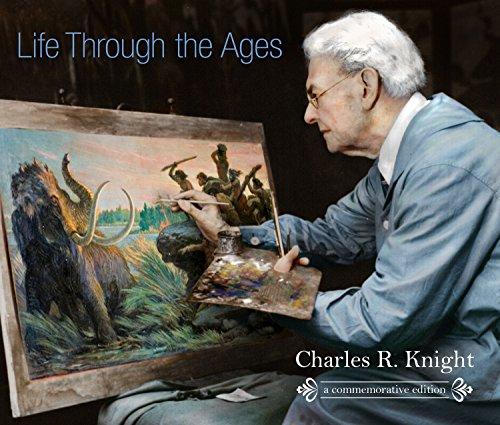
knight

You can pick up the book here.Somewhere between being a teenager and having a child of my own, museums changed. The sense of solemn and elegant wonderment was replaced with lots of ‘accessible’ little cartoon smiley faces on posters and ‘feel me/ touch me’ displays. There was no place any more for the display curator who knew everything, and certainly no room for the professional artwork which was usually placed beside information plaques, showing how the architectural-looking bones would have looked when living and breathing.

These were the days before mobile phone cameras – as a child, I remember each museum visit needed a sketch-book, to copy the artist’s interpretation and then colour them when you went home. Museum visits were joyous and exciting rituals of imagination and learning, and my own feeling (which you may well disagree with if you are younger and don’t remember older museums) is that many changes have been for the worse in modern times, allowing no scope for creativity. They have shunted the input of the ‘expert’ who was omnipresent beside cases and displays. As a child, you learnt how to ask the curators for further information – they were always so benevolent and encouraging, especially to oddball kids who maybe were the first in their families to love ancient things. They were the people you rather hoped you would grow into. When they told you things, oh my, how grown up you felt!

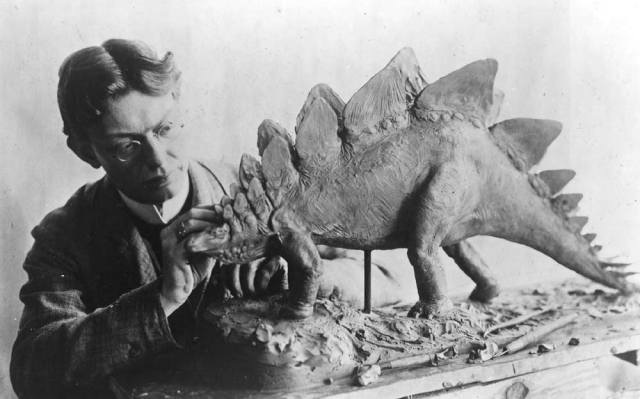
Some sanctuaries remain, which keep the balance of modernity and antiquity of displays – places like Dublin’s ‘Dead Zoo’ (Natural History Museum) , the ground floor of Edinburgh’s National Museum of Scotland, and the  Natural History Museum in London still ‘get’ it.  “Shall these bones live?” TS Eliot asked, and the answer for any heritage or natural history aficionado is that yes, they can, infinitely in imagination, but only when it is shown how marvellous the creatures were in the flesh. My mum and dad used to buy me wonderful books after visits, to encourage my sad attempts at art, and I was inspired by artists such as Zdenek Burian, and his work in Life before Man, and Glut et al’s. Dinosaurs, Mammoths and Cavemen, which showcased the work of Charles R. Knight, illustrator extraordinaire. His influence echoes through the work of modern palaeoartists.

i dig dinosaurs

From Wiki Commons, Charles R. Knight. The artist making a stegosaurus clay model

It’s been my pleasure to revisit that childhood of awe and inspiration in reviewing the commemorative edition of Charles R. Knight’s ‘Life through the Ages’ from Indiana University Press, which was published first in 1946. Knight blended scientific accuracy (only limited by what was known in his era) with a lively and elegant art style to reconstruct in both model and canvass, creatures of the past. The text includes wonderful charcoal illustrations such as a cheerful looking Styracosaurus, a jolie-laide rhinoceros iguana, a too-cute cluster of Glyptodon, armadillo, sloth and Megatherium as the best ever gang, just hanging together beside a fruit tree (can I join? Please?), and a woolly rhino who is enjoying tossing a rather surprised hominid up in the air, far too much. The illustrations are full of verve and character, and will likely have you aching to be a kid and pick up a pencil again.

cats

Hello, kitty! Page 41 of Life through the Ages. Bet a nice cardboard box would have worked for the sabre tooth as well as the little cats!

There is so much charm and genuine warmth from Knight within the text, it is obvious that he never lost his own sense of wonderment at the beasts from not just the twilight of history but the deep dark night. This text is the archaeology of a science, the text which issued generations of wide eyed kids into the natural history galleries of a myriad of museums worldwide, with avuncular kindness. It is hard not to look on this re-issue as a souvenir of all the museums and books which made us do what what we do, be it archaeology, palaeoecology, palaeontology, palaeobotany…whatever takes your core sample.

Of course, the text is dated. We now work with equipment which would have been science fiction in the 1940s, but much of what we built on and questioned, started life as ‘what ifs’ during this period of science. The past few years have proved dramatic for natural history, with much of the old text books being challenged or replaced. Przewalski’s horse is now known to be an ‘escapee’ from domesticity, meaning that there’s an earlier ancestor out there. We now know that dog domestication was earlier than we once thought too. Our own @deepfriendDNA, Ross Barnett, can relate many new findings on the Great Cats. Perhaps the reason to purchase and read this book does not lie in its accuracy for the 21st century. Perhaps it lies in remembering the child who caught sight of their first dinosaur fossil, or who wondered what the Cambrian seas were like. This is a book of memory and enchantment, our own childhood passions rekindled.

I suspect it has not just been me who feels this way. The equally gentle and gracious foreword by the late Stephen Jay Gould,  formerly of Harvard University, is bathed in whatever the palaeontology equivalent of a 1970s Kodachrome photo is; all is suffused in a wonderful, golden retro light. Philip J. Currie of the Royal Tyrell Museum of Canada adds some updates to the text, making me certainly feel this would be an ideal book to buy after a day at a museum, and read with kids beside you, be you mum, dad, aunt, uncle or whatever. Equally, buy it for yourself, share it with the very young you of a couple of decades ago, and prepare to just smile the whole time.

If you do buy it, could I make a suggestion? Buy a sketch pad and some pencils with it, for you or a young’n. It’s Easter, you might have a couple of days to chill out.  Make like it is 1956/66/76 again and sit and draw whatever takes your fancy in the museums. Be inspired how good it feels when science and art combine. It doesn’t matter if you’ve kids with you, or not – just go back and remember awe and amazement and fun.  I’d suspect that the sage shade of Charles R. Knight may well be hanging round, nodding approval….

Written by Rena Maguire (@JustRena)

Further Reading

Barnett, R., Sinding, M.H.S., Vieira, F.G., Mendoza, M.L.Z., Bonnet, M., Araldi, A., Kienast, I., Zambarda, A., Yamaguchi, N., Henschel, P. and Gilbert, M.T.P., 2018. ‘No longer locally extinct? Tracing the origins of a lion (Panthera leo) living in Gabon’. Conservation Genetics.  pp.1-8. [Full article]

Czerkas, S. and Glut, D. 1982. Dinosaurs, Mammoths and Cavemen. London: Dutton

Gaunitz, C.,  Fages, A.,  Hanghøj, K.,  Albrechtsen, A.,  Khan, N.,  Schubert, M.,  Seguin-Orlando, A.,. Owens,I.J.,  Felkel, S., Bignon-Lau,O., de Barros Damgaard,P., Mittnik,A., Mohaseb, A.F., Davoudi,H., Alquraishi, S., Alfarhan, A., Al-Rasheid, K., Crubézy, E., Benecke,N., Olsen,S., Brown, D., Anthony,D., Massy, K., Pitulko,V., Kasparov,A., Brem,G., Hofreiter, M., Mukhtarova, G., Baimukhanov, N., Lõugas,L., Onar,V., Stockhammer,P.W., Krause, J., Boldgiv, B., Undrakhbold,S., Erdenebaatar, D., Lepetz, S., Mashkour,M., Ludwig, A., Wallner, B., Merz,V., Merz,I., Zaibert,V., Willerslev,E., Librado,P., Outram,A.K and Orlando, L.  2018. ‘Ancient genomes revisit the ancestry of domestic and Przewalski’s horses’. Science. [Abstract only]

Phillips, J.B., Smith, S.A., Johnson, M.L., Abbot, P., Capra, J.A. and Rokas, A., 2018. ‘Genome wide association analysis identifies genetic variants associated with reproductive variation across domestic dog breeds and uncovers links to domestication’. bioRxiv, [Full article] available at: .

Spinar, Z. and Burian, Z. 1972. Life before Man. London: Thames and Hudson

Blaschka models: http://www.thejournal.ie/blaschka-models-3884516-Mar2018/

National Museums Scotland: https://www.nms.ac.uk/collections-research/collections-departments/natural-sciences/

Natural History Museum: http://www.nhm.ac.uk/

Posted in art | Tagged , , , , , , | 7 Comments

The fanged beast

The light from the full moon shines down, glimmering off the soft, brown, velvety fur. It’s rare for this creature to venture above ground. It moves clumsily in search of new food, but pauses. It sensed something. And from the shadows something came at terrifying speed. The creature slashed its giant claws at the predator as it attacked, missing feebly. Despite being more than three times its size, it was no match for the ferocious beast. The creature stepped back clumsily, scraping up dry dirt which hung in the air, glistening in the light of the moon like star dust. Sharp fanged teeth snapped violently at the creature. It’s claws slashed again, but it was no match for the speed for the predator. Retreating awkwardly, the creature felt a sharp pain: the fangs had driven deep inside the muscular arm, so deep they hit bone. The creature limped slowly backwards. The night became darker. The creature flopped down on its stomach. For an animal so used to spending its days living in darkness, it had never seen such pure blackness. The predator inched forward and began its feast.

This was a titanic battle. On a miniature scale. The poor creature whom sunk into darkness was in fact a mole. Our predator, a shrew.

This imaginary clash of the tiny titans sounds fanciful. Yet something like this actually happened. Amongst fossils of humans, hippos, and giant lions, one small bone of a mole humerus was found. The site of Sima del Elfeante, in Spain, has revealed a rich ecosystem long lost, in the very early Pleistocene site in Spain, some 2 million years ago.

For such a rich site in large species, it is amazing that this one bone was looked at. The humerus had bite marks on it, which matched the teeth of the extinct shrew Beremendia fissidens.

The thick mole humerus showing bite marks on the bone. (Image from Bennasar et al 2014)

A shrew biting into the arm of a mole? A bite so hard it went all the way down to the bone? This shrew maybe small, but it was a bad-ass.

Shrews are pretty small animals. All species would comfortably fit in the palm of my hand. There are shrews that are semi-aquatic. Shrews that live underground. Shrews that live in trees. In fact, shrews are one of the most diverse mammal species. Some species even use echolocation to hunt for prey! Their fossils are very abundant in Pleistocene cave sites, thanks to owls. These stealthy hunters feast on shrews and many other small vertebrates. They cannot digest the bones or fur, so they cough them up in balls and spit them out. In caves these can accumulate in their thousands, resulting in hundreds of thousands of tiny bones. These fossils give palaeontologists a rich understanding of past ecosystems.

I spent many months at the Natural History Museum, London, sieving and sorting the tiny bones from ancient owl sick. It might sound tedious, but to see the tiny teeth or vertebrae of little animals hundreds of thousands of years old was addictive. I always got more excited than I should have at seeing a shrew jaw: they are so beautiful and impossibly perfect. One would fit on my fingernail easily. They always made me smile and I would stare at them longer than perhaps I should have. My voyeurism was warranted. The cusps of the back teeth are a vibrant dark red colour. This is amazing: shrews add iron particles to their back teeth to make them stronger and more resistant to wear. So the little critters can enjoy crunching on the tough exoskeletons of beetles and grasshoppers without worrying about cavities.

But flesh eating shrews? With venomous fangs? This may not be as crazy as it sounds. Some shrews do eat dead carcasses if they stumble on them. Some even eat small rodents. The living relative of Beremendia fissidens, the northern-short tailed shrew (Blarina brevicauda), eats fish, amphibians and small mammals.

The gorgeous Northern Short-tailed Shrew, from Canada. (Image Giles Gonthier. Public Domain)

The upper canines of our ancient shrew had a c-shaped groove along the length of the tooth. This is seen in venomous animals, such as snakes, and is used to transport the venom from the venom sac to the animal it bites.  Some researchers don’t think that this ‘channel’ in the tooth signifies venom, but looking at other animals, it seems quite likely. Even more so as it’s living relative the northern short-tailed shrew is venomous. If it was venomous, then it would have been an active predator, not a scavenging animal.

The fangs of our beast, Beremendia fissidens. These fangs injected venom into its prey. (Image from Bennasar et al 2014)

This one small mole bone has given a glimpse into a fraction of time almost two million years ago. What’s more, our shrew must have had a pretty mighty chomp: it left tooth marks on the bone. Tooth marks not from gnawing on a dead carcass, but evidence of an extremely powerful bite.

Knowing there was once a fanged venomous shrew, (and now knowing that there is a venomous shrew alive today!), I for one have a new found respect for shrews. These may be little mammals, but they sure as hell are feisty.

Written by Jan Freedman (@JanFreedman)

Further reading:

Bennasar, M., et al. (2015). ‘Exceptional biting capacities of the Early Pleistocene fossil shrew Beremendia fissidens (Soricidae, Eulipotyphla, Mammalia): new taphonomic evidence.’ Historical Biology. 27(8). pp.978-986. [Full article]

Martin, I. G. (1981) ‘Venom of the short-tailed shrew (Blarina brevicauda) as an insect immobilising agent.’ Journal of Mammology. 62. pp.189-192. [Abstract only]
Masaki, M., et al. (2004) ‘Blarina toxin, a mammalian lethal venom from the short-tailed shrew Blarina brevicauda: isolation and charachterization.’PNAS. 101 (20). pp. 7542-7547. [Full article]

Tomasi, T. E. (1979) ‘Ecolocation by the short-tailed shrew Blarina brevicauda.’ Journal of Mammology. 60(4). Pp.751-759. [Abstract only]

Posted in Shrew | Tagged , , , , , , , , , | 6 Comments

It’s Miller-time

“Life itself is a school, and Nature always a fresh study.”

Hugh Miller, “My Schools & Schoolmasters”, 1854

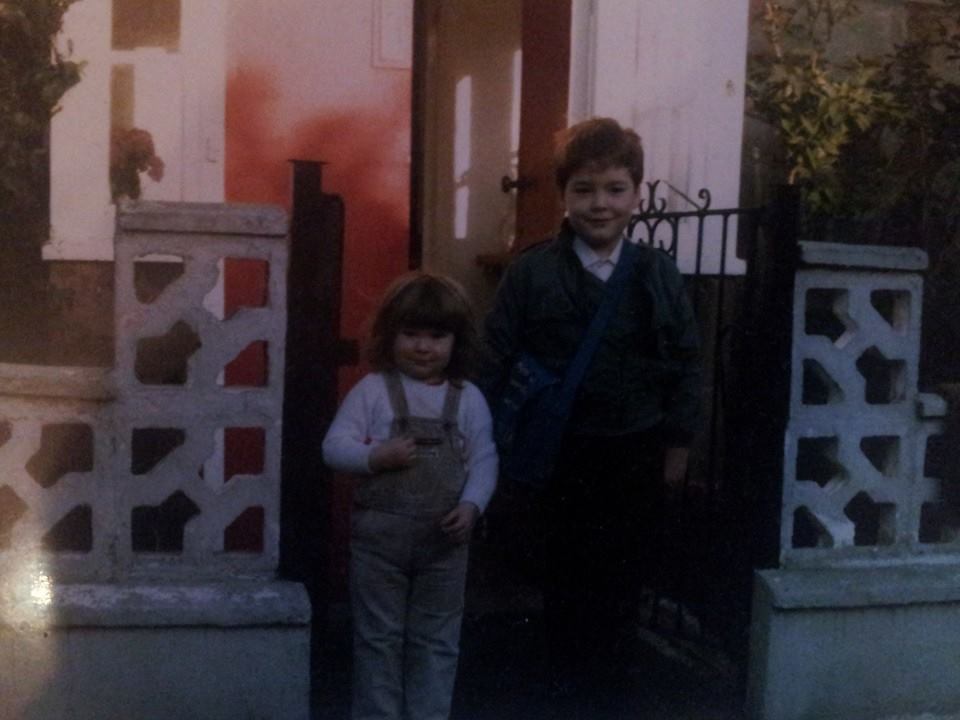
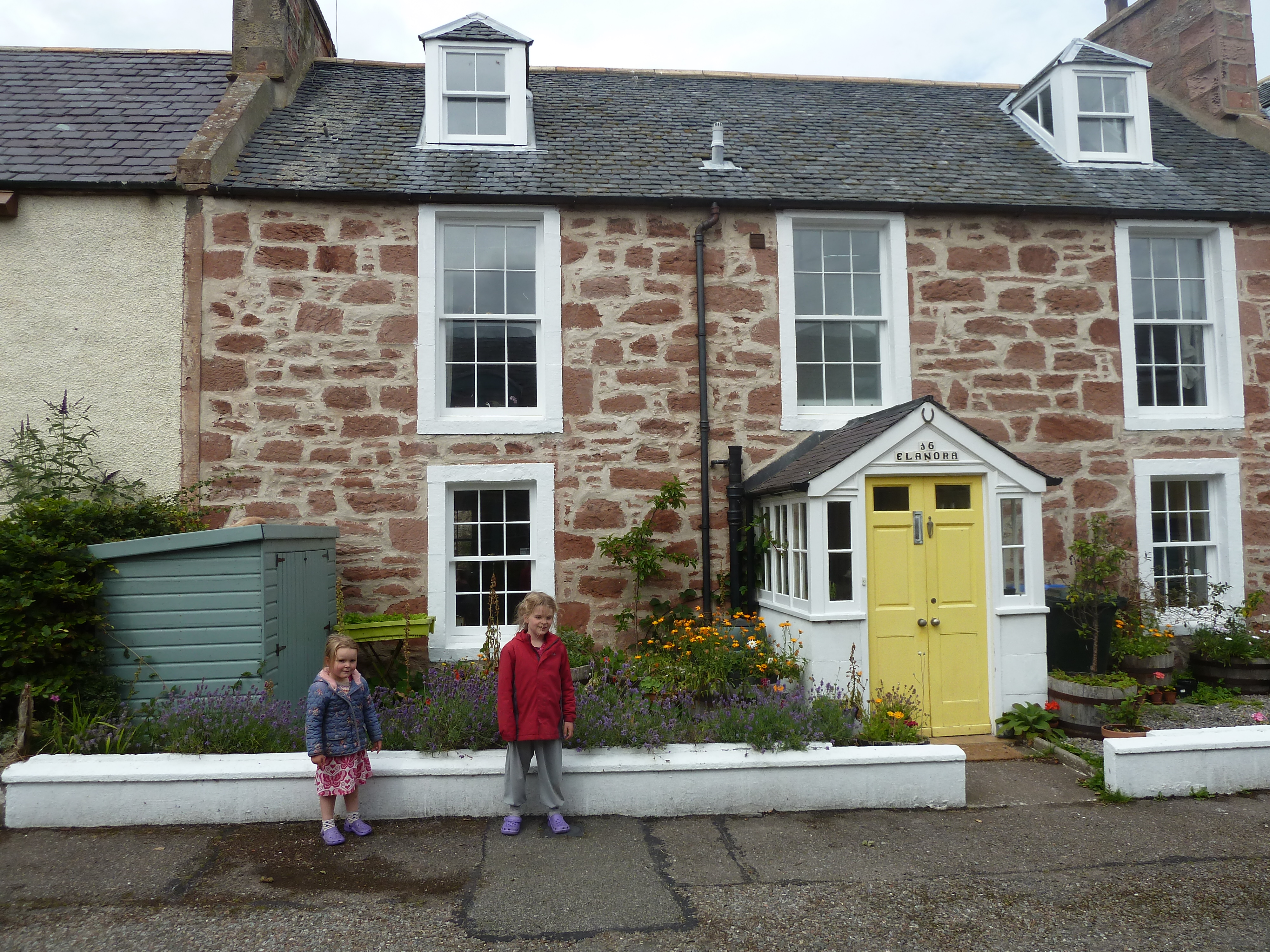
Hugh Miller. Almost before I was aware of who I was, I was aware of who he was. From just after birth until the age of five I lived in the small Black Isle fishing town of Cromarty. It’s here that I first went to school, first made friends, formed my first memories. Hugh Miller is Cromarty’s most famous son. He was a stonemason. And a geologist. And a palaeontologist, theologian, journalist, poet, and folklorist. In fact, there was very little he couldn’t do. His presence is still palpable in Cromarty. The thatched cottage he grew up in is preserved, fossil-like, as a museum. The village retains carvings and sculptings that were done by his hand and can still be seen on houses that are now the homes of artists and bohemians.

Above: Me and my younger sister outside our house in Cromarty. Below: The same house today. Photos ©the author

Miller was one of those 19th century geniuses that grew, like lichen on a cracked stone, out of the tumultuous struggle between revealed religion and the testimony of the rocks. At this time the North of Scotland was (some would say still is) a conservative and god-fearing place. Presbyterianism was in full swing and the schisms that heralded the birth of the Free Church were on the horizon.

Into this fertile landscape Hugh was born the son of a sailor. Many said his father was the best sailor in the village. He disappeared at sea when Hugh was five years old. In his best-selling memoir he describes a curious incident that happened at home on the day of the storm that sank his father’s boat. In the gloaming, while young Hugh was playing beside the open front door, he saw the apparition of a severed arm pointing towards him. Terrified, he ran to his mother for comfort. It was only later in the week that news of what had happened to his father made its way to the town. This early brush with decidedly pagan and unchristian supernatural forces encouraged a lifelong love of folklore and storytelling. Miller collected and anthologised these in his first book “Scenes and legends of the north of Scotland”. Even in my childhood I remember being entranced by my grandparents stories of second-sight and other classically Highland tales, typically told as things that had personally happened to friends they knew. Then as now in the Highlands there seemed to be no conflict between belief in the gospels and belief in the two sights.

Hugh Miller’s cottage. Photo ©the author

Miller’s most famous and long-lasting contributions were in geology and palaeontology. The area around the Black Isle has many good outcrops of Carboniferous, Silurian, and Devonian age rocks. Much too old for Twilight Beasts. This was a time of fish and amphibians, ammonites and eurypterids. Self-taught in the sciences, Milller’s careful observations and life-long collecting of fossils were a boon to students of the distant past. He wrote these up in massively popular works such as “The Old Red Sandstone”, “The Testimony of the Rocks”, and “Sketch-book of Popular Geology”. As a person who has spent more time than most reading 19th century works of science I can tell you that Miller’s prose is in a class of its own. It is hugely readable in a way that few scientists of that time managed. There is no pretension. There is no jargon. I would even go as far as to say his works are still a thoroughly enjoyable read.

Currently I am re-reading “My Schools & Schoolmasters”, Hugh Miller’s memoir cum autobiography. In his scrupulously modest way he gives thanks to all who encouraged him in his pursuit of knowledge from when he was a young laddie. There are more than a few curious tales recounted within. One of them caught my attention. Here it is:

“One of my discoveries of this early period would have been deemed a not unimportant one by the geologist. Among the woods of the hill, a short half-mile from the town, there is a morass of comparatively small extent, but considerable depth, which had been laid open by the bursting of a waterspout on the uplands, and in which the dark peaty chasm remained unclosed, though the event had happened ere my birth, until I had become old and curious enough thoroughly to explore it. It was a black miry ravine, some ten or twelve feet in depth. The bogs around waved thick with silvery willows of small size; but sticking out from the black sides of the ravine itself, and in some instances stretched across it from side to side, lay the decayed remains of huge giants of the vegetable world, that had flourished and died long ages ere, in at least our northern part of the island, the course of history had begun. There were oaks of enormous girth, into whose coal-black substance one could dig as easily with a pickaxe as one digs into a bank of clay; and at least one noble elm, which ran across the little stream that trickled, rather than flowed, along the bottom of the hollow, and which was in such a state of keeping, that I have scooped out of its trunk, with the unassisted hand, a way for the water.

I have found in the ravine–which I learned very much to like as a scene of exploration, though I never failed to quit it sadly bemired–handfuls of hazel-nuts, of the ordinary size, but black as jet, with the cups of acorns, and with twigs of birch that still retained almost unchanged their silvery outer crust of bark, but whose ligneous interior existed as a mere pulp. I have even laid open, in layers of a sort of unctuous clay, resembling fuller’s earth, leaves of oak, birch, and hazel, that had fluttered in the wind thousands of years before; and there was one happy day in which I succeeded in digging from out the very bottom of the excavation a huge fragment of an extraordinary-looking deer’s horn. It was a broad, massive, strange-looking piece of bone, evidently old-fashioned in its type; and so I brought it home in triumph to Uncle James, as the antiquary of the family, assured that he could tell me all about it. Uncle James paused in the middle of his work; and, taking the horn in his hand, surveyed it leisurely on every side. “That is the horn, boy,” he at length said, “of no deer that now lives in this country. We have the red deer, and the fallow deer, and the roe; and none of them have horns at all like that. I never saw an elk; but I am pretty sure this broad, plank-like horn can be none other than the horn of an elk.” My uncle set aside his work; and, taking the horn in his hand, went out to the shop of a cabinet-maker in the neighbourhood, where there used to work from five to six journeymen. They all gathered round him to examine it, and agreed in the decision that it was an entirely different sort of horn from any borne by the existing deer of Scotland, and that this surmise regarding it was probably just. And, apparently to enhance the marvel, a neighbour, who was lounging in the shop at the time, remarked, in a tone of sober gravity, that it had lain in the Moss of the Willows “for perhaps half a century.” There was positive anger in the tone of my uncle’s reply. “Half a century, Sir!!” he exclaimed; “was the elk a native of Scotland half a century ago? There is no notice of the elk, Sir, in British history. That horn must have lain in the Moss of the Willows for thousands of years!” “Ah, ha, James, ah, ha,” ejaculated the neighbour, with a sceptical shake of the head; but as neither he nor any one else dared meet my uncle on historical ground, the controversy took end with the ejaculation.

I soon added to the horn of the elk that of a roe, and part of that of a red deer, found in the same ravine; and the neighbours, impressed by Uncle James’s view, used to bring strangers to look at them. At length, unhappily, a relation settled in the south, who had shown me kindness, took a fancy to them; and, smit by the charms of a gorgeous paint-box which he had just sent me, I made them over to him entire. They found their way to London, and were ultimately lodged in the collection of some obscure virtuoso, whose locality or name I have been unable to trace.”

What could young Hugh have found? Was it an elk [moose]? Miller does not leave much by way of description but we can compare our more complete modern knowledge of the extinct deer of Britain to what he found.

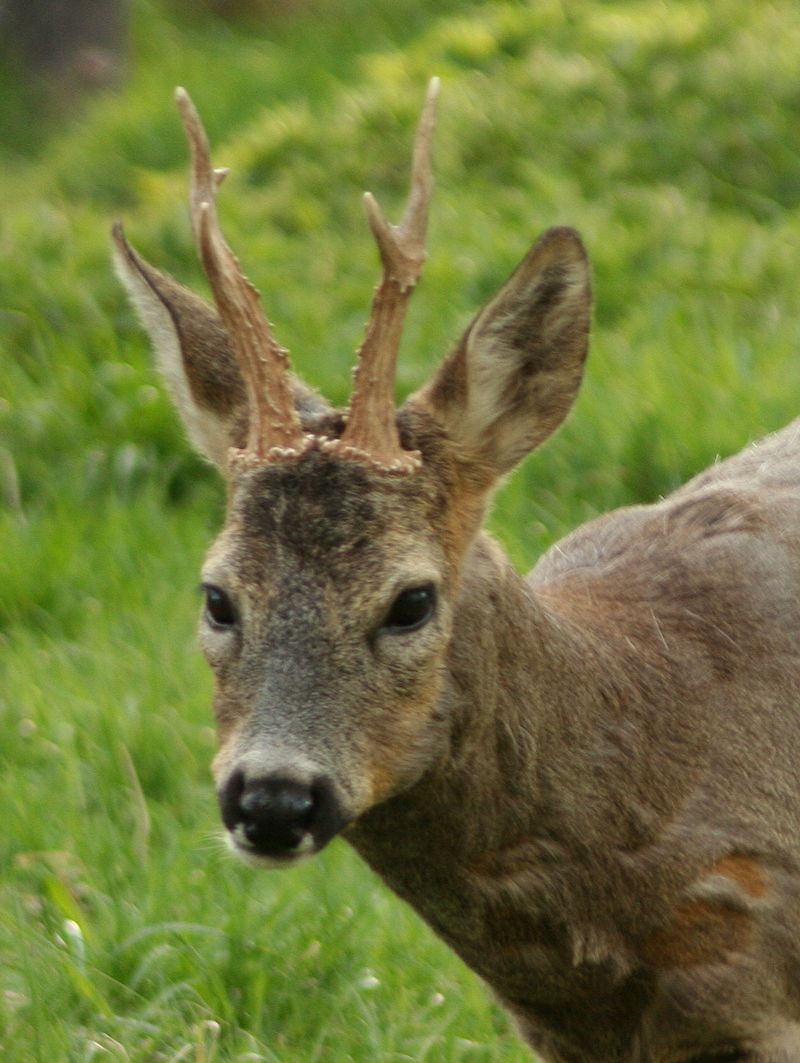
Male roe deer (Capreolus capreolus) with teeny horns. Image by Przykuta via Wikimedia Commons

Red deer (Cervus elaphus) skull. Public domain image

Reindeer (Rangifer tarandus) skull. Public domain image

Moose (Alces alces), are known as Elk in Europe. In America, elk (also called wapiti) are red deer relatives. Public domain image

Fallow deer (Dama dama). Image by Michael Palmer via Wikimedia Commons

Irish Elk (Megaloceros giganteus). Public domain image.

As well as the red (Cervus elaphus), roe (Capreolus capreolus), and fallow (Dama dama), we now know that Britain also used to have the reindeer (Rangifer tarandus), moose or elk (Alces alces) and giant deer (Megaloceros giganteus). Now, if this was a broad, palmate kind of antler then we can immediately exclude everything except the fallow, moose and giant deer. Hugh’s Uncle James- a man of considerable learning- discounted the fallow deer as a possibility, so that leaves only the moose and giant deer as contenders. I think we can discount the giant deer as well since it is last known in Britain from the late Pleistocene, a time period when northern Scotland was under a mile of ice. The reality is there are very few Pleistocene fossils known from northern Scotland. The only exception I can think of are from deep within caves on the northwest coast. The bone caves of Inchnadamph held their silent quarry safe from the ice thanks to the protective rock walls. Scotland is, however, rich in Holocene fossils from after the great ice retreated. Bears, wolves, lynx, beavers and other lost species are recorded from Neolithic to Iron age times. Some, even later than that. Let us assume that what young Hugh found really was a moose antler. How late did they survive in Scotland and how old would it possibly have been?

Like the aurochs, moose lived until pretty late in mainland Europe. Caesar mentions something that is probably moose in the Hercynian forest of Germany. Some data suggests that they lived in northern Germany up until medieval times. In Britain they probably died out before the Roman invasion. In argument for a later, even medieval survival, are claims that there are specific gaelic names for the moose. Since gaelic speaking scots only came over from Ireland in the 4th or 5th century AD this seems unlikely. However it’s possible they knew about moose from contact with Scandinavians, who still have moose today. There really is not much information on British moose out there. Someone needs to implement a comprehensive radiocarbon dating project to get to the bottom of this.

All of this points to the idea that Hugh’s antler was probably a moose from the first or second millennium BC at the latest, making it three or four thousand years old when it was dug up by young Hugh, and that his Uncle James was correct in every detail.

There is a delightful postscript to this story. A few years ago, within a brisk days walk from  Cromarty, a moose calf was born. At the Alladale estate in Sutherland a pair of Scandinavian moose were brought over as part of the owner’s ambitious rewilding project. Hulda and Hercules (as the pair were called) gave birth to the first Scottish moose to be seen for at least three thousand years in 2011. I think Hugh Miller would have been thrilled.

Written by Ross Barnett (@DeepFriedDNA)

Further Reading:

Miller, H. “My Schools & Schoolmasters”, 1854. [Full Text]

Miller, H. “Scenes & Legends of the North of Scotland”, 1834 [Full Text]

Schmolcke, U., and F. E. Zachos. “Holocene Distribution and Extinction of the Moose (Alces alces, Cervidae) in Central Europe.” Zeitschrift für Säugetierkunde 70, no. 6 (2005): 329-44. [Abstract]


Posted in Irish Elk, red deer, Reindeer | Tagged , , , , , , , , , , , , , , , , | 4 Comments

Sabertooth

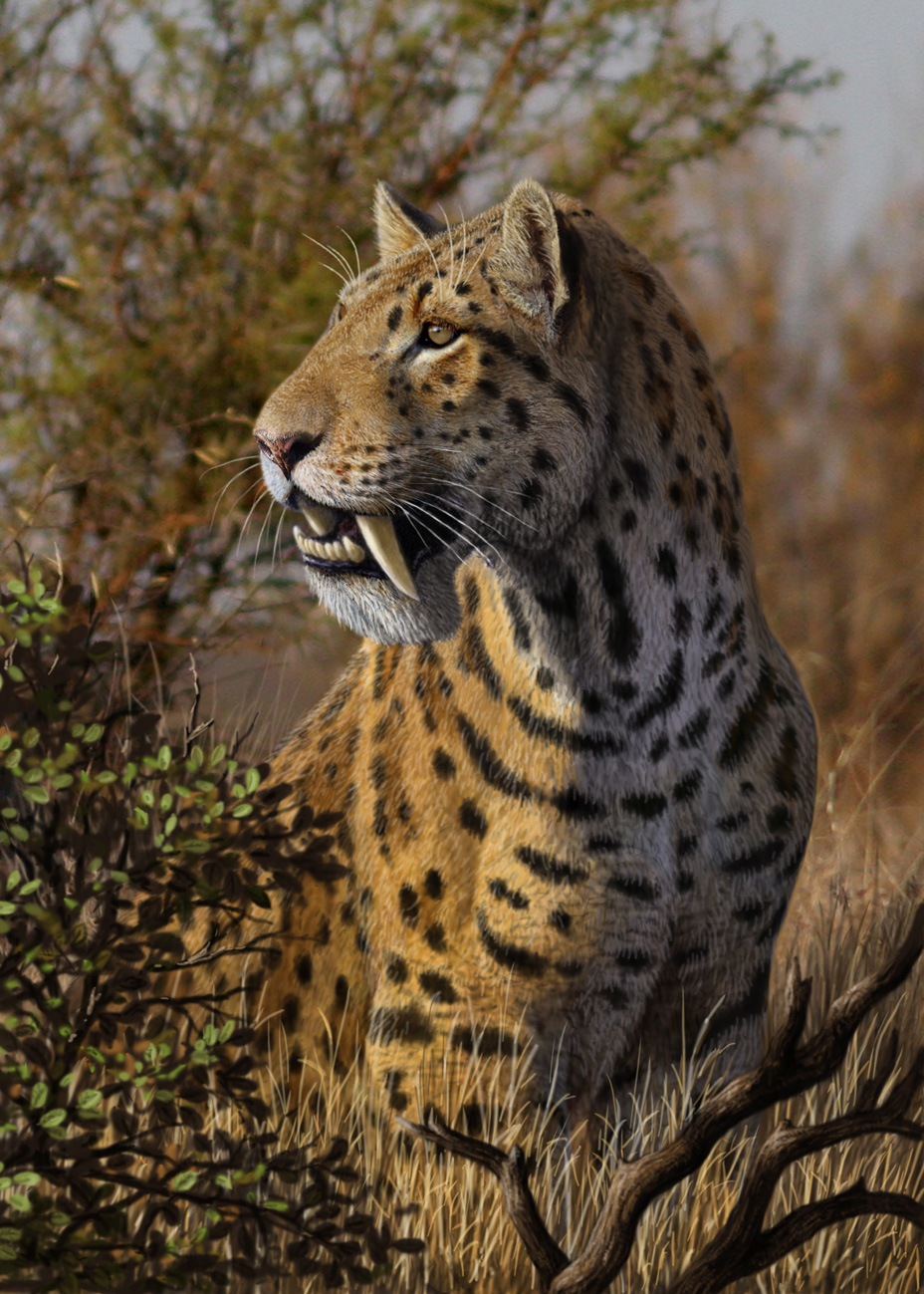
Image

Image © Mauricio Anton

[This review was written in 2014, when the book first came out]

I recently read “Sabertooth” by Mauricio Anton. Obviously given my interests, this was one book I had to treat myself to. Anton and Turner’s “Big cats and their fossil relatives” was the first “technical” text I bought at the start of my D.Phil and has a special place in my heart (and bookshelf). That well thumbed volume was an invaluable help to getting a handle on the often confusing and complicated history of felid taxonomy and fossil description. I always get the feeling that the Felidae must be the most abstruse taxonomic family, outside the Hominidae, beset by lumpers and splitters all over the place. A favourite example comes from the history of two cat-like genera. Nimravides and Eofelis. It used to be thought that the family of carnivores now known as the Nimravidae were part of the Felidae. This lasted well into the twentieth century until a detailed examination of skulls (in particular the auditory bulla) showed that there was a great degree of separation between the two families. Unfortunately, this splitting led to species being moved from one family to another despite being named under the assumption that nimravids were cats and cats were nimravids. The genus Eofelis (literally “dawn cat”) moved to the nimravid side. The genus Nimravides moved to the felid side. Ugh!

Anyway, the new book is a beauty. Mauricio has, I think wisely, broadened the scope from just the more familiar machairodont sabertooths (e.g. Smilodon, Homotherium) to include also the marsupial sabertooths and creodont sabertooths, on top of the sabre-toothed nimravids and barbourofelids. This meant that personally, I found a lot more new information on mammal groups I was generally unfamiliar with. The writing is lucid and clear throughout, without being overly technical where it is not needed. In a book like this it can be very difficult to pitch the right tone- appealing to specialists and laypeople alike. I think Mauricio managed to get it almost right in this book.

The main draw for many will be the unparalleled beauty of Mauricio’s art. Almost nobody can match him for the lithe grace and exoticism of his paleontological reconstructions of extinct felids. That Mauricio has spent countless hours observing wild felids in their natural environment and hours more dissecting every muscle and tendon shows in his work, produced with the eye of a field naturalist and a palaeontologist combined in one. A minor niggle is that some of the artwork has been recycled from “Big cats and their fossil relatives” but given the overlap between the two books and the obvious effort that must have gone into the paintings and drawings this can be more than forgiven.

I have been lucky enough to have had a small amount of professional interaction with Mauricio. He was extremely generous in allowing us to use his wonderful images of Smilodon fatalis and Miracinonyx trumani in our paper on their evolution. For that I am hugely appreciative.

Written by Ross Barnett @DeepFriedDNA

Further Reading:

Sabertooth, Mauricio Anton [Buy the book]

Posted in Sabre tooth Cat, Uncategorized | Tagged , , , , , , , , , , | 2 Comments

Lost Animals

Public domain image of Mr Weaver and his bagged thylacine, 1869

[This book review was written when the book was first published]

I’ve been a big fan of Errol Fuller’s thoughtful prose for about 13 years. When I was finishing my undergraduate degree I had my imagination fired by reading some papers on ancient DNA, which sent me into a flurry of research, trying to find out everything I could about the rare and the recently extinct. In the early 2000s this meant reading about Higuchi’s work on the Quagga (Equus quagga), Pääbo’s work on the Thylacine (Thylacinus cynocephalus), and Cooper’s work on New Zealand moa (Dinornithiformes). This was a pivotal point in my life. So much so that I eventually directly emailed Alan Cooper during my final year, to ask about postgraduate opportunities in his Oxford lab. I was lucky enough to be taken on for a BBSRC D.Phil position there and that was the beginning of my professional introduction to the world of ancient biomolecules. Anyway, what blew my mind back then was the sheer scale of recent extinction events. Despite having been interested in science and biology for my whole life, I had never heard of the great auk (Alca impennis), the solitaire (Pezophaps solitarius), Steller’s sea cow (Hydrodamalis gigas),  Delalande’s coua, (Coua delalandei) the Huia (Heterolochas acutirostris), and all those other amazing animals that we just missed out on seeing. I researched these species for a course essay but found instead that I  was so consumed by the need to find out about them that I spent most of the year researching every obscure and little-known extinct species I could find, on the internet and in the University’s library holdings. I also spent a lot of time at the Royal Museum of Scotland at their excellent exhibit on extinction. One day while in the museum shop I spotted a copy of Fuller’s “The Great Auk” and despite my meagre student budget, and its hefty price, I had to buy it. If there has ever been a more thorough account of the life, habits, and relics of a single extinct species then I don’t know of it. Pure scholarship and a delight to read. Every facet of this extinct bird was explored and new information was there on each page. After that I knew I had to read more and Fuller’s “Extinct Birds” was the one thing I asked for for Christmas that year. The two books have been read and re-read many, many times and are just a joy to leaf through. When I heard (on Twitter) that there was a new book coming soon on extinction and the photographic record I knew I had to get that as well. And I wasn’t disappointed. “Lost Animals” is a bittersweet delight. I’ve read some of the criticisms of the book online, saying that it is dumbed down, but I think that misses the point. The text is entirely secondary to the power of the images contained within.  The Thylacine was persecuted to extinction by bounty and hunter, yet now with the passage of time the few feet of film and handful of photographs speak powerfully of the human weakness of only caring enough when it is too late. The focus of the writing is properly on the people who came to capture these fleeting glimpses of living animals. Often they knew they were glimpsing something that would never happen again. Sometimes the importance of the pictures they had stuffed in a shoebox in the attic only became clear decades later. I loved this book and read it in a single sitting. I don’t think I will revisit the text as often as I do with “The Great Auk” or “Extinct Birds” but the pictures- from the delicate, silvered plates to the exuberant kodachrome prints will be a part of my mind palace for evermore.

Written by Ross Barnett (@DeepFriedDNA)

Further Reading:

Lost Animals: Extinction and the photographic record, Errol Fuller [Buy the book]

Posted in Extinction, Uncategorized | Tagged , , , , , , , , , | 1 Comment

Island hopping hippos

My mum passed away suddenly at the beginning of January. It was a huge shock. It still is a huge shock. It still doesn’t seem real that I will never see her again. Life is so fragile. I wish there could have been more time. She was an exceptionally kind woman, and had a wicked sense of humour (traits which I hope have been passed on to me). Whenever I visited my folks, her and I would escape my chaotic loud siblings and play Scrabble for over an hour (she always won). We would catch up, and she would always chuckle endearingly at my nerdy fossil talk.

I wanted to write a little post that would have made her smile. There are thousands of animals that are good mothers: birds, mammals, even reptiles. But I think she would have liked something a little unusual. A little different. A post about weird hippos would have done the trick.

Despite the African hippopotamus (Hippopotamus amphibius) being a massive herbivore, there is something about them that is pretty special. They are undoubtedly adorable creatures: their huge curved mouths that look like a big smile; those short stumpy legs waddling; those big soft eyes. And they are extremely good mothers. The Ancient Egyptians knew this, and worshiped the half-hippo, half-human goddess Taweret who protected pregnant women during childbirth. The mighty hippopotamus even makes a slightly comical appearance in music, with Edward Keffer’s ‘Hippopotamus Polka’, and a delightfully flamboyant accompanying illustration.

My mum would have seen the humour in this. A somewhat flamboyant, yet gallant, hippopotamus taking the lead. The image is from the ‘Hippopotamus polka’. (Image public domain)

Then there’s also the lovable, but highly threatened, pygmy hippos (Choeropsis liberiensis). These little beasts are only around 0.8 meters: an adult would reach up to my hips! Coming out at night in forests to feed on ferns, grasses and fruit, they live in just three areas in Africa. Pygmy hippos are a different genus to the larger species, which means they didn’t evolve from the larger Hippopotamus amphibius, but shared a common ancestor some 8 million years ago.

A very cute pygmy hippo (Image public domain)

Today hippos are restricted to the continent of Africa. In the past they were widespread across Europe, with a number of different species. Our familiar large African beast was even shuffling around in Britain. Not all hippos outside of Africa were big. Some were pretty small. And I’m not talking about pygmy hippos.

Islands are fantastic harbingers for evolution to run wild. Originally desolate places, any species that makes their home there has unique opportunities to explore new niches. Seeds and insects are blown to islands by the winds. Some animals accidentally end up there by sitting on logs. Some even swim there. Once there they have little competition compared to their home lands, and evolve some incredible adaptations for their new environments.

Not all island inhabitants are the new comers. Some arrive long after flora and fauna have been established on this isolated paradise. And some strange things can happen. Small animals can evolve relatively quickly to be pretty darn big, like the Maltese dormouse, or the komodo dragon. With little competition and less predators than the continent, these small animals exploit the new environment and enjoy the new bounties.

Small animals become big. The very opposite happens to big animals: over time they shrink! There are three species of mammoths that shrunk to pure cuteness in the past, and it has happened to our own genus too, with the enigmatic Homo floresiensis on the Indonesian island of Flores. Large animals need a lot of food to survive. Those individuals who are a little smaller and can survive with less food have more offspring. A lack of predators also means they don’t need large size for safety. And so, through time, the species becomes smaller.

The Mediterranean Sea, with it’s half a dozen large islands. (Image from Google Maps)

The warm Mediterranean Sea is scattered with dozens of islands. Today they are popular tourist getaways to enjoy the sun and the sea. Not too long ago they would have been very different with some truly incredible animals. Two of these islands were home to dwarf mammoths: the Sardinian dwarf mammoth and the Cretan dwarf mammoth. Perhaps more incredibly, four islands had hippos living on them!

As well as a dwarf mammoth, Crete had a dwarf hippo (Hippopotamus creutzurgi). Sicily, Malta and Cyprus also had dwarf hippos (H. pentlandi; H. melitensis; and H. minor respectively). Around the same size as the pygmy hippo, these little hippos were not their close relatves. Skeletal features suggest that they evolved from the hippo that was at home in Europe, H. antiquus, most likely four separate times.

The smallest of the Mediterranean dwarf hippos, Hippopotamus creutzburgi. (Image by Twilight Beasts)

Lower sea levels in the Mediterranean between 150,000 and 100,000 years ago meant that animals did not have as far to swim to these islands (relative to today!). And hippos can swim quite well. Once big lumbering hippos first stepped ashore, there were no natural predators. These hot islands may seem like an unusual habitat for hippos, but the environment was different then. Examining oxygen isotopes in nearby Macedonia, shows it was cooler and wetter from around 100,000 years ago compared to today’s climate. These plump little beasts would have waddled around in pretty lush forests feeding on grasses, shrubs and fruits.

What a sight they must have been.

We don’t know for sure exactly when or why these buxom (a word my mum would have liked) beasts disappeared. Today the Mediterranean islands are hot and very dry. British people travel there in their thousands every year only to return with ghastly red and sunburned skin. The Mediterranean began to warm up quite quickly around 25,000 years ago. With a warmer climate comes a drier, harder environments for animals, especially those which love the wetness. More research needs to be done on these well-rounded little animals until we can say much more.

There’s more cute hippos to add to our list, the Madagascan dwarf hippos (Hippopotamus (sometimes called Choeropsis) madagascariensis; H. lemerlei; H. laloumerna), which lived in, well, yes, Madagascar! There may well have been three species living on the large island of Madagascar.  They were very small, smaller perhaps than the pygmy hippo. Living in freshwater highland environments, their very well worn teeth indicate slightly tougher vegetation than their bigger ancestors, Hippopotamus amphibious.

Just look at the size of this hippo! The dwarf Madagacan hippo Hippopotamus (Choeropsismadagascariensis. (Image by Osborn, public domain)

What’s truly fascinating is that these hippos lived until very recently, just around 1000 years ago. There’s even evidence of cut marks on bones, showing that humans were not too shy to eat them. For these species, the arrivals of humans to Madagascar around 2000 years ago was their end. Small, chubby legs were no way set up for outrunning fast predators. Sadly they vanished around the same time William the Conquer became King of England.      

When species have gone, they are not gone really. Our blog posts keeps these wonderful creatures alive. I like to think the same is true when someone has passed away. I know that they will never really be gone.  It is our memories of our loved ones that keep them alive inside us. Just like we share our blog posts, our memories too can be shared, so they are still alive in our children, and their children too. I don’t know if my mum ever read any of my blog posts, but I’m pretty sure if she read this and discovered tiny, cute, plodding dwarf hippos were once alive, she would have smiled to herself.

Written by Jan Freedman (@JanFreedman)

Further reading:

Adams, A. L. (1863),  ‘Observations on the Fossiliferous caves of Malta’. Journal of the Royal Society, 4 .2. pp.11–19.

Burney, D. A. ,et al. (2004). ‘A chronology for late prehistoric Madagascar.’ Journal of Human Evolution: 25-63. [Full article]

Carroll, F. A., Hunt, C. O., Schembri, P. J., & Bonanno, A. (2012). ‘Holocene climate change, vegetation history and human impact in the Central Mediterranean: evidence from the Maltese Islands’. Quaternary Science Reviews. 52. pp.24-40. [Abstract only]
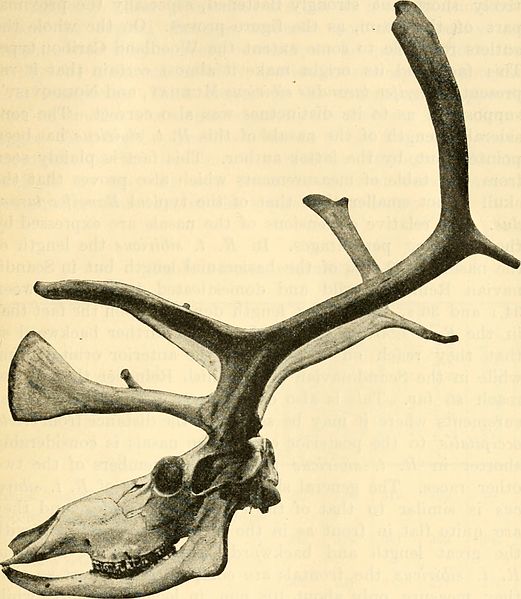
Dewar, R. E. (1984). ‘Extinctions in Madagascar. The loss of the subfossil fauna.’ In: P. S. Martin and R. G. Klein (eds), Quaternary extinctions. A prehistoric revolution, pp. 574-593. The University of Arizona Press, Tucson, AZ, USA. [Book]

Dobson, M. (1998). ‘Mammal distributions in the western Mediterranean: the role of human intervention’. Mammal Review.28.2. pp.77-88. [Abstract only]

Hunt, C. O. (1995). ‘The natural landscape and its evolution’. In: Barker, G. (Ed.), A Mediterranean Valley.  Leicester:Leicester University Press. pp.62-83.[Book]

Lacey, J. H., et al. (2016). ‘Northern Mediterranean climate since the Middle Pleistocene a 637ka stable isotope record from Lake Ohrid.’ Biogeosciences. 13. pp.1801-1820. [Full article]

MacPhee, R. D. E. & Burney, D. A. (1991). ‘Dating of modified femora of extinct dwarf hippopotamus from southern Madagascar: implications for constraining human colonization and vertebrate extinction events’. Journal of Archaeological Science 18: pp.695-706. [Full article]

MacPhee, R.D.E. & Flemming, C. (1999).’ Requiem Aeternam. The last five hundred years of mammalian extinctions.’ In: R.D.E. MacPhee (ed.), Extinctions in Near Time, pp. 333-371. Kluwer Academic/Plenum Publishers, New York, USA. [Book]

Stuenes, S. (1989). ‘Taxonomy, Habits and relationships of the subfossil Madagascan Hippopotami Hippopotamus lemerlei and H. madagascariensis.’ Journal of vertebrate Paleontology. 9(3). op.241-268. [Abstract only]

Posted in Uncategorized | Tagged , , , , , , , , , , , , , , , , , , , , | 10 Comments

The most (and least) read posts of 2017!

It’s that time of year again when websites shout about their most read blog posts. Of course it’s a little bit of self promotion, but it is also quite interesting to see what has been popular over the last year.

In our little annual tradition we will share with you the top five posts along with the least read five posts of the year. We think it’s quite nice to share the ‘bottom’ five posts to spread a little love to these undiscovered gems. (We should obviously say that these are not the least read because they are not interesting – all our posts are interesting! It might be that they are not as sexy as the big beasts, or that they have not been shared enough. Whatever the reason, these five least read posts are a fantastic little read.)

We really are so very grateful for your continued support by reading this blog and we have loved engaging with so many of you on the blog and on Twitter this last year. We hit 250,000 views on our blog just a few months ago – which is incredible! Thank you readers for your encouragement and support for this blog site.

Least read blog posts of 2017:

  1. When life gives you lemmings… Discover how a classic 1980s video game links to small arctic mammals in Britain. Give these little fury critters a boost!

The Norwegian Lemming (Lemmus lemmus) is just one species of lemming. (Image by Oma Kuva. Public Domain)

2. Big find in little China. An amazing fossil discover in 2017 could put humans in China around 120,000 years ago.

3. Mini-beasts, giants and mega-floods. From beetles to mammoths, fossil evidence can help us to understand when the English Channel formed.

4. Time capsules from the Ice Age: Find out how nature’s collectors have helped to preserve evidence from past environments.

5. Forever young: Like Peter Pan, the Key Deer in Florida almost never grow up. Find out how this beautiful little deer stays youthful throughout their lives.

Most read blog posts of 2017:

  1. A very brief introduction to mammoths: This is a mammoth post. Literally. There were ten species of mammoths from giants to dwarves.

The smallest mammoth that has ever lived, the mighty-mini Cretan Dwarf Mammoth

2. The stuff of night-mares: A clever title. A great post. About a freakin’ enormous horse!

3. Mammoths! Mammoths make it twice in the top five. This post is about our familiar giant, the Woolly Mammoth.

4. The lonely walk to extinction: We are pleased this post has been read quite a lot. It brings home just how vulnerable species are, and how those last few individuals have a very hard, lonely life.

5. Lost as the Moa is lost! This is the second year running this fantastic post has made it into the tope 5. Read it and you will see why!

We wish all our readers are very happy and healthy 2018. And we are looking forward to some exciting things in 2018, and of course, lots of new Beasts to share with you! Ross (@DeepFriedDNA), Rena (@JustRena) and Jan (@JanFreedman)

Follow us on Twitter – @Twilightbeasts 

Posted in Arctic Ground Squirrel, Homo sapiens, Horse, Key Deer, Lemming, moa, Woolly Mammoth, Woolly Rhinoceros | Tagged , , , , , , , , , , , , , , , , , , | 3 Comments