The bear necessities

Reconstruction of a European Cave Bear (Ursus spelaeus) by Sergiodlarosa

Reconstruction of a European Cave Bear (Ursus spelaeus) by Sergiodlarosa (Image from here)
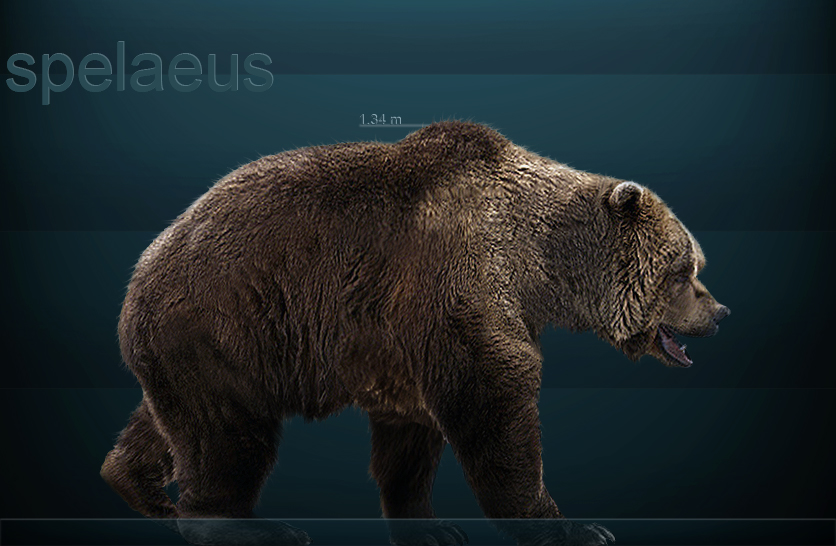
Humans and bears have a strange relationship. On the one hand we see them as lovable, smart, curious creatures (think Baloo from the Jungle Book). On the other, we have taken great pains to exterminate them wherever and whenever we could. Thankfully, no bear species has gone extinct for over 10,000 years (although many subspecies have been lost). During the Pleistocene, the old world was home to a complex of species that may have been amongst the biggest of bears. The cave bear (Ursus spelaeus) was perhaps the first Twilight Beast to be studied in a scientific sense, thanks to the millions of bones the animal left behind in caves throughout Europe and Asia, the legacy of many individuals who failed to survive hibernation. Thought to have inspired legends of dragons that lived in caves, the bones were so numerous that they were occasionally mined as a source of phosphate. Named way back in the 18th century by Johann Christian Rosenmüller, the cave bear has been at the forefront of Pleistocene research ever since. This vanguard position continues into the present day: Ursus spelaeus was the first extinct mammal to have its nuclear genome sequenced. The oldest mitochondrial genome we have is that of a Middle Pleistocene cave bear (and it was used to test methods that were later utilised to sequence DNA from Homo heidelbergensis)

The Cave Bear was a very big species of bear!

The Cave Bear was a very big species of bear! (Image by Jan Freedman)

The cave bear (along with other “species” within the complex such as Ursus ingressus, Ursus deningeri) was a huge animal. Larger than the largest Kodiak brown bears (Ursus arctos), this imposing creature was probably a strict vegetarian rather than an omnivore. Analysis of teeth micro-abrasions and the stable isotopes that were incorporated into the bones show that these were gentle giants (although, giant herbivores are not to be underestimated, as anyone who lives around hippos or elephants will tell you). They may have been one of the main prey of another Pleistocene predator, the cave lion (Panthera spelaea). One can imagine a stealthy lion, winding through the winter caves, picking off the hibernating bears.

We still find traces of the lifestyle of the vanished cave bear within European caves. Many caves, including the famous Chauvet, still have visible marks from where the animal sharpened their claws on the walls. In some cases Palaeolithic people incorporated the marks into their art. Some caves (e.g. Große Klingerberg Höhle in Bavaria) have circular depressions visible in the cave floor, which have been interpreted as bear nests, caused by the animal turning in its sleep while hibernating. Speleologists have even recovered kidney stones from amongst the skeletons of cave bears.
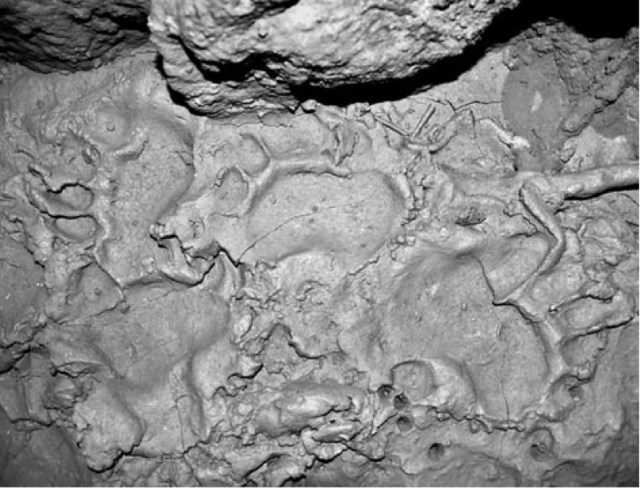
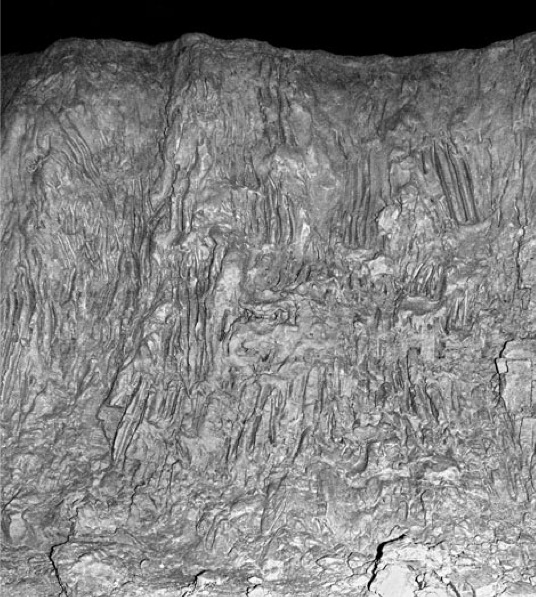
Spelaeusfootprints spelaeusscratches spelaeusnestsExamples of cave bear trace fossils from the Ursilor cave in Romania. Top: footprints, Middle: clawmarks, Bottom: hibernation nests. Images ©Cajus Diedrich

Perhaps the most evocative sign left by the cave bear, which speaks of how integral the species once was to the European ecosystem, and how long it was a part of it, is something known as Bärenschliffe. Simply put, this is stone found in narrow cave routes that has been polished to a reflective shine by the scratching and rubbing of thousands of cave bears over tens of thousands of years.

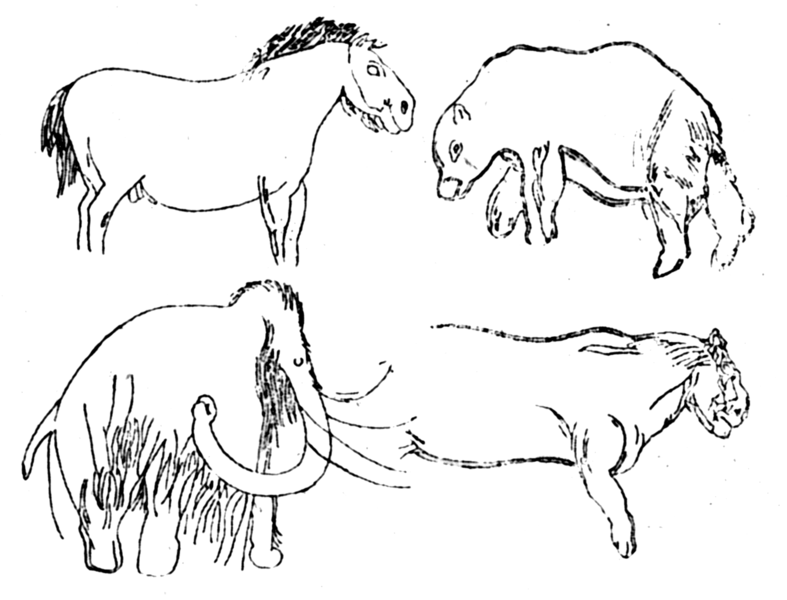
Within these caves, the bears would have occasionally encountered another apex predator (Homo sapiens, Homo neanderthalensis). There are a few images within cave art that may be of the cave bear. Separating the paintings of brown bears and cave bears can be difficult but there are some morphological differences that can point us in the right direction. Compared to brown bears, cave bears have a huge protruding forehead, which is sometimes noticeable in cave art.
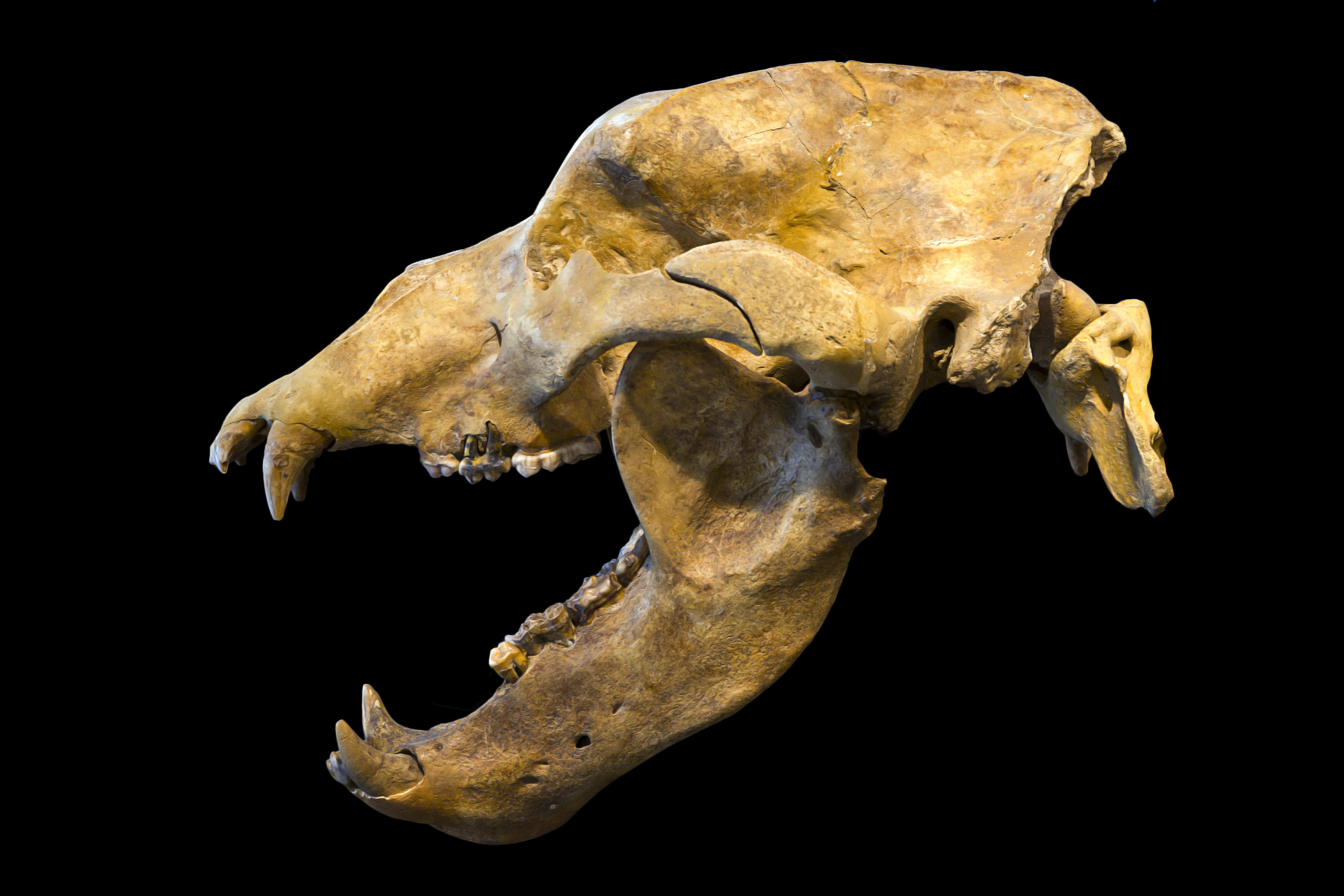
Ours_des_carvernes_-_Crâne

787px-De_nyeste_Kunstretninger_og_smitsomme_Sindslidelser-Vægtegning_i_Combarelles

Top: The distinctive skull of Ursus spelaeus. Image by Didier Descouens via Wikimedia Commons

Bottom: Public domain image of art from Les Combarelles cave, showing a bear (top right) with the distinctive forehead of Ursus spelaeus
The last cave bears probably died about 27000 calendar years ago, much earlier than the extinction of mammoth, woolly rhino, or cave lion. Genetic evidence suggests that this extinction occurred after a prolonged period of genetic bottlenecking. The cause is likely to have been a combination of change in climate affecting the nutritious vegetation the cave bear needed as well as an increase in pressure from Palaeolithic humans for cave sites.

Written by Ross Barnett (@DeepFriedDNA)

Further Reading:

Dabney, J., M. Knapp, I. Glocke, M. Gansauge, A. Weihmann, B. Nickel, C. Valdiosera, et al. “Complete Mitochondrial Genome Sequence of a Middle Pleistocene Cave Bear Reconstructed from Ultrashort DNA Fragments.” Proceedings of the National Academy of Sciences of the United States of America (2013). [Article]

Kurtén, B. The Cave Bear Story; Life and Death of a Vanished Animal. New York: Columbia University Press, 1976. [Book]

Noonan, J. P., M. Hofreiter, D. Smith, J. R. Priest, N. Rohland, G. Rabeder, J. Krause, et al. “Genomic Sequencing of Pleistocene Cave Bears.” Science 309 (2005): 597-600. [Article]

Peigne, S., C. Goillot, M. Germonpre, C. Blondel, O. Bignon, and G. Merceron. “Predormancy Omnivory in European Cave Bears Evidenced by a Dental Microwear Analysis of Ursus Spelaeus from Goyet, Belgium.” Proceedings of the National Academy of Sciences of the United States of America (2009). [Article]

Rosendahl, W., and D. Döppes. “Trace Fossils from Bears in Caves of Germany and Austria.” Scientific Annals, School of Geology AUTH 98 (2006): 241-49. [Article] [This paper has excellent images of bärenschliffe]

Stiller, M., G. Baryshnikov, H. Bocherens, A. Grandal d’Anglade, B. Hilpert, S. Munzel, R. Pinhasi, et al. “Withering Away-25,000 Years of Genetic Decline Preceded Cave Bear Extinction.” Molecular Biology and Evolution 27, no. 5 (2010): 975-78. [Article]
Posted in Cave Bear | Tagged , , , , , , , , , , , , , | 4 Comments

A prickly giant with a very long tongue

The Giant

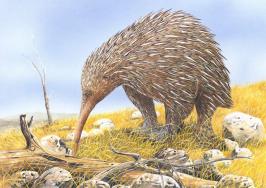
The Giant Echidna (Zaglossus hackettii) which lived in South West Australia until around 55,000 years ago. It is the largest monotreme so far discovered. (Art by Eric Alibert. Image from here)

Australia’s native fauna are undeniably odd and none more so than the curious monotremes (the Monotremata). These egg-laying, milk-producing, furry creatures are mammals, but with organs and body parts that may be more at home in birds or reptiles including a cloaca, an interclavicle bone, and ankle spurs on adult males. These unusual features hint at the ancestry of the monotremes, which are thought to have diverged from the rest of the mammals some 220 million years ago.

The familiar short-beaked echidna (Tachyglossus aculeatus) is Australia’s only remaining species of echidna, although it has been suggested that the western long-beaked echidna, Zaglossus bruijni, may still be found in the Kimberley region of Western Australia. Three more species of long-beaked echidna (Zaglossus spp.) are still found in New Guinea, and several others are known from the fossil record in Australia. But as the First Australians were making their way into the continent it was the largest of these – the Giant Echidna (Zaglossus hacketti) – that trundled its way through the landscape of southwestern Australia.

Known only from a small number of bones found in Mammoth Cave, southwestern Australia, the Giant Echidna was first described by geologist and palaeontologist Ludwig Glauert in 1914. Ten years earlier, Ernest Le Soeuf had been made aware of some unusual bones at this cave and collected several bones of long-extinct mammals. His finds drew the attention of the Hon. Dr John Winthrop Hackett, Chairman of both the Caves Board and the Western Australian Museum. Hackett visited the site in 1905, and recommended further research and excavation of bones from these deposits, offering to fund the costs of fieldwork. However, it was not until 1909 that the Museum managed to secure the services of Glauert, who had emigrated from England to Australia in 1908 with his wife, Winifrede. While on unpaid leave from his employers at the Geological Survey, Glauert and his colleagues collected over 2000 specimens from Mammoth Cave in less than two months, including several previously unknown species. Five years and several seasons of fieldwork later, Glauert and his assistants had collected and identified over 10,000 bone specimens, and described and published three new mammal species, including the Giant Echidna, making the Mammoth Cave fossil fauna one of the most extensively studied in Western Australia.

The media went wild over the extinct Giant Echidna (Zaglossus hackettii) heralding the discovery to be “the palaeontological event of the year”. The excitement was justified: this creature was the largest monotreme ever to have lived, more than twice the size of its closest living relative. At close to a metre in height and weighing in at 30 kilograms or more, this beast was about the same size as an average sheep!

One of the things that make the echidna so unique is its long, tubular snout, which only opens just enough to enable the extremely long, sticky tongue to dart out and capture juicy food – typically earthworms, ants and other small invertebrates. This big beast would have been able to quickly and efficiently decimate an ant colony with a tongue estimated to be almost 50 cm long! It was this massive tongue which gave the animal its name: Zaglossus means ‘ huge tongue’ in Latin. It is difficult to know much about the feeding behaviour of these giants, as cranial bones have not been identified. However, the design of their limbs and body mean that they almost certainly lived off a similar diet of worms and insects like their smaller relatives – only consuming a lot more! They may also have enjoyed larger insects such as moth larvae (Bardi or ‘Witchetty’ grubs) found in the trunks of decaying grasstrees and tree roots.

Modern day echidnas move rather slowly, with stocky legs and spade-like feet. Based on the size and shape of the bones examined by Glauert, it seems likely Zaglottus hackettii moved in quite a similar manner, shuffling through the leaf litter and underbush in search of food. However, there is a small difference to be note; the Giant Echidna of the Pleistocene had slightly different limb proportions to its modern relatives, and as a result its centre of gravity was probably closer to the back legs. Perhaps this allowed the creature to shift its weight back on its hind legs while ripping into decaying tree stumps, termite mounds and ant hills with its powerful forelimbs and strong claws in search of juicy, nutritious bugs?

Like other echidnas, Zaglossus hackettii would have laid eggs into a pouch rather than giving birth to live young like other mammals. The young of all echidnas are called ‘puggles’, and once hatched, are suckled from mammary glands in the similar way as other mammals. The Giant Echidna puggles would have lived safely in mum’s pouch until they begin to grow spines, at which point they were (understandably) evicted, remaining in underground burrows until they are old enough to join their mother to forage for food.

Despite the fearsome spines along this extra large monotreme’s back, its response to danger would have been far more like a hedgehog than a porcupine. The quills were firmly embedded in the animal’s muscle, so unlike a porcupine, they don’t come out of the animal on contact with a predator. Instead, this gentle giant curled into a ball, using its strong limbs to partially burrow into the ground to anchor itself in place. In this way the exposed, quill-ridden hide remained exposed, and the animal waited until the predator loses interest. Once any echidna, megafaunal or modern, has rooted itself to the spot in this way, it would be almost impossible to remove!

It is thought that Zaglossus hackettii became extinct around 55,000 years ago, at around the same time as many of Australia’s other Pleistocene beasts. As in other parts of the world, this timing coincides with the earliest dates we have for the arrival of humans. The causes for the extinction are as yet unknown, but it’s very possible that environmental influences, combined with human activities such as over- hunting and destruction of habitat, contributed to the amazing creatures’ demise. We can only imagine the amazement of the First Australians encountering this unique lumbering, prickly anteater as it became a fading shadow in the twilight of Australia’s Pleistocene fauna.

Written by Carly Monks (@_CarlyMonks)

Edited by Rena Maguire (@justrena)

Further Reading:

Glauert, L. (1914), “The Mammoth Cave (Continued)”, Records of the Western Australian Museum, 1(3), 244-252. [Full article]

Helgen, K. M, et al, (2012), ‘Twentieth century occurrence of the Long-Beaked Echidna Zaglossus bruijnii in the Kimberly region of Australia’, ZooKeys, 255, 103-132. [Full article]

Jenkins, C.F.H. (1983), “Glauert, Ludwig (1879-1963)”, Australian Dictionary of Biography, 9. [Full article]

Long, J., Archer, M., Flannery, T. and S. Hand2002. Prehistoric Mammals of Australia and New Guinea. Sydney: UNSW Press. [Book]


Posted in Giant Echidna | Tagged , , , , , , , , , , , | 5 Comments

The last of its kind

Chalicotheres, a strange

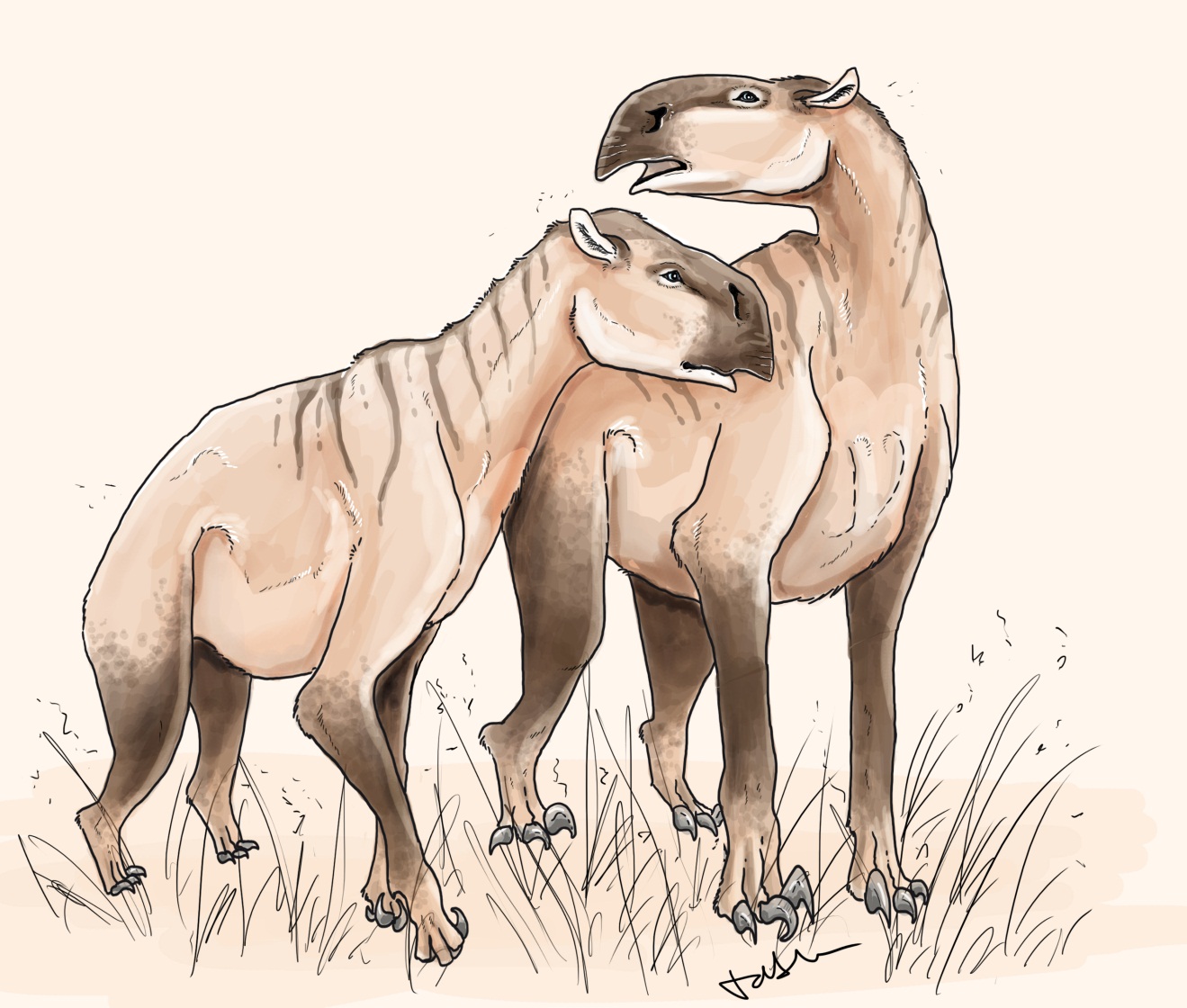
Chalicotheres, a strange creature distantly related to rhinos, horses and tapirs. An earlier knuckle walking Chalicothere on the left, which died out just before the Pleistocene began. Our Twilight Beast, Ancylotherium hennigi, the last of the great Chalicotheres. (Art by Tabitha Paterson)

Twilight beasts come in all shapes and sizes, with some being more familiar, like the sabretooth cat, Smilodon, and others less so, like the strange mini-sheep, Myotragus. Although we have some fossils, there are still a lot of awesome things to learn about many extinct animals. After almost 200 years from the discovery of the first member of a very bizarre group of creatures, little is still known about them even today. This beast isn’t an iconic mammal, but it should be; it was one of the last of its kind, and also witnessed the origins of our own species.

Tracing its beginnings back to the Eocene, around 40 million years ago, Chalicotheres were a successful group of animals that only relatively recently vanished from the world. Ranging across North America, Asia, Africa and Europe, they were a widespread group flourishing across the northern hemisphere. (They didn’t reach southern continents such as South America and Australia because these were cut off by oceans). They may have been long-lived and a promising group of mammals, but they were also pretty weird.

Chalicotheres are grouped together with horses, rhinos and tapirs (in the order Perissodactyla, meaning ‘odd toed’). Like rhinos, they had three toes on each foot. Unlike rhinos, or any other Perissodactyla, they had claws on their feet instead of hooves. Some suggest these often oversized claws were used to pull down branches for easier browsing. It is equally as likely that they were used in defence.

A defining feature of the group is their oversized arms compared to their legs and for a creature that walks on all fours, this is quite unusual. Their shorter, squat back legs took a lot of weight as the big animal walked. Some fossils even show evidence of callosities in the hip bone, indicating that that some species may have sat down whilst feeding, similar to gorillas today. Oddly, some species had another similarity to gorillas as result of the Chalicothere’s elongated arms; some walked on their knuckles, with enormous claws on the front hands curved backwards when they walked.

These big claws were not used to catch prey. Their odd teeth give away their less ferocious table manners. We all can find a skull, or even a single tooth, and automatically ‘know’ if the creature was a carnivore or a herbivore. Chalicotheres were herbivores with their large, flat ridged molars. The top jaw (the maxilla) didn’t have any incisors, and all the molars are quite unworn, suggesting that generally this group browsed on fairly soft vegetation which didn’t wear down the teeth.

North American Chalicotheres were successful for around 10 million years with the last Genus, Moropus becoming extinct around 13.6 million years ago. Across the Atlantic, although fossils are not common, the group was still strong, with specimens found in Greece, Turkey, Asia and Africa.

Ancylotherium was the last surviving Genus of this successful group. Taller than a horse, its massive head would have scoured the land for luscious trees as it moved around on the African savannah. Typical of Chalicotheres, this magnificent beast had longer forelimbs than it did back limbs, but the fossil hand and feet bones show that it didn’t walk on its knuckles. Remains of this big beast have been discovered at several sites in Africa along with hominin fossils (including Laetoli, Olduvai and Omo).

Even though the group of Chalicotheres were around for over 40 million years, with fossils turning up all over the northern hemisphere, not much is known about these amazing creatures. Their unusual body form, dentition and mode of locomotion have caused debate since the very first fossils were discovered in 1833. Our Twilight Beast, Ancylotherium hennigi, was the last of a once great group of magnificent creatures. A change in climate, and perhaps increased competition could have given the final blow to this species, vanishing an entire group forever. Often the most specialist creatures are more vulnerable to extinction; if the climate changes and the food they rely on vanishes, they will vanish too. And vanish these strange beasts did.

Chewing soft luscious leaves in the shade on the savannah, this wonderful animal may have absent mindedly watched a funny group of apes walking on two legs hurrying through the grass whilst constantly looking around them: another Twilight Beast, that of our ancestors.

Written by Jan Freedman (@JanFreedman)

Art by Tabitha Paterson (@TabithaPaterson)

Further Reading:

Butler, P. M, (1978), ‘Chalicotheriidae’, In Maglio, V. J, & Cooke, H. B. S (Eds) (1978), ‘Evolution of African Mammals’, Harvard University Press, Cambridge, Massachusetts & London, England, 368-370. [Book]

Coombs, M. C, (1975), ‘Sexual dimorphism in Chalicotheres (Mammalia, Perissodactyla)’, Systematic Zoology, 24 (1), 55-62. [Abstract only]

Coombs, M. C, et al, (2001), ‘Stratigraphy, chronology, biogeography and taxonomy of Early Miocene shmall Chalicotheres in North America’, Journal of Vertebrae Paleontology. 21 (3), 607-620. [Full article]

Coombs, M. C, (2009), ‘The chalicothere Metaschizotherium bavaricum (Perissodactyla, Chalicotheriidae, Schizotheriinae) from the Miocene (MN5) Lagerstätte of Sandelzhausen (Germany): description, comparison, and paleoecological significance’, Palaontologische Zeitschrift, 83 (1), 85-129. [Abstract only]

Geraads, D, et al, (2007), ‘A skull of Ancylotherium (Chalicotheriidae, Mammalia) from the Late Miocene of Thermopigi (Serres, N. Greece) and the relationships of the Genus’, Journal of Vertebrate Paleontology, 27 (2), 461-66. [Full article]

Hooker, J. J. & Dashzeveg, D, (2004), ‘The Origin of Chalicotheres (Perissodactyla, Mammalia)’, Paleontology, 47 (6), 1363-86. [Full article]

Peterson, O. A, (1907), ‘Preliminary notes on some American Chalicotheres’, The American Naturalist, 41 (492), 733-52. [Full article]

Wang, X, & Wang B, (2001), ‘New material of Chalicotherium from the Tsaidam Basin in northern Qinghai-Tibetan Plateau, China’, Palaeontologische Zeitschrift, 75 (2), 219-226. [Full article]

Posted in Chalicothere | Tagged , , , , , , | 6 Comments

Impressions of the Pleistocene

In 1915, prominent American palaeontologist, Henry Fairfield Osborn, published Men of the Old Stone Age: Their Environment, Life, and Art. Drawing from his three-week-tour of archaeological sites across Paleolithic Europe, Osborn’s book integrated archaeology, geology and prehistory. Painstaking in its scientific detail, Men of the Old Stone Age also offers a beautiful collection of early-twentieth century illustrations of landscapes, fauna, and hominins from renowned paleo-artists Charles R. Knight and Erwin S. Christman.

At the beginning of the twentieth century, artists, scientists, and museum curators worked closely to create the most real or true-to-the-fossil record reconstructions of long-extinct animals. As the president of the American Museum of Natural History, Osborn was well-situated and sought Knight’s artistic expertise to provide illustrations for Men of the Old Stone Age. Knight, who had already contributed many dinosaur murals to the very same museum, was eager to participate in Men of the Old Stone Age and many of the illustrations in the book have become iconic of the Pleistocene – even emblematic of how early twentieth-century paleo intelligentsia thought about the epoch.

Neanderthals at Le Moustier (Art by Charles Knight, 1915. From Welcome Images)

Neanderthals at Le Moustier (Art by Charles Knight, 1915. From Welcome Images)

While reconstructions of taxa vied for authenticity and scientific accuracy, artists like Knight understood that the inherently incomplete, and even scrappy, nature of the fossil record left a lot of room for imagination in reconstructed landscapes and species. He recognized that how people imagined and made sense of long-extinct landscapes of the Pleistocene depended largely on his art and others’ science.

It’s hard to not have a subconscious connection to Charles Knight’s artwork, whether you know you do or not. I would venture to guess that just about any paleo-enthusiast, Pleistocene or otherwise, has walked across a museum exhibit backstopped by one of Knight’s paintings. Even palaeontology icon, Stephen Jay Gould, used two of Knight’s dinosaur prints for book covers and gushed that Knight’s artistic skill and vision were unmatched in the paleo world of imagined landscapes. The paintings are familiar, yet the origins are not.

In early nineteenth century landscape painting, artists painted idealized, romanticized, representations of the landscapes they were looking at. The paintings were realistic and the genre demanded attention and faithfulness to detail. This was all fine and good for a era of landscape realism, but how could one paint a landscape long-since extinct. How does an artist “credibly present the form, action, and environment of any fossil creature,” to quote Knight, with the fossil record’s inherent incompleteness?

By the end-of-the nineteenth century, however, landscape artists utilized growing impressionistic trends to soften lines, emphasize sweeping movement, and to embrace colour. This impressionism provided a key artistic schema for Knight’s work and quickly signified his style. The impressionists’ techniques allowed for a believability of imagined space – and such techniques would be useful in the reconstructions and abstractions of a palaeoenvironment. Moving away from harsh pen-and-ink sketches, Knight’s watercolored and impressionistic landscape paintings illustrated extinct species living in idyllic, Eden-esque environs. The lines in Knight’s Pleistocene paintings are soft, the colours muted, and the tone transcendental.

Smilodon

The infamous sabretooth cat Smilodon populator, standing at the edge of a cliff, roaring. (Art by Charles Knight, 1905. From here)

In one such painting, the portrait of Smilodon, Knight draws on the viewer’s familiarity with big cats, but creates subtle differences. The familiar back line of Smilodon catches the viewer’s eyes – the line of the cat’s back, emphasizing its shorter front legs and powerful neck – and cuts across the painting. In the glorious painting, Mammoths, the viewer anticipates the mammoths’ journey toward the sun, low on the mural’s horizon. The hovering, warm light begs the question of whether the mammoths are walking toward a new horizon, depicting the migration of the herd walking toward a sunrise, or whether the proboscideans are walking toward their extinction, a sunset on the landscape. Henry Fairfield Osborn considered Mammoths, painted in 1916 for the Hall of the Age of Man at the American Museum of Natural History, to be Knight’s magnum opus.

Mammoths

Woolly Mammoths marching through the snow near the Somme River in France. A mural painted at the American Museum of Natural History. (Art by Charles Knight, 1916. From here)

Knight’s work with prehistoric man, offers a more complicated narrative of hominin evolution than one might expect from the early twentieth century. Knight’s use of natural light, his emphasis on movement within the scene, and a commitment to colour highlights the natural and impressionistic undertones of his work. His work offers a softened, sympathetic narrative of humanity’s deep geologic past.

Cro-man

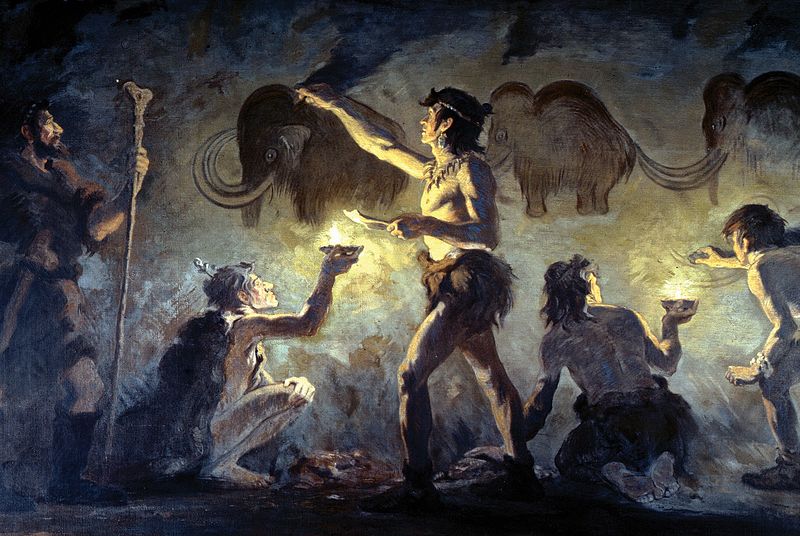
Cro-magnon artists painting in Font-de-Gaume, France. (Art by Charles Knight, 1920. From here)

Cro-Magnon artists painting in Font-de-Gaume, for example, shows the early ancestors of modern human and invites the viewer into the scene through the front-and-centre point of view. Situating his Cro-Magnon subjects in the centre field immediately imbeds the viewer as a member of the clan; part of the visual narrative. Moreover, Knight painted many Neanderthal portraits and murals – he considered himself immensely sympathetic to the evolutionary plight of what he saw as a doomed species. As such, his Neanderthal landscape paintings contain a pathos that many early twentieth-century reconstructions lacked – Knight’s Neanderthals have dignity without caricature. Knight considered the Neanderthal evolutionary trajectory of extinction tragic, but inevitable.

Neanderthals

A detail from the beautiful giant mural ‘The Flint Workers of the River Vezere.’ The mural at the American Museum of Natural History was restored in 1994. (Art by Charles Knight, 1920. Image from here)

The Pleistocene landscapes and murals of Charles Knight act as cultural touchstones, even as the science of the megafauna and hominins evolves. His work is ubiquitously present in many iterations of many paleo disciplines and illustrates a brilliantly understated, carefully studied, and sympathetic portfolio of the Pleistocene.

Written by Lydia Pyne (@LydiaPyne)

Edited by Jan Freedman (@janfreedman)

This is an expanded version of a blog post from http://www.pynecone.org/blog.

Further Reading:

Gould, S. J. (1990), ‘Wonderful Life: The Burgess Shale and the Nature of History’, New York: W.W. Norton & Company 1990. [Book preview]

Knight, C. R. (1935), ‘Before the Dawn of History’, New York, London: Whittlesey House, McGraw-Hill Book Company Inc. [Book]

Milner, R. & Knight-Kalt, R, (2012), ‘Charles R. Knight: The artist who saw through time. New York: Harry N. Abrams. [Book review]

Osborn, H. F. (1915), ‘Men of the Old Stone Age: Their Environment, Life, and Art’, New York: Charles Scriber’s Sons. [Full book]


Posted in Scientific Art | Tagged , , , , , , , , , | 7 Comments

Galloping across the steppes

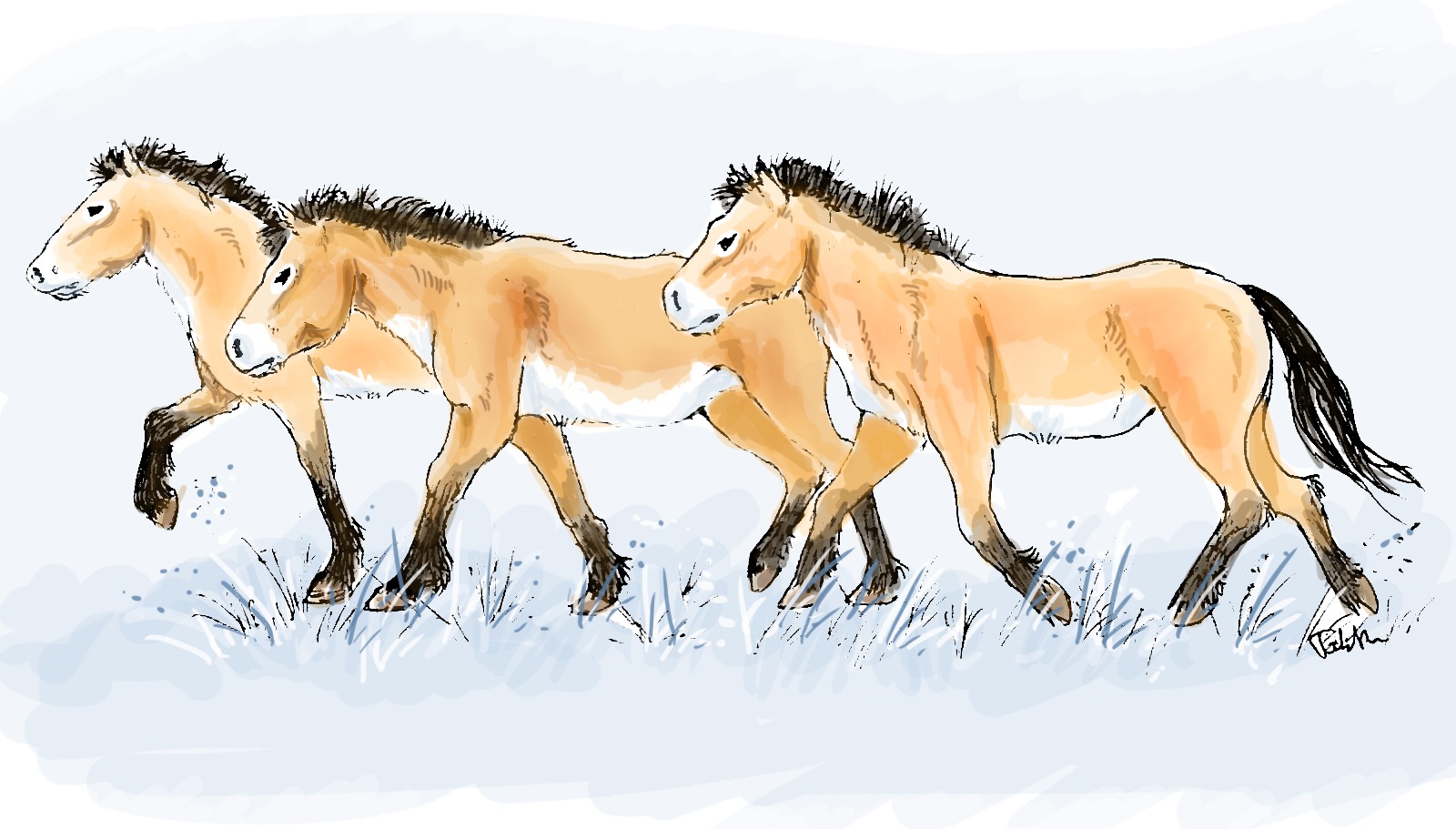
A team of horses (Equus caballus) slowly moving across the European steppes around 30,000 years ago. (Art by Tabitha Paterson)

A team of horses (Equus caballus) slowly moving across the European steppes around 30,000 years ago. (Art by Tabitha Paterson)

Around 50 million years ago, long before the Epoch of the Twilight Beasts, a little mammal, Eohippus, scurried about in the forests of North America. This creature, about the size of an average dog, was the ancestor of the magnificent horse we know today. During this Period, called the Eocene, the environment and climate was constantly changing, and little Eohippus responded to adapt. Some species kept the paw like feet and just grew a little larger. Others lost a few toes altogether. Like the plants Eohippus fed from, horse evolution was a bushy tree of different species, some branches giving rise to new species, others evolutionary dead ends.

The horse that we know today, Equus caballus, evolved from the tiny little Eohippus. In one group, the little paw-like feet developed into a single hard ‘toe’, which we now know as a hoof. (If you run your hand down a modern horses leg, careful not to be kicked, you will feel  small bony structures either side of the ankle; these are called ‘chestnuts’ and are the rudimentary, diminutive,  proto-pony paws!) This solid, hard hoof allowed for rapid galloping across the plains of North America, and due to the land bridges of the Miocene and Pliocene Epochs, it’s believed that herds of horses galloped their way into Eurasia and Europe.

The horses of the Americas evolved in a slightly different way through the Pleistocene period, with the Hippidion species, which does not appear to have spread into Eurasia. Funny enough, with its name meaning ‘little horse’ the average Hippidion was the size of a small pony (although smaller variations have been found), with a distinctive flexible snout. Some 70% of North American fauna became extinct at the end of the Pleistocene, with the wild equines diminishing in body size, perhaps because of poor grazing and climate changes. No-one really knows if the extinction was due to dwindling vegetation from of climate changes or if human ‘overkill’ hunting methods contributed as well.

We know from beautiful artwork in caves such as Chauvet Cave, dating to around 30,000 years ago, that early humans must have looked in wonder at these herds of creatures. It is easy to imagine the freedom and thrill Ayla gets from riding her wild horse across the steppes in The Valley of Horses by Jean Auel (and equally easy to sympathise with Jondalar’s obvious embarrassment as he sits behind her on the horse and they ride it together!).

Although early humans hunted the horse for food, skins and bone, these big beasts must have also been appreciated for their grace and beauty, as the cave paintings and figurines convey a wonderful understanding of the horse’s elegant natural movements. One of the most fabulous sculpted pieces is the Vogelherd horse, with its neck arched proudly, carved some 32,000 years ago during the bitter cold of the Aurignacian period.

The steppes had the greatest variation of types, from the tarpan to the horse we now know as Przewalski’s Horse. The tarpan (Equus caballus ferus) is the true European Pleistocene horse, depicted in cave art.  Their small height (similar to that of a Exmoor Pony), belied a strength and capacity to survive some of the most challenging conditions of prehistory. They grazed the steppes and steppe/forest lands of Eastern Europe, where some of the subspecies appear to have increased in height to become the ancestors of the exquisite and ancient Akhal Teke breed. Little is known of the other subspecies of European wild horse which roamed freely from Spain to Russia, although we know there was a genotype which created the unusual ‘leopard spot’ horse colouring depicted on the walls of Chauvet  and Lascaux caves in France.

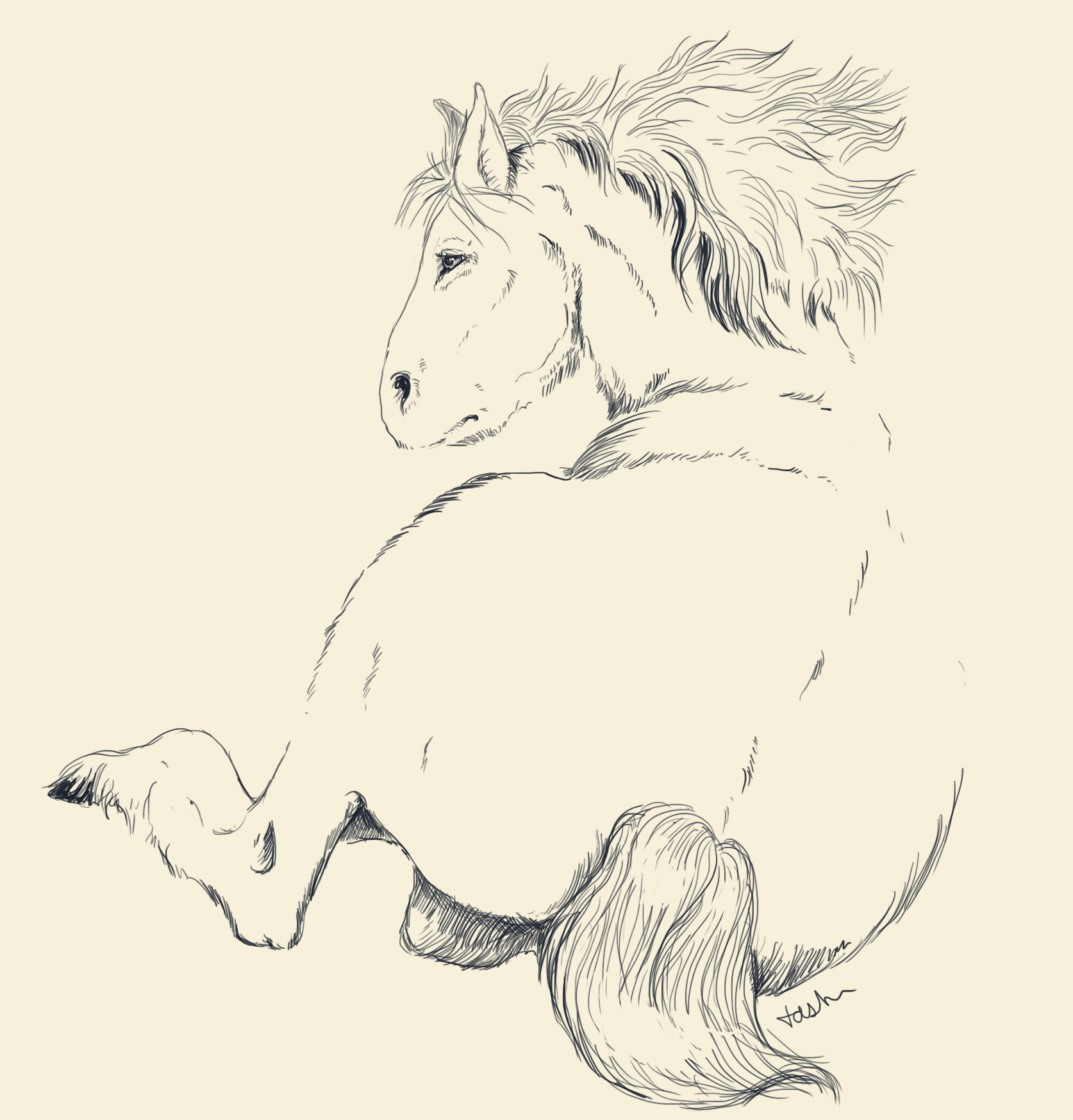
A sketch of a tarpan, (Art by Tabitha Paterson)

A sketch of a tarpan (Equus caballus ferus) the first true Pleistocene European modern horse. (Art by Tabitha Paterson)

The tarpan was usually a mousey grey colour, with black legs and muzzle and a dorsal stripe down its back, like many of the most ancient breeds extant today. The closest genetic relatives to Equus caballus ferus may well be the modern Exmoor, Dortmund and Konik. The last pure-bred tarpan died in 1879, in the Ukraine, plunging to its death down a ravine rather than accept being captured by humans, which in itself speaks volumes about the wild nature of these wonderful ancestors of the modern horse.

The remote steppes of Eurasia were also the last natural home of the other, perhaps better known wild horse of the Pleistocene, Equus ferus przewalskii; the Przewalkski wild horse.  One man, Dr Przewalksi, saved this horse from extinction, by breeding a number of the animals in captivity to preserve the lineage. With its distinctive golden coat, hogged mane and mealy muzzle, the Przewalski looks the epitome of the primitive wild horse depicted in mobilary art from the dawn of mankind. So unique are its looks that it was considered by many taxonomists to be a unique species in its own right. Research into mitochondrial DNA in 2009 suggests it is closely related to the modern horse, and doesn’t form a separate (or monophyletic) group. This hardy and stunning little pony is a true victor of the Ice Age, perfectly adapted for bitterly cold temperatures, drought and scant food supplies.

As a typically ‘horsie’ little girl, I can understand the awe they held, and as an adult its my own personal ambition to see the Przewalski horses in one of the sanctuaries now created for them across Europe. I admit my preference would be the spectacular Paläon centre in Schöningen, Germany, where a Pleistocene landscape has been recreated for these magical creatures! I can think of few things as fabulous as gazing at a creature whose bloodline is derived from Ice Age survivors and imagining how our own ancestors fell in love with them as much as we do today.

Written by Rena Maguire (@justrena)

Art by Tabitha Paterson (@TabithaPaterson)

Further reading:

Auel, J. M. (1987), The Valley of Horses. Cornet Books. 11th Ed. [Book]

Clutton-Brock, J. (1999), A natural history of domesticated mammals. Cambridge: Cambridge University Press. [Book]

Guthrie, D. (2003), ‘Rapid body size decline in Alaskan Pleistocene horses before extinction’, Nature, 426, 169–171. [Abstract only]

Kavar, T and Dovč, P. (2008), ‘Domestication of the horse: Genetic relationships between domestic and wild horses’, Livestock Science, 116, 1-14. [Abstract only]

Lau, A, et al. (2009), ‘Horse Domestication and Conservation Genetics of Przewalski’s Horse Inferred from Sex Chromosomal and Autosomal Sequences’, Mol. Biol. Evol, 26, 199–208. [Full article]

Levine, M. (2006), ‘mtDNA and Horse Domestication: The Archaeologist’s Cut’ in Mashkour’, M. (ed.), Equids in Time and Space. Oxford: Oxbow Publications, 192-201. [Full article]

Price, N (Ed). (2001), The Archaeology of Shamanism. London: Routledge. [Book]

Weinstock J. et al. (2005), ‘Evolution, Systematics, and Phylogeography of Pleistocene Horses in the New World: A Molecular Perspective’. PLoS Biol. 3.8 e241. doi:10.1371/journal.pbio.0030241 [Full article]

Posted in Horse | Tagged , , , , , , , , , , , , , | 51 Comments

The mouse-goat crocodile chimera

A small family of Myotragus balearicus enjoying a brief moment of luscious grass. (Illuastration by Tabitha Paterson)

A small family of Myotragus balearicus enjoying a brief moment of luscious grass. (Art by Tabitha Paterson)

Lets be honest, size really does matter. Especially when it comes to being noticed. An ‘average sized’ creature would really make an impressive headline; ‘Mammoth discovered, the most average one yet’. Crowd pleasing adjectives such as ‘the biggest’, ‘the largest’, ‘the longest’ and even opposites like ‘the smallest’ and ‘the shortest’ will win the day. Even if the creature is pretty mediocre, quirky traits, or witty scientific names, will bring an otherwise inconspicuous beast to the public eye (recently demonstrated by ‘Pinocchio Rex’ an averaged-sized relative of Tyrannosaurus rex that had an unusually long snout).

Rarely, very rarely, something truly remarkable is discovered that fits all the above.

When the great TrowelBlazer Dorothea Bate received a letter in 1909 telling her of bones discovered in a cave in Majorca, she could never have dreamt about what she would find. An inspirational woman, Dorothea was passionate, determined and focused. She travelled to Majorca on her own, and spent a month travelling around the rough, dry terrain of the island searching in caves for bones. The bones in the letter were of a very peculiar animal. So peculiar was the first skull she discovered, she held back on describing it until she found more. Her fossil had extremely odd features.

This strange beast, which Bate named Myotragus balearicus, would have reached half a metre tall; tiny by any non-rodent standards. Myotragus (Greek for ‘mouse-goat’), is neither a mouse nor a goat; it is closely related to sheep. The diminutive size is a classic result of the ‘Island Rule’ (or ‘Fosters Rule’). Simply put, the Island Rule states that some animals will get bigger on islands, and others will get smaller depending on predators and food availability. In this case, the ancestors of Myotragus arrived on Majorca around 5 and a half million years ago and with less food available, survived by getting smaller.

But it wasn’t just the teeny weenie size that continues to make this animal the focus of vigorous debate 100 years later. The mouse-goat had several other adaptations for living on a small island; individually bizarre but together creating an animal like nothing you would expect. Especially weird for a relative of the humble sheep. The closer you looked, the more peculiarities popped up.

Myotragus molars were nicely ridged and flat, typical of herbivores ,so we know this cat-sized goat mouse ate shrubs and low lying vegetation. An unexpected feature was the front teeth (the incisors). All ruminants (sheep, goats, giraffes, antelopes, etc.) have six incisors on their lower jaw; Myotragus had two and none on the top. Even odder, these two teeth grew constantly, so they never wore down. Rats, mice, voles, squirrels and other rodents share this feature. But our little friend appears to have evolved it independently. This may be an adaptation to eating tough, hard vegetation with some researchers suggesting they used it to strip bark or even lichen.

Little Myotragus was a herbivore with strange teeth. You wouldn’t guess it was a plant eater from looking into its eyes. They point forward. All herbivores have eyes which are positioned at the sides of their heads, so they can keep an eye out for predators. Living on an island, with little worry about being eaten (apart from the occasional bird of prey), there was no need for eyes at the side of their heads. Eyes pointing forward were more of an advantage for these mini-mammals; perhaps better vision allowed them to spot each other better.

The list of oddities continues. Both the boys and the girls had little horns on their heads. Normally it would be the males who had the horns, to fight for a female, or show off to a female. Horns on the heads of both sexes may be an adaptation to remove obstacles in the drier seasons to reach food.

Quite possibly the strangest feature of all is the way the bones grow; more like a reptile than a mammal! The bones didn’t grow constantly like a normal mammal, instead, something made the bone grow slower, or even stop growing for a period of time, just like a crocodile. This ‘something’ was the environment; the cells in Myotragus were able to react to a drier, more difficult season with less food, by slowing its growth. Truly remarkable and something no other mammal does.

The astonishing adaptations allowed this animal to survive for around five and a half million years on Majorca and another nearby island, Minorca. Humans met Myotragus, and even tried to domesticate it. They failed, and this wonderful animal vanished forever only around 5000 years ago. This may truly be one of the most peculiar Twilight Beasts ever to have lived.

Written by Jan Freedman (@janfreedman)

Art by Tabitha Paterson (@TabithaPaterson)

Further Reading:

Alcover, J. A. et al. (1999), ‘The diet of Myotragus balearicus Bate 1909 (Artiodactyla caprinae), an extinct bovid from the Balearic islands: Evidence from coprolites’, Biological Journal of the Linnean Society. 66 (1) 57-74. [Full article]

Andrews, C. W. (1914), ‘A description of the skull and skeleton of a peculiarly modified rupicaprine antelope (Myotragus balearicus Bate) with a notice of a new variety M. balearicus var. major‘, Philosophical Transactions of the Royal Society. series B, 206, 281-305. [Full article]

Bate, D. (1909), ‘Preliminary note on a new artiodactyle from Majorca: Myotragus balearicus gen. et sp. nov’, Geological Magazine. 5 (6) 385-8. [Abstract only]

Bate, D. (1914), ‘On the Pleistocene ossiferous deposits of the Balearic islands’, Geological magazine. 6 (1) 337-45. [Abstract only]

Bover, P, and Alcover, J. A. (1999), ‘The evolution and ontogeny of the dentition of Myotragus balearicus Bate 1909: evidence from new fossil data’, Biological Journal of the Linnean Society. 68, 401-28. [Abstract only]

Köhler, M., and Moyà-Sola, S, (2009), ‘Physiological and life history strategies of a fossil large mammal in a resource-limited environment’, PNAS. 106 (48) 20354-58. [Abstract only]

Schindler, K. (2005), Discovering Dorothea: The life of the pioneering fossil-hunter Dorothea Bate’, Harper Collins Publishers. [Book]

Posted in Mouse Goat | Tagged , , , , , , , , , | 10 Comments

The one with the sabretooth

Smilodon opening wide. The cat could open its jaws to 120º (Painting by Tabitha Paterson)

Smilodon opening wide. The cat could open its jaws to an incredible 120º (Art by Tabitha Paterson)

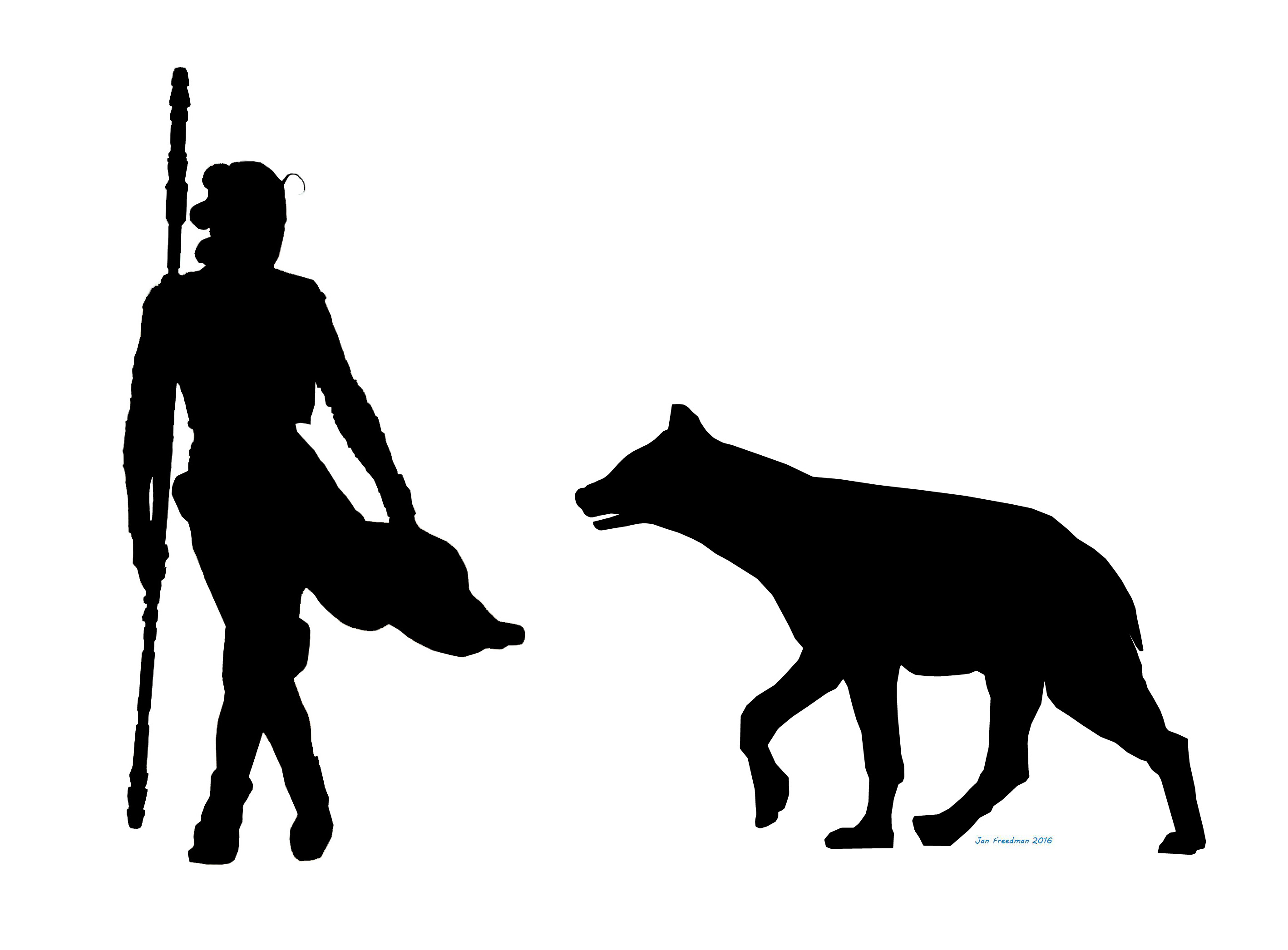
Smilodon is the genus of extinct sabretooth that everyone knows. Stocky, hugely muscled, with canines that protrude far below the jaw, it is the archetypal Pleistocene predator. It was a member of the machairodontinae, an extinct subfamily of the Felidae (all modern cats are members of the subfamily felinae), which split from the ancestors of our furry house-pets way back in the Miocene. Interestingly enough, it was almost as different from Homotherium as it was from lions, tigers, and kin. The scimitar-cat split very early on from Smilodon and its relatives. In fact, there are three species of Smilodon known to science. The earliest, Smilodon gracilis, lived in North America during the late Pliocene to middle Pleistocene, and was probably a direct ancestor of the two later species, Smilodon fatalis (found in North America and western South America) and Smilodon populator (found in eastern South America). Smilodon populator was probably the largest sabretooth that ever lived- average individuals easily weighing over 250kg! This enormous cat has been found at many sites in South America and even made it down to Tierra del Fuego.

The size of Smilondon compared with Rey shows just how big this cat would have been. (Image by Jan Freedman)

The size of Smilodon compared with Rey shows just how big this cat would have been. (Image by Jan Freedman)

The most distinct feature of Smilodon is obviously its enormous canines. Measuring up to 11 inches long with enormous roots to keep them anchored within the skull, the teeth grew at a much faster rate than in modern cats. Smilodon kittens started off with milk canines, and in a similar fashion to modern cats, the adult teeth actually grew in alongside the deciduous teeth- meaning that some young sabrecats actually had four sabres in their mouth for a short period of time. This must have looked incredible, as we know that Smilodon was a very “gummy” cat. The gums likely extended quite far down the canine, and had a unique, stepped, profile that probably allowed the cat to know the penetrance of the teeth during the killing bite, giving greater control of the placement.

The canines of Smilodon were pretty delicate and prone to breakage (due to their thin cross-section). Many individuals from the famous tarpit site of Rancho la Brea even show evidence of living for years after the loss of one (or both) sabres, shown by the reseach of the great TrowelBlazer, Blaire Van Valkenburgh. This observation leads directly on to one of the most interesting questions in cat palaeontology- was Smilodon social? We know of individuals who survived long periods with broken sabres (the broken ends became polished through use by the living animal), and the la Brea skeletons also show examples of animals with massively debilitating skeletal problems (crippling arthritis, badly healed fractures), so could these cats have had a group structure that allowed incapacitated members to feed? There is evidence both for and against this idea. Positive evidence includes comparisons to what happens in modern ecosystems when recordings are played of a herbivore in distress (as would have happened at la Brea when animals got stuck in the tar)- social carnivores show up more often than asocial carnivores. The numbers of Smilodon at la Brea are very high, and only comparable to another presumably social predator, the dire wolf (Canis dirus). Against the sociality argument is the fact that modern felids are almost exclusively solitary (with the exception of the lion), and the lion species found at la Brea (Panthera leo atrox) is present at a much lower frequency than Smilodon. Felids also have very high metabolic rates and a fast healing process, which means that wounds and breaks tend to heal faster than we expect. What would be a debilitating wound in some mammal species may have not been so for a felid.

So there you have it. Smilodon: the sometimes four sabred, gummy, panamerican maybe social sabretooth (not quite a) cat.

And as a postscript: did you know that that Smilodon had a recurring role in the series Friends? Ross Geller, despite supposedly being a dinosaur expert, had a replica skull of Smilodon fatalis on the bookshelf in his apartment. Also in “the one with Ross’ library book” when Ross is patrolling the library section to prevent students from using the area to make out, he sarcastically comments “Oh-oh, you’re fellow scholars. What exactly were you looking for, hmm? Perhaps, Dr. Chester Stock’s musings on the Smilodon californicus?” This is a real book, written in conjunction with JC Merriam (who gets a shoutout later in the scene), and perhaps the definitive work on Smilodon from Rancho la Brea.

Written by Ross Barnett (@DeepFriedDNA)

Art by Tabitha Paterson (@TabithaPaterson)

Further reading:

Barnett, R., et al. (2005), ‘Evolution of the extinct sabretooths and American cheetahlike cat’, Current Biology, 15 (15), R589-R90. [Full article]

Berta, A. (1987), ‘The sabercat Smilodon gracilis from Florida and a discussion of its relationships (Mammalia, Felidae, Smilodntini)’, Bulletin of the Florida State Museum of Bioogical Sciences, 31 (1), 1-67. [Full article]

Carbone, C., et al. (2009), ‘Parallels between playbacks and Pleistocene tar seeps suggest sociality in an extinct sabretooth cat, Smilodon’, Biology Letters, 5, 81-85. [Full article]

Christiansen, P. and Harris, J. M. (2005), ‘Body Size of Smilodon (Mammalia: Felidae)’, Journal of Morphology, 266, 369-84. [Abstract only]

Feranec, R. S. (2004), ‘Isotopic evidence of saber-tooth development, growth rate, and diet from the adult canine of Smilodon fatalis from Rancho La Brea’, Palaeogeography, Palaeoclimatology, Palaeoecology, 206 (3-4), 303-10. [Full article]

Merriam, J. C. and Stock, C. (1932), The Felidae of Rancho La Brea (Carnegie Institute of Washington Publications). [Book]

Prevosti, F. J., Martin, F. M., and Massone, M. (2013), ‘First record of Smilodon Lund (Felidae, Machairodontinae) in Tierra del Fuego Island (Chile)’, Ameghiniana, 50 (6), 605-10. [Full article]

Tejada-Flores, A. E. and Shaw, C. A. (1984), ‘Tooth replacement and skull growth in Smilodon from Rancho la Brea’, Journal of Vertebrate Paleontology, 4 (1), 114-21. [Abstract only]

van Valkenburgh, B. and Hertel, F. (1993), ‘Tough Times at La Brea: Tooth Breakage in Large Carnivores of the Late Pleistocene’, Science, 261, 456-59. [Full article]

Posted in Sabre tooth Cat | Tagged , , , , , , , , , , , , , , | 36 Comments

Mr Darwin’s lost sloth

Mylodon

A delightfully grouchy looking ground sloth, Mylodon darwinii. (Art by Tabitha Paterson)

Ground sloths are weird. The two-toed and three-toed varieties of memetic fame that we are left with only hint at the absurdity of different genera such as Eremotherium, Megalonyx, and Nothrotheriops: bear-sized to elephant-sized behemoths, covered in shaggy fur, and sporting enormous curved claws.

The great diversity of Pleistocene sloths shuffled around (yes, they walked on the outside of their pedes, as if club-footed), a wide variety of habitats from frigid Alaska to tropical Florida to bleak Patagonia, and even the Caribbean islands. The species Mylodon darwinii was probably about the size of a giant panda and lived along the western coast of South America, even down into Patagonia. You may have spotted something familiar about the latin name of the species. This sloth was named after a certain Mr Charles Darwin.

Darwin’s Beagle voyage is well known for sparking his ideas on how evolution worked. His keen observations of the finches (and mockingbirds and giant tortoises) on the different Galapagos islands struck a chord. The voyage is not so well known for his discovery of several new species of Pleistocene mammals.

Hopping down the South American coast, and occasionally riding inland on horse, Darwin collected a lot of fossils. Back then (in the 1830s) there were very few big mammals known and with some specimens being only teeth or bones, Darwin had little to compare them to. Boxes of bones were sent back to England and the famous anatomist Richard Owen identified a number of enormous mammals, from the giant armadillo-like Glyptodon clavipes to the wonderfully weird  Macrauchenia patachonica.

These extinct giants hinted to Darwin at some kind of relationship between living and extinct forms. He writes at length about it in his Voyage of the Beagle, written 20 years before On the Origin of Species. Here he describes how living animals are always found in the same region as their extinct relatives. Discovering so many incredible Twilight Beasts was pivotal in developing the young Darwin’s thinking about how and why evolution happened.

Amongst the 15 or so new mammals identified by Richard Owen in the crates of fossils was the fairly large sloth, Mylodon darwinii. This large beast was described on the basis of a jawbone and named in honour of its discoverer.

Mylodon is one of the better known extinct sloths, thanks to copious material found preserved in the cold, dry cave systems of Chile and Argentina. In fact, one site, imaginatively named Cueva del Milodon (Mylodon Cave), has produced an abundance not just of skeletal material, but dung, nail, hair, and skin. When the site was first discovered in the 1890s, the remarkable preservation of a complete Mylodon skin (clearly removed from an animal by ancient human hands) encouraged many people to think that ground sloths still survived in the remoter parts of South America. This optimism has lasted for over a century, with the occasional expedition still being mounted to search for giant sloths in the jungles of the Matto Grosso. It’s a wild goose chase for sure.

The Cueva del Milodon material has been studied intensely, and radiocarbon dated to the late Pleistocene (>10,000 years old). The cold, dry conditions of the cave have preserved the soft tissue due to a natural freeze-drying process. The bones from this site are so well-preserved that ancient DNA has been recovered from a number of the species found there.

Written by Ross Barnett (@DeepFriedDNA) and Jan Freedman (@janfreedman)

Art work by Tabitha Paterson (@TabithaPaterson)

Further reading:

Akersten, W. A. and McDonald, H. G. (1991), ‘Nothrotheriops from the Pleistocene of Oklahoma and paleogeography of the genus’, The Southwestern Naturalist, 36 (2), 178-85. [Full article]

Cartelle, C. and De Iuliis, G. (1995), ‘Eremotherium laurillardi: The Panamerican late Pleistocene Megatheriid sloth’, Journal of Vertebrate Paleontology, 15 (4), 830-41. [Full article]

Fernicola, J. C., Vizcaino, F, and de Iuliis, G. (2009), ‘The Fossil Mammals collected by Charles Darwin in South America during his travels on board the HMS Beagle’, Revista de la Asociatión Geológica Argentina. 64 (1), 147-59. [Full article]

Höss, M. , et al. (1996), ‘Molecular Phylogeny of the extinct ground sloth Mylodon darwinii‘, Proceedings of the National Academy of Sciences of the U.S.A., 93, 181-85. [Full article]

Lönnberg, E. (1900), ‘On a remarkable Piece of Skin from Cueva Eberhardt, Last Hope Inlet, Patagonia’, Proceedings of the Zoological Society of London, 379-84.

McDonald, H. G., Harington, C. R., and G., De Iuliis. (2000), ‘The ground sloth Megalonyx from Pleistocene deposits of the Old Crow Basin, Yukon, Canada’, Arctic, 53 (3), 213-20. [Full article]

Owen, R. (1840), ‘Part I. Fossil Mammalia’, in C. R. Darwin (ed.), The zoology of the voyage of H.M.S. Beagle, under the command of captain Fitzroy, R. N., during the years 1832 to 1836 (London: Smith, Elder and Co.). [Full text]

Steadman, D. W. (2005), ‘Asynchronous extinction of late Quaternary sloths on continents and islands’, Proceedings of the National Academy of Sciences of the U.S.A., 102 (33), 11763-68. [Full article]

Vizcaino, S. F., Farina, R. A., and Fernicola, J. C., (2009), Young Darwin and the ecology and extinction of Pleistocene South American fossil mammals’, Revista de la Asociatión Geológica Argentina. 64 (1), 160-69. [Full article]

Posted in Ground Sloth | Tagged , , , , , , , , , , , , , | 18 Comments

Clan of the cave hyena

A family of hyenas.

A family of hyenas resting in the grass somewhere in Europe. (Art by Tabitha Paterson)

Their deathly hypnotic stare sends shivers down the spine. The long, strong neck gives these amazing creatures additional cause to be feared. Hyenas are infamous for their ferocious ways of hunting in packs (known as cackles, or clans), scavenging carcases and loudly, excitedly, yelping as they rip their food to pieces.

There are four living species of hyenas; the spotted hyena (Crocuta crocuta), the striped hyena (Hyaena hyaena), the brown hyena (Hyaena brunnea) and the lesser know little aardwolf (Proteles cristatus). The striped hyena is the only species, in present time, to live outside of Africa; as well as north and east Africa, it also lives in the Middle East and Asia. In the Earth’s recent past, another species of hyena was running around Europe; cackling across the plains.

Hyenas are one of the keystone species excavated in the first Pleistocene fossil discoveries. In the early 1800s in England, fossils in caves were being dug up by limestone quarrymen. At first thought to be old farm animals they were used for adding to road rubble, but they soon attracted the attention of naturalists, and one man in particular became obsessed with them.

The somewhat eccentric William Buckland, a geologist and theologian in Oxford, was made aware of one of these early sites at Kirkdale Caves in Yorkshire. Bone of hippopotamus, elephants, bison and other creatures were all identified. A strong believer in the literal truth of the Bible, Buckland first thought that the remains had been washed in by Noah’s flood. The more he looked, the more he realised that the giant beasts could not have been washed through the small opening of the cave. How else could they have got there?

Abundant fossils of another creature gave Buckland the answer. Fossils of hyenas, young and old, along with gnawed bones of animals and fossilised hyena poo (called coprolites) provided evidence of hyenas actually living in the cave. Clans of hyenas were denning in the caves, dragging in bodies of the animals which lived nearby. Far from confirming the Biblical account, Buckland had discovered a time when these exotic creatures were living in Britain (he attributed this to an ‘antediluvial’ time, or a time before the great flood).

(Incidentally, William Buckland really was an eccentric character. He had a rather unusual penchant for wanting to eat every animal on the planet. He did actually manage to eat his way through quite a lot of different critters, finding blue bottles and moles rather untasty. [I have heard badger isn’t a very nice meal either.] Buckland was going to try eating a hyena, but he became too attached to it and so kept him as a pet, and named him Billy.)

By examining hyena fossils and looking very closely at other fossils (for gnaw marks), Buckland had set a new standard for examining cave sites.

The spotted hyena is a larrge carnivore

The spotted hyena is a larrge carnivore, and the most abundant carnivore in Africa today. (Image Jan Freedman)

The spotted hyena (C. crocuta) has been incredibly successful throughout most of Europe and Asia for almost a million years. Commonly known as the European Spotted Hyena, or the Cave Hyena, this hyena has historically been named as a separate species (C. spelaea) or sub-species (C. crocuta spelaea). Recent genetic work has demonstrated the European Spotted Hyena has had continual gene flow through Africa and is one species, C. crocuta.

The first evidence of C. crocuta in Western Europe is found in Sierra de Atapuerca, Spain, dating to 800,000 years ago. They rapidly spread throughout Europe and are one of the main fossils recovered from many cave sites. Beautifully preserved jaws, and skeletal remains, have been found in caves in Somerset, Devon and Yorkshire. As Buckland demonstrated for the first time with the fossils at Kirkdale in Yorkshire, many of the caves sites across Europe have young and old specimens indicating that they were used as hyena dens.

These hairy terrors were not restricted to warm environments during the ever changing Pleistocene. Their remains have been found throughout the mid-late Pleistocene of Britain, including times when it was so warm hippopotamus swam in the Thames, and later, cooler, times when mammoths roamed Derbyshire. Although they are absent in Britain during a few extremely frigid periods, these were efficient, successful predators.

They suddenly became extinct in Britain around 30,000 years ago, and soon after in the rest of western Europe. It is likely that changing climate  and changing vegetation had an effect on populations. Around 30,000 years ago the climate was colder and the prey species were becoming isolated in refugia. With the colder climate and less herbivores, these great beasts would have had more competition from wolves and even lions. They were lost from Britain and Europe. Fortunately, this Twilight Beast survives today. Watching one (on the television), you can imagine clans of these incredible animals yelping and cackling all over England.

Written by Jan Freedman (@janfreedman)

Art work by Tabitha Paterson (@TabithaPaterson)

Further Reading:

Buckland, W. (1822), ‘Account of an assemblage of fossil teeth and bones of elephant, rhinoceros, hippopotamus, bear, tiger, and hyaena, and sixteen other animals; discovered in a cave at Kirkdale, Yorkshire, in the year1821: with a comparative view of five similar caverns in various parts of England, and others on the continent’, Philosophical Transaction of the Royal Society of London, 112, 171-236. [Full article]

Diedrich, C. G. (2008), ‘The holotype of the upper Pleistocene Crocuta crocuta spelaea (Goldfuss, 1823: Hyaenidae) and Panthera leo spelaea (Goldfuss, 1810: Felidae) of the Zoolithen Cave hyena den (South Germany) and their palaeo-ecological interpretation’, Zoological Journal of the Linnean Society, 154, 822-31. [Abstract only]

Dodge, D., et al. (2012), ‘Mitochondrial DNA haplotypes of Devensian hyenas from Creswell Crags, England’, Archaeological and Anthropological Science, 4, 161-66. [Full article]

Garcia, N., & Arsuaga, J., L (1999), ‘Carnivores from the early Pleistocene hominoid-bearing Trinchera Dolina 6 (Sierra de Atapuerca, Spain)’, Journal of Human Evolution. 37. pp.415-430.  [Full article]

Klein, R., G. & Scott, K. (1988), ‘Glacial/Interglacial Size Variation in Fossil Spotted Hyenas (Crocuta crocuta) from Britain’, Quaternary Research. 32. pp.88-95. [Full article]

Rohland, N., et al. (2005), ‘The Population History of Extant and Extinct Hyenas’, Molecular Biology and Evolution. 22(12). pp. 2435-2443. [Full article]   

Stiner, M., C. (2004), ‘Comparative ecology and taphonomy of spotted hyenas, humans, and wolves in Pleistocene, Italy’, Revue de Paléobiologie, Genève. 23 (2). pp.771-785. [Full article]

Stuart, A. J. and Lister, A. M. (2013), ‘New radiocarbon evidence on the extirpation of the spotted hyaena (Crocuta crocuta (Erxl.) in northern Eurasia’, Quaternary Science Reviews, in press. [Abstract only]

Turner, A. (1992), ‘Large Carnivores and earliest European hominids: changing determinants of resource availability during the Lower and Middle Pleistocene’, Journal of Human Evolution. 22 (2). pp.109-126. [Full article]

Turner, A. (1995), ‘Evidence for Pleistocene contact between the British Isles and the European Continent based on distributions of larger carnivores’, Geological Society, London, Special Publications. V.96; pp.141-149. [Abstract only]

Turner, A., Antón, M., (2004), Evolving Eden: An Illustrated Guide to the Evolution of the African Large-Mammal Fauna. Columbia University Press, New York.   

Posted in Hyena | Tagged , , , , , , , , , | 16 Comments

An elk that wasn’t an elk

A herd of the giant Megaloceros giganteus.

Standing proud: A herd of the giant deer Megaloceros giganteus during the closing years of the Pleistocene. (Art by Tabitha Paterson)

To see an Irish Elk (Megaloceros giganteus) in all its glory, visit the National Museum of Ireland, in Dublin. Here, skeletons of this magnificent beast are articulated, proudly towering higher than the visitors. What really stands out are the incredibly enormous antlers, spanning 3.6 metres across! Standing face to face with a skeleton of Megaloceros you can imagine the awe-inspiring beast, roaming in herds across Europe around 13,000 years ago, at the very twilight of the Pleistocene.

Commonly known as the ‘Irish Elk’, Megaloceros was neither exclusively Irish, nor an elk. This giant was the largest deer to have ever existed; it’s closest relative, the Fallow Deer (Dama dama), was less than half the size! Elks were prancing around Europe, and there were earlier, larger species of Moose. But Megaloceros giganteus was the largest, and perhaps the most impressive and regal of the Old World deer family Megalocerini.

Around 17,000 years ago humans saw these glorious creatures and created their own interpretations of them on the cave walls at Lascaux, with others at Cougnac. These exquisite paintings depict M. giganteus with speckled coats and dark shoulder hair that accentuated a distinctive hump. Ancient paintings give an ancient animal its colour, but it is the skeleton where we can learn about its life. The vertebrae along its shoulders had longer dorsal processes (a hump) which may have been used as a fat reserve; or perhaps for extra muscle to keep the head and those huge antlers up.

The deep and ancient lake sediments underneath the famous bogs in Ireland have produced some of the finest complete skeletons so far discovered. The first recorded finds were unearthed from County Meath bogs in 1588, but it was in 1697 when aristocratic scholar Thomas Molyneux described these remains as belonging to a moose, that the epithet of Irish Elk was adopted. It would be 1812 before naturalist Georges Cuvier would identify the great antlers as belonging to a totally different family than moose or elk. During the 19th century, many natural philosophers thought the Irish specimens were a unique breed. But this majestic deer thrived all over Europe where there were grasslands and herbaceous plants, shown in the wear on their teeth. The name of Irish Elk persisted, along with beautifully preserved skeletons makes Megaloceros the most famous prehistoric beast in Ireland.

The post-Ice Age world of Megaloceros was very different from today. It thrived during a period known in Irish palaeoecology as the Woodgrange Interstadial around 11,000 – 12,000 years ago. Interstadials are short periods of slightly warmer temperatures in between times when ice pushed its way down through Europe (a glacial period). We would think the Woodgrange Interstadial was cold today, but compared to the glacial time preceding it, it was a tropical haven! It was a favourable time for plants to grow, and animals to thrive.

Fossil finds indicate that Megaloceros shed their antlers every year. Modern fallow deer scent glands are larger than those of the Giant Deer (located just below the eyes) so it is unlikely that they relied greatly on scent to attract the females. Their magnificent size may have meant that they could have just intimidated rivals without needing to fight at all, although it appears likely that they did. A study into the engineering of the antlers and associated muscles in the late 1980s were used for fighting.

Fascinatingly, there are very few recognised female skeletons of Megaloceros, but lots of males (the National Museum of Ireland has 6 female skulls and 200 male skulls!). One theory is that antler-free female skulls were mistaken to be horses by natural philosophers in the early 1800s and so were  discarded. We’ve got it on the best authority, Dr Ruth Carden, Research Associate at the National Museum of Ireland, that some horse and cow skulls have been mistaken for Megaloceros. These new findings, along with future publications might mean a reassessment of what we thought we knew about the last of the Giant Deer in Ireland and the UK.

A proud, handsome male Megaloceros giganteus standing protectively over his mate.

A proud, handsome male Megaloceros giganteus standing protectively over his antler-less mate. (Art by Tabitha Paterson)

Around 12,700 years ago, the Woodgrange Intersadial (that short wamer period) gave way to a much colder period known as the Younger Dryas (also known as the Nahanagan Stadial in Ireland and the Loch Lomond Stadial in England). This sudden cooling may have been caused by melting ice sheets changing the ocean currents. With the extreme cold came the loss of vegetation and with that, the loss of the giants. The days of the Irish Elk were coming to an end.

Wonderfully old books about the Pleistocene have images of ‘cavemen’ hunting Megaloceros with spears. In Ireland, humans arrived around 2,000 years after these giant deers became extinct there. The cold wet climate combined with shorter seasons for plants to grow hit these herds badly, eventually dwindling so much that they had vanished forever from the beautiful Irish landscape.

Megaloceros hung on into the Holocene (the Epoch we are living in now), until around 7,500 years ago in the Ural mountains. As the climate changed, so did the vegetation. Herds migrated northwards following the luscious grassy steppes at the tips of the ever melting ice. There is little evidence that humans hunted these great beasts to extinction. It is more likely that human presence in their environment along with their habitat being decreased by changing climate attributed to these magnificent beasts disappearing completely.

Addendum: Immense thanks to specialists Mr Nigel Monaghan and Dr Ruth Carden of the magical and wonderful Natural History Museum in Dublin for their input and valuable additional knowledge. If you are visiting Dublin, a visit to their museum – known to us as the ‘Dead Zoo’- is a must.  You won’t just get some superb Megaloceros skeletons and multitudes of other fascinating things, but an experience of stepping back in time to the time. The building is so perfectly maintained as a Victorian museum, that an episode of the BBC series Ripper Street was filmed there. The building will enchant you, from the frolicking goat-shaped hedges outside, to its association with Dr Livingstone (I presume!).

Written by Rena Maguire (@JustRena)

Art work by Tabitha Paterson (@TabithaPaterson)

Further Reading:

Coxon, P. (2008), ‘Landscapes and Environment of the last glacial and interglacial transition: a time of amazing rapid change in Ireland’, Irish Naturalist Journal. (29) 1-19. [Abstract only]

Gould, S. J. (1974) ‘Origin and function of ‘bizarre’ structures – Antler size and skull size in ‘Irish Elk’, Megaloceros giganteus’, Evolution 28 (2), 191-120. [Full article]

Hall, V. (2010) The making of Ireland’s Landscape. Cork: Collins Press.

Kitchener, A. (1987), ‘Fighting behaviour of the extinct Irish elk’, Modern Geology. 11. 1-28.

Lister, A. et al. (2010), ‘The phylogenetic position of the giant deer Megaloceros giganteus‘, Nature. 438 (7069) 850-853. [Abstract only]

Stuart, A. J. et al. (2004), ‘Pleistocene to Holocene extinction dynamics in giant deer and woolly mammoth’, Nature. 431 (7009) 684-689. [Abstract only]

Worman, C. & Kimbrell, T. (2008), ‘Getting to the hart of the matter: Did antlers truly cause the extinction of the Irish Elk?’, Oikos (9). 1397. [Abstract only]

Posted in Irish Elk | Tagged , , , , , , , | 19 Comments