The dragon down under

Not so long ago an enormous lizard dragged it claws through the dried, dead leaves deep in the Australian woodlands. Longer than a black cab, this was the largest lizard (so far discovered) ever to walk on land. Its teeth were around 2 inches long, curved back, and as sharp (and as big) as steak knives.

Fossils of this enormous lizard were first discovered in 1859 on the beautiful farmlands of Darling Downs, Queensland in Eastern Australia.  Named by the great Victorian scientist, Richard Owen (is there a beast he didn’t name?), the creature was called Megalania prisca which translates as the ‘roaming lizard’. Today the name of this giant should belong in the same Genus as monitor lizards, like the infamous Komodo Dragon, so should be called Varanus priscus. Both genus names are accepted, although Varanus is preferred. Megalania is accepted as the common name. Taxonomists can be a pernickety bunch sometimes.
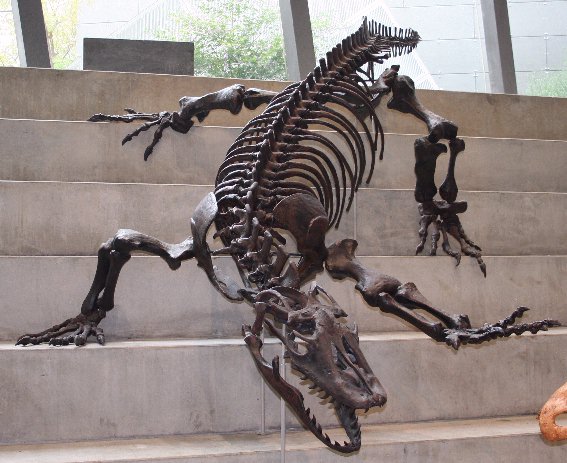
A classic photo of a reconstructed skeleton of Varanus priscus at the Melbourne Museum (Image from here)

A classic photo of a reconstructed skeleton of Varanus priscus at the Melbourne Museum, Australia. (Image from here)

This terrifying lizard is only known from a few scattered remains. Skull fragments, teeth, a few arm and leg bones, and vertebrae have been found at several sites across Eastern and Southern Australia. No complete skeleton has yet been found. Isolated fossils have been found in old stream and river bed sediment, and in cave sites: but these were not their natural habitats, the bones ended up there after falling into water or carcases being scavenged and dragged into caves. It is more likely that Megalania trundled through open woodlands and forests.

With such fragmented fossil remains, where Megalania sits within the family of monitor lizards (Varanidae) is difficult to ascertain. These extinct lizards may be closely related to Australia’s largest living lizard, the particularly cute looking perentie; the shape of the top of the skull shares similarities. However, studies of the brain case look like it may be a sister species to the Komodo Dragon. Until more complete specimens are found, the true relationship remains contentious.

As to it’s size, we can make a fairly educated guess by comparing the fossils to skeletons of monitor lizards alive today. This was a massive lizard; bone size calculations compared to other monitor lizards to work out the percentage size difference, place this giant to be somewhere between 4.5 meters and 7 meters. Working out sizes based on a few bones can be problematic, because individuals in populations vary quite dramatically. The Megalania fossils do not represent a fantastically significant sample. However, even based on ‘smaller’ size ranges, it shows that this was one pretty big lizard.

Two possible sizes of Megalina (Image from here)

Two possible sizes of Megalania (3A and 3B) based on the fossil bones recovered. The Komodo dragon (1) is the biggest lizard alive today. Megalania was double, almost triple its size. (Image from here)

This is a more conservative estimate of Megalania (IMage by Jan Freedman)

Megalania was like a giant Komodo Dragon, and would have been a ferocious creature to see in the flesh. (Image by Jan Freedman)

This was a terrifying predator roaming Australia for almost 2 million years. For such an enormous lizard there had to be some pretty big prey around. And there most certainly was. Australia was isolated for over 40 million years since the break up of Gondwana, and the animals there evolved into some incredible forms. During the Pleistocene, the continent was home to a rich and diverse mega-fauna including giant kangaroos, Diprotodon (a kind of massive wombat), and the mihirung (a giant flightless bird). All these strange animals, and many others would have supplied ample food for Megalania. The largest lizard alive today, the Komodo Dragon, has little trouble in taking down massive prey, like water buffalo, and there is no doubt that Megalania would have tackled a Diprotodon with ease. But how could they overcome such big animals?

It was thought that Komodo Dragons had extremely bad dental hygiene resulting in deadly bacteria building up around the rotting flesh stuck to their teeth, resulting in just one bite from this animal causing a slow, and painful death. Komodo Dragons actually have venom glands in their lower jaws. Around 5 glands push venom up, inbetween the teeth; when the Dragon sinks it’s teeth into it’s prey, the venom seeps into the open flesh. It is possible, although not confirmed with fossil evidence, that the huge Megalania also had venom glands: several other species of monitor lizards have venom glands, as well as many other types of lizards. For reptiles, venom makes a lot of sense. Reptiles can move pretty fast, but only in short bursts over small distances; they lack the ability to burn enough continuous energy for a good run. If a reptile can bite and inject venom, the job of seriously wounding (or even killing) it’s prey is done. Megalania may have used this technique, along with ambushing its prey. Fossil footprints preserved at Lake Callabonna, in South Eastern Australia, show evidence of the huge marsupial Diprotodon moving in herds. Animals move in herds for safety. For such large animals like Diprotodons to be travelling in groups means they were protecting themselves from something. Something big.

Contrary to cryptozoologist claims, it appears that this enormous lizard became extinct  about 40,000 years ago. Around this time, Australia’s climate was beginning to get warmer, and drier, resulting in less forested areas. The open lands would have been too hot for such a large lizard to survive in the intense heat (smaller lizards can easily scurry into little crevices for shade). Along with the vanishing safety of the wooded areas, the large herbivores that were once at home here, and also the food for Megalania, began to decline. This extinction coincides with many other of Australia’s mega-fauna. Some animals may have survived in small refugia, pockets where little populations were safe. The arrival of a new hunter, Homo sapiens, may have been the final blow to the big herbivores. And as the prey vanished, so did the last hope for these incredible, unique reptilian giants.

Written by Jan Freedman (@JanFreedman)

Further reading:

Nice post on the Australian Museum website: http://australianmuseum.net.au/Megalania-prisca

Fry, B. G. et al., (2009), ‘A central role for venom in predation by Varanus komodoensis (Komodo Dragon) and the extinct giant Varanus (Megalania) priscus’, Proceedings of the National Academy of Science. 106. p.8969-8974. [Full text]

Hecht, M. (1975). “The morphology and relationships of the largest known terrestrial lizard, Megalania prisca Owen, from the Pleistocene of Australia”. Proceedings of the Royal Society of Victoria. 87: 239–250.

Hocknull, S. A. et al. (2008), ‘Dragons paradise lost: palaeobiogeography, evolution and extinction of the largest-ever terrestrial lizards (Varanidae)’, PLoS ONE.  4(9). E7241. [Full article]

Lee MSY (1996). “Possible affinities between Varanus giganteus and Megalania prisca“. Memoirs of the Queensland Museum. 39: 232. [Full article]

Molnar, R,  E. (2004). Dragons in the dust: the paleobiology of the giant monitor lizard Megalania. Bloomington: Indiana University Press. [Book]

Reed, E, and Hutchinson, M. N. (2005), ‘First record of giant Varnaid (Megalania, Squamata) from the Pleistocene of Naracoorte, South Australia’, Memoirs of the Queensland Journal. 51 (1), 203-213. [Full article]

Posted in Megalania | Tagged , , , , , , , , , , , , , , | 9 Comments

An adorable goofy looking giant

There’s a legend in Australia of a shadowy creature called the bunyip which lurks at watering holes, swamps: places which are just a little removed from everyday life. It’s described as having dark smooth fur, tusks or large prominent teeth, a dog-like face and is pretty big; big enough to drag you to an early and watery grave. Now, you’ll be glad to know we aren’t writing of a newly discovered bunyip. This is the story of the beautiful, enormous beast Diprotodon optatum, which some believe was the basis for the legend of the dangerous swampy fiend!

The rather cute looking Diprotodon (Image from here)

A rather cute looking illustration of the giant Australian twilight beast, Diprotodon opatum (Image from here)

Today’s wombats and koalas are distant relatives, but Diprotodon optatum did its own unique jolie laide version of cute and cuddly on a massive scale. There were several species of Diprotodon, but this was the largest. Roughly the size of a smallish modern hippo or rhino, this giant had sturdy legs ending in hairy little turned-in toes, very similar to wombat’s feet. As with all other marsupials, they carried their young in a pouch. The prominent front teeth gave this beast its Latin name; Diprotodon translates as Two First (or prominent) Teeth. The esteemed Victorian academic Thomas Henry Huxley examined the first bone assemblages containing Diprotodon remains, and his stringent analysis of jaws and molars provided some understanding of the animals’ diet. The structure of the mouth and teeth allowed this animal to tear into tough woody plants as much as succulent leaves and fruits. The overall appearance resembles a very large hamster, weighing around 2700kg.

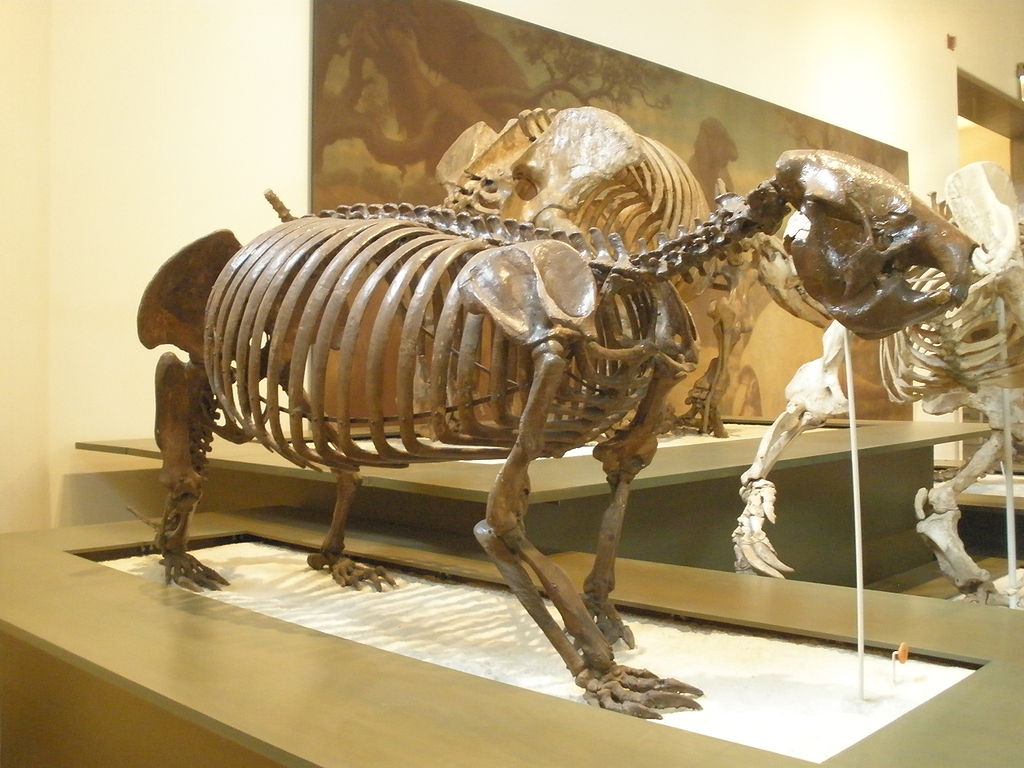
A close up of a skeleton of Diprotodon skull. Those front prominent teeth are clearly visible. (Image from here)

A close up of a skeleton of Diprotodon skull. Those goofy front teeth stick out beyond the mouth. (Image from here)

The first Diprotodon optatum fossils were found in New South Wales, in the early 19th century. Subsequent finds were so well preserved, many naturalists thought they were the remains of an undiscovered extant species. Many remains were around lakes and marshlands, presumably where the giant met its fate searching for water during droughts – maybe this was what sparked the myth of the bunyip and the association of Diprotodon with it.

Environmental change and Diprotodon’s fate are inextricably linked; the original climate of Pleistocene central eastern Australia facilitated luscious dense rainforests, vegetation-rich wetlands and some open savannah grassland further inland: this was the period when Diprotodon evolved around 1.6 million years ago. With so much delicious vegetation to graze on, these big marsupials were more than happy; these were creatures requiring somewhere between 100 to 150kg of herbs, grasses and fruits per day.

Trace fossils, those rare and underappreciated marks left by once living animals and trapped in the rocks for millennia, provide a glimpse into lives long gone. At Lake Callabonna, South Eastern Australia, there is an ancient trackway; a trackway made by many Diprotodon optatum. The muddy deposits of the lake preserved the tracks made by these giant marsupials, with indentations of the paws as they made their way across the mud. The trackway shows us that this group was moving in a herd. But it also tells of another tale. A tale of drought and death. In the Late Pleistocene, the climate started changing in eastern and southern Australia. The predictable and regular monsoons weakened and became erratic, resulting in reduced precipitation. Vegetation changed and many megafauna perished in their quest for water. At Callabonna there are the remains of many large and awkward creatures which became trapped in the soft, sticky lake mud and died.

Compared to a human, Diprotodon was a pretty big beast! (Image from here)

Compared to a human, Diprotodon was a pretty big beast! (Image from here)

Towards the Late Pleistocene, all Australian fauna had an added and lethal peril – humans. Diprotodon became extinct about 40,000 years ago, and it is certain the last of the line would have encountered humans who had crossed shallow seas and temporary land-bridges to reach Australia by around 50,000 years ago. Mysteriously, there is uncertain evidence for butchery of any Diprotodon optatum bones found to date; these lumbering herbivores surely would have made easy targets for hunters. Cuddie Springs in south-eastern Australia is one of the few sites that display evidence that extinct megafauna and humans were around at the same time, at the same place. Part of the bone assemblage found there comprised of a Diprotodon mandible and a tarsometatarsus from the large flightless bird, Genyornis newtoni, with a stone flake tool wedged between them. The surface analysis of the bones has so far proved inconclusive with regards to butchery, and there are also chronological and stratigraphical issues with the finds, so the jury is still out with regards to human hunting activity being a major causal factor of Diprotodon’s extinction. Other finds on Liverpool Plains, within the same area of Australia have come with claims of very late extinction dates of between 20,000 years and 6,000 years BP, although there is no revised or up-to-date substantiation of these claims. The ‘engraved’ Diprotodon tooth found at Spring Creek is equally controversial, with some considering it to be an indicator of human artistic agency, while others have suggested the grooves on it are gnaw marks from scavengers. The really interesting aspect of this find is the radiocarbon date – 19,800 ±390 years which may make the Liverpool Plains hypothesis not quite as unfeasible as it first appears.

It would appear, though, that most agree that populations of the mega-cuddly critter were already critically declining by the time humans arrived in Australia. It seems likely that a cluster of factors, ranging from fire-clearance of land by humans, to climate change all conspired against this unique animal in the late Pleistocene.

While it was considered briefly that some petroglyphs in south-eastern Australia may have represented the hairy little pads of Diprotodon feet, it’s mostly – and disappointingly – acknowledged the rock art is much too recent to show any detail of the creatures. If the descendants of ancient peoples of Australia found bones of huge creatures by inland lakes, they could very well have wondered what kind of monstrous animal these were, and linked them to the folk memory of herds of gently ambling Diprotodon, wandering the savannah and scrublands of Australia’s southern expanses. It could be easy to associate fireside scary stories with the gigantic bones, and give rise to the legend of the bunyip (I seem to remember much worse things being fabricated at Girl Guide field-trips!). We may never know, but we can look at the remains of Diprotodon optatum, and marvel at the biggest and perhaps cuddliest representative of Australian Pleistocene megafauna.

Written by Rena Maguire (@JustRena)

Further Reading:

Nice webpage with detail of Diprotodon from Melbourne Museum: click here.

Bednarik, R. (2010), ‘Australian rock art of the Pleistocene.’ Rock Art Research: The Journal of the Australian Rock Art Research Association (AURA) 27. 1.95. [Abstract only]

Brumm, A. and Moore, M. (2005). ‘Symbolic revolutions and the Australian archaeological record.’ Cambridge Archaeological Journal.  15 .2. 157. [Full article]

Dodson, J; Fullagar, R; Furby, J; Jones, R and Prosser,I. (1993), ‘Humans and megafauna in a late Pleistocene environment from Cuddie Springs, north western New South Wales.’ Archaeology in Oceania. 94-99.

Fensham, R.J. and Price, G.  (2013), ‘Ludwig Leichhardt and the significance of the extinct Australian megafauna’. Memoirs of the Queensland Museum – Culture. 7.2. 621- 632. [Abstract only]

Field, J, and  Wroe,S.. (2012), ‘Aridity, faunal adaptations and Australian Late Pleistocene extinctions.’ World Archaeology  44.1. 56-74. [Abstract only]

Field, J;  Wroe, S;  Trueman,C; Garvey, J and  Wyatt-Spratt,S. (2013),  “Looking for the archaeological signature in Australian megafaunal extinctions.” Quaternary International 285. 76-88. [Abstract only]

Fillios, M; Field, J and Charles, B. (2010), ‘Investigating human and megafauna co-occurrence in Australian prehistory: mode and causality in fossil accumulations at Cuddie Springs.’  Quaternary International  211. 123-143. [Abstract only]

Gorecki, P. P.; Horton, D; Stern, D and Wright, R. (1984), ‘Coexistence of humans and megafauna in Australia: improved stratified evidence.”Archaeology in Oceania.  117-119.

Huxley, T, H. (1862), ‘On the premolar teeth of Diprotodon, and on a new species of that genus.’ Quarterly Journal of the Geological Society 18. 1-2. 422-427.

James, E and Thompson,J.  (2014), ‘On bad terms: Problems and solutions within zooarchaeological bone surface modification studies.’ Environmental Archaeology. [Full text]

Murray, P. F., (1984), Extinctions down-under: A bestiary of extinct Australian Late Pleistocene monotremes and marsupials’ in Martin, P. S. and Klein, R. G. (eds) Quaternary Extinctions. Tuscon: The University of Arizona Press. 600-628. [Book]

Price, G. (2008), ‘Taxonomy and palaeobiology of the largest‐ever marsupial, Diprotodon Owen, 1838 (Diprotodontidae, Marsupialia).’ Zoological Journal of the Linnean Society 153.2. 369-397. [Abstract only]

Price, G. (2012), ‘Plio-Pleistocene climate and faunal change in central eastern Australia.’ Episodes-Newsmagazine of the InternationalUnion of Geological Sciences 35. 1  160.

Wright, R. (2012), ‘The Future of Australia’s Prehistoric Past.” Arts: The Journal of the Sydney University Arts Association. 12. [Full article]

Wroe, S, et al.  (2013), ‘Climate change frames debate over the extinction of megafauna in Sahul (Pleistocene Australia-New Guinea).’ Proceedings of the National Academy of Sciences 110.22. 8777-8781. [Full text]

Posted in Diprotodon | Tagged , , , , , , , , , , , , | 10 Comments

The giant owl and those giant claws

When we talk of megafauna we tend to think of the wild and wonderful mammals of the Pleistocene and Pliocene. Megafauna are all the fabulous big and familiar exciting beasts, like mammoths, giant sloths and sabre-tooths, right? Wrong. We don’t automatically think of avian taxa, but we really should as some of them are truly wonderful! Like this chappie here; Ornimegalonyx, the Giant Cuban Owl.

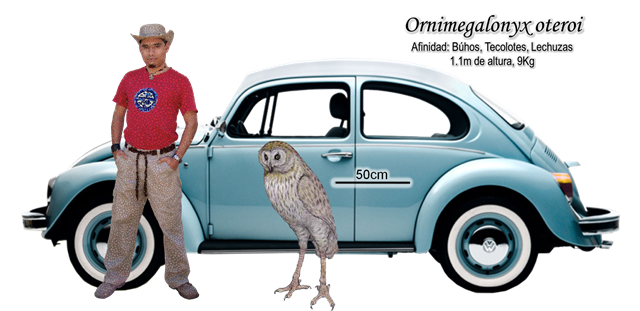
If Hedwig had been an Ornimegalonyx, I suspect Harry would not have had as much grief from Dementors! Standing at over a metre high, with ferocious claws (the Latin name translates as ‘The Bird of the Giant Claws’), this Pleistocene feathered friend was not to be messed with. Ornimegalonyx spp were the biggest owls ever to walk the earth. Remains of these giant flightless birds have been found at rare locations in Cuba. One of these was Sierra de Sumadero, which has since been declared an area of great scientific importance and is now protected, mostly due to the skeletal remains of Ornimegalonyx and other Pleistocene fossils.

That is one big owl. Ornimegalonyx superimposed next to a man and a car. (Image from here -

That is one big owl. Ornimegalonyx superimposed next to a man and a car. (Image from here. Worth clicking the link, to see this guy and this car used as a scale for other giant birds. Wonderful stuff.)

Islands are notorious for evolving odd permutations of species – just think of the tiny pygmy mammoths of Crete, and the cute, but odd, mouse goat, Myotragus. Specimens of Ornimegalonyx were initially mistaken as belonging to Terror Birds (Phorusrhacidae), a previously unknown variety of which had hopped from South America to Cuba. Ornimegalonyx had long legs, similar to Terror Birds, which helped it to run swiftly in pursuit of its prey rather than swooping down like a modern owl. This carnivorous bird was the equivalent of a speedy sight hound like a saluki or a greyhound. Those distinctive long legs gave the species an incredible elegance, although the small to medium sized mammals and lizards it predated on may not have fully appreciated it!

One of the debated arguments is that this bird had a capacity for a very limited flight – the keel, or breast bone, is not like that of the massive and earlier (Miocene) Terror Birds, the Phorusrhacideae. Put your hand flat on your chest over your heart, raise your other hand like you are taking an oath, keep it up, and move your arm towards your back, and then to your chest; the muscle you feel moving is the pectoralis muscle, the same muscle which is massive on birds that fly, so they have pretty big keels. Terror Birds didn’t fly, so their keel was relatively small. The Ornimegalonyx keel was a little larger in proportion leading some to believe it could have possibly flown. The fossil pollen and seeds associated with the bones indicates this big bird liked being among trees; it looks possible that the bird had developed a less than elegant or graceful means of attack – awkwardly fluttering its way into low branches, hunkering down with those big powerful legs then springing up in the air, and landing on ground dwelling animals below. Before you giggle at the idea of leaping leggy flightless owls springing out of trees hooting  ‘surprise!’, consider that it’s likely that  those claws were savage and powerful enough to take down juvenile ground sloths.

The Cuban ground sloth (Image from here)

The Cuban ground sloth Megalocnus rodens  (Image from here)

There’s a possibility this species of giant owl also inhabited other parts of the Gulf Coast, with the discovery at the Kingston Saltpeter Caves of Georgia of avian bones very similar to the Cuban specimens. It’s been presumed these US mainland flightless giants became victims to the overkill hypothesis – like the Cuban birds, their extinction occurs relatively late, some 8 to 10,000 years ago. We know there were humans active within the Gulf area during this period of time. But what of Cuba? As a country which once had incredibly strict censorship laws, most aren’t aware of the islands fabulous past and the sheer wealth of palaeontology and archaeology.

Cuban archaeology is one of the most exciting and mysterious of all the Caribbean. The Guanahatabey and Siboney cultures were just two of the (known) Palaeolithic peoples inhabiting the island just after the end of the Ice Age. This large island is also a perfect place to see environmental determinism in action; it has a clearly defined series of climate and sea-level changes throughout the Pleistocene. Lucky Cuban environmental archaeologists get the ultimate scientific playground of fabulous pollen, spores and artefacts, showing all kinds of changes brought on by everything from hurricanes to tidal floods – a palaeoenvironmental paradise indeed!

The extinction of Ornimegalonyx is possibly synchronous with the hunter gatherer cultures of the Guanahatabey people, who may have arrived between 8000 and 6000 years ago – there’s conflicting evidence, as there usually is within archaeology! As one of those argumentative archaeologists I am always excited and intrigued by human interactions with creatures of the late Pleistocene, and how people reacted to them. Imagine how frightening a walk in the warm Cuban forests would have been if you were a slightly built human of the Caribbean Archaic period, trying to get home to your camp fire, aware that these huge carnivorous birds were sitting in the dusk, shaded by trees… waiting…..always ready to spring out on the unsuspecting, with no differentiation between hominid or herbivore. These owls didn’t give a hoot – they were lethal predators.  If the last of the birds were co-habiting the island with humans, it would make a lot of sense that some of the late extinction could be due to hunting if the Archaic Period’s chronology started around 8000 years ago.  There may be other very likely factors though. Leaving the possibility of anthropogenic land-clearance to one side, there was a complex series of climate changes throughout the Pleistocene, which would have affected vegetation cover, and as a result forced the giant owls into increasingly remote areas, with less chance of successful hunting (a number of almost perfect, intact skeletons of Ornimegalonyx have been found in mountain caves). The remaining, but diminished forests of Cuba were safe again. The reign of the Giant Clawed Bird was over.

Its memory, however, may linger on. In North America there is the legend of the ‘mothman’: an urban legend which involves a terrifying entity which hides in trees, springing out to take down its prey. It is described as having huge eyes and this beasts head can turn almost 360º. Could this be the folk memory of Ornimegalonyx, from Cuban immigrants who moved up into North America, bringing tales of beasts from their homeland with them? Considering the modern Cibrony tribe classify themselves as the direct descendants of the Guanahatabey, it’s just about possible!

Written by Rena Maguire (@JustRena)

Further Reading:

Arredondo, O. (1958), ‘Aves gigantes de nuesto pasado prehistorico’, Divulga cientificas. 10-12. [Full article]

Arrendondo, O.  (1976),  ‘The Great Predatory Birds of the Pleistocene of Cuba’  in Olsonn, L ( ed) Smithsonian Contributions to Paleobiology number 27, Collected Papers in Avian Paleontology Honoring the 90th birthday of Alexander Wetmore Washington DC : Smithsonian Press  169-187. [Full article]

Arrendondo, O. (1982). ‘Les Strigiformes fosiles del pleistocene Cubano’, Paleontologia. 33-52 [Full article]

Badillo, J. (2003), ‘ A General History of the Caribbean’.  New York: UNESCO Publishing. 47-48. [Book]

Cooper, J and Peros, M. (2010), ‘The archaeology of climate change in the Caribbean’, Journal of Archaeological Science. 37. 1225-1232​. [Full article]

Garrido, O. H. and A. Kirkconnell. (2000), ‘Field Guide to the Birds of Cuba’, Ithaca, NY: Comstock Publishing Associates. 253-254. [Book]

Godfrey, L. (2013), ‘American Monsters ; a history of monster lore in America’, New York: Penguin Books. [Book]

Keegan, W. F. (1994), ‘West Indian archaeology: overview and foragers’. Journal of Archaeological Research. 2. (3). 255–284. [Abstract only]

Keegan, W. F. (1989), ‘Creating the Ghuanahatabey (Ciboney): the modern genesis of an extinct culture’, Antiquity 63. 373-379. [Abstract only]

Macphee, R. (1997), ‘Digging Cuba: the lesson of the bones’. Natural History. 106. 50–55. [Abstract only]

Olson, S.L. (1978), ‘A palaeontological perspective of west Indian birds and mammals’ in Gill, F ( ed) Zoogeography in the Caribbean. Philadelphia: Fulton Press. 99-119. [Full article]

Olson, S.L. (1984), ‘A very large enigmatic owl (Aves: Strigidae) from the late Pleistocene at Ladds, Georgia’ Contributions in Quaternary Vertebrate Paleontology: a volume in memorial to John E. Guilday. 1. 44-46. [Full article]

Santos, L. (2010), ‘New early tradition stone tool industries in Cuba’ in Kepecs,S; Curet, A and Corza, G.L (eds)  Beyond the Blockade: New Currents in Cuban Archaeology. Alabama; Alabama University Press. 47-70. [Full chapter]

Saunders, N. (2004), ‘The Peoples of the Caribbean’, Los Angeles: ABC Clio. 82-84. [Book]

Posted in Giant Cuban Owl | Tagged , , , , , , , , , , , , | 7 Comments

An elusive giant

For thousands of years traditional Chinese medicines have used all sorts of slightly bizarre ingredients. From enigmatic creatures of the animal kingdom, to the more toxic elements of arsenic and mercury, there is little that hasn’t been pounded, grounded and ingested. The more exotic the better the ‘medicinal properties’. You most certainly would see some oddities in a little old Chinese pharmacy; bottles of potions and powders, skulls and animal skins all lining the shelves. It is not the place you would expect to discover new species of extinct creatures.

For centuries ‘dragon bones’ have been collected from the Chinese countryside, crushed down to a fine powder, and used to treat a surprisingly large array of aliments. Here’s a jolly description of preparing the medicine from around 400AD (from Shapiro, 1974. p.33):

“Wash the bone twice in hot water, then reduce it to powder and place it in backs of thin stuff. Take two young swallows and, after removing their entrails, stuff the bags into the swallows and hang them over a spring. After one night take the bags out of the swallows, remove the powder and mix it with a preparation for strengthening the kidneys.”

Very specific. And perhaps not really something you should try yourself. In the early 1900s, powdered dragon bones were used to treat a whole range of different, very unrelated, ailments including, gallstones, malaria, liver disease, and even paralysis. These dragon bones, of course, are fossils. Discovered by farmers and villagers in the fields and limestone caves around the Chinese capital, Beijing (also known as Peking), they were sold to pharmacies where they were prepared into ‘medicine’.

In the early 1900s, prospecting geologists from Europe and America moved to China to map the layers of rock across the vast landscape. Searching for clues to map coal and ore layers, some became aware of these medicinal pharmacies and that they housed fossils. And fossils could be linked to certain outcrops. One geologist, Johan Gunnar Anderson, followed a trail from the pharmacy, to local villages, back to the source of the bones; a limestone cave filled with sabre-tooth cats, bears, rhinos, and hyenas. The cave also held the famous Homo erectus specimens, named Peking Man. The fascinating tale of Peking Man and the sad loss of the bones can be read in more detail here.

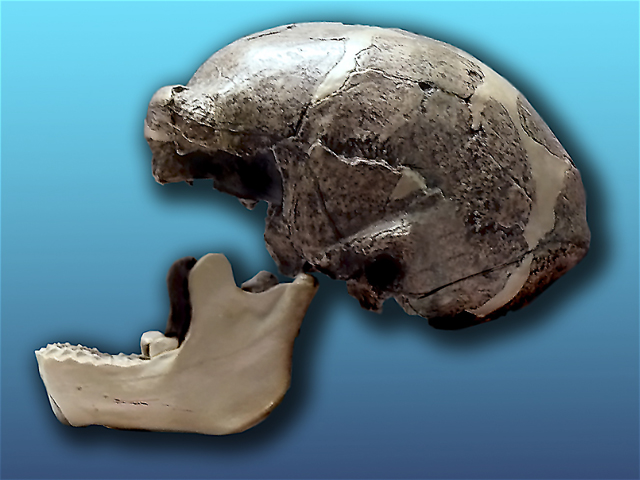
A cast of the skull of the only known (Image from here)

A cast of the skull of Peking Man (Homo errectus) discovered in 1929. The original fossils were lost during the Second World War. (Image from here)

For now, there were bigger things lurking behind the counters in those Chinese pharmacies. Bigger fossils that were once thought to belong to dragons. Fossils which were even a thought to belong to a giant species of human.

Following in the footsteps of his predecessors the German palaeontologist, Ralph von Koenigswald, scoured Chinese medicine shops and examined their piles of dragon bones before they were ground down to dust. He was searching for more Homo erectus fossils to potentially point to new sites. Amongst the many different fossils he saw, von Koenigswald discovered a molar. A massive molar. He spent 4 more years searching the little obscure pharmacies, and was rewarded with three more massive teeth. These molars were enormous. The teeth had features which were very similar to orang-utan teeth, leading Von Koenigswald to propose these fossil teeth belonged to a new species of extinct ape, which he named Gigantopithecus (literally meaning ‘giant ape’).

At the height of the Second World War, von Koenigswald was held as a prisoner of war on the Island of Java. Luckily, his four teeth were safely buried in a garden. With von Koenigswald and his original fossils safe, but both temporarily out of the picture, a colleague at the American Museum of Natural History, the anthropologist Franz Weidenreich, examined casts of the four teeth. Weidenreich theorised they were the teeth of an extinct species of human. An extinct species of giant human. The theory lasted for nearly twenty years, with Weidenreich even writing a fairly convincing book, Apes, Giants and Humans. For a while, these four teeth were evidence that a giant human thrundled across the Asian landscape, and was the ancestor of modern Asian and Australian humans.

In the 1950s, Chinese palaeontologists sought to find more fossils of these mysterious giants. Teams headed around the provenance in search of the very source of these fossils, talking to villagers and farmers for possible leads. One team found a number of teeth in-situ in reddish cave sediment; the first fossils found linked to stratigraphy. Another team had more luck and discovered over a thousand teeth and a fossilised jaw. Gigantopithecus was a giant ape, not a human ancestor.

An enormous cast of a Gigante black lower jaw. (Image from here)

A cast of the enormous Gigantopithecus blacki lower jaw. (Image from here)

Three species of Gigantopithecus have been discovered so far: G. blacki, G. bilaspurensis and G. giganteus. Fossils of this Genus have been found across Nepal, China, India and Vietnam, and in sediments which suggest the group originates around 9 million years ago. These were a very successful group of apes. The largest, and the first species discovered in that Chinese medicine shop, was Gigantopithecus blacki. This ape had some pretty impressive statistics: it may have been around 3 meters tall, and weighed as much as three gorillas. This was the largest ape (so far discovered) ever to have walked the Earth.

As with any extinct creature, clues to the size and lifestyle can be inferred from the fossils (and trace fossils if they exist). Current fossils finds of Gigantopithecus blacki suggest a slightly restricted geographical range to China and Vietnam. With no post cranial bones found so far, and only a handful of jaws and a few thousand teeth, can we really provide an accurate description of this giant, let alone suggest how it lived?

Surprisingly, we can get an awful lot of information from these fossils.

The teeth and jaws show that this creature was an ape. Unmistakably an ape. But an ape of gigantic proportions. We can make a fairly good guess to the size of this animal based on the size of the jaws; it is highly unlikely that this was an average sized ape with a ridiculously oversized head. Keeping it simple, researchers have used measurements from orang-utan skulls to work out the size of G. blacki’s skull, by scaling upwards. (It is thought that orang-utans were close relatives, and the two species had similar feeding habits.) From the estimated head size, you can work out the body size, the head to body ratio of 1:65 (using the gorilla as the model assuming G. blacki didn’t swing through threes like an orang-utan). So with a little maths, and tweaking of ratios to best fit how this big ape would have moved, researchers came up with the height and weight. Admittedly, this method is based on a skull size which is calculated by a very small number of jaws which wouldn’t provide an exact average and we have no idea how G. blacki moved. But from what we have, the estimates are not too bad. More complete fossils will provide more precise data.

A somewhat terrifyling silhouette of Gigantopitecus blacki (Image from here)

A somewhat terrifying silhouette of Gigantopitecus blacki to portray the creatures size. (Image from here)

The teeth themselves, and there are a lot, provide some really interesting information. The flat surfaces, and the low cusps, of the molars and premolars suggest that it was chewing a lot of tough plant material, such as bamboo. Firing beams of electrons at the teeth with a Scanning Electron Microscope (SEM) shows the smallest scratches, and even tiny particles on the teeth. The SEM highlighted little phytoliths on the teeth, which are tiny secretions made by plants and they remain after the plant has long gone. With phytoliths present and some actually embedded in the surface of a couple, Gigantopithecus blacki was definitely eating grasses. Although these small silica blobs don’t give the species of plant, it is more than likely that they were from bamboo; this grass was in such an abundance, more than enough to sustain the appetite of such a large herbivore.

The sex lives of this big ape can also be worked out by the teeth. A very detailed study of 735 teeth grouped them into two different size ranges, big teeth and smaller teeth. These are not the teeth of different species; this size range is typical for species with sexual dimorphism: male Gigantopithecus blacki were much larger than the females, similar to gorillas today. Male gorillas are much larger than females, and will have several in their harem. Possibly G. blacki had a similar sex life with males using their larger size to compete for females and hold a harem.

Our own relatives, Homo erectus would have seen Gigantopithecus blacki. Two caves in China (Jianshi Cave and Longgupo Cave) and one in Vietnam (Tham Khuyen Cave) have revealed fossils of both G. blacki and Homo erectus. Radiometric dating at Tham Khuyen places the fossils there at around 500,000 years ago and Longgupo Cave has produced an even older date between 1.5 and 1.9 million years ago. Across Asia, one species of human co-existed with these giants for over a million years. But then, around 100,000 years ago, Gigantopithecus blacki, the last in the line of these apes, became extinct. Their demise may have been dues to a series of unfortunate events. At a similar time, giant pandas had moved to the same range, competing for the same food. Another species of ape, Homo sapiens was fairly new to the scene and may have even hunted G. blacki for food (there is no direct evidence for this, but primate meat is a large source of protein in Africa). Their specialist diet may have provided the fatal blow: bamboo are known for their periodic mass die offs, and take the food source away from a specialist eater and it will be in trouble.

Currently no complete skeletons, or even post cranial bones have been found. The acidic soil of forests, along with the many different types of minibeasts living there, break down flesh and bones fairly rapidly leaving nothing left (this is why the fossil record for chimpanzees, gorillas and other forest dwelling animals is so poor). Finding teeth and jaws in caves does not mean these were living in the caves. It is more likely they represent individuals who were killed, or scavenged, and dragged into the caves. More fossils will give us more information on these giants.

Written by Jan Freedman (@Jan Freedman)

Further Reading:

Nice post with detail by Eric Pettifor: From the Teeth of the Dragon – Gigantopithecus blacki

Another good post by Russell Ciochon: The Ape that was

Coichon, R, et al. (1990) ‘Opal phytoliths found on the teeth of the extinct ape Gigantopithecus blacki: implications for paleodietary studies’, Proceedings of the National Academy of Sciences. 87. 8120-8124. [Abstract only]

Ciochon, R, et al. (1996), ‘The co-occurrence of Homo erectus and Gigantopithecus blacki from Tham Khuyen Cave, Vietnam’, Proceedings of the National Academy of Sciences. 93. 3016-3020. [Full article]

Olenjniczak, A. J, et al. (2008), ‘Molar enamel thickness and dentine horn height in Gigantopithecus blacki‘, American Journal of Physical Anthropology. 135. 85-91. [Full article]

Shapiro, H, (1974), ‘Peking Man. The Discovery, Disappearance and Mystery of a Priceless Scientific Treasure’, Book Club Associates, London. [Book]

Weidenreich, F, (1946), ‘Apes, Giants and Humans’, University Chicago press. [Book]

von Koenigswald, G. H. R. (1952), ‘Gigantopithecus blacki von Koenigswald, ‘A giant fossil hominoid from the Pleistocene of Southern China’, Anthropological Papers of the American Museum of Natural History43. 295-325. [Abstract only]

Posted in Gigantopithecus | Tagged , , , , , , , , , , , , , | 6 Comments

A home on the range

Imagine an igloo. Now picture it with a crash helmet poking out the front, and a medieval spiked club sticking out the back. Elevate that image on four stubby legs, convert it into bone and flesh and you have a good approximation of a glyptodont. For my money the weirdest extinct animal that humans encountered on their global tour. Relatives of sloths and anteaters, glyptodonts are grouped with them in the taxonomic superorder Xenarthra due to shared features such as a lack of tooth enamel, extra articulations on their vertebrae, and (presumably) males with internal testicles.

Glyptodon skeleton in the MNHN in Paris, image by @DeepFriedDNA

Glyptodon skeleton in the MNHN in Paris, image by @DeepFriedDNA

Reconstruction of Glyptotherium sp. by Sergiodlarosa

Reconstruction of Glyptotherium sp. by Sergiodlarosa

Found all over South America, having evolved in isolation there during its long history as an island continent, the glyptodonts ranged as far north as South Carolina during the Pleistocene. At least three genera are known to have survived up to the late Pleistocene: Panochthus, Glyptodon(Glyptotherium), and Doedicurus. Despite superficially looking identical, these three genera packed their punches in pretty different ways. Glyptodon had a tail made from concentric rings of spiky bone with a fringe of points around its carapace. Doedicurus had a long cylindrical tail club with enigmatic circular depressions over the end (probably indicative of enormous keratin horns that grew during life). Panochthus was a mix of spiky tail rings and a cylindrical, horny, club. This was the business end of the glyptodonts and ensured that an adult probably had no natural predators. However, the young ones were hunted- there is a famous subadult Glyptotherium texanum skull from Southeastern Arizona that has two neat, elliptical holes punched in the top. They exactly match the only predator with elliptical canines from that timeframe- Smilodon fatalis. Interestingly, this method of attack is sometimes used by the extant jaguar (Panthera onca), which will kill capybara and other medium-sized prey by piercing the braincase through the ears. Could jaguars have honed this method on another, now extinct, species that formerly shared its range?

With such powerful predators around, growing glyptodonts would have been glad of their mammalian thagomizers. It seems likely that as well as a defensive weapon, the tail clubs were also used in intraspecific competition. Some carapaces show traces of damage that match the size and shape of another animals tailclub. Researchers have calculated that a single blow from the tail of one species, Doedicurus clavicaudatus, could produce 60 kiloNewtons of force (by way of comparison, 4 kiloNewtons is enough to fracture an average human femur). There is even evidence that the tail evolved to produce an offensive weapon analogous to a baseball bat, with a centre of percussion at the exact point where the spikes began, allowing it to transmit maximum force with each blow.

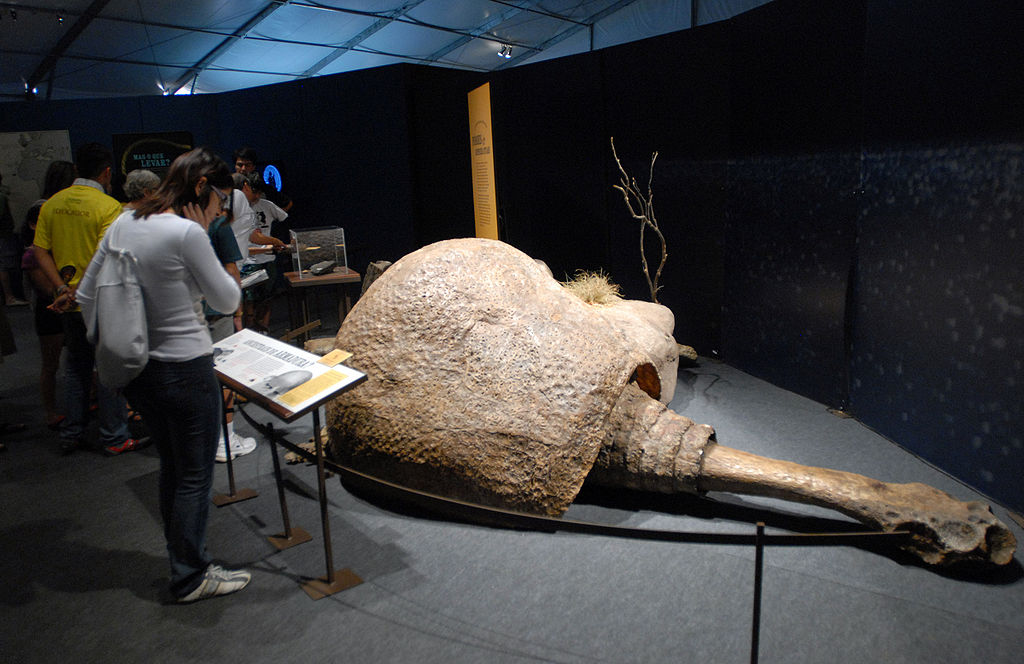
Fossil of Doedicurus clavicaudatus, showing the tail club with spike positions

Fossil of Doedicurus clavicaudatus, showing the tail club with spike positions. Image from here

The glyptodonts appear incredibly weird to modern eyes. How might they have been viewed by the paleoindians who encountered them? There is surprisingly little “good” archaeology on interaction between them and man. However, some less than charming vignettes are suggested. The famous palaeontologist Florentino Ameghino claimed to have found two examples of the carapaces of glyptodonts used as temporary shelters! He recounts finding the detritus of occupation: flints, cutmarked bones, and charcoal around a glyptodont shell excavated close to the town of Mercedes, by Buenoes Aires in Argentina. He surmised that the glyptodont had been hunted by people, who then dug a small pit and roofed it with the carapace to provide shelter on the treeless pampas. There is also evidence of the use of glyptodont osteoderms (the hexagonal bones that make up the carapace) as grave offerings (at the site of Arroyo Seco 2 in Argentina).

Such an incredible creature, and it stopped you getting sunburnt too.

Written by @DeepFriedDNA

Further Reading:

http://www.azgs.az.gov/arizona_geology/spring10/article_feature.html

http://www.wired.com/2011/02/extra-armor-gave-glyptodon-an-edge/

Marquis de Nadaillac (1884), “Prehistoric America” [Book]

Gillette, D. & Ray, C. E. (1981) “Glyptodonts of North America” Smithsonian Contributions to Paleobiology #40 [Full Article]

Fariña, R. E., Vizcaino, S. F., & De Iullis, G. (2013) “Megafauna: Giant beasts of Pleistocene South America” [Book]

McNeill Alexander, R., Fariña, R. E., & Vizcaino, S. F. (1999) “Tail blow energy and carapace fractures in a large glyptodont (Mammalia,Xenarthra)” Zoological Journal of the Linnean Society 126, 41-49 [Abstract]

Blanco, R. E., Jones, W. W., & Rinderknecht, A. (2009)”The sweet spot of a biological hammer: the centre of percussion of glyptodont (Mammalia: Xenarthra) tail clubs” Proceedings of the Royal Society, Series B 276, 3971-3978 [Abstract]

Huxley, T. H. (1865) “On the osteology of the genus Glyptodon” Philosophical Transactions of the Royal Society of London 155, 31-70

Politis, G., & Gutiérrez, M. (1998) “Gliptodontes y cazadores-recolectores de la región pampeana (Argentina)” Latin Am Ant 9, 111–134

Posted in Glyptodon | Tagged , , , , , , , , , , , , , | 13 Comments

Antique water horses

The year 2014: An enormous 64 foot long hippopotamus makes its way slowly down the River Thames. Longer than a double decker bus, it’s big soft eyes softly peer out of the water welcoming onlookers as it slowly glides past.

Created by the Dutch artist, Florentijn Hofman, this giant wooden art instillation was made as part of the Totally Thames festival, and someone has been rather witty and christened it ‘HippopoThames’. But this oversized, flat bottomed piece of art is not in isolation. Part of the festival includes a talk by Madame Trowel Blazer herself, Victoria Herridge, about the prehistoric Thames and the real hippopotamuses that lived there around 125,000 years ago.

Along with giant Straight Tusked elephants (Palaeoloxodon antiquus), an extinct type of rhinoceros (Stephanorhinus sp.), and cave lions (Panthera spelaea), hippopotamus were very at home in Britain 125,000 years ago. These were the modern hippos which are still around today, Hippopotamus amphibius. From Trafalgar Square, all the way up north to Derbyshire, during this rather warm interglacial period, Britain’s lakes and rivers were teeming with these giant mammals. There was another species of hippo that once lived in Britain, and Europe. An extinct hippo, that was the largest river horse ever to have existed.

A truly gorgeous fossil skeleton of Hippopotamus antiquus at Florence Palaeontology Museum (Image from here)

A truly gorgeous fossil skeleton of Hippopotamus antiquus at Florence Palaeontology Museum (Image from here)

Fossils of the European Hippopotamus (Hippopotamus antiquus) first appear in sediments 1.8 million years old, at the dawn of the Pleistocene. This big beast is slightly younger than the still extant Hippopotamus amphibius whose fossils are found dating to around 2 million years ago. As the name suggests, the European Hippopotamus was common across Europe during the Pleistocene, from Spain, Germany, Greece and Britain.

Along with a few minor differences in the teeth, the size tells the species apart from one another; H. antiquus was much larger than its cousin, around 1 and a half times bigger. It is unsure why this species grew bigger than the hippos you see today. With more resources around to support animals they can get bigger. Equally, it may have been through sexual selection: modern hippos today live in a pod of up to 30 within a territory of river with one male looking after it. Males will fight for territory. It may be that the European Hippo had larger male bulls which spread through the population. Whatever the reason, this was a very successful species and was around for almost 2million years. .

This big hippo first appears in Britain during the early Middle Pleistocene, around 860,000 years ago until around 400,000 years ago. Named after the site, Cromer in Norfolk, where lots of fossils from this time were found, the Cromerian is one of the more famous early Pleistocene times. This was mainly a warm interglacial time (although as typical of the Pleistocene, it was not many years of warmth; the climate dipped and peaked as glaciers melted and grew).

This was a different time in British prehistory, with giant Steppe Mammoths and Straight Tusked elephants stomping around, the lesser known sabre tooth, Homotherium, perched, waiting for its next meal, and a strange rhinoceros (Stephanorhinus hundsheimensis) munching its way through the low lying bushes. The English Channel was non-existent. Instead fertile grasslands spread from the south coast to mainland Europe. Animals migrated freely back and forth up into Britain, and back down again to suit their needs.

With extreme cold glacial times following the Cromerian, the European Hippopotamus moved out of Britain, never to return. It would be another 250,000 years before a hippopotamus were to waddle into Britain again.

There is an odd, possible synonym to our big hippo; Hippopotamus major. This hippo lived around the same time as our European Hippo, and at some of the same sites. There is not a lot of information is out about this species; if it is a separate species. It is possible it is a sub-species (like the Siberian Tiger is a sub species of tiger). It may even be the same species as H. antiquus. With not a lot of fossils to assess and compare, it is difficult for us to determine.

A beautifully simple illustration of Hippopotamus major, from the classic book 'Men of the Stone Age'. (Image from here)

A beautifully simple illustration of Hippopotamus major, from the classic book ‘Men of the Stone Age‘. (Image from here)

Hippopotamus antiquus survived in Europe for many years, happily living in Italy, Greece, and Germany. It is a slight irony, that this, the biggest species of hippo spawned the smallest species: the extinct Cretan Dwarf Hippopotamus (Hippopotamus creutzburgi) which evolved a much smaller size to survive on an island.

We are unsure as to the main reason for it extinction; possible changes in environment, or a fall in temperatures. There were extreme climatic changes throughout most of the Pleistocene and the European Hippo appears to have become extinct at the same time of many of the other mega-herbivores. This was the biggest species of hippo to evolve, and was a very successful animal throughout Europe.

The Eruopean Hippo would be a delight to see today. Bigger than any hippo you would see in Africa, this would be a beast you wouldn’t disturb. Perhaps Florentijn Hofman and his giant wooden hippo should begin touring through Europe, retracing the steps of this lost giant.

Written by Jan Freedman (@JanFreedman)

To find out more about the other hippopotamus that lived in Britain, click here.

Further Reading:

Mazza, P. P. A. (2014), “If hippopotamuses cannot swim, how did they colonize islands?”, Lethaia, in press [Article]

Mazza, P. P. A. & Bertini, A. (2012), “Were Pleistocene hippopotamuses exposed to climate-driven body size changes?”, Boreas, 42(1), pp. 194-209 [Article]

Stringer, C. (2006), ‘Homo britannicus. The incredible story of human life in Britain’, Penguin. [Book]

Stuart, A. J. & Lister, A. M. (2001), ‘The mammalian faunas of Pakefield/Kessingland and Corton, Suffolk, UK: evidence for a new temperate episode in the British early Middle Pleistocene”, Quaternary Science Reviews, 20. pp. 1667-1692. [Full article]

van der Geer, A. A. E. Anastasakis, G. & Lyras, G. A. (2014), “If hippopotamuses cannot swim, how did they colonize islands: A reply to Mazza”, Lethaia, in press [Article]

Posted in Hippopotamus | Tagged , , , , , , , , , , , , , , , , , , | 2 Comments

The hyena that was overshadowed by a Tyrannosaurus rex

One of the wonderful things about being part of Twilight Beasts is that we are discovering new beasts all the time. Many beasts are familiar, like mammoths and sabretooth cats. Others not so much, like the unbelievably cute Great Jerboa, or the strange pig-like peccaries. (Astonishing as it may sound, even woolly rhinoceros are not that well known to some: I have taken woolly rhinoceros bones out for a big museum event, and having spoken to over 500 people, I counted 10 who knew what a woolly rhino was.)

Reading one of our recent guest posts, I came across a beast I didn’t recognise and when I looked into it, I got a little excited! Elegantly written, the post tells us about the pretty nippy pronghorn antelope which only just snuck through the end of the Pleistocene. One of the things that helped it slip through while many others fell, was their speed. These were fast animals, reaching speeds of up to 80km per hour (around 50 miles per hour). Some suggest that speedy predators may have given this antelope a good reason for evolving to be zippier than most. Possibly. There were a few fast predators around, including the American cheetah, and before the dawn of the Pleistocene, a few sabre-tooth cats. One species of carnivore in particular jumped out at me. A species that I didn’t think would be there.

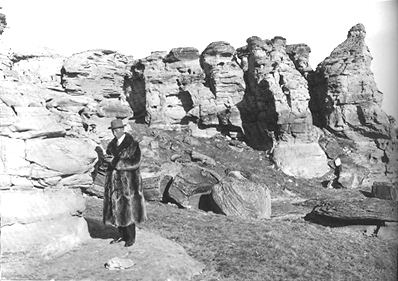
I first heard of Barnum Brown fairly recently on the great, award winning, educational children’s programme Dino Dan. Barnum Brown was a palaeontologist in the late 1800s and early 1900s. He was famous for his discovery of the first Tyrannosaurus rex remains in 1902, which were found in the Hell Creek Formation, Montana.

Perhaps slightly overdressed? Barnum Brown doing field work in Montana in 1914. (Image from here)

Perhaps slightly overdressed? Barnum Brown doing field work in Montana in 1914. (Image from here)

A couple of years later Brown collected some fossil mammal remains from a fissure which miners discovered at Val Verde Copper Mine in Arizona in 1901. He labelled the bones and packed them off to the United States National Museum (which would become the Smithsonian Institution). Brown was due to re-examine these fossil, and if the infamous T. rex hadn’t taken the public by storm, he may have had the chance.

It took twenty years before anyone pried open the wooden crate full of fossils. It was the curator, Oliver Perry Hay who peered in unleashing one fossil that would stir up debates for decades to follow. The fossils found in the mine were of Pleistocene animals and some were familiar, like pronghorn antelopes and squirrels. One jaw had the label ‘cat’ with it. Comparing the jaw with other cat species, and other carnivores, Hay concluded that it belonged to an extinct hyena. He named it Chasmaporthetes ossifragus which translates to ‘he who saw the canyon’.

This was a huge discovery. A species of hyena living in America?! Before then hyenas had been found in other parts of the world, but not in America. (It has always been fascinating that the more recent cave hyena never followed mammoths or reindeer into America.) This was an exciting fossil.

The Genus Chasmaporthetes evolved some time towards the end of the Miocene around 7 million years ago. It is unsure if this group evolved in Africa, Europe or Asia. 9 different species belonging to this Genus have been discovered so far, including a relatively new one named in 2013 which lived around 4million years ago on the Tibetan Plateau. It was a very successful group of hyenas. In fact species have been found across Africa, in Europe, China and North America, giving it a very large geographical distribution.

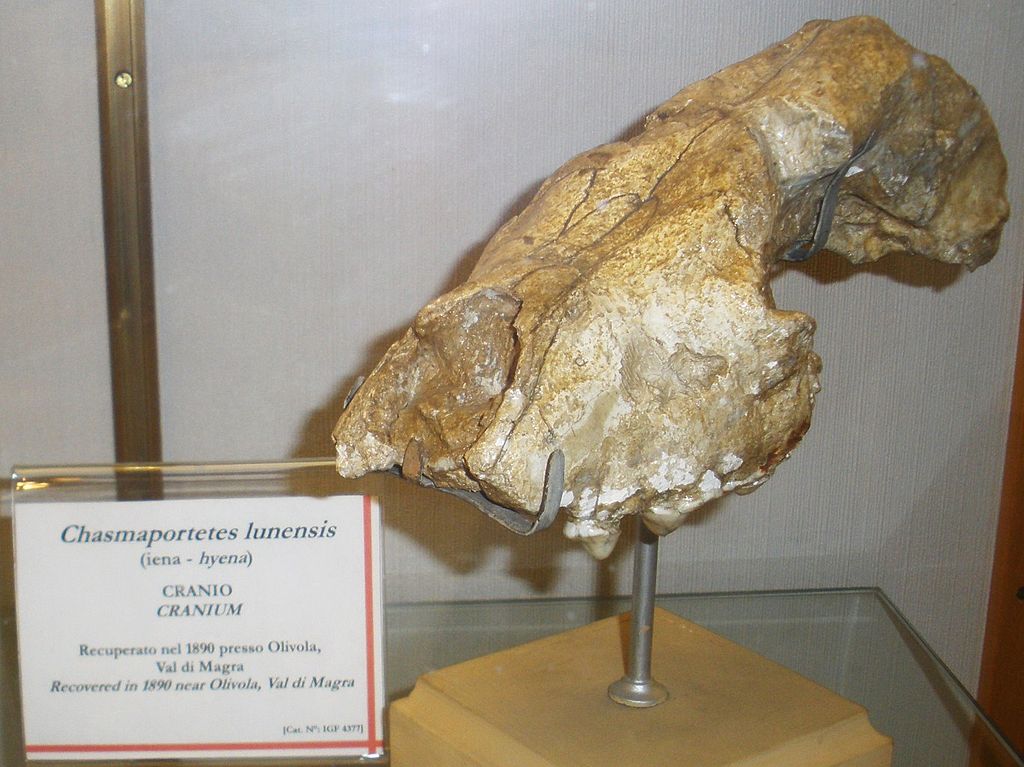
A beautifully preserved skull of Chasmaporthetes lunensis found in Italy. (Image from here)

A beautifully preserved skull of Chasmaporthetes lunensis found in Italy. (Image from here)

Chasmaporthetes ossifragus was the only species of hyena (so far as we know) to have stepped its paws over the Bering Land Bridge into North America. This ‘bridge’ linked the Eastern tip of Siberia to the Western tip of Alaska when sea levels were lower. And once here, around 5million years ago, this hyena moved south. Fossils have been discovered in Arizona, Texas, Florida, and Mexico. Remains, however, are nowhere near as abundant as the European cave hyena where one site may yield dozens of beautifully preserved specimens. The North American specimens are sparse, and fragmentary.

This American hyena is also known as the American hunting hyena, or the running hyena. Not the most elegant of common names, and also a little misleading: although commonly perceived as scavenging ugly beasts, the living species of hyenas today do hunt, and they also run (and they are beautiful animals too). But there is method in the madness. Although fairly few fossils have been found, fossil bones from other species in this Genus show these hyenas were more closely related to the dog-like hyenas (like the extant, but fairly unknown aardwolf) rather than the bigger, robust species. The bodyform appears to have been long, somewhat slender, similar to that of a cheetah. The teeth were sharp, great for slicing flesh, but not a thick as it’s bone crunching cousins.

The extant Aardwolf () one of the lesser known species of living hyena (Image from here)

The Aardwolf (Proteles cristata) one of the lesser known species of living hyena. More slender, and somewhat elegant in appearance. Our American hyena was a close relative, and would not have looked too dissimilar.  (Image from here)

A fast, fierce hyena, Chasmaporthetes ossifragus was a top predator on the North American grasslands. Other fossils associated with the American hyena include horses, camels, deer, giant marmots and pronghorns: plenty of prey for an active predator. The North American savannah was full of predators, with other ferocious beasts looming such as the Pliocene scimitar toothed cat (Homotherium) and the dirk toothed cat (Megantereon). There was also the America cheetah, and the hugely robust canid Borophangus diversidens which, ironically, superficially resembled the bigger hyenas from Africa in body shape, and are known as the bone crushing dogs. It was a competitive world for animals at the beginning of the Pleistocene.

Most of the competition vanished as the Pleistocene moved into full swing. There were no bone crushing dogs around, or scimitar tooth cats. The American hyena was doing quite well. Hunting other animals, possibly including pronghorns, it was at the top of the food chain. Current evidence points to its extinction in North America around 780,000 years ago based on the youngest fossil evidence so far found. It appears the erratic climate that was the signature of the ever changing Pleistocene Epoch, was to blame for their extinction: changing climates and temperatures replaced the open grasslands to more covered forests.

Hyenas are a misunderstood species that are portrayed as rather ugly, scavenging beasts. Hyenas are one of my favourite Twilight Beast because they are awesome. They had an enormous diverse range of different species living in the past, ranging all across the northern hemisphere. Not far from where I work, around 35,000 years ago, hyenas were running around, dragging back carcasses to their caves. These amazing animals were living in Britain until pretty recently. What’s even more incredible is that one of their cousins was very happily living in North America.

Written by Jan Freedman (@JanFreedman)

Further reading:

Nice overview of the Ameican Hyena on two blogs:

The American Hyena (Chasmaporthestes ossifragus)
The Hyena who saw the canyon

Anton, M, et al. (2006), ‘A complete skull of Chasmaporthetes lunensis (Carnivora, Hyaenidae) from the Spanish Pliocene site of La Pueble de Valverde (Teruel)’, Estudios Geologicos62. (1), 375-388. [Full article]

Galiana, H & Frailey, D, (1977), ‘Chasmaporthetes kani, New species from China, with remarks on Phylogenetic relationships of Genera within the Hynaenidae (Mammalia, Carnivora)’, American Museum Novitates, No. 2632. p.1-16. [Abstract only]

Hay, O. P, (1921), ‘Descriptions of species of Pleistocene Vertebrata, types or specimens of most of which are preserved in the United States National Museum’, Proceedings of the United States National Museum. 59:599-642. [Book]

Kurtén, B, (1968), ‘Pleistocene mammals of Europe’, Weidenfeld and Nicolson.[Book]

Kurtén, B, (1980), ‘Pleistocene mammals of North America’ Columbia University Press. [Book]

Kurtén, B & Werdelin, L, (1988), ‘A review of the Genus Chasmaporthetes Hay, 1921 (Carnivora, Hyaenidae)’, Journal of Vertebrate Palaeontology(1), p.46-66. [Full article]

Posted in Hyena | Tagged , , , , , , , , , , , , , , , , , , | 4 Comments

Ghosts of the desert

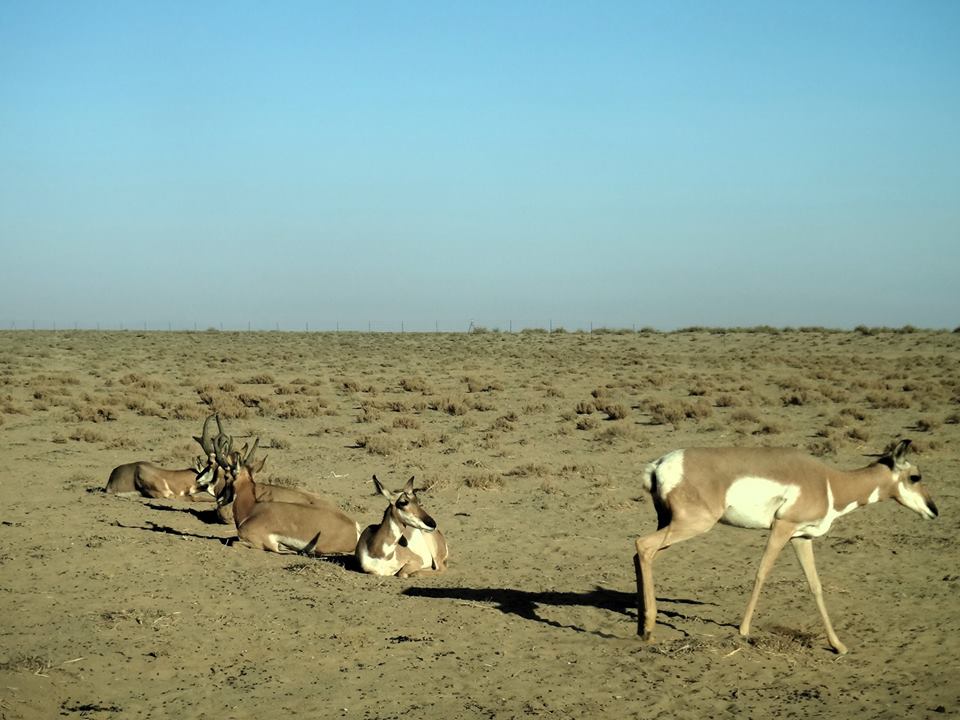
pronghorn along with a photo of pronghorns in a reserve in Baja California (credit for Gerardo Garibay Melo)

Beautiful, sleek and elegant resting pronghorns in a reserve in Baja California. (Image credit Gerardo Garibay Melo)

The sun sets over the plains of Vizcaíno Desert, Baja California península, Mexico; a vast desert watered by fog from the Pacific Ocean. A group of peninsular pronghorn antelope (Antilocapra americana peninsularis) stretch and lay about in the cool afternoon, and a few, spooked by a rustle in the bushes, dash by at speeds of over 80 kph. The fastest land animals in the Americas, adult pronghorns (A. americana) can easily outrun any potential modern-day predators, such as coyotes or grey wolves. Their physiology hasn’t changed significantly in the past 10,000 years, and their vestigial speed is a remainder of the deep past millions of years ago, when they outran Protocyon – a Pleistocene pack-hunting canine – and American cheetahs (Miracinonyx sp.). Today, the pronghorn is a survivor from a distant world, when huge extensions of North America were vast savannas populated by lions, cheetahs, and antelopes.

Several million years ago, several genera of Antilocapridae dashed across the North American grasslands with other ungulates like horses, tapirs, peccaries, camels, muskoxen, and several species of bison. Their predators were equally diverse and some quite formidable. American cheetahs, large, swift felines, preyed on the ungulates of the North American grasslands and pronghorns may have been among their preferred delicacies. It’s thought that the pronghorn’s exceptional speed is the result of predation by Miracinonyx: their top speed near 100 kph are much more than capable of outrunning extant predators like coyotes, grey wolves or cougars. American cheetahs were likely the principal agents of selection that prompted the evolution of the pronghorn’s extraordinary running speed.

Cheetahs were far from the only twilight beasts that threatened ancient pronghorns: Protocyon and hyenas (Chasmaporthetes ossifragus) may have pursued adult pronghorns in chases like those now carried out on gazelles by African wild dogs. The giant short-faced bear (Arctodus spp.), possibly the largest carnivorous land animal to have lived in North America, may have ambushed or stalked pronghorns. Saber-toothed cats (genera Megantereon, Smilodon, and Homotherium) were adapted to hunting large, slow, prey, but pronghorns may have been taken occasionally. The dire wolf (Canis dirus), a large Wolf with powerful jaws, was probably a slow scavenger, but may have posed a threat to fawns or weak adults. Canis lepophagus, a Pleistocene ancestor of the coyote, was likely a major predator of pronghorn fawns, much as coyotes are today.

By around 12,000 years BP, there was an additional predator in North America. Homo sapiens had arrived from Beringia.

The world has changed radically in the last 5000 years: sea levels have risen, much of North America has become hotter and drier, and the giant mammals of the Ice Age are mostly long gone. Pronghorns, however, are one of the few survivors of another world, where cheetahs and mammoths roamed what is now northern Mexico. Hunter-gatherers, such as the creators of the Comondú archaeological complex (probably ancestors of the Cochimí people), were well established in the deserts and coasts of Baja California. They left few material remains, but the Comondú artists left behind a prolific number of cave paintings, dating from around 7,500 B.P. until around 600 years ago; they make up the oldest rock art tradition in the Americas, which lasted for millennia. Murals several metres high show humans, anthropomorphic figures, sea animals and desert fauna such as pronghorns, mule deer (Odocoileus hemionus), and bighorn sheep (Ovis canadensis). Although their meaning is obscure, some archaeologists suggest that they had ritual purposes linked to ancestor worship or hunting magic, perhaps as life became more difficult due to overhunting or the general desiccation of western North America.  Pronghorns, along with other large mammals and anthropomorphic figures, appear in several murals in the Sierra de San Francisco, Baja California Sur, Mexico.

Beautiful cave art from Baja (Image from here)

Beautiful cave art from Baja Californian Sur State in Northwest Mexico. Can you spot the elegant pronghorns leaping? (Image from here)

A few thousand years have passed since the Baja Californian artists painted the Great Murals of the Central Desert. The Spanish came, native people died in huge numbers in plagues and famines, empires fell and countries were born. During the tempestuous nineteenth and twentieth centuries, whalers, miners, sailors and vaqueros traversed the Baja Californian deserts. By the early twentieth century, pronghorn populations in northern Mexico had been diminished by hunting and habitat fragmentation due to cattle ranching. Pronghorns in the United States faced similar threats, and were hunted out of most of California by the 1940s.

Today, pronghorns are abundant in much of western North America from the southern Prairie Provinces of Canada south through the western U.S. to northern Mexico. However, certain subspecies such as the endemic Baja California pronghorn (A. americana peninsularis) are critically endangered. Today, the Baja California pronghorn inhabits a much smaller range than in the past, due to poaching (hunting pronghorns is banned by Mexican law since 1922) and habitat fragmentation. Predation of fawns by coyotes is another major problem; according to a conservation worker, “Where people go, they take trash, and where there’s trash there are coyotes”. As human activity expands across the Vizcaíno desert, threats to pronghorn populations can increase directly and indirectly. Aerial surveys indicate that there are less than 100 Baja California pronghorns in the wild, mostly within the Vizcaíno Biosphere Reserve –a UNESCO World Heritage Site– and the Valle de los Cirios Protected Area. Fortunately, the Mexican National Park Comission (CONANP) is actively breeding Baja California pronghorns in captivity, with over 400 individuals located in three reserves over 56,000 hectares of the Central Desert. As efforts continue, Baja California pronghorns may be reintroduced into the wild, and continue being a connection with the distant world of the Pleistocene.

Written by Michelle María Early Capistrán (@EarlyCapistran)

Edited by Jan Freedman (@JanFreedman)

Further reading:

Anderson, E, (1980), ‘Pleistocene Mammals of North America’, New York: Columbia University Press. [Book]

Byers, J, A, (1997), ‘American Pronghorn: Social Adaptations and the Ghosts of Predators Past’, Chicago: University of Chicago Press. [Book]

Chorn, J, Frase, B, & Frailey, C, D, (1988), ‘Late Pleistocene Pronghorn, Antilocapra Americana, From Natural Trap Cave, Wyoming’, Transactions of the Nebraska Academy of Sciences, XVI: 127–139. [Full article]

Crosby, H. W, (1997), ‘The Cave Paintings of Baja California: Discovering the Great Murals of an Unknown People’, San Diego: Sunbelt Publications. [Book]

Cunningham, L, (2010), ‘A State of Change: Forgotten Landscapes of California’, Berkeley: Heyday Books. [Book]

Hoffmann, M., Byers, J. & Beckmann, J, (2008), ‘Antilocapra americana. The IUCN Red List of Threatened Species’. Version 2014.2. [full info here]

Instituto Nacional de Ecología, and SEMARNAT, (2000), ‘Proyecto para la conservación, manejo y aprovechamiento sustentable del berrendo’, Mexico City: Instituto Nacional de Ecología. [Full article]

Medellín, R. A, et al. (2005), ‘History, Ecology, and Conservation of the Pronghorn Antelope, Bighorn Sheep, and Black Bear in Mexico’, In Biodiversity, Ecosystems, and Conservation in Northern Mexico. Jean-Luc E. Cartron, Gerardo Ceballos, and Richard Steven Felger, eds. Oxford: Oxford University Press. [Book]

Meighan, C. (1966), ‘Prehistoric Rock Paintings in Baja California’, American Antiquity 31:3, pp. 372-392. [Full article]

Posted in Pronghorn | Tagged , , , , , , , , , , , , , , , , , , , , , , , , , , , , , , , | 8 Comments

An unexpected river horse

In the cool breeze, beneath the shady cover of beech trees in the valley of Kirkdale, North Yorkshire, quarry workers revealed a world long forgotten. It was the summer of 1821, when shrubs and trees were being removed to excavate the cold grey limestone underneath, when they came across bones. Looking like cattle bones, they were thrown into the kilns with the blocks of limestone. Many bones were destroyed in this way, until it was brought to the attention of a certain William Buckland some months later. The site would change the way Buckland viewed ancient fossils, and how the palaeontological community would assess ancient fauna.

Buckland was a strong believer in the literal truth of the bible, and saw fossils as evidence of the Great Flood. Bones and teeth in caves, thought Buckland, were obviously washed there by the Deluge. How else could sites, like Oreston in Devon, hold the remains of elephants and bears that are not around today?

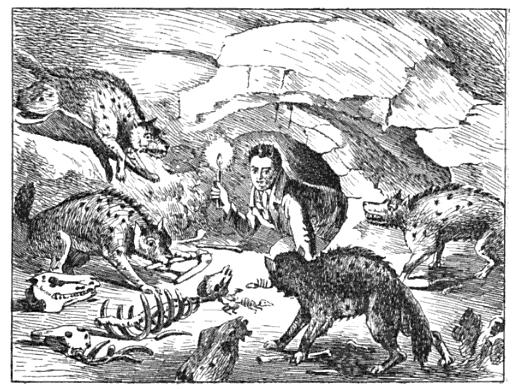
But Kirkdale was different. Buckland was present for the duration of the excavations, and he oversaw everything. There were no rounded pebbles in the cave sediment (as one would expect from water deposited sediments). The bones and teeth showed no sign of being smoothed by water. In fact there were no full skeletons of larger animals; just a lot of teeth and a lot of bone splinters. One species in particular was very abundant; hyenas. It became clear to Buckland that hyenas were using the site as a den, dragging carcasses inside to feast upon.

William Buckland

Witty cartoon of William Buckland poking through a cave to find a hyena den. (Image from here)

The fossils excavated showed what other animals were living around the cave at the time of the hyenas; amongst others, they included rhinoceros, elephants, bear, and hippopotamus. These are pretty exotic creatures that were living in North Yorkshire! In his article about the Kirkdale Caves, Buckland writes (page 185):

“I have information of about 10 elephants’ teeth, but of no tusk…I have seen but six molar teeth of the hippopotamus, and a few fragments of its canine and incisor teeth…Teeth of the rhinoceros are not so rare…”

Buckland correctly suggests that these animals lived a long time ago, but makes no specific comment on the exoticness of the species present. Mammoth fossils were known from other cave sites (although the elephant from Kirkdale was the straight-tusked elephant). Woolly rhinoceros fossils were known as well (the rhinoceros at Kirkdale was a different species, the narrow-nosed rhinoceros). But hippos?! In Yorkshire?!

A big hippo out of the water. (Image from here)

A big hippo out of the water. (Image from here)

At one time during the Pleistocene hippos (Hippopotamus amphibius) were actually very at home in Britain, and across Western Europe (Spain, France, Italy and the Adriatic countries). A surprising number of sites across Britain hold hippopotamus fossils, from the northern site in Kirkdale, Yorkshire, to further south at Yealmpton, Devon.

One of the few large surviving mega-fauna from the Pleistocene, hippos are massive, formidable animals living in Africa, south of the Sahara. Their name, Hippopotamus amphibius, translates from Greek to ‘river-horse’; a rather beautiful poetic name for such a beast. The name comes not from their looks, but from their lifestyle; hippos spend all day living in lakes and rivers in huge pods, mostly submerged beneath the surface. During the evenings, they move onto the land to graze on the grassy banks.

During the Pleistocene, hippos lived happily at much higher latitudes than today. Like the other giants of the Ice Age, they came over from Europe, when the English Channel was little more than a river. Numerous sites across Britain have hippopotamus fossils, including Cambridge, Derby, Leeds, and Trafalgar Square.

Beautiful reconstruction of the fauna of Trafalgar Square, London. (Art by Tabitha Paterson)

Beautiful reconstruction of the fauna of Trafalgar Square, London. (Art by Tabitha Paterson)

As we saw, hyenas today live in hot environments, but in the past they survived during different climates. Was the same true for hippos; were they happy in a cold Britain?

The answer appears to be no. These are big animals, which spend most of their time in water. If the water temperature is too cold, they cant survive. Other fossils found alongside the hippo remains point to a warm climate too. At Trafalgar Square, microscopic fossilised pollen indicates regional temperate environments, including fruit of the water chestnut (Trapa natans), southern European maple (Acer monspessulanum) and fruit of the cocklebur (Xanthium sp.). The ground beetle Oodes gracilis has also been found alongside the great river horse fossils; today these beetles live in the warm climates of central and southern Europe.

Hippopotamus are one of the more special Twilight Beasts. They were able to live in Britain during a short, particularly warm interglacial period. Using Uranium series age determinations on stalagmites in cave sites containing hippo fossils, this interglacial period dates to around 120,000 years ago. This period was hotter than today, allowing warm, lush rivers and lakes, typical of a scene you may see in Africa today.

Hippopotamus only made it to Britain during this particularly warm intergalcial period (known as Stage 5e). The number of sites with fossils (around 90) shows that these large animals were very successful. Towards the end of the interglacial, around 90,000 years ago, the climate cooled, ice caps grew, and an environment with less grasses and colder waters was just too severe for the British hippos. The magnificent river horse still lives on today providing a glimpse into the last warm interglacial of the British Isles.

Written by Jan Freedman (@JanFreedman)

Art by Tabitha Paterson (@TabithaPaterson)

Further reading:

Buckland, W. (1822), ‘Account of an Assemblage of Fossil Teeth and Bones of Elephant, Rhinoceros, Hippopotamus, Bear, Tiger, and Hyaena, and Sixteen other Animals; Discovered in a Cave at Kirkdale, Yorkshire, in the Year 1921: With a Comparative View of Five Similar Caverns in Various Parts of England and Others on the Continent’, Philosophical Transactions of the Royal Society of London. 112. pp. 171-236.

Currant, C. & Jacobi, R. (2001), ‘A formal mammalian biostratgraphy for the Late Pleistocene of Britain’, Quaternary Science Reviews. 20, pp, 1707-16. [Full article]

Franks, J. W. (1959), ‘Interglacial deposits at Trafalgar Square, London’, The New Phytologist. 59 (2). pp 145-152. [Full article]

Kurten, B, (1968), ‘Pleistocene Mammals of Europe‘, The World Naturalist. [Book]

Stuart, A. J. (1982), ‘Pleistocene vertebrates in the British Isles‘, Longman: London and New York. [Book]

Stuart, A. J. (1991), ‘Mammalian extinctions in the Late Pleistocene of Northern Eurasia and North America‘, Biological Review. 66. pp. 453-562. [Abstract only]

Sutcliffe, A. J. (1985), ‘On the track of Ice Age mammals‘, British Museum (Natural History). [Book]

Posted in Hippopotamus | Tagged , , , , , , , , , , , , , , , , , , | 11 Comments

The deadliest Twilight beast?

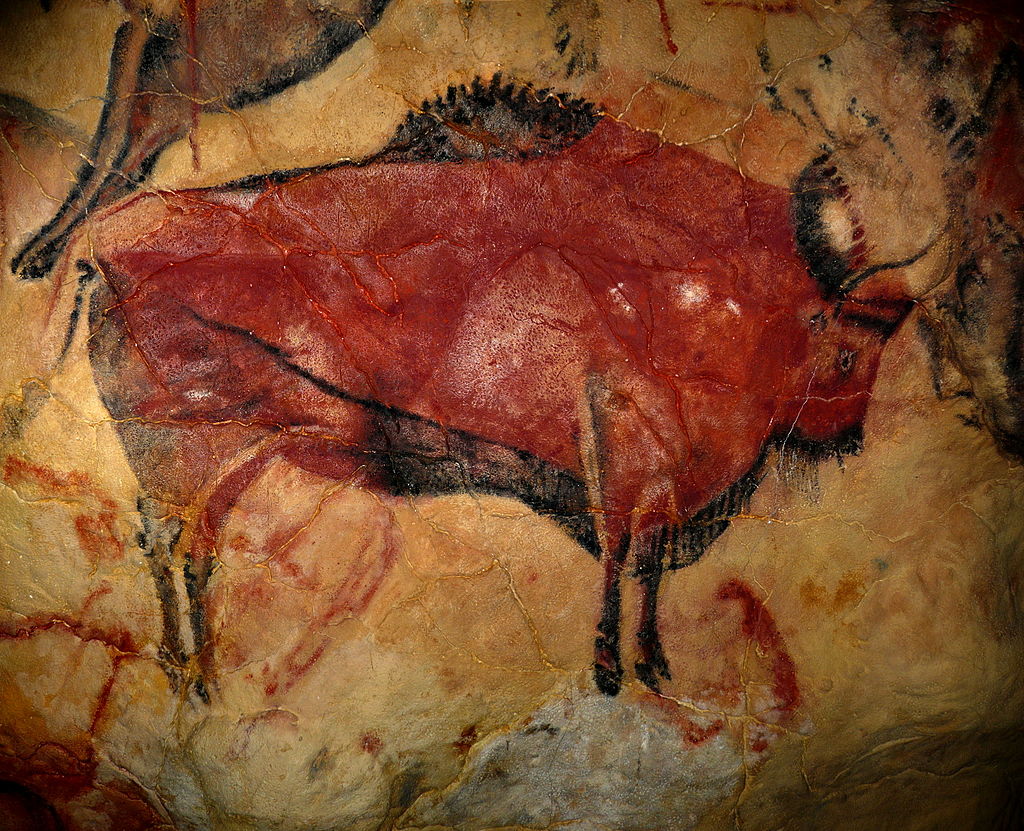
Beautiful cave painting of the magnificent steppe bison, Bison priscus. (Image from here)

Beautiful cave painting of the magnificent steppe bison, Bison priscus. (Image from here)

A long time ago, 1879 to be precise, a little girl and her father were exploring a cave in Spain when she gasped in amazement “ Look, daddy! Bulls!” The images she saw for the first time in about 16,000 years were cave paintings in red ochre of prancing creatures of the steppe and tundra. The cave was Altamira, in Spain, and the bulls were Bison priscus, the steppe bison, which is one of the predecessors of the iconic modern bison we know today. It gets complicated, actually – the modern bison in Europe is likely closer related to Bison priscus than the American bison, which comes down to us today via a different evolutionary path!

Imagine a huge ruminant over 2 metres tall at the shoulders, with the adult  males having a huge horn span of about 1m, horns curving lethally outwards at the tips – all the better for goring you with. These are the Pleistocene bison shown attacking humans in cave art at Lascaux and Villars. The shoulders had two powerful humps of solid muscle from the withers back, and longer hind legs than todays bison (but similar to the only other living species of bison; Bison bonasus, or European wisent) these were aggressive bovine warriors on the moo-ve.

The steppe bison, Bison priscus, were creatures well suited to the cool steppe grasslands from 2 million years ago to their eventual extinction about 10,000 years ago. They were found across Europe and Eurasia, from where they crossed the Beringia land-bridge and lolloped across the grasslands of North America with equally large Pleistocene creatures such as mammoths and mastodons. Assemblages of pollen in the stomach of a well preserved carcass from the frozen Indigirka Rover in Siberia have shown that like bison around today, our shaggy Twilight Beast, Bison priscus, liked grasses and hardy little wild herbs of the Brassicaceae and Chenopodaceae families to graze on. Blue Babe, the most famous –and frozen steppe bison to date had a post-mortem dental check, which showed he’d been munching on dry grasses such as Agropyron and Danthonia. As Blue Babe was a big Alaskan bull, it’s interesting to note that these grasses still grow plentifully in the Yukon and Alaska to this day.

Blue Babe was found near Pearl Creek, Alaska, in 1979. He takes his name from Paul Bunyan’s legendary ox who was so huge he could haul anything, and the ‘blue’ part because he was covered in a sapphire blue mineral deposit which had assisted the preservation considerably. This 36,000 year old beast was apparently so well frozen that a chunk of shoulder steak was cooked and eaten by the excavation team! (We’ve really no idea if this is truth or bravado, though!) That being said, if the excavators did tuck into prime 36,000 year old steak, they weren’t the first Homo sapiens to do so. Our ancestors exploited Bison priscus as food. Not only are there indications of flint points in the carcasses and bones of specimens in Siberian specimens, but there  is also considerable evidence of hunting and butchering at the Schoningen 13 Palaeolithic hunting settlement excavated sporadically from 1992 onwards.

As an archaeologist writing for this blog, I always tend to look at the animals which had close links to humans, the creatures which meant something to the tenacious ancient people. It’s to be suspected that Bison priscus would have been quite a trophy for a hunter. These bovines would not have been a walkover to take down; a scene at Villars shows a mortally wounded steppe bison savagely goring a fallen hunter. Our ancestors must have watched and waited opportunistically to hunt these creatures which were formidable opponents to Ice Age humans, yet agreeable and gregarious among their own kind, until rutting!  There are beautiful images of these massive creatures all over Europe: an engraved bone fragment from Le Morin depicts a mummy bison and a little baby one (which were very sweet indeed by the looks of the artwork!). A fabulously observed image at Le Portel Caves shows two horny bulls clashing during the rut, with swishing tails. But perhaps my favourite of all is a piece of mobiliary art, made of clay, showing a male mega-moo wooing a lady steppe bison. This was found at Tuc d’Audoubert, France. The figures, in all their vitality, date to 15,000 years ago, and may very well be some sort of fertility magical figures.

So, what caused the end of these splendid bovines with serious attitude?  The steppe bison was evolved to cope and thrive on wide open grasslands. The changes in climate post Younger Dryas resulted in boreal forests springing up across Europe in particular. The last known steppe bison were found in Dakota, dating to some 8,000 years ago. Climate change was likely the main feature in their extinction, although it’s likely that the most lethal animal of the Holocene, mankind didn’t do them any favours either. We just have to think how the plains bison were hunted to near extinction by descendants of post-medieval European colonists in the USA. While indigenous peoples would have shared the land with these magnificent animals understanding the breeding seasons and environmental factors needed to sustain them, newly arrived colonising peoples may very well have hunted for sport, not food.

A terribly sad photograph of an enormous pile of unfathomable American bison skulls in the 1870s, waiting to be ground into fertiliser. (Image from here)

A terribly sad photograph of an enormous pile of unfathomable American bison skulls in the 1870s, waiting to be ground into fertiliser. (Image from here)

When we look at the reintroduction of the American plains bison today, we can imagine what an awe inspiring sight the Ice Age peoples would have witnessed as the herds sought their favourite grasses. As it is, we still have the wonderful sympathetic art our ancestors left, drawn in red ochre,– the ultimate ‘red bulls’ snorting with energy and vibrance!

Written by Rena Maguire (@justrena)

Further reading:

Excavation of Bison priscus skull from permafrost.

Begouen,R; Fritz,R; Tostello,G, Clottes,J, Pastoors,A  and Faist,F. 2009. Le Sanctuaire Secret des Bisons Il y a 14,000 ans dans la cavern du Tuc D’Audoubert. Paris: Somogy D’Art. [Book]

Boeskorov, G., Potapova, O., Protopopov, A., Kolesov, S., & Tikhonov, A. 2012. ‘The Yukagir Bison: A complete frozen mummy of the extinct Bison priscus from Yakutia,Russia’. Journal of Vertebrate Palaeontology. 32. 65-66. [Full article]

Boeskorov, G. G., Potapova, O. R., Mashchenko, E. N., Protopopov, A. V., Kuznetsova, T. V., Agenbroad, L., & Tikhonov, A. N. 2013. ‘Preliminary analyses of the frozen mummies of mammoth (Mammuthus primigenius), bison (Bison priscus) and horse (Equus sp.) from the Yana‐Indigirka Lowland, Yakutia, Russia’ . Integrative zoology. [Full article]

Guthrie, D.  1990. Frozen Fauna of the Mammoth Steppe: The Story of Blue Babe Chicago : University of Chicago Press. [Book]

Kolfschoten,  I; , Knul,T;  Buhrs,M; and Gielen, M. 2012. ‘Butchered large bovids (Bos primigenius and Bison priscus) from the Palaeolithic throwing spear site Schoningen 13″-4 (Germany)’ in. Raemaekers D;. Esser, E, Roel C; Lauwerier,G and Zeiler, J.T (eds) A Bouquet of Archaeozoological Studies: Essays in Honour of Wietske Prummel Groningen: Barkhuis Publishing. [Book]

Kurtén, B. 1968. Pleistocene Mammals of Europe. Weidenfeld and Nicolson, London. [Book]

Kurtén, B. and E. Anderson. 1980. Pleistocene Mammals of North America. Columbia University Press, New York. [Book]

Leroi-Gourhan, A. 1982. The Dawn of Paleolithic Art. Cambridge University Press, Cambridge. [Book]

Van Geel,B; Protopopov,A; Bull, I; Duijm,E; Gill,E; Lammers,Y; Nieman,A; Rudaya,N; Trofimova,S; Tikhonov,A; Vos,R and Zhilich,S. 2014.’Multiproxy diet analysis of the last meal of an early Holocene Yakutian bison’ Journal of Quaternary Science. 29.3.261-268. [Abstract only]

Windels, F., & Laming-Emperaire, A. 1950 The Lascaux cave paintings. Viking Press. [Book]

Posted in Bison | Tagged , , , , , , , , , , , , , | 16 Comments