Side by side by Homo

Of the many and varied animals that lived alongside the earliest members of our own genus, Homo, few are as captivatingly enigmatic as the hominins that are grouped together as ‘robust australopithecines’, or placed in the genus Paranthropus. These are truly Twilight Beasts, in part because they went extinct in the Pleistocene as did so many fascinating critters, but also because research into Paranthropus has often been over-shadowed by investigations of their Australopithecus and early Homo contemporaries. It is almost as if palaeoanthropology decided that Paranthropus was definitely not a direct human ancestor and parked it on the academic back-burner. Lets bring these charming hominins waddling back into the limelight.

So what were they? Known from the African fossil record from about 2.5 million years to just over 1 million years ago, the (probably) three known Paranthropus species shared a number of distinctive characteristics (P. robustusP. boisei and P. aethiopicus. They were small bipedal primates, probably capable of walking upright and with quite dextrous hands able to manipulate objects rather well.  At around 4 feet tall, standing next to a Paranthropus the head would probably reach my chest. From the neck down, this little hominin may have looked much like a small, rather short-legged and portly human.

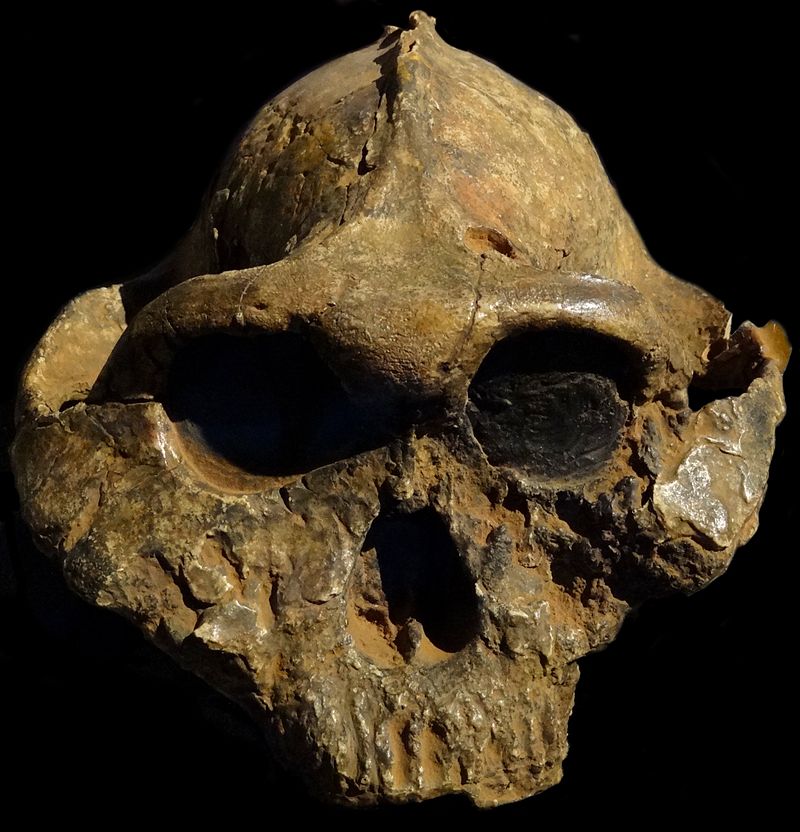
"Paranthropus-boisei-Nairobi" by Bjørn Christian Tørrissen - Own work by uploader, http://bjornfree.com/galleries.html. Licensed under CC BY-SA 3.0 via Wikimedia Commons - http://commons.wikimedia.org/wiki/File:Paranthropus-boisei-Nairobi.JPG#/media/File:Paranthropus-boisei-Nairobi.JPG

Paranthropus boisei skull from Nairobi. Note the very large cheek bones, and ridge at the top of the skull. (Image by Bjørn Christian Tørrissen. From here)

Atop that body was a head with a low vault and brow-ridges reminiscent of today’s chimps, a rather flattened nose, and heavy, muscular jaws equipped with impressive teeth. Paranthropus showed what palaeoanthropologists call megadonty, the development of teeth that are very large in relation to body size. In fact, the incisors and canines were distinctly small: it was the premolars and molars that filled most of the mouth. Between them, the broad premolars and massive, flat-crowned molars, with exceptionally thick enamel, were a means of chewing abrasive plant material for hour after hour after hour…. And to drive those jaws, the masseter muscles were really big, as shown by broad, flat cheek-bones pushed round to the front of the face. That anterior position aligned the chewing muscles to have maximum efficiency over those big molars. From the neck up, Paranthropus was a highly-derived chewing device.

The impressive skull of 'Nutcracker man' ("Paranthropus boisei skull" by Durova - Own work. Licensed under CC BY-SA 3.0 via Wikimedia Commons - http://commons.wikimedia.org/wiki/File:Paranthropus_boisei_skull.jpg#/media/File:Paranthropus_boisei_skull.jpg From here)

The impressive skull of ‘Nutcracker man’ (Paranthropus boisei) skull. This specimen has a slightly longer face than that of the skull above. Notice the huge molars giving this skull it’s nickname. (Image by Wiki member Durova. From here)

The first Paranthropus boisei fossil was discovered by the TrowelBlazer Mary Leakey in 1959. Louis and Mary named a new Genus Zinjanthropus boisei based on many differences between this skull and Austrlopithecus. It wasnt originally thought to be Paranthropus because it appeared more as an ancestor to Homo. Naming and classifying fossils (taxonomy) was a ricky business, especially when only fragments were found, or where there was such a small sample to compare it too. For some time ‘Dear Boy’ as it was affectionatly known as by Mary and Louis, was placed into the Genus Australopithecus. It was later moved over into the Paranthropus Genus, as more fossils were found, but kept the species name. The first specimen Mary found (the type specimen) was nicknamed ‘Nutcracker Man’ on account of it’s enormous molars.

It would be easy to get the wrong impression of this hominin. Their anatomy was all about eating low-quality plant material, so were they just a herbivorous side-branch of hominins, while the real business of evolution went on elsewhere? Enamel microwear and bone stable isotope studies confirm that Paranthropus ate more plants such as tough, drought-adapted grasses (known as ‘C4’ plants), than any of their contemporary hominins: such a diet would take most waking hours to ingest and process.

This wasn’t just a bipedal ape browsing shrubs and bushes. There is some evidence to suggest that Paranthropus used stone tools. Evidence from the Swartkrans, Drimolen and Sterkfontein sites in South Africa show that Paranthropus robustus used pieces of bone as digging tools, possibly to access tubers and tasty termites. In fact, there are no grounds for thinking that Paranthropus was less socially and behaviorally complex than any other Plio-Pleistocene hominin, including the various assemblages of unique fossils that constitute Homo habilis. The adaptation to eating tough plant material may just have been a broadening of Paranthropus’ dietary niche. Think of pigs: they have the teeth to cope with tough roots and nuts, but will eat all manner of foodstuffs if they are available, including pizza and footwear.

The several species of hominins through time (Image from Wiki Commons)

The several species of hominins through time. The Genus Paranthropus are seen as a seperate cousin to other hominin species. A species that vanished.  (Image from Wiki Commons)

When the first Paranthropus fossils were found at Swartkrans in 1938, Robert Broom, a magnificently eccentric medical practitioner and palaeontologist, named them Paranthropus meaning “Beside human”. It was a good choice of name. Eight decades later, with Paranthropus known from numerous sites in East and South Africa, it still appears as an animal ‘beside human’, a minor character with a walk-on part in the human story. It is fascinating to think that these little root chewing apes were on Earth at the same time as at least 6 other hominin species.

I think that is a shame that these hominins have been overlooked – they developed their own distinctively derived morphology and, presumably, behavior. These relatively unknown Genus were very sucessful: the species were around on the African savanah for around 1.5 million years. Paranthropus is much more interesting than just one of the crowd, looking on as early Homo emerged from the great Plio-Pleistocene australopith mish-mash, and deserves more attention in its own right.

Written by Terry O’Conner (@osteoconner)

Edited by Rena Maguire (@JustRena)

Further reading:

Cerling, T. E., et al. (2011). ‘Diet of Paranthropus boisei in the early Pleistocene of East Africa’, Proceedings of the National Academy of Sciences108(23), 9337-9341. [Full article]

Clarke, R. J. (2014). Paranthropus. In Encyclopedia of Global Archaeology (pp. 5807-5810). Springer New York. [Book]

d’Errico, F., & Backwell, L. (2009). Assessing the function of early hominin bone tools. Journal of Archaeological Science36(8). pp.1764-1773. [Abstract only]

Gunz, P. (2012). Evolutionary relationships among robust and gracile australopiths: an “evo-devo” perspective. Evolutionary Biology39(4). pp.472-487. [Full article]

Ungar, P. S., Grine, F. E., & Teaford, M. F. (2008). Dental microwear and diet of the Plio-Pleistocene hominin Paranthropus boisei. PLoS one3(4), e2044. [Full article]

Wood, B., & Constantino, P. (2007). Paranthropus boisei: fifty years of evidence and analysis. American journal of physical anthropology134(S45). pp.106-132. [Abstract only]

Posted in Paranthropus | Tagged , , , , , , , , , , , | 7 Comments

“Nice Beaver!”

Childhood stories probably influence how we see familiar creatures. If someone talks about beavers, I think about Narnian beavers. In the delightful C. S Lewis book The Lion, The Witch and The Wardrobe, the good beavers have cozy homes, make tea and are very much on the side of the Pevensie children who are on the run from the malevolent White Witch, who has turned the world into ‘always winter and never Christmas’. Incidentally, I consider this the most concise description of the Ice Age I can think of! Not all cultures had friendly beavers in their legends, however, and not all beavers were the little chaps we think of today.

There’s a legend that was told by the Pocumtuck tribe of Native Americans, of Massachusetts, USA. It’s a curious tale, and one that raises questions about what may have been observed by the earliest people as the great ice sheets of the last Ice Age receded. The Pocumtuck would tell you how the hills near Deerfield, MA were created from the carcass of a giant beaver. This beaver lived in a huge lake near the Sugarloaf Mountains, MA, and it was not a friendly sort. It would raise itself from the lake and drag people back to its dam where it would devour them. The ancient tribes lived in terror of this huge monstrous beaver, and prayed that there would be some kind nature deity who could protect humans against such a powerful enemy. A heavenly giant hunter heard the plea and decided to intervene. He battled with the giant beaver until it was finally killed, and as it sank into the lake it became stone, then heaved suddenly upwards to the skies, becoming a mountain range.

Now, initially this looks like a good story for round a camp-fire. Until, that is, you consider the kinds of animals they had in that region back during the Pleistocene. They had real giant beavers.  The first ever fossils were found in a peaty swamp near Nashport in Ohio, back in the 1830s, and were named Castoroides ohioensis – the Ohio beaver – by the geologist J.W Foster in 1838.  Since then, numerous fossils have been found across North America, from New England to Nebraska. But this was an all-American beaver as it has never been found outside of North America, for all its widespread distribution.

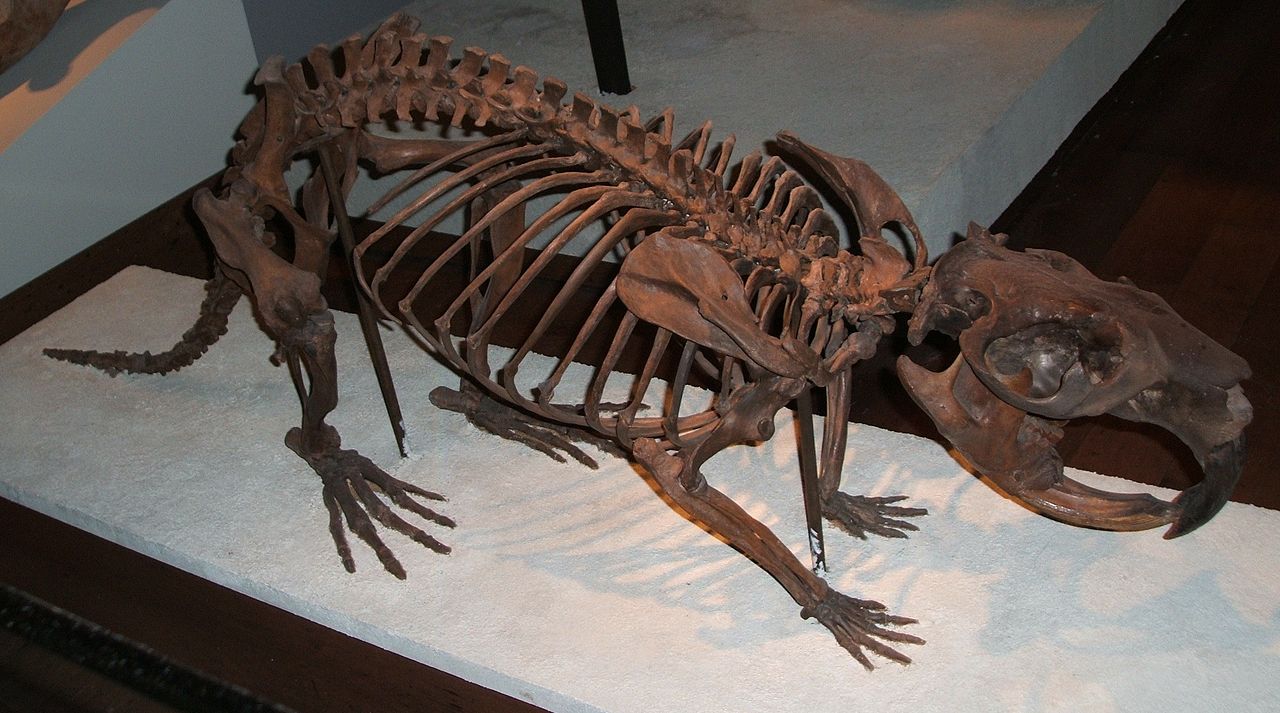
The skeleton of teh Giant Beaver (Castoroides ). Image by Steven G. Johnson from here)

The skeleton of the Giant Beaver (Castoroides ohioensis) on display at the Field Museum Chicago. (Image by Steven G. Johnson from here)

We’ve a pretty good idea about its appearance – especially as there’s an almost complete skeleton in the Science Museum of Minnesota. Based on fossils found, C. ohioensis grew to about 2m in length (longer than the average human). Estimates have put this enormous beaver weighing about the same as a black bear (around 120 kg).  There have been mutterings in palaeontological circles that this beaver could reach the size of a black bear, and some fossils suggest they did grow larger, but it’s unlikely they were bear sized. Not quite the size of a mountain, granted, but still a lot bigger than the modern Castor canadensis, which weighs in at a comparatively measly 32kg! Needless to say, Castoroides was not a direct ancestor of our furry river pals today, more of a cousin a few times removed.

One model of the Giant Beaver. (Image by Ross Barnett)

One model of the Giant Beaver. (Image via Ross Barnett)

The gnawing teeth on extant beavers are kind of goofy and slightly endearing, but may have been a little less so on its giant relative. Think of C. ohioensis with huge convex incisors extending about 15cm or more beyond the gums! Those teeth were considerably different from modern beaver species too; extant species have rounded surfaces on their incisors, but the Pleistocene was a harsh and difficult time, and even a playful water creature needed incisors that could handle the most challenging conditions – the teeth were ridged to act like girders, to protect the animals phenomenal gnawing capacity. Yet it’s been hypothesised a couple of years ago that Castoroides ate mostly pond plants. Macrofossil and pollen assemblages found in context with a wonderful find of a Castoroides skull in Erb, Wisconsin, provided a near-perfect palaeoenvironmental study on the Younger Dryas landscape (12,500yrs ago) of North America. The plant material summoned a dramatically accurate image of the post-Ice Age environment of Castoroides. It was a cold, damp one, with various species of Carex (sedges) and Najas flexilis (naiad pond weeds). Nearby were trunks of ancient Populus with telltale gnaw marks. The palaeoecologist who carried out the study, Dr Catherine Yansa, compared C. ohioensis to little hippos, munching on aquatic plants.

There are numerous excellent radiocarbon dates, gleaned from robust dental collagen which suggests the Giant Beaver survived the ice, and continued well into the Younger Dryas, a climatic ‘cold snap’, or stadial, which started around 13,000 years ago, as the glaciers receded. It was possibly caused by a large chunk of glacier breaking off in the Great Lakes region (the Laurentide Ice Sheet), cooling air and water currents and thereby altering them. Of course, palaeoenvironmentalism would be nothing without alternative theories, and one of the newer ones is that the Dryas was caused by a cometary impact. It’s been a compelling argument, and I’d be inclined to think there may be parts of the hypothesis well worth consideration.

Graph illustrating the dip in temperature about 1 (Image from here “Younger Dryas temperature variation”作者Iceage_time-slice_hg.png: Hannes Grobe/AWIderivative work: Alexchris (talk) - Iceage_time-slice_hg.png。来自維基共享資源 - http://commons.wikimedia.org/wiki/File:Younger_Dryas_temperature_variation.png#/media/File:Younger_Dryas_temperature_variation.png根据知识共享 署名 3.0授权)

Graph illustrating the dip in temperature about 13,000-10,000years ago. The present day is on the left side of the graph, and you go further back in time as you look right. Temperature estimates come from Oxygen isotope measurements in tiny oceanic microfossils. (Image from Wiki Commons)

It cannot be denied that the end of the Ice Age brought massive changes, environmentally and climatically. As the climate warmed up the entire ecosystem started to change. There’s a group of fungi, Sporormiella, which I might have mentioned before with poor Archaeoindris. It’s a fungus which breaks down organic waste material, and was plentiful in megafaunal dung. Without it, the vegetation cover of environments will change. The lack of this fungus is often used as a proxy for megafaunal extinctions during the end of the Pleistocene, and certainly, this has been the case in the USA.  It’s likely that climate change was working strongly against the Giant Beaver, who was supremely equipped for the cold.

The Giant Beaver was a giant. (Image by Jan Freedman)

The Giant Beaver was a giant. (Image by Jan Freedman)

One of the reasons I am madly in love with palaeoecology is that you can ‘see’ in your minds eye  a whole prehistoric landscape come back to life as the pollen chart builds. Sometimes, when I have been counting pollen, and know what  vegetation is there, I pause and imagine what it would smell like, what birds would sing there, what animals would rustle through the grasses and trees. So, come with me for a moment back to the last days of the Giant Beaver in the North America of maybe 11,000 years ago.

Where the enormous stretch of glaciers receded, wet swamps and marshes fill the hollows left by the retreating ice sheets, fed by the glacial melt-waters. There is a smell of marsh in the air, and it is bitingly cold, so you can see your breath when you walk from the dense clusters of colonising trees towards the sedgy lakes. These wetlands are pretty good habitation spots for beavers to make dams.

But you’ll hear other noises and rustles which are strangely familiar in their footfall; human hunters. The newly ice-free landscape witnessed increasing numbers of humans wandering the forests and wetlands looking for food, armed with the elegant Clovis point lithics, from which we take their identifying name. Castoroides ohioensis was about to come into direct and deadly contact with the Clovis culture, the hardy hunter-gatherers of North America – and those who came afterwards, who refined hunting with the slender and utterly deadly Folsom lithic weapons.

Beautifully intricate Clovis points (image from here)

Beautifully intricate Clovis points from Rummells-Maske Cache site, Iowa. (Image by Bill Wittaker, from here)

I’m not detracting from human tenacity to survive the worst of environments, but as an archaeologist I am fascinated (but in truth personally repelled) by how humans elevate hunting into something beyond a function for food. Predators of the animal kingdom consume what they need, yet humanity hunts as a social act, replete with status and ego, especially within hunter gatherer societies and tethered mobility groups. It’s understandable to hunt the Giant Beaver for a dense, water-resistant pelt in a bitter cold climate, but it’s pretty likely that it took more than the odd successful trapper to push the species onto the endangered lists of the Pleistocene.

The overlap of Castoroides ohioensis and humans is relatively brief, and it’s uncertain if hunting was 100% responsible for their entire extermination – environment and climate changes had probably already decreased the populations of the great creature.  It’s most likely that the last of the Giant Beavers of North America were pushed into extinction by humans who had no idea they were destroying the last of a line.  Castoroides was left to fireside stories, and the dreams of wide- eyed children, who would always see them as the size of mountains and with the ferocity of lions.

Written by Rena Maguire (@JustRena)

A link to one of the best sight gags ever, from the Naked Gun (source of this article’s title)

Further Reading:

More about the research from Dr C Yansa and the Erb Site here.

More information about the Clovis culture here.

Abbott, K. (1907), ‘Old paths and legends of the New England Borders’. Knickerbocker Press. [Book]

Boulanger, M. T, et al. (2015), ‘AMS Radiocarbon Dates for Pleistocene Fauna from the American Northeast’. Radiocarbon. 57 (1). pp.1-4. [Full article]

Boulanger, M. T, & Lyman, R. L. (2014), ‘Northeastern North American Pleistocene megafauna chronologically overlapped minimally with Paleoindians’, Quaternary Science Reviews85. pp.35-46. [Full article]

Buchanan, B, O’Brien, M. J, and Collard, M. (2014), ‘Continent-wide or region-specific? A geometric morphometrics-based assessment of variation in Clovis point shape’. Archaeological and Anthropological Sciences. 6. pp.145-162. [Full article]

Engels, W. L. (1931). ‘Two new records of the Pleistocene beaver, Castoroides ohioensis’. American Midland Naturalist. 12(12). pp.529-532. [Full article]

Grootes, P. M., et al, (1993), ‘ Comparison of oxygen isotope records from the GISP2 and GRIP Greenland ice core’. Nature. 366. pp.52–554. [Abstract only]

Kurten, B, & Anderson, E. (1980), Pleistocene mammals of North America. New York: Columbia University Press. [Book]

Martin, R. A. (1969), ‘Taxonomy of the giant Pleistocene beaver Castoroides from Florida’, Journal of Paleontology. pp.1033-1041. [Full article]

McDonald, H. G, & Glotzhober, R. C. (2008), ‘New radiocarbon dates for the giant beaver, Castoroides ohioensis (Rodentia, Castoridae), from Ohio and its extinction’. Unlocking The Unknown: Papers Honoring Dr. Richard J. Zakrzewski. Fort Hays Studies, Special Issue, 2. pp.51-59.

Melott, A. L., Thomas, B. C., Dreschhoff G.,  & Johnson, C. K., (2010), ‘Cometary airbursts and atmospheric chemistry: Tunguska and a candidate Younger Dryas event’ Geology.  38. pp.355–358. [Full article]

Miller, R. F., Harington, C. R., & Welsh, R. (2000), ‘ A giant beaver (Castoroides ohioensis Foster) fossil from New Brunswick, Canada. Atlantic Geology, 36(1). [Full text]

Muller-Schwartz, D. (2011). Living Beavers, Now and Then: The Species, Including Fossils. New York: Cornell University Press. [Book]

Redmond, B. G & Tankersley, K. (2011). ‘Species Response to the Theorized Clovis Comet Impact at Sheriden Cave, Ohio’. Current Research in the Pleistocene. 28.

Surovell, T. A., et al., (2009), ‘An independent evaluation of the Younger Dryas extraterrestrial impact hypothesis’ Proceedings of the National Academy of Sciences of the United States of America. 106. pp.18155–18158. [Abstract only]

Posted in Giant Beaver | Tagged , , , , , , , , , , , , , , , , | 8 Comments

The long reign of terror

Something has survived.

Bold capital letters spell out the above chilling sentence on the back cover to Michael Crichton’s sequel to Jurassic Park. No blurb. No description of the novel. Those three words say enough.

That short, simple, yet powerful sentence could be used for one of the most famous events in geological history: the K-T extinction. This is now formally known as the K-Pg extinction and heralds the end of the Cretaceous Period and the beginning of the Paleogene Period. It still marks the same asteroid impact that happened 66 million years ago and the end of the non-avian dinosaurs. But something has survived. The avian dinosaurs we see every single day: birds.

In Paleogene park: something has survived.

This may seem a little over the top. But we are not talking about blue tits, or blackbirds. There were once bigger avian dinosaurs running extremely fast across the grasslands of the Pleistocene. Some which were just as terrifying as their relatives back in the Cretaceous.

One group of birds in particular may well have been the most terrifying of all. The Phorusrhacids. Most of the species in this group were huge, giving the group their well-known name, the ‘Terror Birds’.

So far, about 13 genera, and 18 species have been discovered for this family, distributed over five subfamilies. These extinct Cariamiformes (related to the extant seriemas) have vast fossil record and are distributed from the Eocene to the Pleistocene coming from Argentina, Brazil, Uruguay, USA and Africa. Recently, some isolated remains from the middle Eocene of Europe have been reported as belonging to Phorusrhacids.

These big birds are characterized by their elongated hindlimbs, narrow pelvis, and reduced forelimbs. It is their enormous skull with their tall, long, narrow, and hollow beaks ending in a hook which really mark these beasts out against others. The structure and design of the beak are exclusive features of the Phorusrhacids. And they are terrifyingly magnificent.

Federico J. Degrange, Claudia P. Tambussi, Karen Moreno, Lawrence M. Witmer, Stephen Wroe - Degrange FJ, Tambussi CP, Moreno K, Witmer LM, Wroe S (2010) Mechanical Analysis of Feeding Behavior in the Extinct "Terror Bird" Andalgalornis steulleti (Gruiformes: Phorusrhacidae). PLoS ONE 5(8): e11856. doi:10.1371/journal.pone.0011856.g001 Skull of the terror bird Andalgalornis steulleti (FMNH P1435). A, dorsal view, B, ventral view, and C, left lateral view, based on volume rendering of CT scan data. Fossil bone is shown in light brown, and rock matrix and plaster restoration are shown in grey.

An incredible CT scan of a skull of the terror bird Andalgalornis steulleti. A, dorsal view, B, ventral view, and C, left lateral view. Notice how thin the skull is, but the beak is huge. Fossil bone is shown in light brown, and rock matrix and plaster restoration are shown in grey. (Image from Degrange, et al. 2010. From here)

The fascinating history of the discovery of the Terror Birds began in 1887. At that time Florentino Ameghino, former Assistant Director of the Museo de la Plata, and Francisco P. Moreno, head of the museum, were in a middle of a bitter dispute. The disagreement between Moreno and Ameghino was triggered by the discrepancies that emerged regarding the publication of the remarkable fossil mammal collection gathered by Carlos Ameghino in Santa Cruz River. Among other fossils, Carlos Ameghino discovered a large, toothless jaw from the Miocene of the Province of Santa Cruz. His brother, Florentino, named the fossil as Phorusrhacos longissimus, assigning it to a new family of edentulous mammal.

After the Ameghino brothers left the Museo de la Plata, they continued with their palaeontological exploration. Meanwhile Moreno, in order to gain priority over his rivals, published a series of brief reports about the new palaeontological discoveries made by his field researchers. In 1888, Moreno was the first to refer to the giant birds of the Mio-Pliocene from Argentina. He proposed the name Mesembriornis milneedwardsi for a tibiotarsus, a fibula and a vertebra collected in Monte Hermoso, on the south-eastern coast of Buenos Aires province. The ever-competitive Moreno also dscribed another species Paleociconia australis from an incomplete tarsometatarsus found in the same location.

After reading Moreno’s paper, Carlos Ameghino wrote to his brother on 23rd December, 1890:

“Moreno’s large fossil birds, which so much puzzled us (Mesembriornis, etc.) have also appeared. They are indeed gigantic birds, some of them perhaps as large as the Gastornis. Could not the beak of Phororhacos belong to one of these birds?”

Florentino Ameghino dismissed this suggestion in a letter dated on 30th January, 1891:

“The possibility that the beak of Phororhacos belongs to a gigantic bird seems unlikely to me; because if it was so, they would be birds from groups completely distinct from those we presently know and without any relationship with the gigantic birds from Madagascar and New Holland. Personally, I tend to believe that it may well belong to an extinct giant monotreme”

A new discovery made by Carlos later during his fourth trip to Patagonia, forced Florentino to recognize Phorusrhacos as a bird. Carlos’s discovery was mentioned in the “correspondence, travels and explorations” section of the Revista Argentina de Ciencias Naturales, without mention of Moreno’s discoveries. But the publication of Moreno and Mercerat’s catalogue of fossil birds from Argentina in 1891 was a decisive element in the history of research on Phorushacids, not only because it contained descriptions and illustrations of many new taxa, but also because it prompted Florentino to quickly publish his own descriptions and interpretations of Phorushacids.

In 1895, the critical financial situation forced Florentino Ameghino to sell his fossil bird collection, in order to support his further work in Patagonia. The collection was purchased by the British Museum (Natural History) by the sum of £350 £ in 1896 (around £40,000 today).

These were fascinating creatures. And the history of their discovery was just as fascinating. The largest known Phorusrhacid was Kelenken guillermoi which lived around 15 million years ago in the Miocene of Argentina. The skull alone was as long as my legs, and the whole animal could reach 3 meters high (double my height!). Kelenken is also represented by a tarsometatarsus and a broken phalanx found at the locality of Comallo (Río Negro Province, Argentina).

Our giant from the Twilight was Titanis walleri. It was big, at 2.5 meters tall and weighed approximately 150 kilograms.

A giant bird (Image by Jan Freedman)

At over 2.5 meters tall, this giant bird would have towered over humans. Our species, however, never saw this group of big birds, as it vanished long before we set foot in the Americas. (Image by Jan Freedman)

It originated in the South American Miocene, around 5 million years ago and appears to have gone extinct at the dawn of the Twilight period, around 2 million years ago. Parts of the skeleton have been found, but to date, no skull. From the fragmentary skeletal remains, it appears to have been marginally shorter than the biggest Terror Bird. It does appear to have had a slightly stockier body than other species, and it seems to have been fast: estimates suggest this bird could sprint at 65 miles per hour!

Illustration of

Illustration of the giant Titanis walleri. (Image by Dmitry Bogdanov from here)

The Phorusrhacids diversity declined towards the end of the Pliocene (around 2.6 million years ago). The latest geologic occurrence of the Phorusrhacidae comes from late Pleistocene sediments of Uruguay (although dates of 400,000 and even 17,000 years have been unsubstantiated with other evidence). These were a successful group of animals that were on the planet from 62 million years ago until around 2 million years ago. They were giants of the ecosystem and the top predators for 60 million years. So what happened?

North and South America were large separate landmasses, drifting blindly for around 120 million years. Each had their own unique creatures, evolving for millions of years on their own. Then, around 3 million years ago, something big happened. North and South America became joined by a tiny slither of land, the Isthmus of Panama. Less than 80km wide, this natural bridge, shaped the Americas we know today. It also impacted on two ecosystems that had been isolated for millions of years.

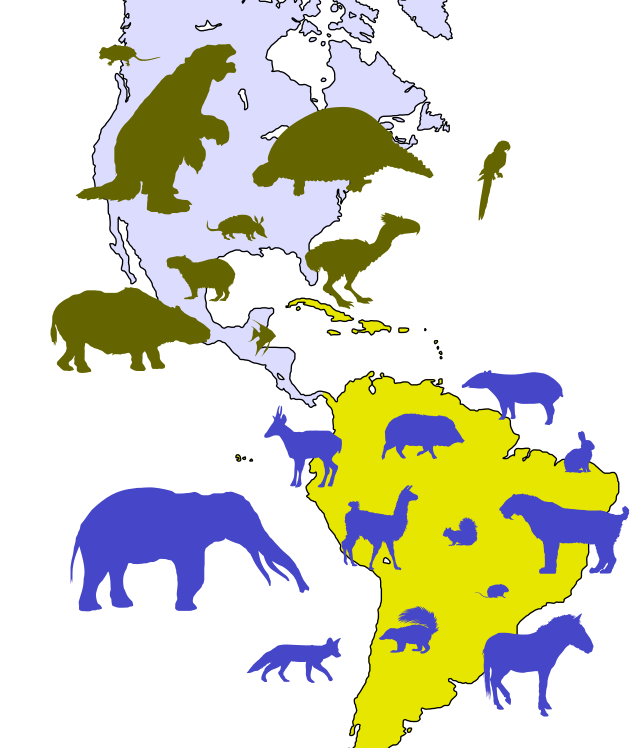
Animals from North America moved across this landmass to South America, and animals in the South moved up to North America. We saw the effect of the Great American Interchange on the Gomphothere, Toxodon and Glyptodon. These animals were specially adapted for their environment. Moving to new pastures on a different landmass was a rapid change in environment. Some animals managed to hold on for some time, while others couldn’t and had no chance of adapting quick enough.

The Great American Interchange. As North an South America (Image from here)

The Great American Interchange saw numerous species move north and south. The blue silhouettes were originally from North America, and the dark green are species originally from South America. (Image by wiki member Woudloper from here).

Titanis walleri moved north over the land bridge. Here was an ecosystem that was drastically different to one it was used to. More swamps, different prey and other predators. A predator that was well adapted to hunt the food there: Smilodon. The Titanis that stayed in South America soon vanished, possibly from increased competition from the northern sabre-tooth cat moving south into the Terror Bird’s territory. Evidence for the root of their extinction at paleontological sites is scant, and it was most probably a combination of new predators from the Great American Interchange along with changing environments at the start of the Pleistocene. We do know that for this extinction humans weren’t to blame.

Very recently a new species of Terror Bird, Llallawavis scagliali was discovered in Argentinean sediments dating to around 3.5 million years. It was one of the most complete fossil Terror Birds ever found, and is 90% complete. One of the interesting things the fossils shows is something that is not preserved in the fossil record: the animal’s voice. Looking at delicately preserved bones in the inner ear, Degrange, et al. (2015) compared it to other species and it closely resembles those that hear in low pitches. For around 60 million years, the deep rumbling voices of Terror Birds would have haunted the land.

Terror Birds left only their fossils as evidence of their existence. But something did survive. An ancient cousin that still silently runs around South America: the seriemas.

"Cariama cristata". Licensed under CC BY 2.5 via Wikimedia Commons - http://commons.wikimedia.org/wiki/File:Cariama_cristata.jpg#/media/File:Cariama_cristata.jpg

Beautiful, but terrifying. The red legged seriema (Cariama cristata) alive today. The closest relative to the Terror Birds. Standing one meter tall, with a sickle claw, this is a formidable beast. (Image by Whaldener Endo from here)

These long legged birds are much smaller than the Terror Birds, with a height of 1 meter. But there are similarities. They rarely take to the air. They are quite vicious carnivores and will bash their prey or sling it against a rock to kill it. These birds also have a sickle claw on their foot which they use to tear flesh into smaller chunks.

A sickle claw. On a bird alive today.

If there was a sequel to the Terror Birds, Michael Crichton’s three words would be more than appropriate.

Written by Fernanda Castano (@Ferwen) and Jan Freedman (@JanFreedman)

Further Reading:

Alvarenga, H. M. F & Hofling, E. (2003), ‘Systematic revision of the Phorusrhacidae (Aves: Ralliformes)’, Pap. Avulsos Zool. (São Paulo). 43(4). pp. 55-91 . [Full article]

Ameghino, F. (1891a), ‘Mamíferos y aves fósiles Argentinos: espécies nuevas: adiciones y correciones’, Revista Argentina Historia Natural, 1. pp.240-259.

Ameghino, F. (1891b), ‘Enumeración de las aves fósiles de la República Argentina’, Revista Argentina Historia Natural, 1. pp.441-453.

Ameghino, F. (1895), ‘Sobre las aves fósiles de Patagonia’, Boletin del Instituto Geográfico da Argentina, 15. pp.501-602.

Angst, D, et al. (2013), ‘A large Phoruschacid bird from the middle Eocene of France’, 8th International Meeting of the Society of Avian Paleontology and Evolution Vienna, Austria, 11th -16th June 2012. [Abstract only]

Brodkorb, P. (1963), ‘A giant flightless bird from the Pleistocene of Florida’, The Auk. 80. pp.111–115. [Full article]

Buffetaut, E. (2013), ‘Who discovered the Phorusrhacidae? An episode in the history of avian palaeontology’, Proceedings of the 8th International Meeting of the Society of Avian Paleontology and Evolution Paleornithological Research 2013. [Full article]

Chiappe, L. M. & Bertelli, S. (2006), ‘Skull morphology of giant terror birds’, Nature. 443. pp.929. [Full article]

Degrange, F. D., et al. (2010), ‘Mechanical Analysis of Feeding Behavior in the Extinct “Terror Bird” Andalgalornis steulleti (Gruiformes: Phorusrhacidae)’, PLoS ONE 5(8): e11856. doi:10.1371/journal.pone.0011856.g001 [Full article]

Degrange, F. J., et al. (2015), ‘A new Mesembriornithinae (Aves, Phorusrhacidae) provides new insights into the phylogeny and sensory capabilities of terror birds’, Journal of Vertebrate Paleontology, 35(2). [Abstract only]

Moreno, F. P. (1889), ‘Breve reseña de los progresos del Museo La Plata, durante el segundo semestre de 1888’, Boletin del Museo La Plata, 3. pp.1-44.

Moreno, F. P. & Mercera, A. (1891), ‘Catálogo de los pájaros fósiles de la República Argentina conservados en el Museo de La Plata’, Anales del Museo de La Plata, 1. pp.7-71.

Tambussi, C. P. & Degrange, F. (2013), South American and Antarctic continental Cenozoic birds. Paleobiogeographic affinities and disparities. Springer, Dordrecht. [Book]

Posted in Terror Bird | Tagged , , , , , , , , , , , , , , , , , , , , , , | 13 Comments

A sticky end for the Monster Birds

California. A state well known for endlessly perfect sandy beaches, sun, wine, and Arnold Schwarzenegger. Hidden below the surface of this famous American state lies a more complex history that only reveals itself when we look a little closer. Locked within the rocks is a history greater than any Hollywood blockbuster. A history where the Earth really did move. A history where volcanoes violently errupted, mountains slowly, quietly grew, and remarkable creatures lived. The movie of how Hollywood came to be may well be one of the greatest yet.

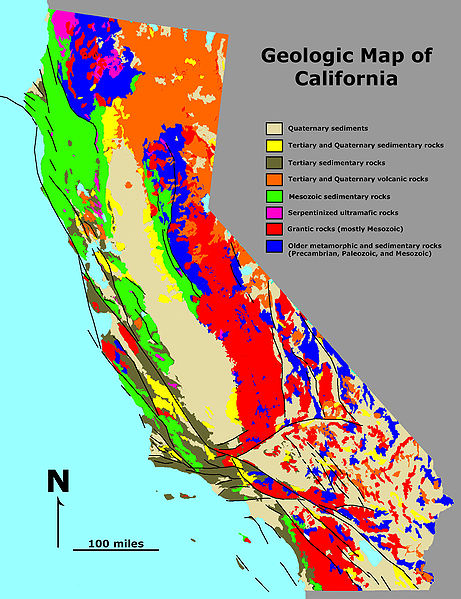
California has a very complex geological history. The north is dominated by volcanic rocks 25 million years old showing evidence of long lost volcanoes that shook the ground as they spewed out magma and ash. Dominating the east and south east, forming Yosemite National Park and the mountains beyond, are hard, tough, Mesozoic granites. This extremely resistant rock originated around 100 million years ago when old rock was being forced deep down into the Earth: so deep, it melted, resulting in plumes of molten granite rising, slowly pushing it’s way up through the Earths crust. The never ending recycling of rocks is one of the most beautiful wonders of geology.

The rocks we are interested in lie towards the south west of California. Here, something spectacular happened.

A simple geological map of California. The different colours highlight the different rock types. (Image from USGS, Public Domain).

A simple geological map of California. The different colours highlight the different rock types. Hidden under this colourful map are huge folds and deep faults that make California a geologically complex area. (Image from USGS, Public Domain).

Marine sediments which settled around 15 million years ago were crumpled into a deep bowl shape as the mountains to the North East formed. More sediments from the sea and rivers built up forming many layers of fine to coarse grained rock. A rock with very high organic content. The organic matter in the coarser grained sediments were trapped with the cap of fine sediments above, and very slowly formed large deposits of oil. Beneath many areas of California lie huge reservoirs of oil. Most are secure underground, tapped by humans and refined. At some places oil has managed to seep to the surface. One place in particular, is the La Brea Tar Pits slap bang in the middle of Los Angles. Here thick, sticky treacle-like asphalt reaches the surface. This semi-solid oil is a death trap. Literally.

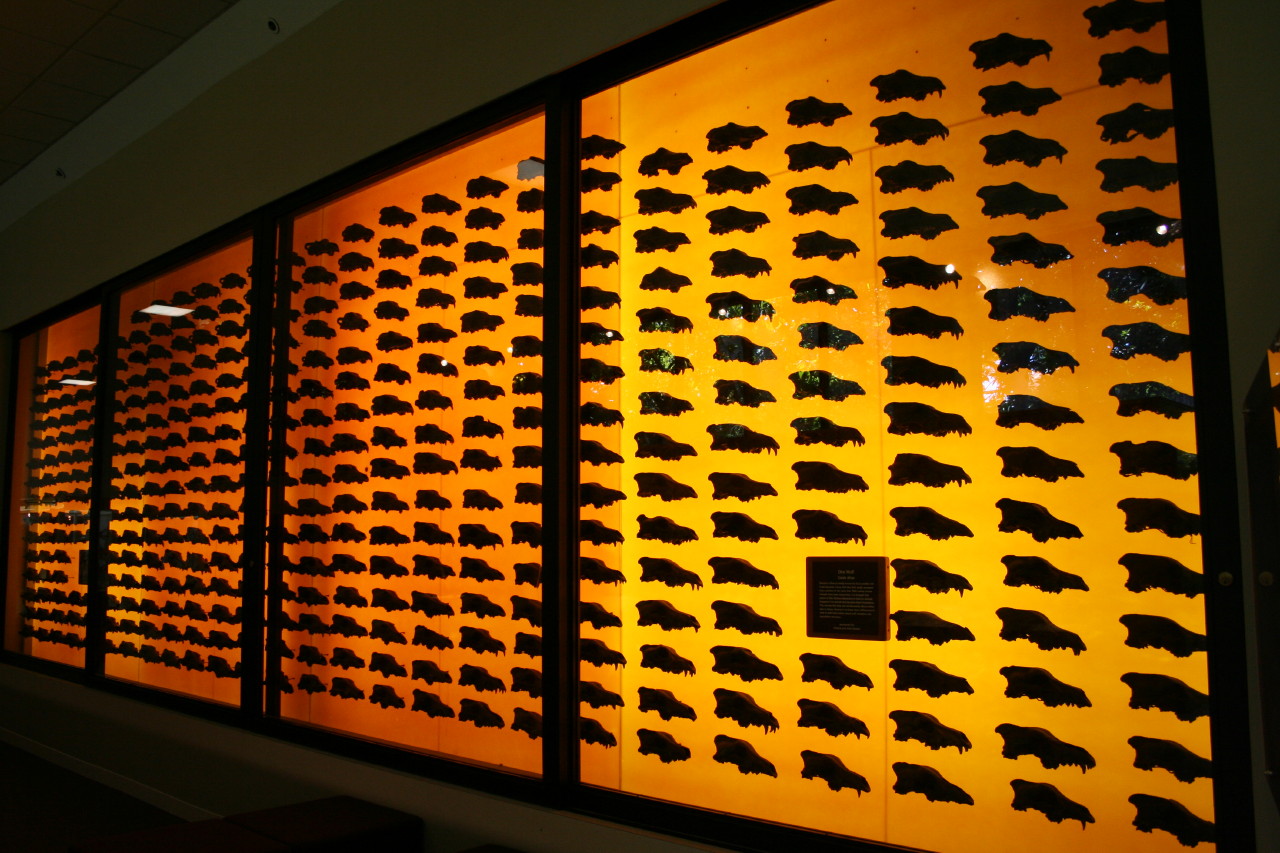
Animals have been entombed in this sticky tar for tens of thousands of years, from tiny beetles to enormous mammoths. Staff at the Page Museum have painstakingly cleaned, and carefully recovered 650 different species with an incredible amount of entire skeletons. The amazing story of Los Angles between 40,000 and 10,000 years ago is being pieced back together with awesome animals from the Pleistocene illustrating a beautiful, diverse ecosystem. With large herbivores, like mammoths and ground sloths, getting trapped in the tar pits they inevitably attracted a lot of predators who sniffed out an easy meal. Hundreds of Smilodon fossils and thousands of Dire Wolves have been recovered after they met their fate in a ‘Red Wedding’ style event, where the diners were completely unexpectedly killed off whilst enjoying a little food. Only this Red Wedding spanned for thousands of years. These are the predators that make it into Sinbad and the Eye of the Tiger, or A Game of Thrones. But there is another beast from the La Brea Tar Pits that equally deserves air time. And this would give Big Bird a run for its money.

Incredible display of hundreds of Dire Wolf skulls at La Brea Tar Pits. (Image by

Incredible display of hundreds of Dire Wolf skulls atthe Page Museum, La Brea Tar Pits. (Image by Pyry Matikainen, from here)

Towards the end of the Pleistocene, there was a giant bird gliding on the air currents. A bird bigger than the largest North American land bird, the California Condor. It was Teratornis merriami. This was a bird you wouldn’t want to see in your back garden. It was huge. Some reconstructions have created a cross between a vulture and a Condor. The wingspan was between 3.2 and 3.8 meters long (that’s about one and a half times as long as me!). Standing, it would have reached my tummy, at 75cm tall. Its sharp, curved beak was made for one thing; slicing and gulping down meat. This was a big beak: large enough to swallow a rabbit whole. It is no wonder this beast belongs to the Teratornithidae Family: which literally means ‘monster bird’.

The incredible skull of Teratornis (Image by

The incredible skull of Teratornis merriami.  (Image by Wiki User Esv, from here)

Teratornithidae (or Teratorns) were first found at La Brea Tar Pits in 1909 with Teratornis woodburnensis as the species describing the new Family. Since then five different species have been discovered. With only a handful of species, the affinities of this group have only recently been agreed upon. They were originally thought to belong to the Family of Vultures (Cathartidae) when they were first discovered due to similarities in their beak and skeleton. They have been thought of belonging to the Order Ciconiiformes, which includes storks and New World Vultures. However, more recent research has brought them back to where they originally began, and are now placed back in the Order Cathartiformes, where the teratorns sit alongside the New World Vulture. Working out the taxonomy of extinct animals can be tricky business!

The Tar Pits are unique: the preservation of the bones at this site is perfect, and more often than not, the entire skeleton is preserved. This rare double dose of preservation provides an enormous amount of information for researchers. Around 100 individuals of T. merriami have been excavated so far, making this the best known of the Teratorns. But there is still a lot we don’t know.

These Monster Birds are full of very cool features to help them fly, scavenge and hunt. For such a big bird to fly, the skeleton was, like all flying birds, very light. The finger bones are all fused, but the index finger has a wide, flat shelf of bone: a shelf to hold large, long feathers that are attached to the hand (the primaries). The extra shelf of bone supports these larger than life feathers to assist in these giants soaring. Originally viewed as of scavenging birds, the leg bones reveal something slightly more terrifying. Compared to Eagles and Condors, the feet were not sharp for grabbing and holding on to prey animals: instead, they could hold down prey which tearing off pieces. This indicates that this bird didn’t hunt on the wing. With longer and stockier legs, it has been suggested that Teratorns would have hunted animals on the ground. It has also been proposed that these animals may have hunted similiarly to an Osprey, by catching fish from rivers. Clearly, as attested by the hundred individuals at La Brea Tar Pits, they were also partial to a little scavenging when the opportunity presented itself.

A classic illustration of La Brea Tar Pits. "Smilodon and Canis dirus" by Robert Bruce Horsfall - http://archive.org/stream/historyoflandmam00scot#page/n9/mode/2up. Licensed under Public Domain via Wikimedia Commons - http://commons.wikimedia.org/wiki/File:Smilodon_and_Canis_dirus.jpg#/media/File:Smilodon_and_Canis_dirus.jpg

A classic illustration of La Brea Tar Pits, and one of my favorites with a Charles Knight feel to it. It shows two dire wolves and a Smilodon on top of a Mastodon carcass. Look up and there are several large birds circling and one sat on a branch. These may be the Condor, but I like to think that these are Teratornis merriami soaring those hot air currents. (Illustration by Robert Bruce Horsfall, 1911, from here)

The giant Teratornis merriami was not just restricted to soaring over the warm thermals of California. Fossils have also been found in Arizona, Florida, New Mexico and Mexico. In 1970, Paul Martin, the advocate for the overkill theory, was examining Stanton’s Cave, Arizona for pack rat middens. (Pack rats are cute little rodents that like to grab vegetation from the surrounding area to make their cosy middens. These middens have survived for over 50,000 years, preserving with them the evidence of the flora of the surrounding area, giving vital information about the climate at that time.) Digging back inside Stanton’s Cave, Martin and two colleagues discovered a huge bird humerus bone. It was from T. merriami and radiocarbon dated to around 15,000 years ago.

Other avian species are present alongside the Monster Bird. Raven, eagles, vultures, and Condors were around at the same as these giants. Bones from the ancestor of the modern California Condor have been recovered from the Tar Pits. Looking at the skull and beak shapes, it appears that Condors are not made to tear open big carcasses. But this was not a problem to T. merriami. Paul Martin postulates that the large, sharp beak of T. merriami could have easily ripped open carcasses of Pleistocene giants. After they had their fill, the less powerful scavengers, like the Condor could have simply tucked in. Which obviously begs the question, when Teratornis merriami became extinct, why didn’t the Condor?

Along with the extinction of the American mega-fauna, our beast also succumbed. Condors are scavengers, but more opportunistic and can survive on a larger variety of food than the Monster Bird could have, but there may be more. The climate was undergoing drastic changes which led to changes in rainfall, and consequently changes in food sources. Hunting on the ground may not been as efficient on smaller prey animals compared to other birds of prey who swoop down from the sky. There is also evidence at the Tar Pits of human presence. Extinctions are extremely complex and very rarely the sole cause of one event. As with many species throughout geological time, it may have just been unlucky. We may never know the true cause for the loss of this incredible bird. With the exceptional preservation at the La Brea Tar Pits, we are lucky to have a record of this truly magnificent bird. And we know that Monster Birds really did roam the planet.

Written by Jan Freedman (@JanFreedman)

Further reading:

Campbell, K. E. & Tonni, E. P, (1983), ‘Size and locomotion in teratorns’, Auk.  100(2). pp.390-403. [Full article]

Campbell, K. E, Scott, E, & Springer, K. B, (1999), ‘A new genus for the Incredible Teratorn  (Aves: Teratornithidae)’, Smithsonian Contributions to Paleobiology. 89. pp.169-175. [Full article]

Campbell, K. E, & Stenger, A. T, (2002), ‘A new Teratorn  (Aves: Teratornithidae) from teh upper Plesitocene of Oregon, USA.’ In Zhou, Z & Zhang, F. Proceedings of the 5th Symposium of the Society of Avian Paleontology and Evolution Beijing. 1-4 June 2000. China Science Press, Beijing. [Full article]

Chatterjee, S, et al. (2007), ‘The aerodynamics of Argentavis, the worlds largest flying bird from the Miocene of Argentina’,  Ameginiana. 104(30). pp.12398-12403. [Full article]

Fisher, H. L, (1944), ‘The skulls of Cathartid vultures’, Condor. 46(6). pp.272-296. [Full article]

Howard, H, (1947), ‘A preliminary survey of trends in avian evolution from Pleistocene to recent time’, Condor. 49(1). pp.10-13. [Full article]

Howard, H, (1952), ‘The prehistoric avifauna of Smith Creek Cave, Nervada, with a description of a new gigantic raptor’, Bulletin of the South California Acadamy of Sciences. 51. pp.50-54. [Full article]

Howard, H, (1962), ‘Bird remains from a preistoric cave deposit in Grant County, New Mexico’, Condor, 64(3). pp.241-242. [Full article]

Martin, P. S. (2007), Twilight of the Mammoths. University of California Press. [Book]

Miller, L. H, (1909), ‘Teratornis, a new avian genus from Rancho La Brea’, University of California Publications, Bulletin of the Department of Geology. 5.  pp.305-317.

Miller, L, (1960), ‘Condor remains from Rampart Cave, Arizona’, Condor. 62(1). pp.70. [Full article]

Posted in Teratorns | Tagged , , , , , , , , , , , , , , , , , , , , | 7 Comments

The last Giant Deer

There’s been recurring themes in much of the research we’ve undertaken while finding new Twilight Beasts for this blog. Overkill, as discussed by Ross in his harrowing blog on the Steller Sea Cow is one of them; environmental changes caused by agricultural expansion is another. A peculiar theme which I’ve noted is the perpetuation of creatures within folklore, as distorted memories. This was evident in the indigenous legends involving Castoroides ohioensis, and pretty likely with the ghoulish modern urban myth of the Mothman being a continuance of the memory of Ornimegalonyx.

I know a little of what the twilight world of dreams and myths are like, for as a child growing up at the height of the euphemistically named ‘Troubles’ in Belfast, my imagination was populated by entities who inhabited my personal refugia, the Ulster Museum. Egyptian mummies and Megaloceros skeletons were not frightening; instead they were benign beings waiting for re-fleshing, their bony state merely an impermanence which tethered them to the same time and place as me.

Perhaps not surprisingly, I eventually became an archaeologist, with specific interests in environmental issues, and how we work within our landscapes and livestock. I’m most fascinated by humans interaction with animals, how we share our spaces and our lives, how the creatures we  domesticate become imbued with status –  in fact, this is part of my thesis-to-be, focusing on horses in the Iron Age! As I’ve researched various Pleistocene creatures here I’ve realised the creatures that manage to avoid domestication also become smattered with humanities dream-dust, becoming either folkloric angel or demon; big bad wolf or Arthurian white hart.

The question of course has been how direct that folk memory is. It’s usually speculated that early peoples found bones, and hunters recognised them as being similar to creatures they were familiar with, only bigger. The stories kick in afterwards, with no tribal ancestor ever having actually witnessed the creatures themselves.

I was, therefore, pretty interested by the headlines circulating social media regarding new dates for the last Siberian Megaloceros: the research cautiously suggest Mesolithic/early Neolithic humans would have overlapped with the Giant Deer.
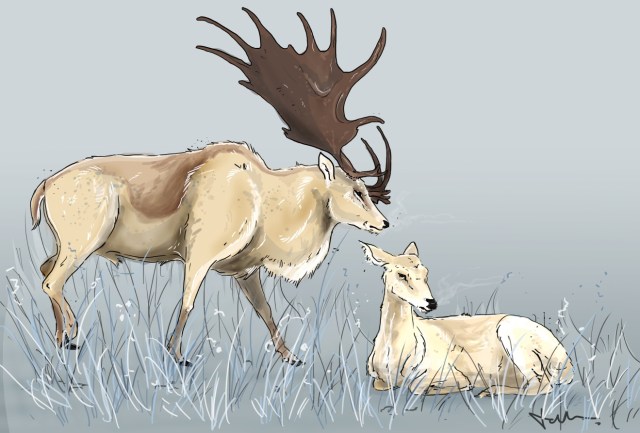
A proud, handsome male Megaloceros giganteus standing protectively over his mate.

A wonderful illustration of a proud male Megaloceros giganteus standing protectively over his mate. Those enormous antlers could grow longer than 12 foot! (Art by Tabitha Paterson)

Some websites reporting this new research indicated Bronze Age dates for the last of the Giant Deer – that is, they were around until only 5000 years before present (BP). This would have been a game-changer in every aspect for both palaeontologist and archaeologist. Within minutes I admit I had accessed my university library website, had Quaternary Science Reviews open and was reading that paper! Sadly, the Bronze Age dates aren’t there, but it is a high quality, well researched paper with excellent chronological results and perhaps an indication of some interesting archaeological possibilities.

This experienced research team developed substantially on the chronology of Giant Deer (Megaloceros giganteus) extinction created during the 1990s. It’s likely that the Giant Deer ceased to exist in Europe around 12,600 BP (calibrated), right on the Younger Dryas, although there’s also evidence suggesting some persisted in the British Isles until the warmer Littletonian phase around 11,500 BP (calibrated). It’s been accepted that there were small, isolated pockets of these majestic creatures surviving in Western Siberia until around 7700 BP, well within the Siberian Mesolithic/Neolithic transitional phase of human settlement.

One of the authors, Yaroslav Kuzmin who works at the Sobolev Institute of Geology and Mineralogy in Russia, has worked on numerous archaeological sites in Siberia, and has contributed greatly to a better understanding of Siberian prehistory. As regions go, Siberia is an incredibly important place, with its Ural mountain boundaries being the home grounds of the Yamna and Sintashta cultures of the Bronze Age. To understand the deep prehistory of the area is to get the prequel of the makings of those societies – and our own. The samples of Megaloceros bone, therefore, were picked from sites which have provided evidence of long-term human use. A sample of antler was found at a deliberate deposition in a grave of the 3rd millennium BC, in the south-western Siberian region of Sopka. Likewise, a maxilla of Megaloceros, with only one molar missing, was found in a burial context at the persistent burial ground of Preobrazhenka, also south-western Siberia. Other samples were taken from the Ust-Tushama and Sosnovy Tushamsk sites in the Angara river basin, in eastern Siberia.
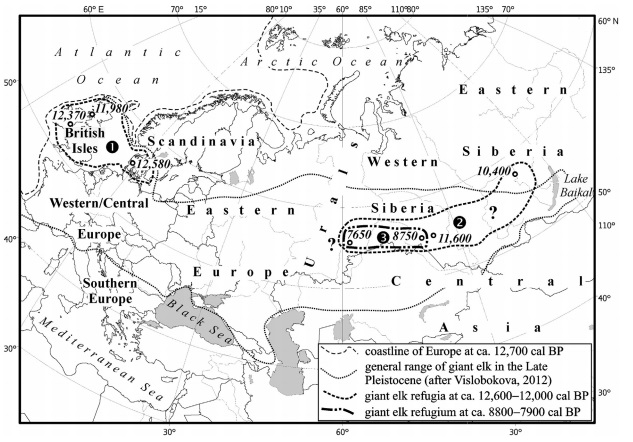
The long (image from )

The long expanse of the Siberian landscape. Illustrating the range of the Giant Deer localities (image from van der Plicht et al. 2015)

The radiocarbon dates are robust – from the reading of the article and the footnotes I have little doubt that the quality of the Megaloceros dental collagen used to produce the dates was enviably good. When modelled beside previous work by Stuart et al (2004), the picture shows an ever shrinking territory of this Pleistocene giant. By the end of the Younger Dryas, around 11,600 BP, the Trans-Ural populations still extended into eastern Siberia, but the next 2000 years resulted in their final decline in a restricted refugial zone of western Siberia, with radiocarbon dates suggesting that extinction occurred sometime after 7600 BP, on the boundary of steppe and mountain. It’s hard to say, however, if this is terminus post or ante quem. It’s clear there’s a lot of new research waiting in the wings, reinforcing what exciting times we live in for all things Pleistocene!

Now, this is a very strong hypothesis and it certainly means that western Siberian hunters of the Mesolithic period would most certainly have caught glimpses of the Giant Deer. It’s likely they hunted them too – food in these harsh environments would have been less abundant than warmer, luscious plains. Imagine the stories they would tell of these rare creatures, and how they passed into myth. When later societies found the huge antlers, and remembered the old, old stories of those eyewitnesses, it is no wonder that those tines were considered to be gifts worth placing within the graves of the palaeometal cultures of the 3rd millennium BC, linking them with the otherworldly land of the ancestors. After all, the dearly departed were making the journey to the same place as those giant Pleistocene monarchs of the steppes.

The steppes nestle at the foot of each side of the Ural mountain range. Presumably humans had long watched herds of wild horse, and various deer ( Megaloceros perhaps?) and ached to gallop across that landscape. Botai, in Kazakhstan, is just south of the final Megaloceros refugial zone; it is the site which offers an early date for the domestication of the horse, around 6000yrs BP. That domestication opened fresh vistas for the nomadic people of the region, new places to winter with their herds of livestock. It also opened trade routes and networks, which in turn created more sophisticated societies which ran in tandem with the development of metalwork.

Around 5000 years ago, the Bronze Age saw changes in burials – it was not sufficient to place a treasured heirloom of a prehistoric deer antler within a grave any more. Chieftains were interred with often exquisitely worked goods to see them into the afterlife. The Sintashta burials are elaborate, with horses and deer placed in graves with chariots and gold objects. The more mobile steppe tribes of early kurgan cultures again linked deer and horses in their burials, as noted by the ubiquitous J. P Mallory, academic par excellence. This link seems to persist from those early Bronze Age times right through to the Eurasian Iron Age. C 500 BC.

Many have heard of the Pazyryk ‘Ice Princess‘, in Siberia. Her exceptionally well preserved burial chamber was found in an area of the Altai called Ukok, known evocatively as the ‘pastures of heaven’. She was a special person to her tribe of Iron Age pastoralists, and archaeology has developed a pretty strong understanding of her early death, likely due to breast cancer. Her semi-mummified body is tattooed with fabulous creatures, which may hint at her holding a shamanic status rather than a royal one. The image of the great spreading antlers of bellowing deer is a recurring image on both her body art and her grave goods.

She is not alone in her embellishments. The great deer with huge antlers is a theme occurring in many Pazyryk graves. Rudenko and Gryaznov worked on many of these kurgan graves through the 1950s and 1960s, and it was not just the humans who were identified with the fantastical deer. Horses which had been sacrificed and placed within the graves were often masked with headgear which made them look like deer. Fabulous creatures now in death, hybrids of the flying deer depicted on Altai standing stones, and the familiar horse, ready to gallop through heaven where the ancestors of man, horse and deer  would know never-ending freedom.

A rather wonderful, if slightly bizarre, horse decorated as a deer. A Giant Deer perhaps? (Image from

A rather wonderful, if slightly bizarre, horse decorated as a deer. A Giant Deer perhaps? (Image from Rudenko, 1970)

Dr Ruth Carden, doyenne of all things Megaloceros, pondered if the deer depicted in these images and masks could be in fact the Siberian Red Deer. There’s a possibility of this, but the horns of the depicted creatures are so ornate, it’s hard to say. They are ornate and stylised , resembling the way a dreamer- or a child- would depict the Giant Irish Deer. Memory and myths are persistent things as we have seen from other Pleistocene creatures which were still half remembered from even earlier phases of human history. So, just for fun, let’s propose a scenario – and it’s only one of many which we can speculate on.

The research by van der Plicht’s team found samples of Megaloceros bones, which were from around 8900 to 8600 BP cal, as deliberate deposits in 5000 year old graves of the Siberian Neolithic. The memory of giant, lordly deer roaming the steppes would still be related in stories, with the presumption they had left the world of the mortal for the place the ancestors of all life dwelt in.  As time passed, hunters did not stalk prey on foot, but sped on horseback after their quarry. If you have ever had the raw delight of allowing a horse to gallop across a flat landscape, you will know that you feel the most complete sense of freedom, as though you are riding the wind itself. This sense of elation would likely be transferred into otherworldly experiences under the influence of hallucinogenic substances, which we know was an important part of the shamanic practice of steppes tribes such as the Pazyryk peoples of the Iron Age, c 500 BC.

In this altered, shamanic state, the hunted Siberian Red Deer would likely be considered a smaller, earthly manifestation of the remembered ancestor of deer, the Megaloceros. Everything is better, more ‘real’ and more heroic on the Other Side, as postulated by Plato in his Theory of Forms.  Horses chosen for sacrifice, which had once run down the lesser, extant species of deer, were making a transition to the heavenly pastures, sharing qualities with the hunted while still being part of the hunting team. Perhaps this is why the unfortunate horses were decked out in the crown of tines to represent the formidable giant deer which once shared those wild plateaux and plains. It is said in many religions of the past that things remembered never actually die.

Just like the sinuous tattoos of the ice mummies are interconnected, and always looking back at each other, so too archaeology, palaeoenvironmentology and palaeontology are interlinked. Papers such as van der Plicht et al’s new dates for the last of the Siberian Megaloceros allow us to look at later cultural practices with questions and potentials. For those of us who love teasing out the knotted wool of archaeology, such new findings of refugia which were shared with humans can only offer more questions and more exploration of that time when giants did indeed walk the earth.

Written by Rena Maguire (@JustRena)

The research and radiocarbon dating that inspired this post is from van der Plicht, J, et al. (2015), ‘New Holocene refugia of giant deer (Megaloceros giganteus Blum.) in Siberia: updated extinction patterns’ Quaternary Science Reviews, 2015, 114. [Full article]

A nice overview of the Giant Deer (Megaloceros giganteus) can be read in An Elk that wasn’t an elk.

Further Reading:

Bayarsaikhan, J. (2005), ‘Shamanistic elements in Mongolian deer stone art’. In: Fitzhugh, W, Bayarsaikhan, J. & Marsh, P.(eds), The Deer Stone Project: Anthropological Studies in Mongolia 2002–2004. Washington, D.C.: Smithsonian Institution, 41–53. [Full article]

Brentjes, B., (2000), ‘Animal Style’ and shamanism: Problems of pictoral tradition in Northern and Central Asia’. In: J. Davis-Kimball, E. Murphy, L. Koryakova and L.T. Yablonsky, eds. Kurgans, Ritual Sites, and Settlements Eurasian Bronze and Iron Age, BAR International Series 870. Oxford: Archaeopress. 259-268. [Full article]

Brück, J., (1999), ‘Ritual and rationality: Some problems of interpretation in European archaeology’. European Journal of Archaeology. 2.(3). pp.313-344. [Abstract only]

Gryaznov, M.P., (1950), Pervyi Pazyrykskii Kurgan. (First Pazyryk Kurgan.) ) St. Petersburg:Hermitage. (Russian.)

Gryaznov, M.P., (1969), The Ancient Civilization of Southern Siberia. J. Hogarth, trans. Geneva: Nagel. [Book]

Kuzin, Y & Orlova, L.  (1998), ‘Radiocarbon chronology of the Siberian Palaeolithic’. Journal of World Prehistory. 12. (1). pp.1-53. [Full article]

Mallory, J. P. (1981), ‘Ritual treatment of the horse in early Kurgan cultures’. Journal of Indo European Studies. 9. (3-4). pp.205-227.

Outram, A. et al. (2009). ‘The earliest horse harnessing and milking.’  Science 323.(5919). pp.1332-1335. [Full article]

Ripinsky-Naxon, M., (1993). The Nature of Shamanism: Substance and Function of a Religious Metaphor. Albany: State of New York University Press. [Book]

Rudenko S. I., 1970 [1953]. Frozen Tombs of Siberia. The Pazyryk Burials of Iron-Age Horsemen. M.W. Thompson, trans. Berkeley and Los Angeles: University of California Press. [Book]

Samashev, Z., (2007), ‘Culture of the nomadic elite of Kazakhstan’s Altai Region (based on materials for the Berel necropolis.)’ In: C. Chang and K.S. Guroff, eds. Of Gold and Grass: Nomads of Kazakhstan, pp.35-44. [Book]

Samashev, Z., et al. (1999). Berel mounds [online]. Kumbez. Available at: http://www.lorton.com/~kumbez/archelogy_2_eng.htm

Shanks, M. & Tilley, C., (1982). ‘Ideology, symbolic power and ritual communication: A reinterpretation of Neolithic mortuary practices’. In: I. Hodder, ed. Symbolic and Structural Archaeology. Cambridge: Cambridge University Press. pp.129-154. [Book]

Sinor, D., (1998), ‘The myth of languages and the language of myth’. In: V. H. Mair, ed. The Bronze Age and Early Iron Age Peoples of Eastern Central Asia. Philadelphia: Institute for the Study of Man and University of Pennsylvania Museum. pp.729-745. [Book]

Stuart, A.J., Kosintsev, P.A., Higham, T.F.G., Lister, A.M., 2004. ‘Pleistocene to Holocene extinction dynamics in giant deer and woolly mammoth’. Nature 431. 684-689. [Abstract only]

Vislobokova, I. A., (2012). ‘Giant deer: origin, evolution, role in the biosphere’. Palaeontology Journal. 46. pp.643-775. [Full article]

Vitebsky, P., (2005). The Reindeer People: Living with Animals and Spirits in Siberia. Boston:Houghton Mifflin. [Book]

Volkov, V. (1981), Olennyie Kamni Mongolii (Deer Stones of Mongolia). Ulaanbaatar: Academiya Nauk.

http://siberiantimes.com/science/casestudy/features/iconic-2500-year-old-siberian-princess-died-from-breast-cancer-reveals-unique-mri-scan/

Posted in Irish Elk | Tagged , , , , , , , , , , , , | 4 Comments

Overkill

“But how could they have killed them all with just pointy sticks?”

This question, or a variation thereof, has been asked of me, seemingly whenever I bring up the concept of overkill as the likely cause of Pleistocene megafaunal extinction. As long as people have known about mammoths, mastodons, and Megatherium, they have wondered why they are no longer around. For a period it was fashionable to blame extinction on climate change: firstly the Noachian flood, and then later the meandering cycles between glacial and interglacial conditions that the science of geology had discovered. However, as knowledge of the oscillations of the climate improved, it soon became obvious that the megafauna had survived numerous switches between warm and fruitful, and cold and frigid, each time passing through unscathed. What was different about the end of the Pleistocene that caused so many to disappear? Even early on, a few brave souls, knowing how humans treated the dodo, the solitaire and the great auk, put forth humanity as the despoiler of a Pleistocene paradise. In the late 20th century these ideas were eloquently condensed and elaborated upon by the great Paul Martin, who published his ideas on overkill: the idea that the megafauna were wiped out by a unique species of mammal. Us.

On the face of it, the evidence is overwhelming, the pattern is clear. Modern humans appear in a pristine environment; then all the largest mammals disappear. It happens at 60,000 years ago in Australia, it happens at 30,000 years ago in Europe, it happens at 10,000 years ago in the Americas. And there is more. Aside from the continental extinctions, megafaunal island extinctions in the prehistoric point the finger at us too. Continental mammoths go extinct everywhere by about 10,000 years ago, except on the isolated Arctic islands of Wrangel and St Paul. There, they hung on for a few thousand more years (until 1600BC on Wrangel) before going extinct at exactly the time when the first human inhabitants are known to have arrived. Similarly, the Caribbean was home to a number of ground sloth species, close relatives of the giants found in North and South America. While the giant Mylodon and Megatherium went extinct about 10,000 years ago, the island sloths survived well into the Holocene before finally joining the choir invisible, you guessed it, right after the first humans sailed there.

To be sure, it seems at first ridiculous, that animals with the size and power of our modern elephant or rhino, could be easily wiped out by humans with stone-age technology. People have been in Africa since the dawn of humankind, hunting elephants with lithics- why are they not extinct? This, to me, is the very crux of the question. In Africa, and south Asia, where humans have lived the longest, we still have megafauna. Those animals have evolved in step with us. As our abilities to hunt improved, so did their ability to avoid being hunted. Run or hide. Fight or flight. In essence, Africa and Asia were humanity’s proving ground, the battlefield for an arms race between megafauna and man. Outside of these regions, animals were naïve, unable to recognise us for the threat we were until it was too late.

Humans have so utterly conquered the globe that the idea that animals once had no experience of our ways, and were likely to greet us with curiosity or indifference is seen as strange. I can only think of perhaps two ecosystems where most animals remain naïve- the Galapagos archipelago and the Antarctic. Actually, there is one other ecosystem where megafauna are mostly naïve- interactions between people and cetaceans in the ocean show that despite our recent efforts at harvesting the majority of wild whales, they still regard us as insignificant and harmless. The history of whaling in the 20th century has shown how fatal this naivety can be to megafaunal species. Whales had the entire ocean to escape into, yet a few species came within a hair’s breadth of extinction. Where a species habitat niche is more constrained the effects are necessarily more severe. This lesson has been learnt before.

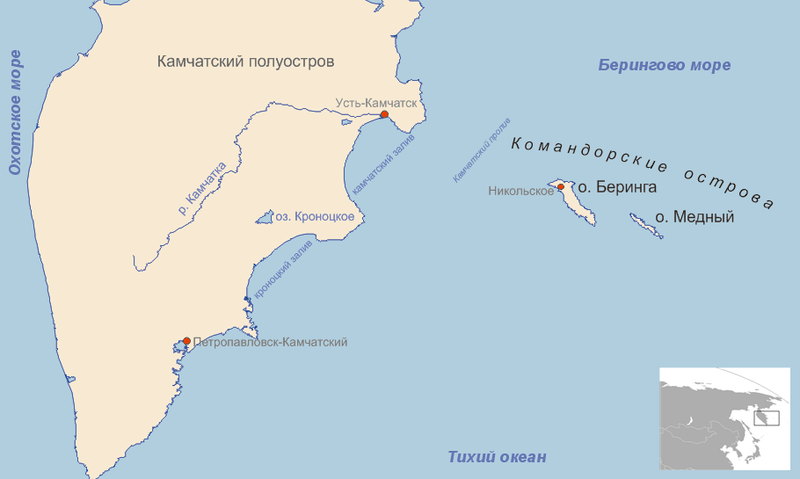
Map of Kamchatka with Bering and Medny islands from Wikimedia Commons

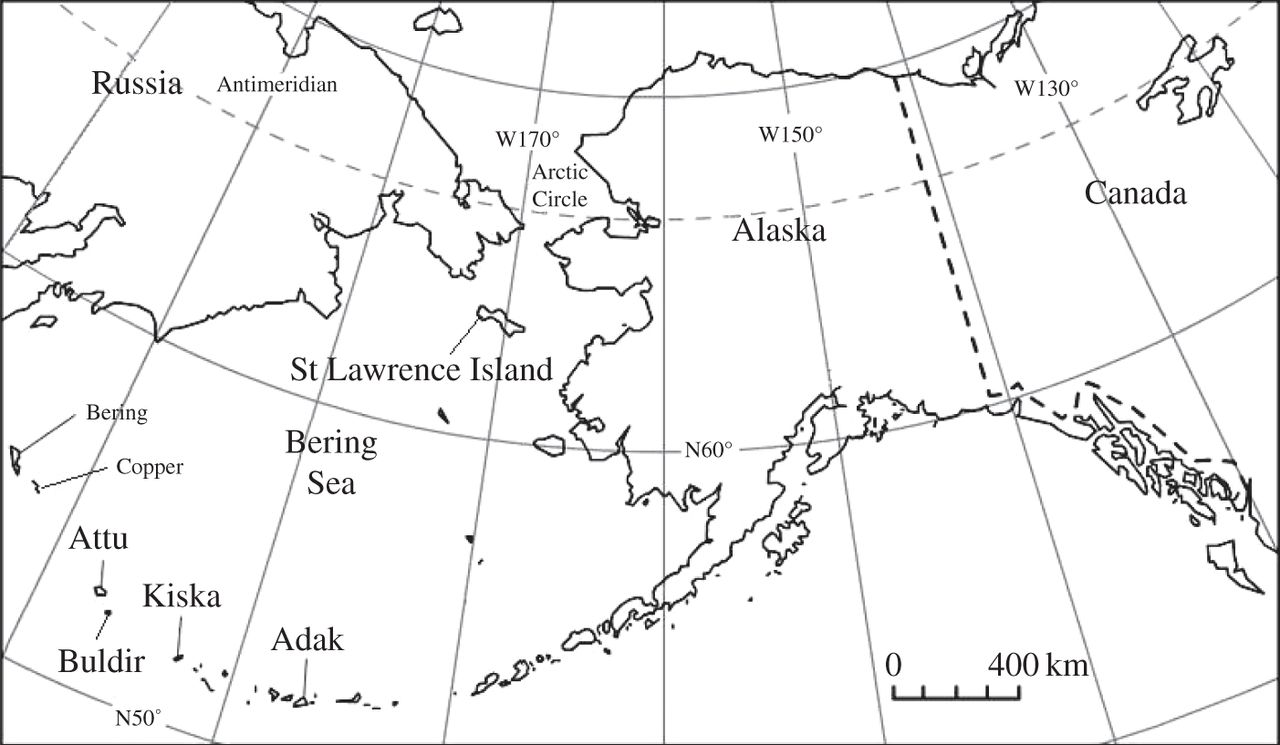
Map of islands of the Bering strait where Hydrodamalis gigas remains have been found. Image from Crerar et al.

Map of islands of the Bering strait mentioned in the text. Image from Crerar et al.

Georg Wilhelm Steller was a German naturalist with a need to prove himself. Like many scientists in the 18th century, the ship-borne age of discovery also had a need for him, and he was accepted aboard an expedition to remote Kamchatka with Vitus Bering (after whom the strait is named). Scurvy and shipwreck eventually took most of the ship’s crew and they were stranded on the uninhabited Commander islands (Bering and Medny[Copper] islands) about 100 miles east of Kamchatka. Despite his parlous situation, Georg managed to survey the biology of the islands. His most spectacular (and probably life-saving) discovery was a previously unknown species of giant sirenian (the family to which sea-cows, manatees, and dugongs belong). The eight metre long Steller’s sea cow (Hydrodamalis gigas) was truly a gentle giant, it ate only kelp and harmed no-one.

The cows lived in herds in shallow water and exhibited no reaction to the humans who would walk up to them, pierce them with a billhook and drag them onto shore to be butchered. Steller observed that herd members came to the assistance of injured herd-mates, and that the survivors of monogamous pairings would lie close to the flensed remains of their partner. To the starving survivors of Bering’s expedition, the animals were manna from Heaven: Steller himself likened the sea-cow meat to beef and the blubber to “the best Holland butter”. There’s no doubt that the nutritious sea-cow kept the expedition survivors alive during the bitter winter. Bering died on the island, but Steller and some other crew managed to return to Russia and stories of their adventure reached far and wide. The news of the epicurean delights to be found in the Commander islands led directly to the overharvesting of Hydrodamalis by fur-hunting expeditions. The speed and rapacity with which this was achieved is frankly shocking. The Medny island population was extinct within nine years. The Bering island population within twenty-seven years.


Skeleton of Hydrodamalis gigas from Bering island in the Helsink museum. Image via Wikimedia Commons

Skeleton of Hydrodamalis gigas from Bering island in the Helsinki museum. Note the lack of carpal bones, which had been lost in this species. Image via Wikimedia Commons

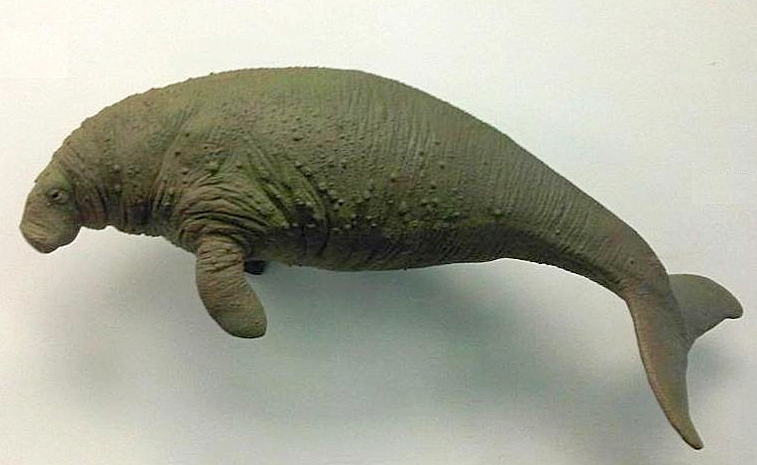
Reconstruction of Hydrodamalis gigas based on Steller's account of the living animal. Image via Wikimedia Commons

Reconstruction of Hydrodamalis gigas based on Steller’s account of the living animal. Image via Wikimedia Commons

And so, a Pleistocene giant, that once ranged from California to Japan, had a last stand on the frigid islands of the north Pacific in the second half of the eighteenth century. The animal was huge, had a very specific habitat requirement, was naïve (“they are not afraid of man in the least” according to Steller), slow-moving, and more importantly slow-reproducing. It’s hard not to see the parallels between the story of Steller’s sea cow and the mammoth- both survived on inhospitable islands, while the rest of their species had long perished, before finally succumbing to human exploitation.

An interesting thought experiment is prompted by a recent paper that reports a previously unrecognised population of Hydrodamalis from St. Lawrence island in the Bering strait. A combination of radiocarbon dating, ancient DNA, and stable isotope analysis showed that these animals went extinct around the 11th century, when Yupik groups colonised St.Lawrence. If the Commander island sea-cows had not been recorded by Steller, we would have an extinction pattern exactly analogous to the mammoth or ground sloths: continental extinction followed by prehistoric island extinction. Would we instead be arguing that Hydrodamalis gigas succumbed to the effects of climate change?

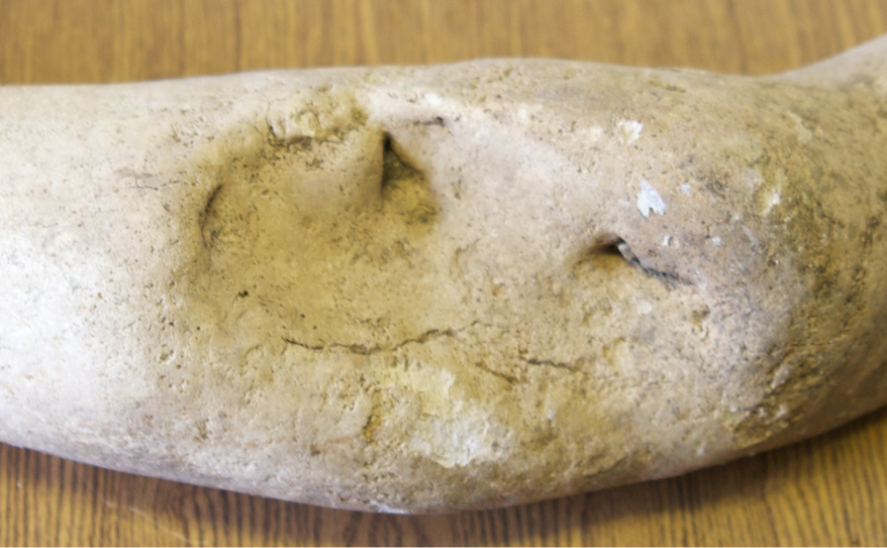
Hydrodamalis gigas rib collected on Bering island showing evidence of pathology. Likely the result of spearing with a 3-pronged harpoon that the individual recovered from. Image from Burdin 2012

Hydrodamalis gigas rib collected on Bering island and showing evidence of pathology. Likely the result of piercing with a 3-pronged harpoon. The individual survived for some time after. Image from Burdin 2012

Postscript

The story of the Steller’s sea cow is a cautionary tale about exploitation of natural resources. In the 27 years that they were known to science, it is estimated that around seven hundred trappers and sailors passed through the Commander islands and killed the cows for food. Their hunting methods were so wasteful that despite each cow containing enough meat for 30-40 people, the entire population of about 2500 animals was slaughtered. Now, even in the death of extinction, their very bones are prized. Carvers and whittlers seek out the thick, dense, ribs of the sea-cow for their work. The bones have found a special niche in the crafting of expensive knife handles. It is through exploitation of this fossil resource that scientists first came to discover that a population had once lived on St Lawrence. Dr Lorelei Crerar noticed the sea cow ribs on display at a craft convention in Atlanta, Goergia and was intrigued by their origin.

Written by Ross Barnett (@DeepFriedDNA)

Further Reading:

Burdin, A. “Climate Change: A view through the prism of Steller’s sea cow extinction.” NPS Reports (2012) [FullText]

Crerar, L. D., A. P. Crerar, D. P. Domning, and E. C. M. Parsons. “Rewriting the History of an Extinction- Was a Population of Steller’s Sea Cows (Hydrodamalis Gigas) at St Lawrence Island Also Driven to Extinction?”. Biology Letters (2015).[FullText]

Domning, D. P., J. Thomason, and G. B. Corbett. “Steller’s Sea Cow in the Aleutian Islands.” Marine Mammal Science 23, no. 4 (2007): 976-83.[Abstract]

Forsten, A., and P. M. Youngman. “Hydrodamalis Gigas.” Mammalian Species, no. 165 (1982): 103.[FullText]

Guthrie, R. D. “Radiocarbon Evidence of Mid-Holocene Mammoths Stranded on an Alaskan Bering Sea Island.” Nature 429 (2004): 746-49.[Abstract]

Martin, P. S. “Prehistoric Overkill: The Global Model.” In Quaternary Extinctions: A Pregistoric Revolution, edited by P. S. Martin and R. G. Klein, 354-403. Tucson: University of Arizona Press, 1984.[Book]

Steadman, D. W. “Asynchronous Extinction of Late Quaternary Sloths on Continents and Islands.” Proceedings of the National Academy of Sciences of the U.S.A. 102, no. 33 (2005): 11763-68.[FullText]

Stejneger, L. “How the Great Northern Sea-Cow (Rytina) Became Exterminated.” The American Naturalist 21, no. 12 (1887): 1047-54.[FullText]

Steller, G. H. De Bestiis Marinis (1751) [Book]

Vartanyan, S. L., K. A. Arslanov, J. A. Karhu, G. Possnert, and L. D. Sulerzhitsky. “Collection of Radiocarbon Dates on the Mammoths (Mammuthus Primigenius) and Other Genera of Wrangel Island, Northeast Siberia, Russia.” Quaternary Research (2008).[FullText]


Posted in Sea cow | Tagged , , , , , , , , , , , , , , , , , , , , , , , | 14 Comments

The strangest animals ever discovered

I love reading through Charles Darwin’s diaries. Who wouldn’t? Written in his early 20s, Darwin writes detailed accounts of his days on board HMS Beagle. For me, these are accounts of fantastic, real, adventures: travelling where no Englishman had travelled before, discovering new animals and plants, and finding gigantic creatures trapped in the rocks. His own words, scrawled in his cramped cabin, or beneath the clear South American night transports you back with him.

Who doesn’t dream of adventure like that? I am a strong believer in creating your own adventures in life, yet there is something wonderfully romantic about being swept away in somebody else’s.

Darwin was almost never on the Beagle. A young Robert Fitzroy unexpectedly took command of the big ship during it’s first voyage when the captain shot himself. It wasn’t unusual for captains to fall into depression on long voyages away from home. Fitzroy was paranoid and didn’t want to go the same way as his predecessor (or his uncle, who slit his own throat). He wanted a travel companion for the next voyage. News of this potential opportunity reached Darwin in a letter from his old lecturer, John Henslow, at Cambridge University. After a meeting with Captain Fitzroy, and then persuading his father it would be a worthwhile journey, Darwin joined the HMS Beagle on what would almost be a 5 year voyage around the world. A voyage that would change how this man viewed the world he lived in.

As the captain’s companion, Darwin had no official duties on the ship. Captain Fitzroy was making a detailed survey of the South American coastline, so there was ample opportunity for Darwin to explore. And explore he did. He collected, prepared and sent back to England numerous crates of new animals and plants unknown to science. Much to Robert McCormick’s frustration. As the ship’s surgeon, McCormick also wore the title of ship’s naturalist. But he was tied up too much in treating sick sailors he couldn’t compete with the enthusiastic young Darwin who was free to spend days collecting as much as he wanted to. McCormick left the Beagle after only 4 months on board.

The route of the 2nd Voyage of the HMS Beagle. (Image "Voyage of the Beagle" by WEBMASTER at the German language Wikipedia. Licensed under CC BY-SA 3.0 via Wikimedia Commons - http://commons.wikimedia.org/wiki/File:Voyage_of_the_Beagle.jpg#/media/File:Voyage_of_the_Beagle.jpg from here)

The route of the 2nd Voyage of the HMS Beagle. The majority of the voyage was spent surveying the coastline of South America. (Image by WEBMASTER at the German language Wikipedia. from here)

The legacy of Darwin’s Beagle voyage goes beyond the Galapagos finches. A huge number of new animals stored in alcohol, prepared as skins, or delicately pinned, were shipped to England in enormous crates. My personal favourite is the beautifully unusual Rhinoderma darwinii: Darwin’s frog. The males of this bizarre amphibian have an extra large air sac, which they uses to raise their young. Inside their body. Nature never ceases to amaze.

There were also bones in the crates Darwin shipped back to England. Bones of giants.

Exploring rugged rock outcrops, and using the local knowledge, Darwin found troves of fossils from all over South America. Fossilised bones of very large beasts. These were the remains of Pleistocene mega-fauna: creatures no one had seen before.

The majority of these long dead creatures were relatively easily identified by the great comparative anatomist, Richard Owen. There were several species of giant sloth (Mylodon darwinii, Glossotherium sp., and others). Other fossils included remains of a horse, a Glyptodont, and some Stegomastodon bones. There were two other animals Darwin collected that were so strange, they baffled even the great Owen: the weird looking Macrauchenia and the misfit rhinoceros-looking beast Toxodon

A herd of wonderfully weird Litopterns. (Art by Tabitha Paterson)

A herd of wonderfully weird Litopterns. (Art by Tabitha Paterson @TabithaPaterson)

Owen thought the Macrauchenia belonged to the now obsolete group, Pachydermata (which grouped the elephants along with some herbivores). He also placed it as being close to the camels. It was later placed in a new Order of its own, the Litopterna.

Analysis of collagen preserved in fossils reveals that the unusual native ungulates of South America (such as Toxodon platensis, seen here) were more closely related to perissodactyls (horses and their allies) than to other extant placentals. (Illustration © Peter Schouten)

The unusual native ungulate of South America, Toxodon platensis. This beast has been moved in and out of different taxonomic groups several times, never really settling in to something which fitted. (Illustration © Peter Schouten)

Toxodon caused similar confusion straight from the beginning. Darwin thought one specimen he purchased was the giant ground sloth Megatherium. Another specimen he suggested belonged to the Rodentia. Owen placed it in that great group that never was, Pachydermata, but he also suggested it shared affinities with Rodentia (mice, rats, etc.), Edentata (sloths) and herbivorous cetaceans (whales). It seems Owen couldn’t really make up his mind about where this creature should sit in life’s grand tree. More recently Toxodon has been reassessed and placed in the Order Notoungulata (which includes Toxodon and Typotheria, another large, extinct rodent-like beast).

Features in the bones of Toxodon and Macrauchenia both have hinted at relationships to several different types of animals, including elephants, rodents and camels. But for over 180 years their true identity has been hotly debated. It’s all been a little chaotic for these two strange animals.

Until now.

A new study by Welker et al. (2015) published in Nature may have sorted out this taxonomic nightmare.

Exploring relationships between organisms can be done by studying DNA. This is the most common way of producing a species tree (or phylogeny). Unfortunately, DNA degrades very quickly and rarely turns up in fossils that are tens of thousands of years old (although it does happen in special cases). Something else in fossils does survive much longer: collagen. This is a pretty tough, resilient protein, which makes up a large part of the muscles, tendons, and organic fraction of bones in our bodies. Collagen can also be a source of evolutionary information, as it is variable. The amino acid sequence that makes up collagen (coded for by genes in the organism’s DNA) differs slightly from species to species, with the closer together the species, the more similar the collagen they share. In an analogous way to DNA phylogenies, the variation in the amino acid sequence from collagen can be used to construct family trees for species.

A large number of Toxodon and Macrauchenia bones were tested, analysed, arranged, and modelled. The team even sequenced a number of other extinct animals with less confused taxonomies – a horse, mammoth and a giant ground sloth, as well as some modern species to check that their methods worked. The results show that these two creatures were more closely related to other mammal groups than previously thought. They both belong to the Order Perissodactyla (the odd-toed ungulates, a group that includes horses, rhinos and tapirs).

An early draft of teh (Image reproduced with kind permission from Matthew Collins)

An early draft of the tree showing the relationship between the Toxodon and Macrauchenia to other mammals. The chicken at the bottom is there for a reason – it tests that the other results are sound: if they fit into the chicken group, then something is very wrong! At the top right, the close relationship between the rhinos, horses, and tapirs. The protein analysis places Toxodon and Macauchenia related to the Perissodactyla, creating the new Panperissodactyla. (Image reproduced with kind permission from Matthew Collins)


This is huge news! As well as resolving one of the oldest mysteries in palaeontology, the methods discussed in this new paper open the door for a  suite of new studies of strange and enigmatic taxa! Ancient DNA is great, but because it is quite a fragile molecule, there are only a few special sites and conditions that allow it to be preserved. Looking at proteins, which are much sturdier molecules, could give us a whole new window into the past!

Written by Jan Freedman (@JanFreedman) and Ross Barnett (@DeepFriedDNA)

Further reading:

Welker, F, et el. (2015), ‘Ancient proteins resolve the evolutionary history of Darwin’s South American ungulates’, Nature. [Abstract only]

Charles Darwin’s Beagle diary online: here

Fernicola, J. C., Vizcaino, F, and de Iuliis, G. (2009), ‘The Fossil Mammals collected by Charles Darwin in South America during his travels on board the HMS Beagle’, Revista de la Asociatión Geológica Argentina. 64 (1), 147-59. [Full article]

Posted in Macrauchenia, Toxodon | Tagged , , , , , , , , , , , , , , , , , , , | 12 Comments

The Islands of the lost fowl

There’s more to Hawaii than Jimmy Buffett (okay, I admit – I’m a Parrothead!), Elvis, surfing or  even Disney’s adorable and naughty alien Stitch. Even more so if you love earth sciences like us at Twilight Beasts. Hawaii is literally a hot spot for seeing hot fiery lava erupt like rivers of thick custard. What makes Hawaii a geologists dream is what lies beneath: it sits on top of a ‘hotspot’ – an area of the earth’s crust which produces considerable tectonic activity, even though there are no plate boundaries nearby. Geologists think that an enormous plume of hot, molten lava from deep within the Earth has floated up and pushed itself out at this location. As the Pacific Plate has been moving slowly for untold millennia in a north-westerly direction, right across the ‘hotspot’ there are older, now dormant Islands: evidence that the tectonic plate moved, slowly, over this massive hot magma balloon. It gets more complicated because it has been active for several million years, so there must be some ‘fresh’ molten rock being fed in to the plume. As it is today, the hotspot shows no signs of slowing, demonstrated by the spectacularly magnificent lava flows Hawaii regularly sees.

The neverending magma being pushed out from teh belly of teh Earth. This disagram illustrated (Image from here: "Hawaii hotspot cross-sectional diagram" by Joel E. Robinson, USGS. - Cropped from the 108 MB PDF file available here and described here.. Licensed under Public Domain via Wikimedia Commons - http://commons.wikimedia.org/wiki/File:Hawaii_hotspot_cross-sectional_diagram.jpg#/media/File:Hawaii_hotspot_cross-sectional_diagram.jpg)

The never-ending magma being pushed out from the belly of the Earth. This diagram illustrates the awesome plume under the crust, as the plate above slowly moves over it. (Image  by Joel E. Robinson, USGS. From here.)

Studding the Pacific Ocean like a chain of fiery garnets, the Hawaiian Islands remained uncolonised by humans for most of prehistory – although who knows what new and exciting evidence will be found at some random excavation? That’s certainly why I do what I do! As a result of that splendid isolation – over 3800 km from the American coastline – the islands became home to species which cannot be seen, or matched, anywhere else in the world. Remember that island life does funny things to living, breathing creatures, making flora and fauna adapt to a specific ecosystem. I could tell you about fiendishly cute bird-eating owls, adorable mole-ducks – but they’ll all be for another time. This story is about the Giant Hawaiian Duck, the Moa-Nalo.

Their name in many ways reflects the sense of island isolation and also their extinction – Moa-Nalo means ‘ lost fowl’ in Hawaiian.  We know of four species; Kauai island’s Chelychelynechen quassus, Maui island’s Ptaiochen pau and Thambetochen chauliodous (though it was found on some other islands too), and Thambetochen xanion from Oahu. The exciting field of DNA research suggests the Moa Nalo were closely related to today’s little dabbling ducks who are members of the Anas genus. That being said, these were not little pond ducklings you’d be feeding peas or cracked corn to on a Sunday walk. These birds weighed in at around 16.5kg, with the muscular body of a large swan, although they were flightless. Their flightlessness initially led to them being classified as a variety of goose. However, one little bone from Moa Nalo that makes a duck quack like a duck and not sing like a lark (the fossilised syringeal bullae) allowed palaeontologists realise they were dealing with a duck which may very well have strayed from a different region of the Pacific a long, long time ago. A very large, very unique duck.

They certainly looked strange compared to our understanding of what a duck should look like. The weird Chelychelynechen quassus had  a stubby little beak which some feel looks more like a turtle’s snapper (the Latin name actually means ‘turtle jawed broken goose’), while the other genera had little serrated teeth-like edges to their beaks, sometimes called pseudoteeth (not true teeth, just teeth-like growths from their beaks).  That turtle beak and those little serrations were for a good reason.  Those ‘teeth’ were needed to chew through much coarser material than pondweed!

A very cute looking giant duck with the odd shaped 'turtle' beak. (Reconstruction by Carl Buell. Image from here)

The very cute looking giant duck, as big as a swan, with the odd shaped ‘turtle’ beak. (Reconstruction by Carl Buell. Image from here)

Fossil poo is a wonderful thing. Coprolites (fossilised poo) can tell us a huge amount about the food consumed by any creature, and what ailments they may have been prone to. Studies of the Giant Hawaiian Duck poo have indicated the vegetation they ate was often coarse and prickly, including Hawaiian lobeliads, as well as tough and chewy ferns.  They had a very specific niche in the environmental order of early Hawaii, keeping vegetation chewed back, and encouraging other plants to thrive.

These birds have been found only on the oldest volcanic islands, suggesting they had many millennia to diverge in such a unique way, and fill a unique biological niche. Although it’s certainly not precise, mtDNA studies indicate time periods of over 3 million years with regards to genetic divergence from other Anatinae, making them pretty special indeed.

However, while our feathered friends were happily being herbivorous to the extreme in sunny Maui, other events were happening, with the expansion of a deadly species. Homo sapiens. The Polynesian peoples were constantly expanding their vistas. This ingenious culture which prized curiosity and adventure sailed the Pacific in deceptively fragile-looking canoes. It appears likely that these seafaring free spirits landed first on Samoan and Tongan shores during the equivalent of Europe’s Bronze Age, c 1500 BC but their eyes were always straining towards the horizon, and their minds moving to what may be found there.

The sand dune settlement at Pu‘u Ali‘I, on South Point, Big Island, has produced intriguing dates of limited human activity at around AD 124, give or take an error of about 60 years (calibrated, by the way). The artefacts found at Bellows sand dunes, Waimānalo on the island of Oahu appeared initially to reinforce an early date, with fish-hooks and adzes of a similar style to those found in the Marquesas Islands, which had been settled by Polynesian adventurers in late prehistory. Perhaps these were sheltering sailors, or castaways from a storm. At any rate, if these dates are even a wee bit right, and not the result of some pretty poor dating, this must have been the earliest colonisation phase, with a long lull between the initial arrival of pioneers and a more substantial colonisation, as the majority of archaeological sites date closer to between AD 800, and perhaps as late as AD 1000.

A fun map of the Hawaii islands, (Public Domain image from here)

A fun map of the Hawaii islands. The older island of Oahu is in the top left of this image. Big Island can be seen in the bottom right.  (Public Domain image from here)

When these people arrived, they discovered an island of strange creatures. The flightless Moa Nalo had no natural enemies except a limited amount of carnivorous owls. The two legged creatures who leapt from their canoes were likely a source of curiosity to these beautiful birds who had existed in a state of balanced environmental peace for so long. They, like the Dodo on Mauritius Island, made for pathetically easy pickings for hungry humans. Extinction was imminent. We know that the Polynesians had hitch-hikers on board their canoes – sneaky little Rattus exulans, the Pacific rat. Its bones are within the same stratification as those of the Moa Nalo at Ewa plains sinkholes, on Oahu. Those have been pretty well dated to around AD 1160 (calibrated). It’s pretty likely R. exulans predated on the eggs of these giant ducks, which again, hastened their demise from the avifauna of the world.

It often infuriates me when history tries to tell us that our ancestors lived in a blissful state of harmony with their environments, when it just isn’t true. Ancient peoples were wasteful, destructive and thoughtless of their environment, which accounts for the recurring theme of extinctions and lack of managing natural resources. It’s an incredibly sad fact that such a little span of time separates us from these stunning and strange birds who were basically unknown until their bones started appearing in Hawaiian excavations during the boom years of the 1980s.  Moa Nalo, the lost fowl, were not lost to history any more.

There’s an interesting addendum to this story, which isn’t as quackers as it seems. The rewilding programme of Makauwahi Cave Reserve, on Kauai Island acknowledges that the modern environment is out of kilter with the original floral and faunal assemblages of even a millennia ago. We are not at a stage where we can do a ‘Jurassic Park’ on the creatures humans have slaughtered, but we can try to ensure the environment can recover from often destructive, invasive species. Makauwahi Reserve have introduced giant tortoises to chomp on the invasive species, allowing the native vegetation to flourish as it did when the Giant Hawaiian Ducks thrived on those remote Pacific shores.

Written by Rena Maguire (@JustRena)

HawaiiHistory.org. Available here

Allen, M. S. (2004), ‘Revisiting and revising Marquesan culture history: new archaeological investigations at Anaho Bay, Nuku Hiva Island’,  Journal of the Polynesian Society. 113. pp.143–196. [Full article]

Athens, J. S. & J. V. Ward. (1993), ’Environmental change and prehistoric Polynesian settlement in Hawai‘I’, Asian Perspectives. 32. pp.205–223. [Abstract only]

Athens, J. S., et al. (2002), ‘Avifaunal extinctions, vegetation change, and Polynesian impacts in prehistoric Hawai‘I’, Archaeology in Oceania. 37. pp.57–78. [Full article]

Burney, L. P. & Burney, D A. (2003), ‘Charcoal stratigraphies for Kaua‘i and the timing of human arrival’. Pacific Science. 57. pp.211–226. [Full article]

Burney, D. A. & Kikuchi, W. K. P. (2006). ‘A millennium of human activity at Makauwahi Cave, Maha‘ulepu, Kaua‘I’. Human Ecology.  34. pp.219–247.

Dye, T. S. (1992). ‘The South Point radiocarbon dates thirty years later’.  New Zealand Journal of Archaeology. 14. pp.89–97.

Emory, K. P. & Sinoto, Y. H. (1961). Hawaiian Archaeology: O‘ahu Excavations Bernice P. Bishop Museum Special Publication No. 49.  Honolulu : Bishop Museum Press.

Hume, J. P, & Walters, M. (2012).  Extinct Birds. London: A and C Black. [Book]

James, H. F., & Burney, D. A. (1997). ‘The diet and ecology of Hawaii’s extinct flightless waterfowl: evidence from coprolites’. Biological Journal of the Linnean Society.  62.2. 279-297. [Full article]

Kirch, P. V. (1971). ‘The Halawa Dune Site (Hawaiian Islands): A Preliminary Report’. Journal of the Polynesian Society. 80. pp.228– 236. [Full text]

Naish, D. (2014). ‘The fossil record of bird behaviour’. Journal of Zoology. 292. pp.4. 268-280. [Full article]

Pearson, R. J , Kirch,P. V, & Pietrusewsky, M. (1971). ‘An early prehistoric site at Bellows Beach, Waimanalo, Oahu, Hawaiian Islands’.  Archaeology and Physical  Anthropology in Oceania 6. pp.204–34. [Full article]

Proctor, N. S. (1993). Manual of Ornithology: Avian Structure & Function. London: Yale University Press. [Book]

Reardon, S. (2014). ‘Rewilding: the next big thing?’. New Scientist.  221. pp.2958. 40-43. [Full article]

Slikas, B. (2003). ‘Hawaiian Birds: lessons from a rediscovered avifauna’. The Auk 120. (4). pp.953–960. Available at:   http://www.bioone.org/doi/pdf/10.1642/0004-8038%282003%29120%5B0953%3AHBLFAR%5D2.0.CO%3B2

Sorenson, M. D., et al. (1999).  ‘Relationships of the extinct moa-nalos, flightless Hawaiian waterfowl, based on ancient DNA’. Proceedings of the Royal Society of London. Series B: Biological Sciences. 266 (1434). pp.2187-2193. [Abstract only]

Spriggs, M. J. T. & Anderson, A. (1993). ‘Late colonization of East Polynesia’.  Antiquity.  67. pp.200–17. [Full article]

Ziegler, A. C. (2002). Hawaiian Natural History, Ecology, and Evolution.  Honolulu : University of Hawaii Press. [Book]

Posted in Giant Hawaiian Duck | Tagged , , , , , , , , , , , , , , , , , , , , | 12 Comments

Real vampires in South America

Vampires have captivated our imagination for centuries. Despite limited (and fairly predictable) on-screen deaths by stake, sunlight, or a splash of holy water, the sci-fi/horror genre is still going strong (if you ignore the recent Twilight ‘saga’). Old school classics such as The Lost Boys and Bram Stoker’s Dracula are still as watchable today as they were 25 years ago. (Some may argue that perhaps the genre reached its heyday with the wonderfully witty and excellent Buffy the Vampire Slayer.) There is something about these fictional beings that fascinate us. Like Sirens before them, vampires seem to lure us in and, for some unfathomable reason, many of us find them utterly compelling.

You won’t be surprised to discover that the mother of all vampires lived during the Pleistocene.

Belonging to the subfamily Desmodontinae, vampire bats can only be found in Central and South America. Contrary to old tales of blood sucking bats in Europe, these fluttering fiends are not, and have never been, residents there. In fact, tales of demons eating flesh and drinking human blood can be found in almost every culture centuries old. The Persians, Babylonians, Maya, Ancient Greeks and Romans all had their own tales of thirsty beings with a particular taste for thick, warm human blood.

Gruesome evidence of ‘vampires’ has been found in over 100 burials in Bulgaria: each skeleton had a metal object thrust through the chest. These ‘vampire killings’ date back to around 800 years ago. But this was long before bats were associated with blood sucking monsters. It appears that bats silently swooped their way into the legends of vampires after Europeans began travelling to the New World. The earliest record of a real vampire bat was from a particular unlucky Spaniard who, in 1526, saw one drinking the blood from his toes, Yep. His toes. A pretty terrifying thing to wake up to. And no doubt that this was ‘proof’ that the tales of blood sucking demons were true.

There are currently only three extant species of vampire bats darting through the night in Southern and Central America. The White Winged Vampire Bat (Dieamus youngi) and the Hairy Legged Vampire Bat (Dyphilla ecaudata) both feed on blood of birds, and the Common Vampire Bat (Desmodus rotundus) feeds on mammals. They split from their common ancestor some time during the middle of the Pleistocene.

The skull of a Common Vampire Bat (). Check out those front inciors! (Image by "Vampire bat skeleton face" by Mokele - Own work. Licensed under CC BY 3.0 via Wikimedia Commons - http://commons.wikimedia.org/wiki/File:Vampire_bat_skeleton_face.jpg#mediaviewer/File:Vampire_bat_skeleton_face.jpg from here)

The skull of a Common Vampire Bat (Desmodus rotundus). Check out those front incisors! (Image by Wiki member Mokele from here)

Vampire bats are not big animals. They would comfortably sit on the palm of my hand. I would rather they didn’t though because they have one terrifying way of feeding. These animals don’t feed on insects, or fruit; they feed solely on blood. Warm, wet blood. They use their highly evolved teeth to slice into the skin of an animal; the top incisors were super sharp, like knives, so the unsuspecting victim wouldn’t feel a thing. Unlike the fictional vampires, real vampire bats don’t suck up the blood, they ravenously lap it up with their tongue, as it oozes out.

Adding to the eeriness of these creatures is that they can walk. Using their hands in front, these animals that are usually more happy on the wing, can scuttle across the ground pretty fast!

There were a few more species of these blood suckers silently flapping around in the Pleistocene’s dark twilight. Amongst others there was the little Florida vampire, Desmodus archaeodaptes, which fluttered around from the Late Pliocene to the middle Pleistocene. There was another, D. stocki, that was a little bit bigger than the Common Vampire Bat, with a skull length of 2.7cm (compared to 2.6cm of the Common Vampire Bat). It appears D. stocki had thicker bones, making this a relatively more robust bat, possibly with a different mode of locomotion when walking. Then, there was the largest of the vampire bats. It should come as no surprise to find out it was named Desmodus draculae.

Comparisons of the fossil skulls of Desmodus draculae (on the left) alongside the Common Vampire Bat, Desmodus rotundus (on the right). (Illustrations by Jan Freedman, based on the Figures in Morgan et al. 1988)

Comparisons of the fossil skulls of Desmodus draculae (on the left) alongside the Common Vampire Bat, Desmodus rotundus (on the right). Scale bar is 1 cm. (Illustrations by Jan Freedman, based on the Figures in Morgan et al. 1988)


With a skull length of 3.1cm, compared to the tiny 2.6cm of the common vampire bat, it wasn’t enormous, but it is the largest vampire bat so far discovered. With the scant remains discovered so far, it has been estimated to be 30% larger than the Common Vampire Bat, and so named the ‘Giant Vampire Bat’. It was no Giant Golden Crowned Flying Fox (which fortunately just eats fruit, but is something from a horror film), but it would have given you a bit of a shock, with a wingspan somewhere between 50-60cm (roughly as long as my arm). Chances are that this big beast would have rather fed on my short rugby player thighs than my little toes. Which begs the question: what on Earth were these giants feeding on?

Luckily for these bats, there was no shortage of blood donors. D. draculae was living during a  time when giant mammals lolloped across the landscape,  including a number of species of giant sloth (Megatherium, Mylodon, and Nothrotherium), Toxodon, and the weird Macrauchenia. Writing on potential food sources for the Giant Vampire Bat, Darren Naish (@Tetzoo) notes how some fossils of the bat have been found associated with some mega-fauna, illustrating that the bats were living alongside these big, hairy mammals. Although we cannot say with 100% certainty, chances are these giants provided a nice warm drink. With terrifyingly larger, sharper incisions D. draculae would have had no problem piercing through the skin of most mega-fauna.

Surprisingly, this species was discovered relatively recently, in 1988. Described from a cave in Northern Venezuela, although no explanation was required, the authors justify naming the species draculae:

“The specific epithet of this largest known chiropteran vampire commemorated Count Dracula, the greatest human vampire of folklore.” (Morgan, et al. 1988)

Fossils remains have been recovered from sites in Venezuela, Ecuador, Brazil, Cuba and Argentina. One specimen has been radiocarbon dated at just 400 years old, suggesting that this giant species has only very recently become extinct. However, it is wise to be cautious of one date from one bone, as there are several reasons for such a young date, including contamination of the specimens. More bones with more dates will undoubtedly provide more fascinating information about this wonderful beast.

Quite possibly the most terrifying God conjured up by the Maya was Camazotz, a half bat half human with an unbelievable bloodthirsty temper. It appears Maya culture was relentlessly gruesome, and this was no exception! Camazotz was known for tearing heads off other gods and ferociously draining blood from its victims. No doubt this figure was created from witnessing vampire bats. Was Camazotz based on the Giant Vampire Bat seen in the flesh by the Maya? Perhaps we will never know, but Camazotz was the original Dracula, modelled on real vampire bats.

Here is an amazing video of a Common Vampire Bat feeding and walking.

Written by Jan Freedman (@JanFreedman)

Further reading:

de Mello Martins, F & Hubbe, M, (2012), ‘Craniometric diversity of the common vampire bat (Desmodus rotundus) in Central and South America’, Journal of Mammalogoy. 93 (2). pp.579-588. [Full article]

Greendhall, A M, Joermann, G, & Schmidt, U, (1983), ‘Desmodus rotundus’ Mammalian Species. 202. pp.1-6. [Full article]

Hutchinson, J H, (1967), ‘A Pleistocene Vampire Bat (Desodus stocki) from Potter Creek Cave, Shasta County, California’, PlaeoBios. 3. pp.1-6.

Morgan, G S. et al. (1988), ‘New species of fossil vampire bats (Mammalia: Chiroptera: Desmodontidae) from Florida and Venezuela.’ Proceedings of the Biological Society of Washington. 101 (4). pp.912-928. [Full article]

Pardinas, U & Tonni, E (2000), ‘A giant vampire (Mammalia, Chiroptera) in the Late Holocene from the Argentinean pampas: palaeoenvironmental significance’, Palaeogeography, Palaeoclimatology, Palaeoecology, 160 (3-4). pp.213-221. [Abstract only]

Suarez, W. (2005), ‘Taxonomic status of the Cuban vampire bat (Chiroptera: Phyllostomidae: Desmodontinae: Desmodus).’ Caribbean Journal of Science. 41. pp.761-767. [Full article]

Posted in Giant Vampire Bat | Tagged , , , , , , , , , , , , , , , , , , , , , , | 97 Comments

When is an aardvark not an aardvark? When it’s from Madgascar!

I think about extinction a lot. Its hard not to when researching Pleistocene mammals. One of the sobering things about this kind of research is that you become aware of the high likelihood of “unknown unknowns”: animals that existed but left no fossil traces for us to find, no hard evidence to let us know of their time on this planet. The scores of species that are known from just one fossil site, or just a few scraps of unusual bone all but confirm that there must have been species that we will simply never know about. And mammals are the one animal group that we actually have a good handle on. Think about how many Pleistocene fish, insects, and other groups we are likely to have missed.

In these kind of situations it is the insular, endemic, and highly specialised fauna of island ecosystems that are most likely to have been totally erased, given they are generally low in population size and restricted in range. It makes it all the sweeter when incredibly rare fossil island taxa get scientific (or media) attention. I would like to introduce a taxon known from only a handful of fossil sites, which comes from the island of Madagascar, and went extinct in the late Holocene. The unique bibymalagasy (Plesiorycteropus madagascariensis) is incredibly weird.

plesio2

Partial skull (below) and ulna (above) of Plesiorycteropus, from MacPhee 1994

plesio

Despite being practically next door to Africa, Madagascar’s fauna is stuffed full of weird endemic creatures: the lemurs, the elephant birds, the eupleridae. The Mozambique channel is so strong that almost nothing gets to Madagascar from Africa- even humans colonised it from the East (the native Malagasy are thought to be a Bornean diaspora). When familiar creatures did arrive from Africa (like the hippos), they evolved in strange directions (into dwarf hippos, with large floppy ears according to local folklore). If selection pressures are intense, issues of homoplasy can come into play, and given enough time, the true ancestry of a species can be obscured. This seems to have been what happened with the bibymalagasy (the name simply means “Malagasy animal”).

Originally described as a relative of the African aardvark (Orycteropus afer) in the 19th century, this dog-sized mammal would surely have continued to be neglected by science if it wasn’t for the attentions of one determined researcher. Ross MacPhee of the American Museum of Natural History gave a comprehensive overview of Plesiorycteropus in 1994, surveying all known material (and erecting a new species P.germainepetterae for some of the material). In his scholarly work, MacPhee argued that almost all the characters that had been used to group the bibymalagasy with the aardvark were as a result of strong convergent evolutionary pressures for a similar insect-eating and burrowing way of life. The super-strong digging arms, the lack of teeth in the mouth (a guess, as no fossil mandibles or maxillae are known), had obscured the true ancestry of the bibymalagasy, and it instead needed the creation of its own order, the bibymalagasia!

The Aardvark. Public domain image

The Aardvark (Orycteropus afer). Public domain image.

Here is how things would have stayed, barring the discovery of new, more complete bibymalagasy material until a really shocking paper came out in 2013.

In parallel to the well-known history of getting ancient DNA from extinct mammals, researchers in York, Manchester, and other centres have pioneered the process of getting protein from subfossil bones. Whereas DNA is quite an unstable molecule and breaks down rapidly after death, except in special circumstances (think the freezer-like conditions of the Beringian permafrost), protein often fills the role of biological building material and some proteins (e.g. collagen, keratin) can last for thousands or perhaps millions of years. In an analogous way to DNA, proteins can be sequenced and the sequences used to build phylogenies. Although all attempts at getting ancient DNA from Plesiorcyteropus have failed, partly due to problems with preservation and partly due to the difficulty of designing good molecular probes for something as supposedly isolated on its own branch of the mammalian tree, Dr Mike Buckley managed to get ancient protein from a few grams of precious bibymalagasy bone. And what did those sequenced fragments of collagen show? The completely unexpected grouping of Plesiorycteropus with the Tenrecidae– the superficially hedgehog-like mammals that find their greatest diversity on Madagascar.

Lowland streaked Tenrec (Hemicentetes semispinosus). Image by Frank Vassen via Wikimedia Commons

Lowland streaked Tenrec (Hemicentetes semispinosus). Image by Frank Vassen via Wikimedia Commons

Using cutting edge techniques, Mike has solved a century-old enigma. Plesiorycteropus was a tenrec that had taken up a myrmecophagous lifestyle, and the needs of its lifestyle had so altered its body that its tenrec origins had been almost completely obscured. Except in the microscopic molecules that made up its bones!

Written by Ross Barnett (@DeepFriedDNA)

Mini glossary

Protein- Protein is what DNA codes for within the cell. The three letter code that DNA is written in acts as a template for the organisation of a string of amino acids into a chain. A chain of amino acids is a protein, and they make the organism’s metabolism work by providing enzymatic catalysts, structural support, transporter molecules, anything! If a growing organism is a bit like a lego set, then DNA is the instruction book and amino acids are the bricks.

Collagen- A structural protein made up mostly of the same repeating set of amino acids that has a triple helical structure giving it great strength and flexibility. Found in bones and cartilage, amongst other tissues.

Keratin- Another structural protein that forms helices and is the main component of skin, hair, and nail.

Homoplasy- When creating a phylogeny or family tree it can be difficult to decide what characters are important due to shared ancestry and which are evolutionary innovations. For example, lions and cows have tails with a tuft of hair on the end, but this character does not indicate recent common ancestry, it is a feature that has been derived independently. Tufted tails in lions and cows is a homoplasy. Since phylogenies are built by comparing a whole suite of character traits amongst a range of taxa, if homoplasies are used, then the resulting tree will be nonsense.

Further Reading:

Buckley, M. “A Molecular Phylogeny of Plesiorycteropus Reassigns the Extinct Mammalian Order ‘Bibymalagasia’.” PLoS One 8, no. 3 (2013): e59614.[Full Text]

Burney, D. A., and Ramilisonina. “The Kilopilopitsofy, Kidoky, and Bokyboky: Accounts of Strange Animals from Belo-Sur-Mer, Madagascar, and the Megafaunal “Extinction Window”.” American Anthropologist 100, no. 4 (1999): 957-66.[Abstract]

MacPhee, R. D. E. “Morphology, Adaptations, and Relationships of Plesiorycteropus, and a Diagnosis of a New Order of Eutherian Mammals.” Bulletin of the American Museum of Natural History, no. 220 (1994): 1-214.[Full Text]


Posted in Bibymalagasy | Tagged , , , , , , , , | 4 Comments