A test of time

Nothing beats the thrill of holding a fossil in the palm of my hand. Feeling the smooth cold surface gently resting on the top of my bare skin instantly transports me back to the time that creature was alive: for I am holding the remains of something that breathed, moved and ate. A reindeer hoof, with its slightly strange curved triangular shape, takes me back to hearing the soft crunch of the frozen snow as the padded feet walk across the desolate land. Holding a Woolly Rhinoceros tooth, I can see the huge beast snorting blasts of frozen air through its nose as the big lips pull up chunks of grass and the creature munches loudly.

Each fossil tells its own story. That fossil found in that place provides us with a rich amount of information. Woolly Rhinoceros and Woolly Mammoths tell of a time when it was cold, very cold – not too different from the Siberian tundra today. Hippopotamus fossils take us even further back in time to when temperatures were much hotter than they are today. These megafauna along with sediment they were preserved in, plants, and pollen all recreate a world long vanished. And in surprising detail too. From careful excavations around the world we have a fairly good picture of the Pleistocene and how local environments have been changing in the past. And what’s even more exiting is we are still learning more and more every year.

A gorgeous sub-fossil hyena jaw from Kitely Caves

A gorgeous sub-fossil hyena jaw from Kitley Caves, Devon from the collections at Plymouth City Museum and Art Gallery.

The Pleistocene is often referred to as the ‘Ice Age’ giving the misconception of a long period of freezing temperatures, and enormous glaciers reaching down on Europe and North America. From the large fossils we know that between 2.6 million years ago until around 11,700 years ago, there were times when the planet was colder, and sometimes times it was warmer. Those cold times (the glacial periods), allowed Mammoths to lollop across Devon. Warmer spells (interglacial periods) were warm enough for hippopotamus to be very comfortable living in Yorkshire! The Pleistocene, then, was a time when the climate fluctuated between extreme warm and rather cold periods.

This simple picture of a couple of pulsating glaciers punctuated by tropical paradises is far, far, far from reality. To find out just what the climate of the Pleistocene was like we look not to the land, but the oceans. And within it, silently drifting along the undercurrents is a tiny beast that holds the keys to unlocking the secrets of the past.

Foraminifera are teeny, tiny singled celled organisms that grow a shell (called a test). They are mainly marine organisms, with a few species floating around in freshwater environments. Many live in the muddy sediment, while others float in the water nearer the surface, with a pretty cool feeding strategy: the walls of the cell are loose, and it is this ectoplasm that swings freely like miniature arms to catch tiny floating particles which it absorbs as food. Pretty nifty little things. And most of the 4000  or so species are small, as small as this full stop. (One species is a huge single celled beast that would fit in my outstretched hand.) What make foraminifera special is their shells. And it is these shells that hold the secrets to the past.

The tests of four different species of forams imaged under a Scanning Electron Microscope highlighting incredible detail.

The tests of four different species of forams imaged under a Scanning Electron Microscope highlighting incredible detail. (Image Public Domain)

A little recap on some very simple chemistry reveals why the shells of our smallest Twilight Beast are so important. A water molecule contains two atoms of hydrogen bound with one atom of oxygen. An atom can have a different number of neutrons and still be the same atom: all that changes is the density of that atom. So if an Oxygen atom had just 8 neutrons and 8 protons (16O)this atom would be lighter than an Oxygen atom with 10 neutrons and 8 protons (18O). Water molecules in the ocean are different from each other with some being ‘lighter’ and others being ‘heavier’. (The number of neutrons makes the Oxygen Isotope lighter or heavier: the number of protons remains the same). And this is where our miniature beasts come in.

As the foraminifera grow their shells, they absorb oxygen out of the water, which is trapped in their shells. The forams take the ratio of light Oxygen isotope (16O) to the heavier Oxygen isotope (18O) to their graves – literally. When these little organisms die, they float to the bottom of the ocean, preserving in their thin little shells the ratio of the Oxygen isotopes from the oceans when they were alive. This ratio of the light Oxygen isotope (16O) to the heavier Oxygen isotope (18O)is important as it can tell us about the temperature of the planet. And here’s how…

We know the heat from the sun evaporates water. What is really cool is that the water molecules with the smaller number of neutrons (16O) are evaporated first, because they are lighter. Normally, the water returns to the oceans through rivers, so the Oxygen isotope ratio of 16O and 18O remains equal. But, during colder glacial periods more of the water falls as snow, and gets trapped in the growing glaciers so the oceans have more 18O than 16O. And the amazing thing is that this is recorded in the microscopic shells of foraminifera. What’s more, it can be measured.

Taking core samples from the ocean sediment is opening up a window into the past. And through this window we are seeing a past that rapidly fluctuated between long periods of cooling (glacial) terminating in fast shorter periods of extremely hot climates (interglacials). At the top of the sediment core is today, the present, and as you run your finger down the muddy core, you are tracing your finger back in time. The core is sampled for forams at regular spots, and the Oxygen isotopes in the tests are tested, providing a zig-zag style graph where the ratio has changed through the core sample. But something is missing. Time. Sure, we know that as you go deeper in the sediment core you are going furrther back in time. But how far back? Weeks? Years? Millennia?

The sediment core sample can be dated by radiocarbon dating, uranium-thorium dating, or correlating to already dated events (like magnetic reversals and volcanic ash layers). The data is very robust and what results is a very detailed graph zig-zagging between warm and cold periods back in time. Not just one or two glacials and interglacials, but a myriad of them!

From analysing the Oxygen isotope ratios recorded in the foram tests, we can see many warm and cold stages throughout the past. (Image by Hannes Grobe Public Domain)

From analysing the Oxygen isotope ratios recorded in the foram tests, we can see many warm and cold stages throughout the past. (Image by Hannes Grobe Public Domain)

We know from the large fossils on land that there were hot and cold times. What the little foraminifera show us is there were more that we ever imaginged. These cold and warm times recorded by the ocean sediment correlates to the glacials and interglacials on land. The obvious question is what on Earth is creating such dramatic changes in the global climate?

The answer is, as always, not just one factor which contributes. And it is not just on Earth either. In the 1930s the Serbian geophysist and astronomer, Mulutin Milankovic, developed a theory that the Earth went through cycles of change as it travelled around the sun. Milankovic proposed that there were three main cycles. The first was Eccentricity which proposed a change in the Earth’s orbit around the sun being more elliptical in a 100,000 year cycle. Milankovic also proposed that the Axial Tilt varied in a 41,000 year cycle. The third cycle he called Precession where the ‘wobble’ of the Earth was quite extreme in a 21,000 year cycle. These three calculations are the Milankovic cycles. This theory based on calculations using observations in space has been backed up by the Oxygen Isotope record, correlating cycles to changes in the climate.

There are other factors too that can affect the climate. Sunspots on the surface of the sun can potentially reduce the amount of heat Earth recieves resulting in mini-ice ages. This is a relatively new theory and is still being debate whether or not sunspots have any effect. Something that can have quite dramatic effects on the climate is right here on our planet.
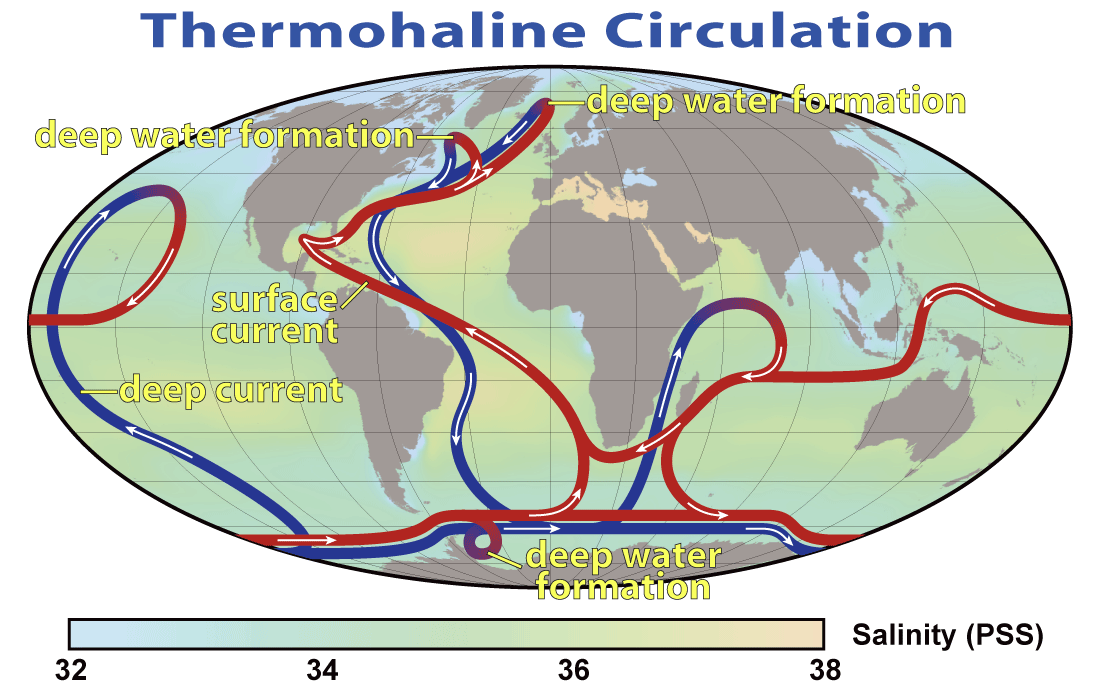
Unseen by us are warm and cold currents traveling around the planet in the oceans. (Image by "Thermohaline Circulation 2" by Robert Simmon, NASA. Minor modifications by Robert A. Rohde also released to the public domain - NASA Earth Observatory. Licensed under Public Domain via Wikimedia Commons - https://commons.wikimedia.org/wiki/File:Thermohaline_Circulation_2.png#/media/File:Thermohaline_Circulation_2.png

Unseen by us are warm and cold currents traveling around the planet in the oceans. The currents can change and if they do they can have dramatic effects on the climate. (Image by Robert Simmon, NASA. Public Domain)

Ocean currents travel the whole planet, with the warmer currents traveling nearer the surface, and the colder, dense currents sinking deep down. The warm ocean current from the Gulf of Mexico is what keeps Britain from literally freezing in the winter. These warm currents have not always been warm – melting of the ice caps can release large amounts of cold water into the oceans, disrupting the temperature of the ocean currents, and having a knock on effect on the climate.

Normally we end our Twilight Beast posts about the creatures extinction, or their current endangered status. Refreshingly, we don’t have to do that for this one. From the tiny shell of our little foraminifera, we have been able to look at the past in incredible detail. Hold a tiny foraminifera fossil in your hand and you will not notice the weight, or even feel it on your skin. What you will feel is finding yourself suddenly floating beneath the waves alongside this enigmatic little organism. You can see the weird ectoplasm unconsciously wave around, grabbing food particles. You zoom in even closer and watch as Oxygen atoms are absorbed into the test. Oxygen atoms that record the planets climate. This unassuming single celled organism is the key for time travel.

Written by Jan Freedman (@JanFreedman)

Further Reading: 

Andrews, J T, (2000), ‘Dating Glacial Events and Correlation to Global Climate Change’, in Noller, Jay S. Et al. (eds), Quaternary geochronology: methods and applications, 2000, American Geophysical Union. [Book]
Benn, D. I. & Evans, D J A. (1998), Glaciers and Glaciation. Arnold Publishers. [Book]

Bond, G. et al. (1992), ‘Evidence for massive discharges of icebergs into teh North Atlantic Ocean during the last glacial period’, Nature. 60. pp.245-249. [Full article]

Bond, G, & Lotti, R. (1995), Iceberg discharges into the North Atlantic on millennial timescales during the last glaciation. Science. 267. pp.1005-1010. [Abstract only]

Curry, R. & C. Mauritzen, (2005). ‘Dilution of the northern North Atlantic in recent decades’, .Science 308: pp.1772–1774. [Abstract only]

Rabassa, J & Ponce, J F. 2013, ‘The Heinrich and Dansgaard-Oeschger climatic events during Marine Isotopic Stage 3: Searching for appropriate times for human colonisation of the Americas. Quaternary International. 299. pp.94-105. [Abstract only]

Rahmstorf, S (2003), ‘The concept of the thermohaline circulation’, Nature 421(6924): pp.699.

Rohling, E. J. et al.(2007). ‘High rates of sea-level rise during the last interglacial period’. Nature Geoscience 1: pp.38–42. [Abstract only]

Wright, J D. (2000), ‘Global Climate Change in Marine Stable Isotope Records’, in Noller, J. S. Et al. (eds), Quaternary geochronology: methods and applications, 2000, American Geophysical Union. [Book]


Posted in foraminifera | Tagged , , , , , , , , , , , , , , , , | 10 Comments

Born in the USA

Think of the 4th of July festival in the United States and you automatically think of all the things associated with that country. Fireworks and flags, Elvis, rock and roll, cowboys and vast expanses of prairie perfect for galloping (ok, maybe that’s just me!), and above all, the magnificent, haughty, beautiful American Bald Eagle (Haliaeetus leucephalus). These are truly beautiful birds; on one occasion I was allowed to hold a very pleasant and surprisingly snuggly one on my wrist. I was surprised at the size, power and muscle of this creature, even though it displayed adorable traits of dorkiness, wanting treats and much bumping of human nose to aquiline beak. Apparently it’s a happy, snuggly eagle thing.

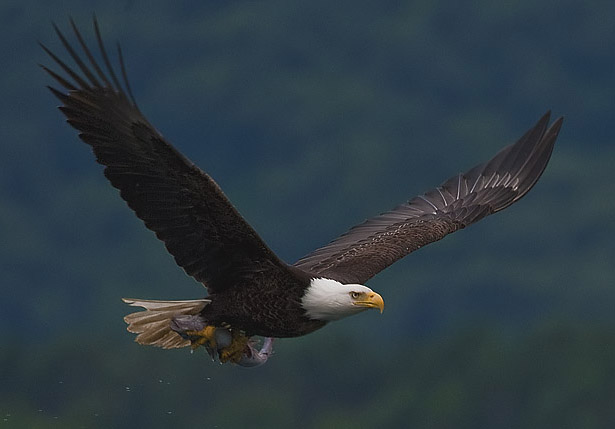
"2010-bald-eagle-with-fish" by Yathin S Krishnappa - Own work. Licensed under CC BY-SA 3.0 via Wikimedia Commons - https://commons.wikimedia.org/wiki/File:2010-bald-eagle-with-fish.jpg#/media/File:2010-bald-eagle-with-fish.jpg

A magnificent Bald Eagle in flight. Here, it has grabbed a fish with it’s enormous talons. (Image by Yathin S Krishnappa Public Domain)

I wouldn’t ever have the heart to tell that beautiful bird there were once much, much larger birds of prey during the Pleistocene. Take the Woodward Eagle of the Americas (Amplibuteo woodwardi), for example, this was a giant that gave the Monster Birds a run for their money. It has been speculated it was the largest raptor of North America and the West Indies, although there have been recently discovered fossils which may suggest there were potentially even bigger birds!

The Woodward Eagle, perhaps should be thought of as the all American mega-eagle. These were enormous creatures by anyone’s standards. The length of the body alone was between 125 to 150cm: that’s almost as long as me! The wingspan was in excess of 3m, as, unlike its equally gargantuan woodland dwelling extinct New Zealand ‘cousin’ Harpagornis moorei, the Woodward Eagle required wide open, arid landscapes to hunt, perhaps in a similar manner to the extant condor.

Strictly speaking, Amplibuteo wasn’t really an eagle – it belonged to the Buteoninae subfamily, and is closer to the hawk or buzzard – true eagles of course share considerable similarities, but belong in the Aquila genus camp! Frankly, I wouldn’t have argued with these birds that they weren’t ‘real’ eagles, as they were quite capable of killing and munching down on larger mammals such as antelope and canids.

Named after Sir Arthur Smith Woodward, mostly remembered nowadays for being suckered by the Piltdown Man fraud, the first fossil finds of the bird date back to 1911. A. woodwardi must have inhabited substantial areas of North America during the Pleistocene as fossils have been found at the world-famous La Brea Tar Pits, California, right across to Florida. Not so long ago, a substantial assemblage of Amplibuteo bones were found in Cuba’s Cuevo de Sandoval region, near Havana. (Cuba does appear to have all the luck with their enviable fossil records.) This unique (to date) find shows that not only was Amplibuteo flying high in Florida, but had spread its wings to settle in the Caribbean.

A classic illustration of La Brea Tar Pits. "Smilodon and Canis dirus" by Robert Bruce Horsfall - http://archive.org/stream/historyoflandmam00scot#page/n9/mode/2up. Licensed under Public Domain via Wikimedia Commons - http://commons.wikimedia.org/wiki/File:Smilodon_and_Canis_dirus.jpg#/media/File:Smilodon_and_Canis_dirus.jpg

A classic illustration of La Brea Tar Pits, with the sabre tooth cat, Smilodon attempting to fend off two Dire Wolves. The posture of the large bird on the branch looks like it could be a Monster Bird. But are those hovering giants the Woodward Eagle? (Image by Robert Bruce Horsfall, 1911. Public Domain)

A. woodwardi was a niche predator in many ways; its gracile form and sheer size meant it likely relied on hovering over open spaces, riding invisible warm currents high in the sky. Relying on its sharp sight to see it’s prey, it would have needed scanty tree coverage to swoop down at astonishing speeds to claim its victims, or just to see a carcass ready for the taking. Researchers have acknowledged the relationship between the bird of prey and its palaeoenvironment hasn’t been fully explored yet (that noise you hear is me squeaking with excitement at the idea of the pollen records from Cuban swamps and caves – you know I love my pollen!). Even less is understood about the decline of this majestic bird in North American contexts.

What we do have, however, is some solid and fascinating research on the changing environment of late Pleistocene Cuba, as the island has a passionate love for exploring its heritage in all forms. We know that somewhere around 10,000 years ago, a series of extinctions occurred throughout the east coast of the United States and the West Indies. These climate oscillations between drought and deluge were rapid, taking their toll on the most environmentally-dependent species first. The demise of the Woodward eagle would not have been as clean cut as it would have been for say, wetland creatures in such circumstances. Amplibuteo was an apex predator, very much in its comfort-zone in savannah-type arid conditions. Its extinction is more likely to have resulted from a cluster of factors, with prehistoric humans arriving in the mid-Holocene from other places, seeking refuge from environmental and climate-related factors elsewhere – mass extinctions seldom occur because of one factor alone.

A magnificent articulated skeleton of (Image Public Domain)

A magnificent articulated skeleton of Amplibuteo woodwardi on display at La Brea Tar Pits. (Image Public Domain)

The first victims of this event were mammals such as monkeys and larger rodents. The balance of the fragile dance of death between hunter and hunted had been upset. Predators such as Amplibuteo would have targeted other food sources, but would also have found themselves in direct competition with humans. They may have been viewed as pests – here in Ireland, to our shame, some of the most beautiful rare harriers and sea eagles have been poisoned by ignorant people who do not understand the balance of nature these animals perform, and that their predation is a necessity in not-so-fluffy nature. Archaeological finds of lithic tools and associated debitage in the Cayo Flores and Langusto areas of the island have been shown to date to around 8000 years ago. This is loosely contemporary with what we know of the extinction of the Woodward Eagle. It is perfectly feasible to envisage these early human settlers exterminating what they saw as threats to their own welfare and lives.

Just like the contemporaneous Ornimegalonyx, the giant eagle-hawk (or sea-eagles), would have faded into the twilight of legend and memory, as landscapes, fauna and vegetation changed from direct human activity, and from unstoppable global climate events. Human activity played some part with these great birds of the Americas, as there seems to be a permanent issue with our own species learning to balance land-use with conservation. In these days of almost immediate communication, and social media, we are painfully, and often agonisingly aware of the pending extinction of wildlife on our planet today, I can’t help wondering if prehistoric humans also mourned the last sightings of Pleistocene megafauna, and was legend the only way they maintained the memory of what had once existed and inspired awe.

While the Bald Eagle may be the iconic symbol of the United States today, it is a petite reflection of Amplibuteo woodwardi, the giant hunter who once arched and swooped over ancient blue skies and golden prairies, ‘from sea to shining sea’.

Written by Rena Maguire (@JustRena)

Further Reading:

Arredondo, O. (1976), ‘The great predatory birds of the Pleistocene of Cuba’. in S. L. Olson (ed). Collected papers in avian paleontology honoring the 90th birthday of Alexander Wetmore. Smithsonian Contributions to Paleobiology 27. pp169-187. [Full article]

Cooper, J., & Thomas, K. D. (2012), ‘Constructing Caribbean chronologies: comparative radiocarbon dating of shell and wood artefacts from Pre-Coumbian sites in Cuba’.  Archaeometry, 54.2. pp 401-425. [Abstract only]

Emslie, S. D. (1998), ‘Avian community, climate, and sea-level changes in the Plio-Pleistocene of the Florida Peninsula’, Ornithological Monographs. pp 1-113. [Abstract only]

Olson, S. L. (1978), ‘A paleontological perspective of West Indean birds and mammals’.  Academy of Natural Sciences of Philadelphia, Special Publication 13.  pp 99-117. [Full article]

Olson, S. L. & Hilgartner, W.B. (1982), ‘Fossil and subfossil birds from the Bahamas’. in S. L. Olson(ed) Fossil vertebrates from the Bahamas. Smithsonian Contributions to Paleobiology 48. pp 22-56. [Book]

Scofield, R. P., & K. W. S. Ashwell, (2009), ‘Rapid somatic expansion causes the brain to lag behind: The case of the brain and behavior of New Zealand’s Haast’s Eagle (Harpagornis moorei)’. Journal of Vertebrate Paleontology 29.  pp 637–649. [Abstract only]

Suarez, W. (2004), ‘The identity of the fossil raptor of the genus Amplibuteo (Aves: Accipitridae) from the Quaternary of Cuba’. Caribbean Journal of Science. 40.1. pp 120-125. [Full article]

Suárez, W. (2009), ‘Biogeografía de las aves fósiles de Cuba’. [Full article]

Tyrberg, T. (2008), ‘The Late Pleistocene Continental Avian extinction—an evaluation of the fossil evidence’.  Oryctos, 7.  pp 249-269. [Full article]

Vergara, R., R. (1988), ‘Relaciones biogeográficas de la avifauna cubana’. I. Biogeografía Histórica. Cienc. Biol. 19-20.  pp 51-61. [Full article]

Posted in Woodward Eagle | Tagged , , , , , , , , , , , , , | 11 Comments

Yesterday’s Camel

Camels are weird. I think we like them because their curmudgeonly reputation reminds us of someone we know (or ourselves!). Easy to recognise and totally unlike any other mammal, the “ship of the desert” is always included in Noah’s ark toys and first dictionaries. Budding zoologists may even realise that there are two different species of proper camel; the Bactrian (Camelus bactrianus), with two humps and the Dromedary (Camelus dromedarius) with one. I always remember which is which by looking at the first letter. A capital B has two humps, and a capital D has one!

The more astute amongst you may know that this is actually less than half the story. There are other camels. In fact, these other camels represent the greatest diversity of the surviving camel family. South American llamas (Lama glama), alpacas (Vicugna pacos), guanacos (Lama guanicoe), and vicuñas (Vicugna vicugna) are also camels! These guys are the stay-at-homes. They never left their place of origin. Camelids are a new world radiation, and a huge diversity of fossil forms are known. Camels with necks like giraffes, camels as large as moose, camels as small as goats. This was a successful and dynamic lineage, with many different forms. The ancestors of the Bactrian and Dromedary fled west across the Bering strait. Some of the New World species even survived until the end of the Pleistocene, as Twilight Beasts; encountered by those American pioneers who first hiked over the Beringian land bridge. Probably the very last of yesterday’s camels was the species Camelops hesternus.

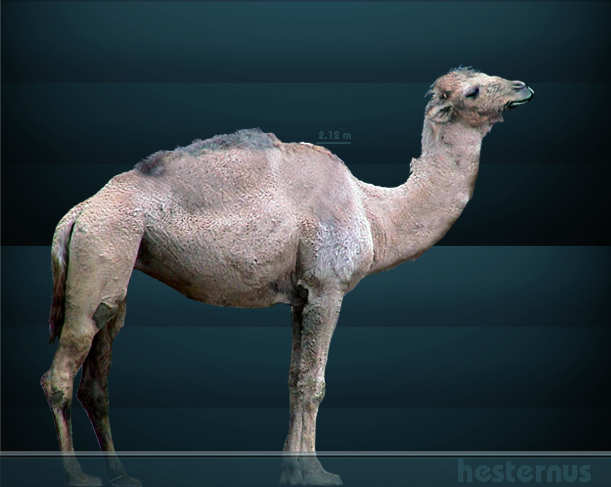
Camelops hesternus bu Sergiodlarosa

Camelops hesternus by Sergiodlarosa via Wikimedia Commons

The binomial name tells us everything we need to know. The genus Camelops comes from the greek for “camel-face”. The species name hesternus, means “yesterday’s”. It’s hard to think of a more appropriate description. It’s also sometimes known as the Western camel as no fossils have been found east of the Mississippi. In life it would not have looked too different from the surviving Dromedary. Subtle changes in the neck and skull, and slightly longer legs are the main distinguishing features. Of course, we don’t know whether Camelops had one hump (or two, or…?) as the hump is made of fatty tissue, which does not survive long in the fossil record.

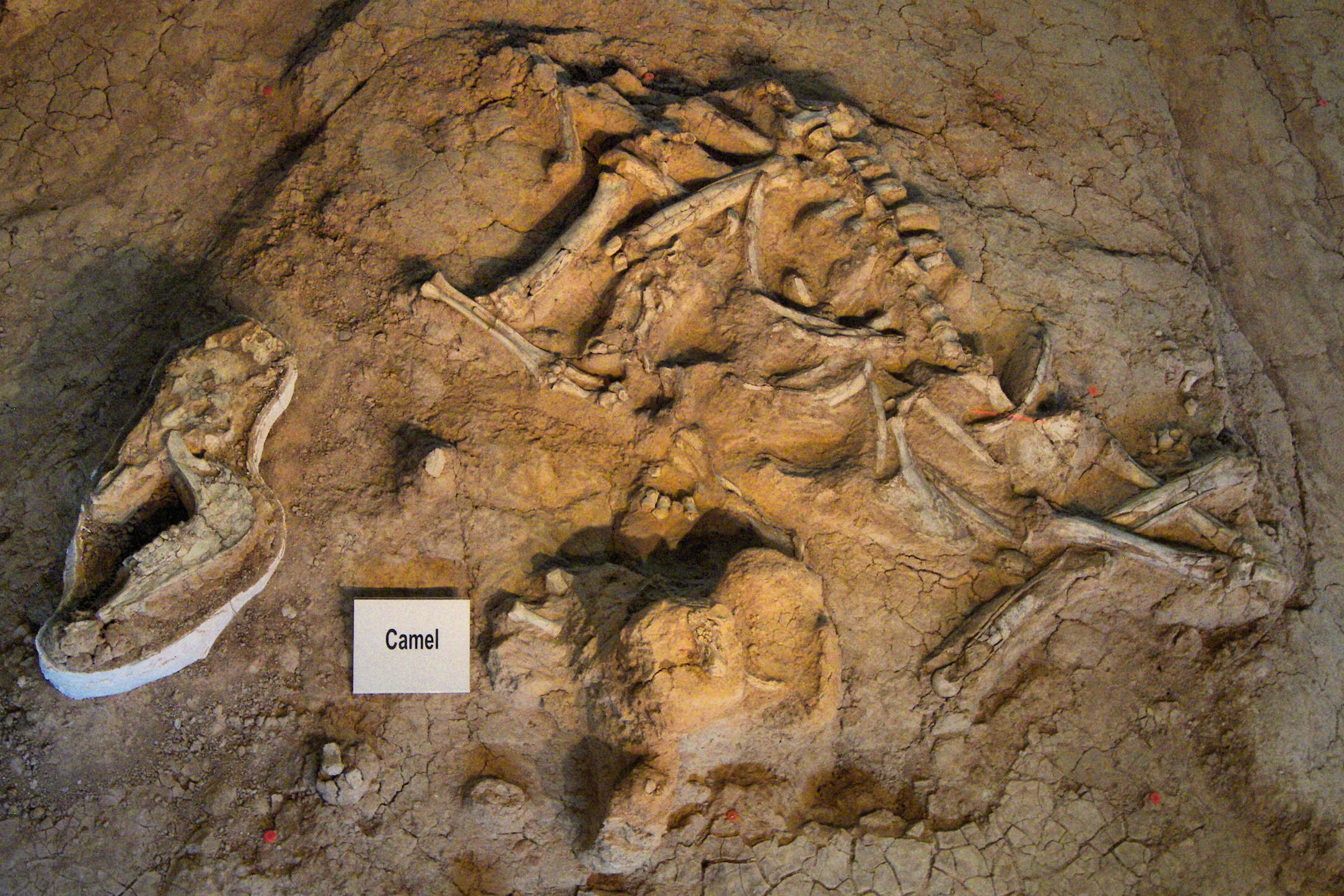
Camelops hesternus remains at

Camelops hesternus remains at the Waco mammoth site in Texas by Larry D. Moore CC BY-SA 3.0

Camelops is one of the few extinct megafauna for which we have good, solid evidence for hunting by Clovis and pre-Clovis peoples. Sites like Wally’s beach in Canada show clear association of lithics and cutmarked bones. I’ve never eaten camel but many folk consider it a delicacy. Aristotle himself is on record saying that camel was the most delicate meat. There are also some other tantalising pieces of evidence to show that Camelops was important in the lives of palaeoindians. An incredible specimen from the site of Tequixquiac in Mexico seems to be art made from the sacral bone of Camelops, carved into the likeness of a face. This amazing piece was found in 1870 and then went missing between 1895 and 1956. It was finally recovered from the desk drawer of a geologist, who had kept it hidden there for the better part of sixty years. Pleistocene art from the Americas is incredibly rare; the fact that this important piece was lost for so long is nothing short of unbelievable.

The "Sacro de Tequixquiac" (Canino Bone), considered as the oldest artistic creation of the American continent,

The Tequixquiac Camelops sacrum. Public domain image

Camelops has also been in the news thanks to advances in ancient DNA. Pete Heintzman, Grant Zazula, Beth Shapiro, and colleagues have recently managed to sequence the complete mitochondrial DNA, and a small percentage of the nuclear DNA from 3 specimens of Yukon camel and used that information to finally sort out their place within the camelid family tree. Surprisingly, Camelops hesternus appears to be on the same branch as the Bactrian and Dromedary camels. It seems that while the ancestor of C. hesternus roamed the ancestral home of the camels, the ancestor of the Bactrian and Dromedary started the long trek to Eurasia sometime around 10 million years ago.

Written by @DeepFriedDNA

Further Reading:

Arroyo de Anda, L. A. “The Pleistocene Carved Bone from Tequixquiac, Mexico: A Reappraisal.” American Antiquity 30, no. 3 (1965): 261-77.[Abstract]

Haynes, G., and D. Stanford. “On the Possible Utilization of Camelops by Early Man in North America.” Quaternary Research 22 (1983): 216-30.[Full Text]

Heintzman, P. D., G. D. Zazula, J. A. Cahill, A. V. Reyes, R. D. E. MacPhee, and B. Shapiro. “Genomic Data from Extinct North American Camelops Reveise Camel Evolutionary History.” Molecular Biology and Evolution in press (June 2 2015).[Abstract]

Waters, M. R., T. W. Stafford, Jr., B. Kooyman, and L. V. Hills. “Late Pleistocene Horse and Camel Hunting at the Southern Margin of the Ice-Free Corridor: Reassessing the Age of Wally’s Beach, Canada.” Proceedings of the National Academy of Sciences of the United States of America 112, no. 14 (2015): 4263-67.[Abstract]

Wilson, M., and C. S. Churcher. “Late Pleistocene Camelops from the Gallelli Pit, Calgary, Alberta: Morphology and Geologic Setting.” Canadian Journal of Earth Sciences 15 (1978): 729-40.[Abstract]

Zazula, G. D., D. G. Turner, B. C. Ward, and J. Bond. “Last Interglacial Western Camel (Camelops Hesternus) from Eastern Beringia.” Quaternary Science Reviews 30 (2011): 2355-60.[Abstract]


Posted in Camelops | Tagged , , , , , , , , , , , , , | 10 Comments

The last trumpet of a giant

“The Columbian Mammoth of North America, Mammuthus columbi, is hereby designated as the official fossil of the state of Washington.”

And so it was written. In 1998 the Washington State Legislature recognised the Columbian Mammoth as their official state fossil. The decision was not easy. Nor was it quick. It took four years of tireless efforts by pupils from Windsor Elementary School, pushing for this magnificent, extinct mammal to have the recognition it deserved.

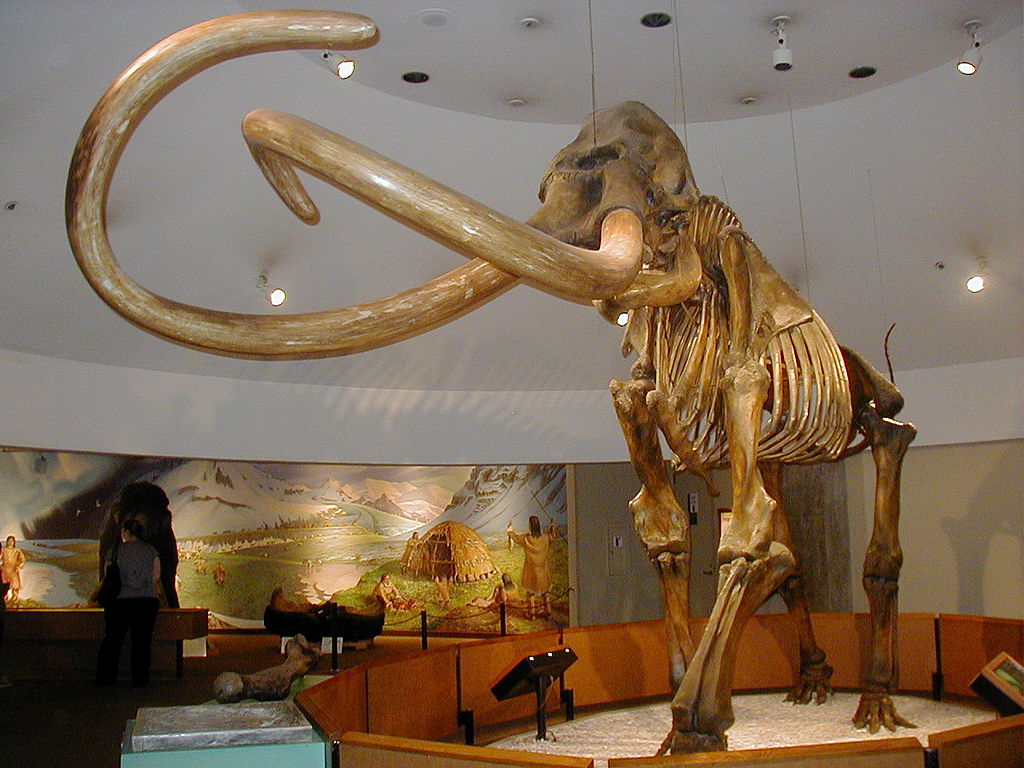
"Columbian mammoth" by WolfmanSF - Own work. Licensed under CC BY-SA 3.0 via Wikimedia Commons - http://commons.wikimedia.org/wiki/File:Columbian_mammoth.JPG#/media/File:Columbian_mammoth.JPG

Magnificent skeleton of the Columbian mammoth (Mammuthus columbi) on display at La Brea Tar Pits. This skeleton is made from several individuals. (Image by Wiki member WolfmanSF from here)

For official American legislation to recognise an extinct creature is fantastic: It ensures this animal is recognised by a more general audience, as well as people pretty high up in government. The wording in the ‘notes’ however may need a little bit of tweaking:

“The legislature recognises that the large, hairy prehistoric elephants of the extinct genus Mammuthus roamed the North American continent, including the Pacific Northwest, during the Pleistocene epoch (ice ages).”

There were actually more than one species of ‘large, hairy prehistoric elephants of the extinct genus Mammuthus [that] roamed the North American continent…during the Pleistocene’. There were at least half a dozen species of Proboscideans lolloping across the landscapes. First came the Southern Mammoth (Mammuthus meridionalis), a real giant stomping across the Bering Strait into North America in the very early Pleistocene, around 2 million years ago. Then there was Imperial Mammoth (Mammuthus imperator) during the middle Pleistocene, a possible descendent from the Southern mammoth. Our big mammoth, the Columbian Mammoth, likely evolved from the enormous Imperial Mammoth in the Late Pleistocene. Some Columbian Mammoths swam across the choppy waters off the sandy Californian beaches, for around 12 miles(!) landing on a small set of islands, where over millennia they were subject to Island Dwarfism. These Dwarf Mammoths (Mammuthus exilis) lived successfully on these Channel Islands for several thousand years. There was more. Our shaggy friend, the Woolly Mammoth (Mammuthus primigenius) made an appearance in North America hovering at the northern part of North America from around 100,000 to 15,000 years ago. The North American landscape would have seen herds of other big Proboscideans too: the awesome Mastodons (Mammut americanum) and a cool Gompothere (Cuvieronius tropicus) dotted the land. North America was owned by the Proboscideans.

"Mammuthus" by Fun-dan - Own work. Licensed under Public Domain via Wikimedia Commons - http://commons.wikimedia.org/wiki/File:Mammuthus.jpg#/media/File:Mammuthus.jpg

The Columbian Mammoth (shown in red) was a real big beast. The more familiar Woolly Mammoth is silhouetted in light blue, almost half the size. (Image Public Domain)

The Columbian Mammoth was one of the largest species of mammoths to have existed. You would think naming it and identifying it from fossils would be easy. Not to begin with. First named in 1857 by the scientist Hugh Falconer, the Columbian Mammoth was christened Elephas columbi (later it was moved into the Mammuthus genus, but keeping the original species). Taxonomy was rather taxing in the 18th and 19th centuries – new species were identified and named, ignoring species already present. M. columbi had several different names, but recent study of many of the fossils have shown that Falconer’s original species holds. Mammuthus columbi survives. (Falconer named the species ‘columbi’ not after the country Columbia, but after Christopher Columbus.)

Fossils of the Columbian Mammoth have been found all across the southern part of North America, as far south as Mexico. This was a hugely sucessful species. With so many fossils of this giant discovered, we have a fairly good understanding of it’s life and environment.

"North American mammoth map" by FunkMonk - Own work, based on https://commons.wikimedia.org/wiki/File:BlankMap-Americas.svg. Licensed under CC0 via Wikimedia Commons - http://commons.wikimedia.org/wiki/File:North_American_mammoth_map.jpg#/media/File:North_American_mammoth_map.jpg

The distribution of the Columbian Mammoth (red) and the Woolly Mammoth (blue). There would have been overlap of the two species at times, but generally they stayed in the environments that suited them. (Image Public Domain)

Living for around 80 years, Mammuthus columbi would have gone through six sets of molars, just like the Woolly Mammoth and modern elephants. Food full of grit slowly wear these though teeth down which is replaced by a new one. After the final sixth molar has gone, the giant will die of starvation. These huge teeth, which can be as long as my arm, tell us about the food it ate and the environment.

Mammoth teeth are pretty funky. Instead of enamel entirely covering dentine, like our teeth, Mammoths have plates of enamel and dentine which repeats along the whole tooth (imagine a loaf of sliced bread and each slice is a plate of enamel, then next a plate of dentine, and so on). The surface of the tooth had strong, sharp ridges of enamel which were needed to pound kilo’s of vegetation every day. Nature’s very own pestle and mortar.

Isotopes in the teeth and rare stomach contents show that the Columbian Mammoth wasn’t a particularly fussy eater. The diet was mostly grasses, and in harsh times they would have eaten tougher shrubs and woody plants. Paul Martin, the great advocate of the overkill theory, and his colleagues has studied Columbian Mammoth dung. And in a lot of detail too. One site, Becham Cave, Arizona, has an enormous layer of dung: 14,000 cubic feet – that’s enough dung to fill two and a half double decker buses! To steal the words of Ian Malcolm, that’s a big pile of shit. And this big pile of shit can tell us an awful lot. Dated to around 12,000 years ago, it was mainly the dung of Columbian Mammoths (some smaller dung balls possibly belonged to ground sloths). Slowly taking it apart and looking at the plant remains revealed a window to past environments: sedges and seeds from marshy habitats were abundant. Birch, rose, saltbush and other herbaceous plants were also found, indicating a time when Arizona was much cooler than the hard, wind blown desert we see today. Surprisingly there were large amount of cactus spines in the dung, indicating that this family of Mammoths in Arizona were happily eating cacti.

This giant enjoyed a more luscious, rich environment shared with other giants of the Pleistocene. To me this warmer, richer environment suggests that Mammuthus columbi was not as hairy as the Woolly Mammoth. It may have retained some of it’s hair, as we know the giant sloths had thick hair. But I see them as less hairy than their colder adapted cousins.

For such an enormous beast, adult Columbian Mammoths had little need to worry about predators. There were big, and fearsome, predators stalking around Pleistocene North America. They would have taken advantage of the old or weak. They no doubt tired their luck with taking down a young Mammoth calf. Smilodon, Dire Wolves, and the Giant Short Faced Bear posed very little threat to a fully grown, enormous Columbian Mammoth. Life was precarious for the young and the old, but at the prime of their lives, these truly magnificent creatures were threatened by no animal.

That is, until humans arrived.

"A Mammoth Hunt" by J. Steeple Davis - https://archive.org/stream/childrensstories01wrig#page/n9/mode/2up. Licensed under Public Domain via Wikimedia Commons - http://commons.wikimedia.org/wiki/File:A_Mammoth_Hunt.jpg#/media/File:A_Mammoth_Hunt.jpg

A rather visual hunt of a Mammoth, in”A Mammoth Hunt” by J. Steeple Davis (Image Public Domain)

Humans entered North America around 20,000 years ago following the same route as the ancestors of the Columbian Mammoth. Several fossil locations show evidence of humans butchering mammoths. These butchery sites give glimpses into what may have happened to push their demise. And it appears that the Columbian Mammoth met the same fate as their Eurasian cousins – and by the same hand. Rapidly changing environments at as the ice at the end of the last major glaciation retreated, put enormous stresses on these mega herbivores. Some animals can bounce back from extreme stress. Perhaps the Columbian Mammoth would have, if it hadn’t been for an additional stress. With diminished numbers in a harder environments hunting by humans may have been the tipping point. Sometime around 11,000 years ago a band of humans would have heard the last trumpet call of a Columbian Mammoth, as it moved slowly across the land. Alone.

Postscript: This ‘large, hairy prehistoric elephant’ is also the state fossil for Nebraska (in 1967) and more recently in 2014, South Carolina. The Columbian Mammoth is a popular choice. All other US states have their own unique official state fossils. Of the 42 American states with an official state fossil, 7 have chosen a dinosaur, whereas 8 have chosen a Twilight Beast!

Written by Jan Freedman (@JanFreedman)

Further reading:

More about the dwarf mammoths here by Brian Switek.

Agenbroad, L. D. (2012), ‘Giants and pygmies: Mammoths of Santa Rosa Island, California (USA)’, Quaternary International 255: p.2. [Abstract only]

Ferretti, M. P. (2003), ‘Structure and evolution of mammoth molar enamel’,  Acta Palaeontologica Polonica. 3 48 pp.383–396. [Full article]

Gold, D. et al.. (2014). ‘Attempted DNA extraction from a Rancho La Brea Columbian mammoth (Mammuthus columbi): Prospects for ancient DNA from asphalt deposits, Ecology and Evolution 4 (4). pp.329–336. [Abstract only]

Lucas, S. G. et al. (1999). ‘Co-occurrence of the proboscideans Cuvieronius, Stegomastodon, and Mammuthus in the lower Pleistocene of southern New Mexico’, Journal of Vertebrate Paleontology 19 (3). pp.595–597. [Abstract only]

Martin, P. S. (1999), ‘Twilight of the Mammoths: Ice Age extinctions and the rewilding of America’, university of California Press. [Book]

McDaniel, G. E. & Jefferson, G. T. (2006), ‘Dental variation in the molars of Mammuthus columbi var. M. Imperator (Proboscidea, Elephantidae) from a Mathis gravel quarry, southern Texas’,. Quaternary International. 142-143: 166–177. [Abstract only]

Muhs, D, et al. (2015), ‘Late Quaternary sea-level history and the antiquity of mammoths (Mammuthus exilis and Mammuthus columbi), Channel Islands National Park, California, USA’, Quaternary Research. 83. pp.502-521. [Abstract only]

Patterson, D. B. Mead, A. J. & Bahn, R. A. (2012), ‘New skeletal remains of Mammuthus columbi from Glynn County, Georgia with notes on their historical and paleoecological significance’, Southeastern Naturalist 11 (2). pp.163–172. [Abstract only]

Purdy, B. A. et al. (2011), ‘Earliest art in the Americas: Incised image of a proboscidean on a mineralized extinct animal bone from Vero Beach, Florida’, Journal of Archaeological Science 38 (11). p.2908. [Abstract only]

Shoshani, J. & Tassy, P. (2005). ‘Advances in proboscidean taxonomy & classification, anatomy & physiology, and ecology & behavior’, Quaternary International. 5. pp.126–128. [Abstract only]

Stuart, A. J. (2015), ‘Late Quaternary megafaunal extinctions on the continents: A short review’, Geological Journal 50 (3). pp.338–363. [Abstract only]

Posted in Columbian Mammoth | Tagged , , , , , , , , , , , , , , , , , , , , | 13 Comments

Forever young

Being conscious of our own mortality has given our species an unhealthy fascination with immortality. Over the millennia we have conjured up stories of everlasting beings, some of which even allow us to follow them after we have died. This of course quenches that unnerving feeling of what is after death. I am more than happy being a mortal. And here’s two reasons why.

Firstly, we live for a pretty long time as an animal. Our average life expectancy (in developing countries) is 82 years old. 82 years! That is far longer than a mammal our size. Horses can live up to 28 years. Elephants live much longer, to around 70 years. But this relatively small bipedal ape can live for an average of 82 years. We have a pretty long life. Longer than other mammals.

We only get it once, so let’s live it.

But there is something else. Something that makes me a very happy mortal indeed. This second reason is something where James Matthew Barrie was actually not too far off.

Peter Pan was the boy who never grew up. The original play, by James Matthew Barrie, struck a chord in adults as well as children, because no doubt they didn’t want to grow up either – and still holds a little sparkle to young and old a hundred years later. You and I are more like Peter Pan than we may think. It seems that Homo sapiens have evolved to look younger (known as neoteny). The great evolutionary biologist Stephen Jay Gould suggested that humans as a species have kept the features of youngsters as they have grown into adults. So, as well as taking much longer to mature,  we also have much flatter faces, bigger eyes and our soft, hairless features: all of which give us a naturally younger appearance. This is why we have such a natural response to ‘coo’ over babies. And why we find young animals adorable, with those big soppy eyes. And this is why I am a happy mortal. I look much younger than I really should. And you really do too.

Lorenz: Studies in Animal and Human Behavior, Volume II.)

The young and adults of a human, rabbit, dog and bird. The human adult (top) retains the flatter face of the young. (Image from Lorenz 1971)

Björn Kurtén’s magnificent novel Dance of the Tiger takes us back 40,000 years ago at a time when Homo sapiens and H. neanderthalensis were both living in Europe at the same time. Here Kurtén introduces the possibility that Neanderthals found H. sapiens very attractive and somewhat godlike with their eternally youthful look no matter what age they were. Some researchers have suggested that Neanderthal faces had much more mature looking faces than sapiens (called gerontomorphic). Furthermore, H. sapiens have a smaller skull than Neanderthals, giving them a younger appearance. I doubt that we were the only hominins that neoteny evolved, but the more robust, stronger features of Neanderthals would have given a different appearance when the two species saw each other.

Modern human skull n teh left compared to the more robust skull of a Neanderthal on teh right. (Image "Sapiens neanderthal comparison" by hairymuseummatt - http://www.flickr.com/photos/hmnh/3033749380/. Licensed under CC BY-SA 2.0 via Wikimedia Commons - http://commons.wikimedia.org/wiki/File:Sapiens_neanderthal_comparison.jpg#/media/File:Sapiens_neanderthal_comparison.jpg)

Modern human skull on the left compared to the more robust skull of a Neanderthal on the right. The gracile, round skull of modern humans, along with the flatter face are traits that adults have retained from childhood. Neanderthals in contrast have larger skulls, and more prominant features. (Image from Cleavland Museum of Natural History. Public Domain.)

It would also seem that you and I are not alone as a species that keeps their youthful looks.

At the very Southern tip of Florida, poking out of the warm crystal clear waters lies an archipelago of small, luscious, green islands: the Florida Keys. On two of these islands, Sugarloaf Key and Bahia Honda Key, there lives an adorable little deer. And what makes this deer adorable to us, is that the adult deer look like youngsters. These are deer that never grow up.

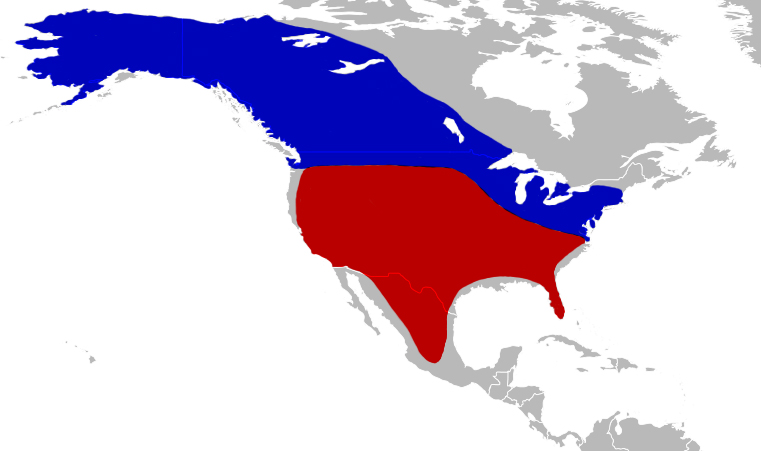
Known as the Key Deer, these are one of the smallest deer around today. Not as small as the Pudu, they still rank pretty high on the adorability scale: adorability in human eyes for those baby features we cannot help but love. And their size is due to events that happened towards the end of the Pleistocene.

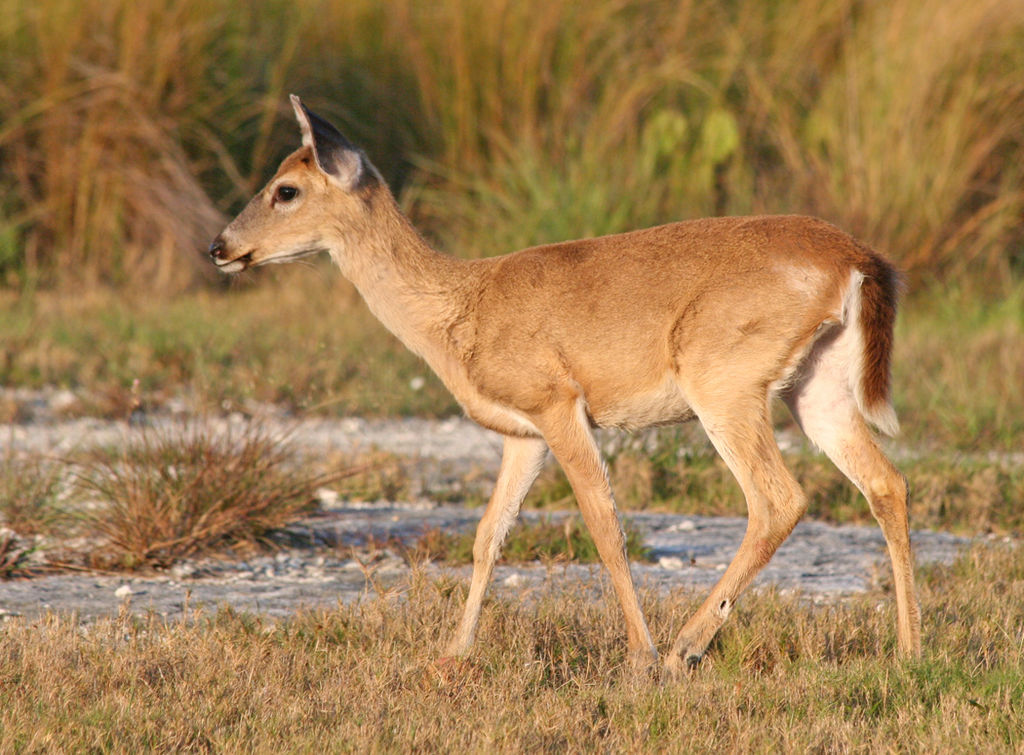
"Key Deer JCB" by Joseph C Boone - Own work. Licensed under CC BY-SA 3.0 via Wikimedia Commons - http://commons.wikimedia.org/wiki/File:Key_Deer_JCB.jpg#/media/File:Key_Deer_JCB.jpg

A beautiful Key Deer (Odocoileus virginianus clavium) on Big Pine Key, Florida. She looks like a fawn, but she is a fully grown adult, as tall as my hips. (Image by Joseph C Boone, from here)

Fossils of the handsome looking white-tailed deer (Odocoileus virginianus) have been found in rocks around 5 million years ago, during the Pliocene Epoch. This was a very widespread species during the Pleistocene of North America, eventually moving into some parts of northern South America in the Late Pleistocene. It has survived the huge end-Pleistocene extinctions and is a very successful species today, with a number of sub-species. Towards the end of the Pleistocene, the climate was changing drastically. With lower sea levels, Florida was almost double the size it is today. As the planet started warming around 13,000 years ago, the northern ice caps began to melt, resulting in sea levels rising. And this is where our Key Deer come in. As the sea level rose much of Florida’s land was flooded, which created small islands which were originally hill tops. Groups of the white-tailed deer became isolated on these small islands and evolved in their own special way.

Key Deer evolved extreme smaller sizes than their mainland relative. White-tailed deer are just over a meter tall. The cute little Key Deer is around 25% smaller, reaching just 76cm – reaching my hips. Because they are smaller, they appear to retain a more youthful look to them, but for a slightly different reason than ourselves. This shrinkage in size is due to island dwarfism, which we have met before with the Pygmy Stegomastodon and the delightful mouse-goat. Once isolated, being small favoured the ancestors of the Key Deer with limited food sources in a reduced environment. Plus being smaller gives shorter times between conceiving and giving birth, so the smaller deer reproduce faster. One quirky feature of the Key Deer now is that they can swim between islands in Florida Keys. Clearly they didn’t swim back and forth to the mainland much, which helped them retain their unique size.

These unique survivors of the Late Pleistocene today have a new threat. The species that shares the Key Deer’s eternal youth is pushing it to extinction. Humans have infringed on this small creatures environment for many centuries, resulting in massive habitat loss. With an estimated 700-800 wild Key Deer left, they are on the endangered species list. Sadly road kill is the biggest threat, with around 40 killed each year.

This amazing little animal tells us of a time long ago when melting glaciers trapped its ancestors on small islands. If we are not careful, their legacy will soon be lost forever. We may be forever young, but as is clear from the story of the Key Deer, we are all just mortals in the end.

Written by Jan Freedman (@JanFreedman)

Further Reading:

Barton, M, et al. (2002), ‘Wild New World: recreating Ice-Age North America’, BBC Books. [Book]

Bogin, B, (1999), ‘Patterns of Human Growth’, Cambridge University Press. [Book]

Collins, D. et al. (1973), ‘Background to archaeology: Britain in its European setting’, Cambridge: Cambridge University Press. [Book]

GoUld, S J, (1977), ‘Ontogeny and Phylogeny’, Cambridge University Press. [Book]

Kurtén, B, (1980), ‘Dance of the Tiger’, University of California Press. [Book]

Lorenx, K, (1971), ‘Studies in Animal and Human Behaviour’, Volume II. Harvard University Press. [Book]

Reed, J W, (1969), ‘Morphological variation in the cranium and mandible of the white-tailed deer (Odocoileus virginianus): A comparative study of geographic and four biological distances’, Journal of Morphology. 128 (1). pp.95-112. [Abstract only]

Shea, B , (1989), ‘Heterochrony in human evolution: the case for neoteny reconsidered’, American Journal of Physical Anthropology. 80. pp.69-101. [Abstract only]

Wearley, P V, & Ruez, J R. (2006), ‘Pliocene Odocoileus from Hagerman fossil beds National Monument, Idaho, and comments on the Taxonomic status of Odocoileus brachyodontus’, Journal of Vertebrate Palaeontology. 26 (2). pp.462-465. [Abstract only]

Posted in Key Deer | Tagged , , , , , , , , , , , , , , , , , , | 9 Comments

The dreams of dogs

Late afternoon sunlight floods the back of my house, rendering the wide first floor landing a luminously golden Byzantine capsule, bathed in light-shafts of ruby, emerald and sapphire from the old Edwardian stained-glass window. I do much of my writing on that landing, enjoying the interplay of light and colour. Where I go, my dog goes. The little terrier likes to doze beside me, sometimes twitching or barking in his sleep. I often wonder what dogs dream about: is it the parklands and mountains, where every rabbit is fair game, or does some other kind of ancient memory, carried in the mitochondria from generation to generation, whisper to  even the littlest  dog  when they rest beside us, of a time when dogs were  fearsome wolves.

I’d recently been reading the delightful research of Hulme-Beaman and Larson on the domestication of the dog. It got me thinking about some of the now-extinct canines of the Pleistocene, such as Xenocyon – that great mystery canid of the Pleistocene. There’s continued debate about what genus Xenocyon actually fits into: many consider it to be a canid, while others classify both X. falconeri and the earlier X. lycanoides to be the true ancestor of today’s ferocious yet beautiful African Hunting Dog, Lycaon pictus.

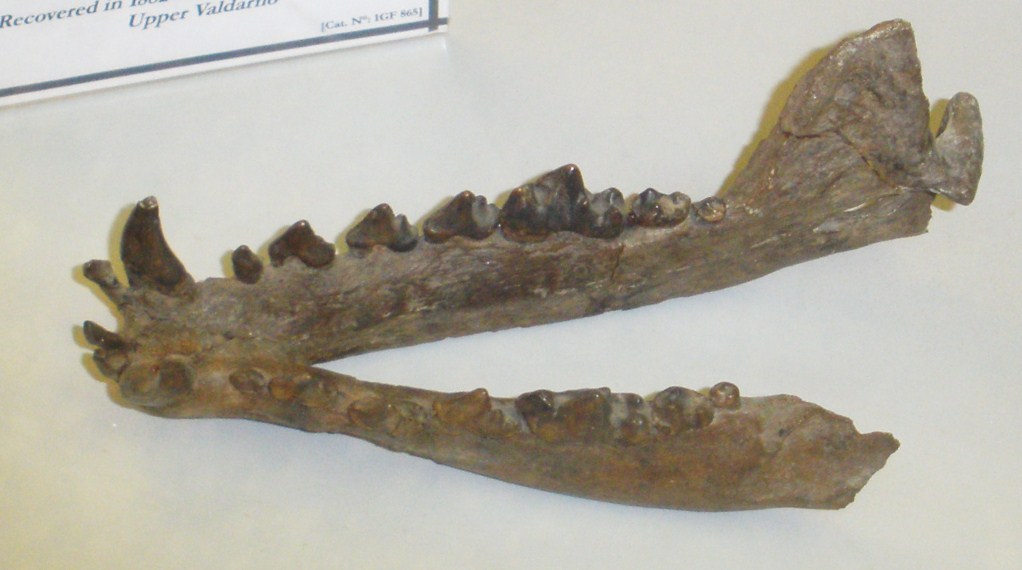
Beautiful lower jaw of "Xenocyon falconeri 2" by Ghedoghedo - Own work. Licensed under CC BY-SA 3.0 via Wikimedia Commons - http://commons.wikimedia.org/wiki/File:Xenocyon_falconeri_2.JPG#/media/File:Xenocyon_falconeri_2.JPG

Beautiful lower jaw of Xenocyon falconeri on display at the Museo di Paleontologia di Firenze. (Public Domain)

It may be that our understanding of the genus Canis is a little too simplistic, and needs a little revision to include creatures such as Cynotherium, Lycaon and of course Xenocyon, which in appearance was likely somewhere between a hyena and a wolf. Weighing between 30 and 40 kg, with a wide and broad head, Xenocyon was not to be messed with. The fangs alone indicated a robust, hypercarnivorous creature roughly the size of a wolf, perhaps a bit bigger in some cases, and a superb predator. If they were indeed the ancestors of the African Hunting Dog, then their hunting pack techniques would have been savage, relentless – and successful. Sadly, we don’t know if these muscular dogs were beautifully speckled and painted like L. pictus, or if they had coats of one colour, more akin to a wolf or dhole.

It is not surprising these canids reached pretty much the top of the food-chain and were found across Eurasia, Europe and even North America during the Mid-Pleistocene. Fossils have been found as far east as Japan, at the Tama River just outside Tokyo, with specimens also found at Westbury in Britain. However, more plentiful fossils have been found in Untermassefeld in Germany and across Italy and Spain. There are even a few specimens in North America, although some believe they never quite got a grip on the landscape due to competition from the larger and heavier Canis dirus.

So, how did Xenocyon spp manage to be so widespread that they ruled Europe and Eurasia with a paw of iron? Well, most of it is probably due to climate fluctuations on the boundary of the Pliocene and Pleistocene Epochs.  We know now that there have been regular periods of glaciation, thaws and reglaciation, long before humans came and made it ten times worse with carbon emissions. The beginnings of the Palaeolithic period are often placed around 1.7 million years ago, when hominids such as Homo erectus were striding out across Africa seeking new vistas. They were not the only ones. Another species of predator was also on the move, in a bio-event known rather catchily as the ‘Wolf Event’. Dogs went walkies from Africa to Eurasia and further.

These periods of intercontinental migration usually occur due to climate changes and the Wolf Event is probably no different (another example of course is the Great American Biotic Interchange, when northern megafauna crossed the land bridge at Panama to access south America). Sometimes Xenocyon is referred to as the African Wolf, as there certainly was movement of the earliest species, X. lycaonoides, from Africa around the same time as other great predators following the movements of herd animals. Nothing remains static in environmental histories. Temperatures in Europe were cooling, starting the story of glaciation and extinction we now call the Ice Age. Herds of herbivorous creatures would follow availability of good grazing, and right behind them would be the hunters, looking for juicy antelopes and equids. In the case of the packs of Xenocyon, they most likely would have welcomed a juicy H. erectus into their a la carte menu, as hominids would have been relatively defenceless against packs of creatures who hunted like African Dogs.

A pack of African hunting dogs. ("Wild Dog Kruger National Park South Africa" by Bart Swanson(Bkswanson) - Own work. Licensed under CC BY-SA 3.0 via Wikimedia Commons - http://commons.wikimedia.org/wiki/File:Wild_Dog_Kruger_National_Park_South_Africa.jpg#/media/File:Wild_Dog_Kruger_National_Park_South_Africa.jpg)

A pack of African hunting dogs at Kruger National Park South Africa. (Image by Bart Swanson. Public Domain)

At any rate, the Wolf Event started a major dispersal of predators which was followed around 0.9 million years ago by what’s not so-catchily named the ‘end-Villafranchian’ event, which created a rejuvenation of fauna. Just for a wee while, the climate improved before the onset of the glaciers. The hypercarnivores, of course, were not as dependant on temperature fluctuations or their physical environment for survival – they depended on that age-old interaction, the balance between predator and prey. As long as there were herds of tasty meals on hooves, they could manage.

As the last Ice Age gripped the Northern Hemisphere, herbivores retreated to refugia, vegetation died, and extinctions occurred, many of course which are documented here on Twilight Beasts. Sometimes humans were involved in extinctions, other times not. In the case of Xenocyon, it is unlikely that humans were responsible – this is one we get off the hook for. In fact, we really don’t have an accurate timeline for their absolute extinction, though it’s mostly considered they were extinct by around 125,000 years ago.  Fossil assemblages of the wild dog were found at Venta Micena, in south-eastern Spain in 1995, and one of the prize catches of this collection was a well-preserved skull. It gave a very good image of those savage canine teeth, the bone-crushing weight of the animals’ jaws and the sheer power of the animal. However, further examination of it, and other skulls, showed a lack of symmetry in the shape of the heads. The conclusions have been surprising – it’s likely the abnormalities of jaw and general conformation were due to genetic homozygosity. This is when an organism has two identical forms of a particular gene, with the same one inherited from each parent: The demise of Xenocyon may very likely have been down to faulty genetics, possibly caused by inbreeding. The fact that the creatures survived beyond puppyhood was also remarkable, indicating the same sort of co-operation and pack behaviour shown by extant Lycaon pictus to encourage the vulnerable to feed first from the softest tissue of the felled prey.

So, to some extent, Xenocyon populations became unstable and short-lived due to small breeding groups and genetic disorders of increasing severity – though it may not be the whole story. Many consider that Cynotherium sardous, a small canid of Pleistocene Sardinia, could well have been the descendant of Xenocyon – though C. sardous is a story for another day. Remember that islands do odd things to species trapped on them – either gigantism or dwarfism, depending on the environmental stresses. The restriction of life on an island reduced the size of the earlier Pleistocene canid resulting in adaptation to an insular environment, with smaller prey, such as Pleistocene bunnies which required a different way of hunting, far removed from roaming vast expanses of grassland and savannah.

Considering that at least on one occasion, Xenocyon contributed to the creation of a different canid, we can revisit the delicious research carried out by numerous geneticists such as Wayne, Larson and Hulme-Beaman, whose collective findings were recently published in Science journal. The conclusion most geneticists are reaching is that all varieties of modern dogs can trace their ancestry to extinct wolf-like creatures. Random interbreeding, environmental changes and then human involvement in selective breeding for specific qualities means that nature just doesn’t stop dead. What we perhaps have thought of as outright extinction sometimes is really just evolution doin’ its thing- changing and adapting until new responses are needed to new environmental challenges.

We still don’t know what ancestral memory whispers to our pups as they slumber, but I like to think that when they sleep, there’s a waft of an ancient savannah breeze, with the scent of a Pleistocene herbivore on that wind, and our little ones get to run with those wonderful twilight dogs who eventually would become our best friends.

Written by Rena Maguire (@JustRena)

Further reading:

An explanation of homozygosity here

Azzaroli, A. 1983. ‘Quaternary mammals and the ‘End Villafranchian’ dispersal event – a turning point in the history of Eurasia’ Palaeogeography, Palaeoclimatology, Palaeoecology. 44. pp 117–139. [Abstract only]

Brugal, J. P. & Boudadi-Maligne, M. 2011. ‘Quaternary small to large canids in Europe: taxonomic status and biochronological contribution’. Quaternary International. 243.1. pp 171-182. [Abstract only]

Flower, L. O., & Schreve, D. C. 2014. ‘An investigation of palaeodietary variability in European Pleistocene canids’. Quaternary Science Reviews. 96. pp 188-203. [Full article]

Gaudzinski, S. 2004. ‘Subsistence patterns of Early Pleistocene hominids in the Levant—taphonomic evidence from the’Ubeidiya Formation (Israel)’. Journal of Archaeological Science. 31.1. pp 65-75. [Abstract only]

Grimm, D. 2015. ‘Dawn of the Dog’. Science 348. 6232. pp. 274-279. [Abstract only]

Hartstone-Rose, A., Werdelin, L., De Ruiter, D. J., Berger, L. R., and Churchill, S. E. 2010. ‘The Plio-Pleistocene ancestor of wild dogs, Lycaon sekowei N. SP.’ Journal Information. 84.2. [Full article]

Kahlke, R. D. 2000. ‘The Early Pleistocene (Epivillafranchian) Faunal Site of Untermassfeld (Thuringia, Central Germany). Synthesis of New Results’. ERAUL. 92. pp 123-138. [Full article]

Koizumi,A. 2003.  ‘The first record of the Plio-Pleistocene hypercarnivorous canid, Canis Xenocyon falconeri Mammalia; Carnivora, from the Tama River, Akishima City, western Tokyo, Japan’. Quaternary Research.422. pp 105-111. [Full article]

Lomolino, M. V., Geer, A. A., Lyras, G. A., Palombo, M. R., Sax, D. F., and Rozzi, R. 2013. ‘Of mice and mammoths: generality and antiquity of the island rule’. Journal of Biogeography. 40.8. pp 1427-1439. [Full article]

Lyras, G. A., A. A. E. Van Der Geer, M. D. Dermitzakis and J. De Vos. 2006. ‘Cynotherium sardous, an insular canid (Mammalia: Carnivora) from the Pleistocene of Sardinia (Italy), and its origin’. Journal of Vertebrate Paleontology 26.3. pp 735-745. [Abstract only]

Madurell-Malapeira, J., et al. 2013. ‘The latest European painted dog’. Journal of Vertebrate Paleontology, 33.5. pp 1244-1249. [Abstract only]

Palmqvist, P;  Arribas, A & Martínez-Navarro, B. 1999. ‘Ecomorphological study of large canids from the lower Pleistocene of southeastern Spain’. Lethaia. 32. pp 75-88. [Full Article]

Palmqvist, P., Mendoza, M., Arribas, A., & Grocke, D. R. 2002. ‘Estimating the body mass of Pleistocene canids: discussion of some methodological problems and a new’taxon free’ approach’. Lethaia.  35.4. pp 358-360. [Full article]

Palombo, M. R., Sardella, R., & Novelli, M. 2008. ‘Carnivora dispersal in Western Mediterranean during the last 2.6 Ma’. Quaternary International. 179. 1. pp 176-189. [Abstract only]

Prevosti, F. J. 2010. ‘Phylogeny of the large extinct South American canids (Mammalia, Carnivora, Canidae) using a “total evidence” approach’. Cladistics 26. pp 456-481. [Full article]

Turner, A. 1995. ‘Evidence for Pleistocene contact between the British Isles and the European continent based on distributions of larger carnivores’. Geological Society, London, Special Publications. 96.1. pp 141-149. [Abstract only]

Van der Made, J. 2011. ‘Biogeography and climatic change as a context to human dispersal out of Africa and within Eurasia’. Quaternary Science Reviews.  30.11. pp 1353-1367. [Abstract only]

Wang, X., Li, Q., & Xie, G. 2015. ‘Earliest record of Sinicuon in Zanda Basin, southern Tibet and implications for hypercarnivores in cold environments’. Quaternary International. 355. pp 3-10. [Abstract only]


Posted in Xenocyon | Tagged , , , , , , , , , , , , , , | 7 Comments

A tiny Twilight Beast in a world of giants

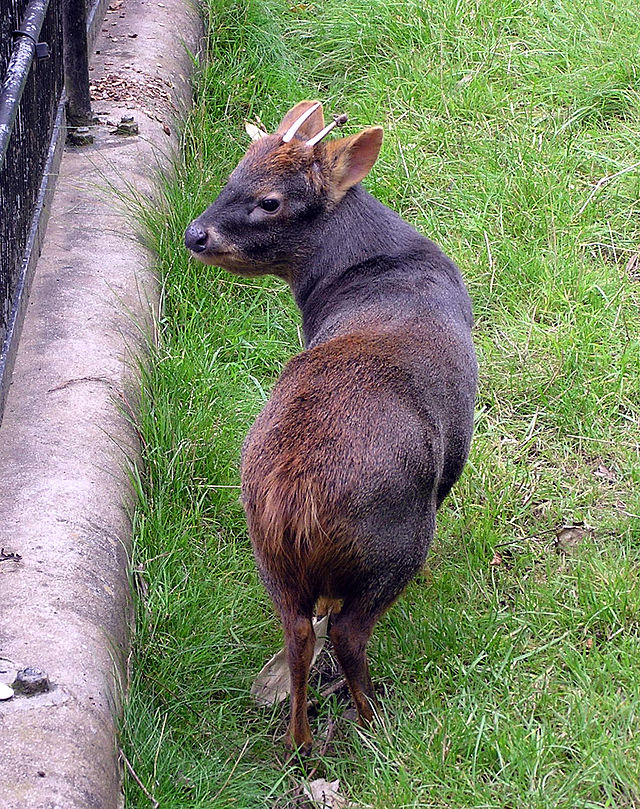
A walk in the temperate rainforests of Chile is like a journey into the deep past: a world of ferns, giant conifers and lichens enshrouded in fog and inhabited by tiny mammals that survived the age of giants. The pudú (Pudu puda) lives in this dense green world of thick foliage and misty air. This minuscule deer is the world’s smallest―it is only a bit larger than a small dog.

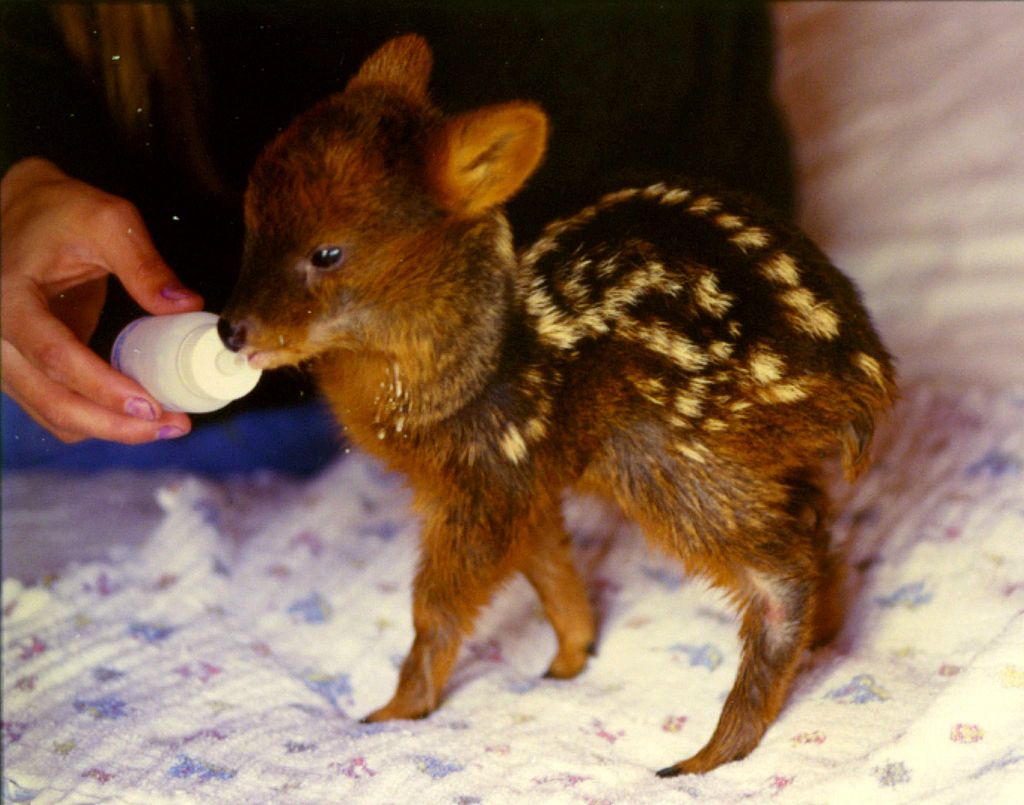
A teeny tiny Pudu fawn.

A teeny tiny Pudu fawn at Katheryn Pingel’s rehabilitation center, Ensenada Llaquihue Province, Chile. (Image by Rodrigo Fernandez from here).

The Mapuche people have inhabited the forests and coasts of austral South America for millennia, and their language ―mapudungun or “the language of the Earth”― is where the pudú’s name comes from.  In Mapuche lore, the pudú is guided by sparrows, whose songs alert it of nearby predators. Myth is often the manifestation of deep memory: as in legend, the pudú quietly slipped out of the Pleistocene leaving its gargantuan predators behind.

Recently, a group of scientist from the Universidad Austral de Chile discovered a 13,350 year old pudú fossil outside of its current range, revealing new information on life in Pleistocene South America. The ancient pudú lived in a rather different climate than the lush Validivian forests. During the colder Pleistocene, southern Chile was more like modern day northern Patagonia, with open forests, grasses and occasional thickets of conifers such as Chilean myrtle (Luma apiculata) and alerce (Fitzroya cupressoides), which can live over 3,000 years. The pudú lived alongside megafauna, such as gomphotheres, Darwin’s beloved giant sloth, Macrauchenica pathachonica (an odd mix of llama and elephant), and South American giant short-faced bears (Arctotherium tarijense), along with camelids such as guanacos (Lama guanicoe). Life would not have been easy for the tiny deer, as they were also prey to a variety of megacarnivores such as Smilodon and the Pleistocene South-American Jaguar (Panthera onca mesembrina). However, it was micromammals such as the pudú and the monito del monte (Dromiciops gliroides) that survived into the Holocene, quietly munching on leaves in the depths of the misty forests.

The tiny southern pudú (pudu puda) now inhabits southern Chile and adjacent parts of Argentina. It stands 35 to 45 cm tall at the shoulder and weighs between 6 to 13  kilograms: just a bit larger than a pug! Males have unforked antlers 3 to 9 centimeters long, which are shed annually. Solitary and secretive, the pudú has little social interaction outside mating. Mostly herbivorous, the pudús use trails in the rainforests in search of vines, shrubs, herbs, ferns, and fallen fruit. Their small stature can be a problem when obtaining food, and they have evolved various behaviour to make the task easier: pudús may stand on their front legs and bend branches, climb on low branches or stumps, or peel saplings with their teeth or antlers.

"Bristol.zoo.southern.pudu.arp" by Adrian Pingstone - Photographed by Adrian Pingstone. Licensed under Public Domain via Wikimedia Commons - http://commons.wikimedia.org/wiki/File:Bristol.zoo.southern.pudu.arp.jpg#/media/File:Bristol.zoo.southern.pudu.arp.jpg

Southern pudu at Bristol Zoo. Looks pretty cute. But those horns are for serious, ferocious business. (Image by Adrian Pingstone Public Domain)

Despite their small size, pudús are as aggressive as larger deer: they defend their home ranges to the point of killing other pudús that encroach on their territory. Both male and females also engage in complex fighting behavior which includes head-butting, jumping, biting, and thrashing with the front legs. They have even developed specialised defecation in their efforts to guard their lairs and trails: they will leave mounds of particularly scented dung when encountering another pudús scent mark in their home range.

The southern pudú is classified as vulnerable on the IUCN red list as a result of decades of poaching and illegal collection for zoos, along with habitat conversion, competition with introduced deer, and depredation by domestic animals such as dogs. Action is being taken to conserve pudús, such as captive breeding, radio tracking, and habitat protection. However, pudú populations are declining and there is much work to be done to ensure this tiny Twilight Beast lives on into the Anthropocene.

Michelle María Early Capistrán (@EarlyCapistran)

Edited by Rena Maguire (@JustRena)

A unique song about the Pudu can be heard here.

Further Reading:

Eldridge, W. D., MacNamara, M. M., & Pacheco, N. V. (1987). Activity patterns and habitat utilization of pudus(Pudu puda) in south-central Chile. In RES. SYMP. NATL. ZOOL. PARK. (pp. 352-370).

Espinoza, C. (2014, diciembre 21). Científicos descubren fósil de pudú más antiguo de América. La Tercera. Santiago, Chile. Recuperado a partir de [Full post]

Geist, V. (1998). Deer of the World: Their Evolution, Behaviour, and Ecology. Mechanicsburg, PA: Stackpole Books. [Book]

González, E., Labarca, R., Chávez-Hoffmeister, M., & Pino, M. (2014). First Fossil Record of the Smallest Deer cf. Pudu Molina, 1782 (Artiodactyla, Cervidae), in the Late Pleistocene of South America. Journal of Vertebrate Paleontology, 34(2), 483-488. [Full article]

Labraca E., R. E., Fuentes M., F., & Mena L., F. (2008). LOS CONJUNTOS FAUNÍSTICOS PLEISTOCÉNICOS DE CUEVA LAS GUANACAS (REGIÓN DE AISEN, PATAGONIA CHILENA): ALCANCES TAXONÓMICOS Y TAFONÓMICOS. Magallania, 36(2), 123-142. [Full article]

Martín, F. M. (2009). Tafonomía y paleoecología de la transición pleistoceno-holoceno en Tierra del Fuego-Patagonia. Interacción entre poblaciones humanas y de carnívoros y su importancia como agentes en la formación del registro fósil. Mastozoología Neotropical, 16(2), 509-510.

Robidoux, Meagan (2014) Puda puda, Southern pudu. In Animal Diversity Web. [Full post]

Vega Sanhueza, M.I. & Muñoz, C. (2014) Leyenda del pudú de la cordillera de Nahuelbuta. Letras de Arauco. [Full post]

Posted in Pudu | Tagged , , , , , , , , , , , , , , , , , , , | 12 Comments

The Old World Jaguar

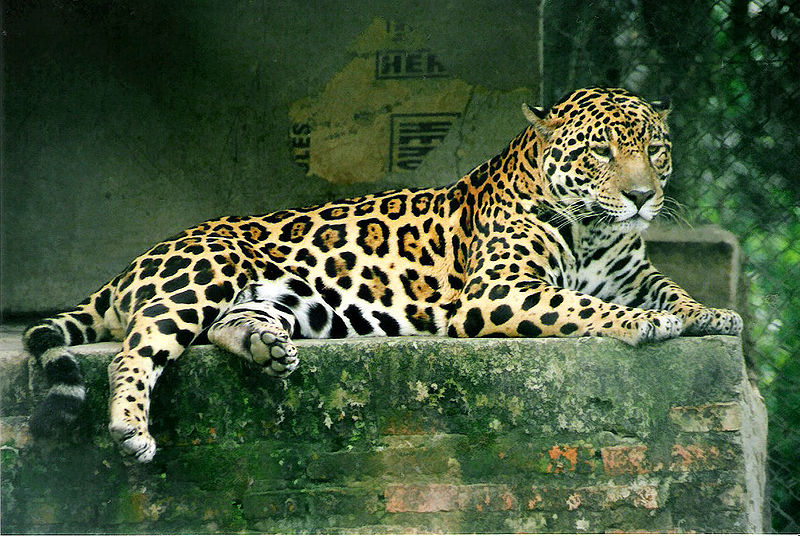
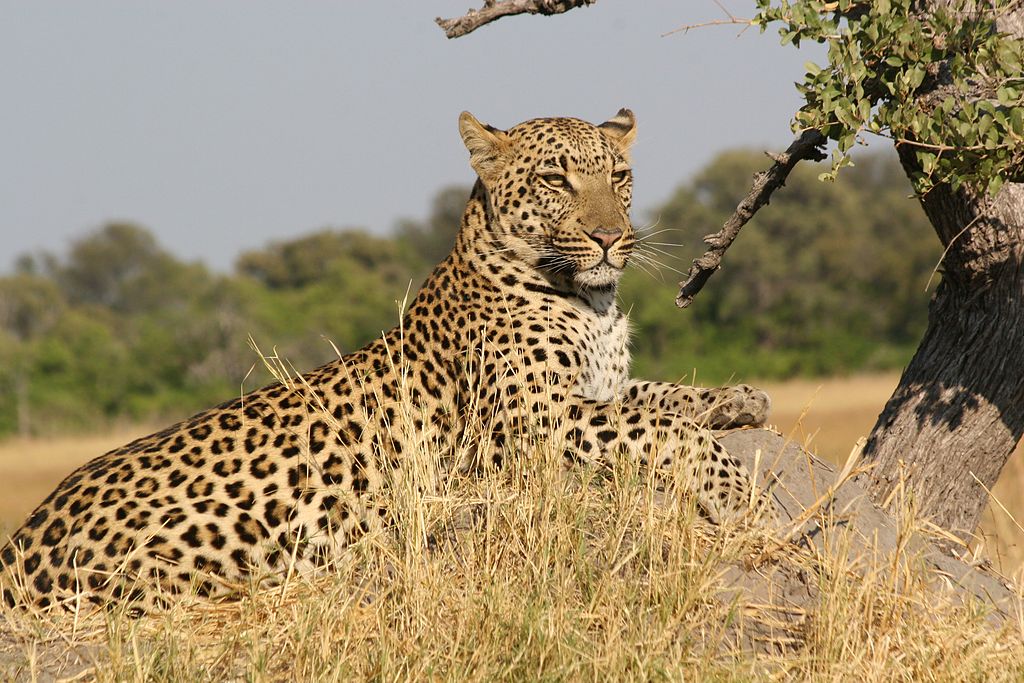
Unless you know your big cats particularly well, it can be difficult to separate the leopard (Panthera pardus) and the jaguar (Panthera onca). Both are large, lithe animals with black rosettes on a yellowish background coat. Put them beside each other and it can be difficult to say which is which. In the wild it’s much easier- the leopard is only found in the old world, and the jaguar in the new world (particularly South America). There are some other subtle clues: the jaguar tends to have rosettes with central spots, while the leopard does not. The jaguar is a more powerful cat than the leopard, known to hunt capybara and kill them by penetrating the skull with their canine teeth. Perhaps paradoxically there have been only a handful of recorded fatal encounters between humans and jaguars in all of recorded history, while the leopard is feared throughout its range as the most cunning and lethal maneater- feared even above the lion and tiger. Given their superficial similarity in appearance it is perhaps no surprise to learn that leopard and jaguar (and the lion) share a common ancestor in the recent geological past.

Panthera onca. Photographed in Argentina by Lea Maimone. Image via Wikimedia Commons

Panthera onca, Jaguar photographed in Argentina by Lea Maimone. Image via Wikimedia Commons

African_Leopard_5

Panthera pardus, African leopard. Photographed in Botswana by Danh via Wikimedia Commons

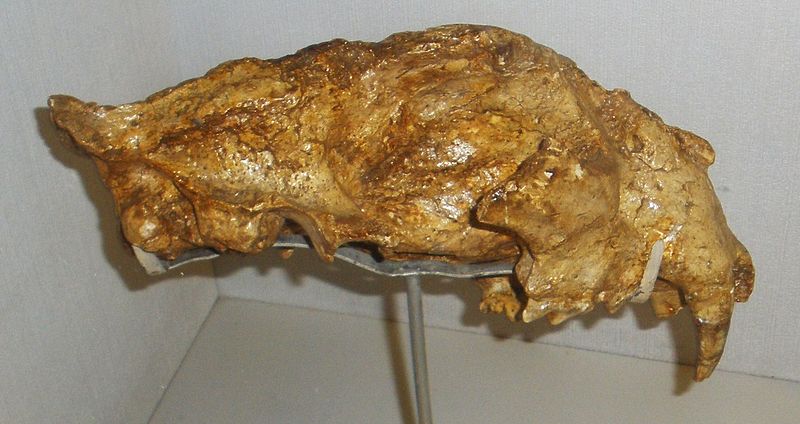
What may be a surprise is that the probable ancestor of the jaguar roamed happily over Europe and even into England! This interesting fossil species is known as Panthera [onca] gombaszoegensis or sometimes colloquially as the European jaguar. It has been found at the Pleistocene sites of West Runton (alongside the famous mammoth), Swanscombe, and Westbury. It’s also been found in the deposits at the bottom of the North Sea, washing up on the shore of the reclaimed polders of the Netherlands.

Italian Panthera gombaszoegensis skull. Photograph by Ghedoghedo, image via Wikimedia Commons

Italian Panthera gombaszoegensis skull. Photograph by Ghedoghedo, image via Wikimedia Commons

What was the European jaguar like? All evidence points to a cat smaller than a lion but larger than a modern jaguar. During the European Pleistocene it was part of a diverse clade of apex felids, alongside Panthera spelaea, Homotherium latidens, and Panthera pardus. Niche partitioning probably ensured that while the lion and scimitar cat prowled the open plains and the leopard flitted between wood and glade, P. gombaszoegensis was like a ghost in the deep forest. Circumstantial evidence from the study of stable isotopes from the Spanish site of Venta Micena places the Eurojaguar as a hunter of wild ovibovids, fallow deer, and giant deer within the closed canopy. Not dissimilar to the modern Amazonian jaguar preying upon deer, tapir, and peccary.

Based on the fossil evidence a likely scenario for the evolution of the Eurojaguar is as follows. The ancestor of the lion, leopard, and jaguar probably lived in Asia. Sometime after the late Pliocene the jaguar branch split off to colonise Eurasia while the ancestor of the lion and leopard invaded Africa. While roaming the old world, the Eurojaguar made use of one of the periodic appearances of Beringia to enter the Nearctic. Once in the new world the flooding of the Bering strait and the appearance of massive glaciers over Canada helped to isolate the American populations, allowing them to evolve along their own trajectory into the jaguar we know today. Although the modern jaguar is smaller than gombaszoegensis, this was not the case in the Pleistocene. Back then, truly enormous jaguar are known from the north and south of their range. Finds of the giant Panthera onca augusta have been dug up in Nebraska, Florida and Washington state. A south American giant jaguar has also been described as Panthera onca mesembrina, known from various caves in Patagonia and Tierra del Fuego. Alas, these giant forms all went extinct by the beginning of the Holocene.

Will the jaguar ever return to its old haunts in North America? Recent sightings of jaguars in Arizona suggest that the largest new world cat could be gaining some territory (or alternatively, getting pushed out of its usual range in Mexico). The saga of celebrity AZ jaguar “Macho B” has ensured that the species has been in the public eye. Despite the subterfuge that surrounded his initial capture and radio-collaring, and the tragedy of his eventual euthanisation, there is still hope that other jaguars have set up a permanent base in the South-West US.

Written by Ross Barnett (@DeepFriedDNA)

Further Reading:

http://www.azcentral.com/news/articles/20121215macho-b-death-jaguar-mystery.html

http://www.azgfd.gov/w_c/jaguar/MachoB.shtml

Garla, R. C., E. Z. Setz, and N. Gobbi. “Jaguar (Panthera onca) Food Habits in Atlantic Rain Forest of Southeastern Brazil.” Biotropica 33, no. 4 (2001): 691-96. [Abstract]

Hemmer, H., R. -D. Kahlke, and T. Keller. “Panthera onca gombaszoegensis (Kretzoi, 1838) Aus Den Fruhmittelpleisotzanen Mosbach-Sanden (Wiesbaden, Hessen, Deutschland) – Ein Beitrag Zur Kenntnis Der Cariabilitat Und Verbreitungsgeschichte Des Jaguars.” Neues Jahrbuch für Geologie und Paläontologie 229, no. 1 (2003): 31-60.[Abstract]

Hemmer, H., R. D. Kahlke, and A. K. Vekua. “The Jaguar- Panthera onca gombaszoegensis (Kretzoi, 1938) (Carnivora:Felidae) in the Late Lower Pleistocene of Akhalkalaki (South Georgia; Transcaucasia) and Its Evolutionary and Ecological Significance.” Geobios 34 (2001): 475-86.[Abstract]

Kurtén, B. “Pleistocene Jaguars in North America.” Commentations Biologicae 62 (1973): 1-23.

Marciszak, A. “Presence of Panthera gombaszoegensis (Kretzoi, 1938) in the Late Middle Pleistocene of Bisnik Cave, Poland, with an Overview of Eurasian Jaguar Size Variability.” Quaternary International 326-327 (2014): 105-13.[Abstract]

Palmqvist, P., J. A. Perez-Claros, C. M. Janis, and D. R. Grocke. “Tracing the Ecophysiology of Ungulates and Predator-Prey Relationships in an Early Pleistocene Large Mammal Community.” Palaeogeography, Palaeoclimatology, Palaeoecology (2008). [Abstract]


Posted in European Jaguar | Tagged , , , , , , , , , | 16 Comments

Neanderthals and us: we’re not so different

I cried the first time I saw a Neanderthal. I was 8 years old, sat cross-legged on the wooden floorboards, watching The Land That Time Forgot. Everything around me ceased to exist as I was transported to a world of extinct beasts. This was the film that began my fascination with prehistoric creatures. It also gave me an intense fondness for Neanderthals. Based on the novel by Edgar Rice Burroughs, the film follows a submarine that has travelled drastically off course, ending up in the lost land of Caprona. After exploring this unknown land some of the crew are attacked by a group of Neanderthals. They manage to capture one called Ahm (Ah-mm). We get to know Ahm, and grow very attached to this enigmatic character: he was simple, intelligent, curious, kind and gentle. He was a wonderful addition to the cast, but there was a simplicity in his portrayal. He couldn’t talk, he slouched uncomfortably when he walked and there was a rather dumb look about him. Sadly Ahm met a rather unfortunate fate whilst helping to save his new friends – he is grabbed by a Pterodactyl and we watch helplessly as he is flown away. The scene still brings tears to my eyes when I watch it today.

Neanderthals have really struggled to shake the view of being rather dim-witted, grunting brutes since they were first described back in 1856. Their name has even become shorthand to describe someone who lacks common sense, or is unable to adapt to change. It almost was worse than that. The wonderful scientist and artist, Ernst Haeckel proposed the name Homo stupidus for Neanderthals (literally translating to ‘stupid man’). Luckily, the species was saved by the rules of nomenclature, as Homo neanderthalensis had been proposed a few years earlier.

Why have the Neanderthals had such a rough time? Were they really slow, dumb creatures?

Although the first Neanderthal to be described was in 1856, it would be another 8 years before it was recognised as a new species. The bones were discovered in a cave in Germany along the Neander Valley (the name ‘Neanderthal’ is a coining of the German for Neander Valley: ‘Neander Thal’).  Amusingly, ‘Neander’ is simply a Greek translation of Neumann – the German name of a local pastor who was associated with the valley. And Neumann means ‘New Man’. Pretty apt. The remains were pretty fragmentary, with only the skull cap, some leg and arm bones and a few other bones being found. At the time the scientific consensus was that humans were unique, and with only one, incomplete skeleton, there was no reason to disagree.

The type specimen of Homo nenaderthalensis. (Image Public Domain)

The type specimen of Homo neanderthalensis found at Neander Valley, Germany. The top part of the skull was the only bit to be recovered. Look at the massively thick eye brow ridges.. (Image Public Domain)

The original description of the bones by the German anatomist, Hermann Schaaffhausen, was published 2 years after they were discovered. Schaaffhausen was very detailed in his report. Although he didn’t recognise a new species, he did make note of the huge brow ridges, the thickness of the bones and the huge muscle scars. Schaaffhausen believed the bones belong to a barbaric tribe that lived in Germany before the Europeans arrived.

The rather droopy looking English anatomist, George Busk, translated Schaaffhausen’s German description in 1861. Busk thought that there similarities between the Neanderthal skull and great apes. Others disagreed, including the great Thomas Henry Huxley, who didn’t see an ancestor, but just an old human, and probably one that was deformed. After examining the skeleton, another German anatomist, Friedrich Mayer, concluded that the bones were deformed from rickets, and the bow-legged shape was from horse riding. The large brow ridge was, Mayer suggests, caused from years of frowning in pain because of his deformed bones! Not an ape, nor an ancient human, but an officer in the army who had climbed into the cave to die. Oddly no mention was made of why he had no clothes, sword or rifle.

The specimen led to a range of explanations. Admittedly, there was a lack of comparable fossils, but the idea in the mid-1800s that Homo sapiens was special was just too strong. In 1864, William King, an English geologist, examined the Neanderthal specimen and concluded that it shared more features with apes than Homo sapiens. In his write up he named a new species for the Neanderthal fossil (almost reluctantly, in a footnote): Homo neanderthalensis. This was the first time that another human species was recognised in the scientific literature. This was pretty big news. But, just to make sure Homo sapiens stayed the wise-man, King went on to write: “thoughts and desires that once dwelt within [the skull] never soared beyond those of the brute.” And so the seed was planted for a barbaric, beast of an ape to enter the popular imagination.

Two Neanderthal skulls had actually been found before the type specimen in Germany but were not recognised at the time. One, found in Gibraltar in 1848, had lain neglected until 1863, when it was examined by William Busk. He saw clear evidence that the  Neanderthals were a different brutish species. Skulls discovered in 1829 in Belgium were not identified as Neanderthal until much later, but were, ironically used to compare the German and Gibraltar skulls. Subsequently, many more Neanderthal fossils emerged which clearly showed they were a separate species. Debates flew around the relationship of these ‘brutes’; were they a direct ancestor to Homo sapiens, or were they just an evolutionary dead end?

A complete skeleton of Neanderthal, with a model next to it. (Image "Skeleton and restoration model of Neanderthal La Ferrassie 1" by Photaro - Own work. Licensed under CC BY-SA 3.0 via Wikimedia Commons - http://commons.wikimedia.org/wiki/File:Skeleton_and_restoration_model_of_Neanderthal_La_Ferrassie_1.jpg#/media/File:Skeleton_and_restoration_model_of_Neanderthal_La_Ferrassie_1.jpg

A complete skeleton of Neanderthal, with a model next to it. (Image  by Wiki member Photaro, Public Domain)

Some particularly spectacular finds in France helped calm the intellectual storm. Sites at La Chapelle-aux-Saints, Le Moustier, La Ferrassie and La Quina all held Neanderthal skeletons, some of which were remarkably complete. The French anthropologist Marcellin Boule noted that specimens of Homo sapiens were found from the same time period, so the two species must have lived side by side and he therefore concluded that Neanderthal was a side-branch. But Neanderthals were still seen as not as intelligent as H. sapiens, and doomed to extinction.

Since the initial finds in the mid-1800s, we now have specimens of over 200 individual Neanderthals from around three dozen sites across Europe. Not only do these fossils tell us about the range of these hominins, but also gives us information about their anatomy, leading to clues about their lifestyles. Genetic evidence points to Neanderthals diverging from our ancestor, Homo heidelbergensis between 250,000- 300,000 years ago. Not a direct ancestor, this sister species evolved separately, quite possibly in Eurasia from H. heidelbergensis. Our species, Homo sapiens on the other hand, evolved from a group of H. heidelbergensis who didn’t leave Africa somewhere around 200,000 years ago.

The last ten years have seen an enormous change in how Homo neanderthalensis is viewed. We now see Neanderthals as a very successful species of hominin that inhabited Eurasia for over 250,000 years. Their range spread across Western Europe and into Eastern Europe and Central Asia, but was limited to the north by the enormous barriers of ice during the last major glaciation. During the Pleistocene the Earth has been through incredible shifts in climate over relatively short periods of time. The ‘Ice Age’ was not one time when the Earth was cold: it was a time when the climate switched fairly rapidly from bitterly cold glacials, to tropical interglacials. It was during the glacial period from 300,000 to around 250, 000 years ago that the Neanderthals evolved. And they flourished. They survived two extremely hot interglacial periods, periods so hot, hippopotamuses were living in Britain! The last major glacial period was a long stint from around 110,000 – 12,000 years ago where Neanderthals became extinct somewhere in the middle of that time. In between these extreme warm and cold phases, there were sudden dips and spikes in temperature. Our recent past was a dangerously unstable place to live.

By measuring different Oxygen isotopes, we can work out the climate of the past. (Image "Ice Age Temperature". Licensed under CC BY-SA 3.0 via Wikimedia Commons - http://commons.wikimedia.org/wiki/File:Ice_Age_Temperature.png#/media/File:Ice_Age_Temperature.png)

By measuring different Oxygen isotopes, we can work out the climate of the past. The red, green and blue recordings are analysis of ice from 3 different sites, which correlate perfectly. The temperature of the last 500,000 years shows a saw-tooth like pattern: rapid warming (shown by the spikes) followed by relatively slower periods of cooling. (Image from here))

A striking feature about the Neanderthal skeleton, which was noticed by the German anatomist Hermann Schaaffhausen when he first described it back in 1856, was the thickness of the bones. This was a well-built, stocky species. Large muscle scars indicated they were very strong. They had larger barrel-like chests, which may have been an adaptation to minimise heat loss. Reconstructions of the nose suggest much larger schnozzles than ours, perhaps to warm the cold air they breathed (or perhaps sexual selection?). Their anatomy points to a species that was well adapted to cooler and drier environments.

Far from dumb brutes, Neanderthals had a very complex array of tools, including axe heads, spear tips, and blades for cutting and scraping and used glue to haft weapons. With a similar diet to Homo sapiens, but perhaps slightly more carnivorous, they had similar tools for hunting large animals. Although some researchers have commented that the range of their tools was not as diverse as H. sapiens. Their hunting style was different, so it may be that there was no need for a really diverse tool kit. Why have a Swiss army knife when all you need is a good steak knife? The Neanderthal skeleton gives us clues to their hunting style. Rather than long distance runners, or even javelin throwers, it appears Neanderthals were more keen on up close combat with their prey. Analysis in the arm bones show that their preferred method of hunting was by thrusting spears, rather than throwing them.

A nice illustration showing the range of Hoo neanderthalensis. (Image "Range of Homo neanderthalensis" by I, Ryulong. Licensed under CC BY-SA 3.0 via Wikimedia Commons - http://commons.wikimedia.org/wiki/File:Range_of_Homo_neanderthalensis.png#/media/File:Range_of_Homo_neanderthalensis.png)

A nice illustration showing the range of Homo neanderthalensis. (Image by Wiki user Ryulong from here)

One huge difference between modern humans and Neanderthals appears to be art. With the many Neanderthal sites so far discovered there is little evidence of Neanderthal art. Paintings and sculptures are lacking from their sites. It could just be that we haven’t found them yet. Only last year some potential Neanderthal art at Gibraltar was reported. Etched onto the wall of the cave is something that looks akin to a noughts and crosses board. Some have called it an engraving, while others have dismissed it altogether. However you may define art, the scratches in the cave wall were purposefully done.

There is, then, more to Neanderthals than meets the eye. There is evidence of culture too. Homes made of mammoth bones for a fairly large community have been discovered at a site in the Ukraine, indicating not only skill to plan and build an intricate structure, but also they lived in complex societies. There are examples of Neanderthal jewellery; including necklaces of sea shells found at the Cueva de los Aviones and Cueva Antón sites, Spain, and more recently a rather striking necklace made from eagle talons from Croatia. Whether for aesthetics or social ranking, Neanderthals clearly had an appreciation for beauty, and an understanding of making something for a use other than food.

One thing that has always niggled me in The Land That Time Forgot was that Ahm grunted. He almost managed to put words together, but they were more grunts than speech. In Jean Auel’s magnificent saga Earth’s Children, the Neanderthals (whom are rather offensively called ‘Flatheads’) can only make limited sounds, and communicated through a very sophisticated form of sign language. Auel’s books were based on palaeoanthropolgy articles and research. It has until fairly recently been thought that speech was uniquely human. It has been speculated that Neanderthals may have been able to speak when a hyoid was found in 1989. However, a study in 2013 by scientists at the University of New England, re-examined the 60,000 year old hyoid, and what they found was very exciting. The hyoid is a small, but very important, piece of bone in our throats, which allows us to make the sounds that we know as speech. Using 3D x-ray technology, the team imaged the hyoid in incredible detail without damaging the specimen. They found it was identical, inside and out, to hyoids in you or I, suggesting that Neanderthals could actually talk.

Recently, there has been some extremely interesting work on Neanderthals. Some of their ancient DNA has survived and what it has shown has changed the way we look at Neanderthals, and our very own species. After moving out of Africa, Homo sapiens shared the same geographic regions as H. neanderthalensis for almost 6000 years. That’s a pretty long time – it can take less than a decade for humans today to wipe out a species. Obtaining good data from ancient Neanderthal DNA isn’t that new; as early as 1997, mitochondrial DNA from a fossil was sequenced by researchers at the Max Planck Institute for Evolutionary Anthropology. But this small genetic sequence showed no similarities with any modern human DNA that would suggest any kind of inter-species loving. In the last few years, however, nuclear DNA has been successfully sequenced. Nuclear DNA is the DNA within our very cells and holds all the information on making us: mitochondrial DNA, in contrast, holds only a small fraction of DNA, telling us only about mitochondria. The resulting Neanderthal genome shows that there was gene flow between modern humans and Neanderthals (i.e. there was some loving). In fact, there was enough mating that some of us today are walking around with around 2.1% Neanderthal DNA inside us. What does this mean? Well, you aren’t suddenly going to grow massive brow ridges, or have bowed legs. But it does show that Neanderthals and modern humans were mating in the past, and some of their genes mixed and are still around today.

Finding out why the Neanderthals vanished is the Holy Grail of palaeoanthropology. This was a successful species. Well adapted to life in extreme European and Asian environments for over 200,000 years. They even lived side-by-side with modern human for 6000 years. Then suddenly, about 28,000 years ago they vanished. There have been a number of suggestions ranging from disease to modern humans out competing and outsmarting them. In truth it was possibly a number of factors that contributed to their extinction. Around 55,000 years ago the ever changing climate of the Pleistocene went crazier than usual: suddenly there were short decades of warmth followed quickly by short decades of freezing conditions. With these drastic changes in temperatures came drastic changes in the environment – plants followed the cold north, and with them so did the dwindling numbers of herbivores. Neanderthals had faced fluctuating climates in the past, only then they were on their own. This time, the regions were being shared with modern humans. The range of Neanderthals had suddenly become more restricted than ever before.

It is unlikely to have been one factor that caused the extinction of our extremely close cousins. Climate, rapidly changing environments, and sharing the land with a species with similar feeding habits most likely had some impact on their demise. What we do know is that Neanderthals were a lot more like us than we realise. I like to know that evidence from sites is being looked at more objectively, and we are learning so much more about this incredible species. Sadly, the only thing that makes us special is that we are here and the Neanderthals are not.

Written by Jan Freedman (@JanFreedman)

Postscript: Early images of Neanderthals often had them slouched, covered with fur and some were even holding a club. This was to highlight that Neanderthals were brutes, much separated from us. Adding fur accentuated the the savageness of the beast. As a slight aside, hominins (the bipedal apes) lost their thick matted fur around 1.6 million years ago. Interesting research by Nina Jablonski and colleagues at Pennsyvania State University, looked at the sweat glands in mammals to try to work out when our ancestors lost fur. Mammals with furry, long matted hair produce a rather thick oily sweat through sebaceous and apocrine glands. Humans, however, produce more watery sweat from eccrine glands. Along with cooling the outside of the skin and keeping body temperatures down, this watery sweat provides a short term barrier from the heat of the sun while it evaporates. Increased activity by walking upright would have increased the eccrine glands and lost the thick hair (Homo sapiens today can have up to 5 million eccrine glands in their skin!). Obviously sweat glands don’t fossilise, but by looking at the body proportions of early hominins, it appears that Homo ergaster, around 1.6 million years ago, were well adapted for long distance walking and running. These ancestors may well have been the first truly naked apes.

Further Reading:

Arensburg, B, et al. (1989), ‘A Middle Palaeolithic human hyoid bone’, Natur. 338 ). pp.758-760. [Abstract only]

Finlayson, C, et al. (2012), ‘Birds of a Feather: Neanderthal Exploitation of Raptors and Corvids’, PLoS ONE. 7(9): e45927. doi:10.1371/journal.pone.0045927

Finlayson, C, et al. (2006), ‘Late survival of Neanderthals at the southernmost extreme of Europe’, Nature. 443 (7113). Pp.850-853. [Abstract only]

Green, R, et al. (2006), ‘A complete Neandertal mitochondrial genome sequence determined by high-thoughput sequencing’, Cell. 134 (3). pp.416-426. [Full article]

Higham, T, et al. (2006), ‘Revisited direct radiocarbon dating of teh Vindija G1 Upper Paleolithic Neandertals’, Proceedings of the National Academy of Sciences. 103 (3). pp.533-537.

Huxley, T, H, (1863), Evidence as to Man’s Place in Nature. London: Williams & Norgate. [Full book]

Howell, F. C, (1957), ‘The Evolutionary Significance of Variation and Varieties of ‘Neanderthal’ Man’, The Quarterly Review of Biology. 32 (4). pp.330–347. [Full article]

King, W. (1863), The Neanderthal Skull. Anthropology Review. 1. pp.393-394.

Ovchinnikov, I, et al. (2000), ‘Molecular analysis of Neanderthal DNA from the northern Caucasus’, Nature 404 (6777). pp.490–3. [Full article]

Prüfer, K, et al, (2013), ‘The complete genome sequence of a Neanderthal from the Altai Mountains’. Nature. 505 (7481). pp.43. [Abstract only]

Radocvčić, D, et al. (2015). ‘Evidence for Neanderthal Jewelry: Modified White-Tailed Eagle Claws at Krapina’, PLoS ONE, 10(3) e0119802. doi:10.1371/journal.pone.0119802

Rodriguez-Vidal, J, et al. (2014), ‘A rock engraving made by Neanderthals in Gibraltar’, PNAS. 111 (37). pp.13301-13306. [Full article]

Schaaffhausen, H. (1858) Zur Kentniss der ältesten Rassenschädel. Natural History Review. 1. Pp.155-176.

Shreeve, J, (1996), The Neadnerthal Enigma. Viking. [Book]

Stringer, C, et al. (2008), ‘Neanderthal exploitation of marine mammals in Gibraltar’, PNAS, 105 (38). pp.14319–14324. [Full article]

Tattersall, I, (1995), The Fossil Trail. Oxford University Press. [Book]

Zilhão, J, et al. (2009), ‘Symbolic use of marine shells and mineral pigments by Iberian Neanderthals’, PNAS. 107 (3). pp.1023-1028. [Full article

Posted in Neanderthal | Tagged , , , , , , , , , , , , , , , , , , , , , , , , , , , , , , | 13 Comments

Who were the Denisovans anyway?

Human evolution used to be the preserve of two groups of academics: the ones who liked fossils and the ones who liked stone tools. Both regarded the other as peculiar for being obsessed with the wrong part of a massive jigsaw puzzle. Then in 1987 the geneticists arrived and they’ve been making things much more untidy ever since…

As recently as 40,000 years ago there were at least four species of hominin living in Eurasia. While we know of three from fossils and archaeological material. The fourth, however, is known almost purely from ancient DNA. ‘Species X’, or more commonly the Denisovans, are helping to re-write our understanding of human evolution during the later Pleistocene. But who were they and were did they go?

Turist_den-peschera_cut

Denisova cave, image by Nerika via Wikimedia Commons


The Denisovans are a species of hominin that occupy a very peculiar place in the human evolutionary story. They are the most poorly understood species in relation to fossils (one tiny finger bone, a toe bone and two teeth!) but they also have the most complete genome of any extinct hominin species. Compared with the fossil record of the Neanderthals, which runs to hundreds of individuals the Denisovan fossils are not even a blip on the radar, but when we factor in the data that comes from ancient DNA we can start to see the power of palaeogenomics as an analytical tool.

Denisova is a cave site located in the Altai Mountains in Siberia near the border with China and Mongolia. Both Homo sapiens and the Neanderthals used the site at least as far back as 125,000 years ago.  Excavations in 2008 uncovered a small finger bone which was initially thought to belong to either a Homo sapiens or Neanderthal (often it can be difficult to distinguish between the two species when only very small or fragmentary fossils are found).  Radiocarbon dating of associated archaeological materials suggested an age of around 40,000 years.

The story would have likely ended there had it not been for the amazing developments in the study of ancient DNA and the pioneering work carried out on the Neanderthal Genome by Svante Pääbo and his team at the Max Planck Institute in the field of palaeogenomics (the recovery of ancient DNA from fossils and reconstruction of the genomes of extinct species). The environmental conditions of the cave site (the average annual temperature is 0oC) meant that conditions for DNA preservation were excellent. The finger bone was analyzed for ancient DNA by the lab of Svante Pääbo. The team was able to initially recover mitochondrial DNA and their results of their analysis turned our thinking about human evolution upside down.

We don’t know very much about what the Denisovans looked like.  The few scanty fossils that have been recovered suggest a robust and well-built hominin that was well adapted to its cold and relatively inhospitable environment. The finger bone is very wide and much thicker than would be found in Homo sapiens. What is especially interesting to note is that the bone comes from a female – which suggests that they were a lot more robust than us but broadly similar to the Neanderthals. But when we look at the teeth they are completely different to both the Neanderthals and ourselves.

Tooth from Denisova cave. Image from Reichs et al.

One of the extremely rare physical evidence of their existence: a tooth from Denisova cave. Image from Reichs et al. 2010

Yet the archaeological material hints at a much more complicated picture. Stone tools made by Homo sapiens and a toe bone from a Neanderthal reveal this site that was used by three different hominin species and hints at the possibility of being used at the same time by at least two of them. Intriguingly analysis of Denisovan DNA shows genes that are found in modern humans that code for some of the phenotypic traits commonly associated with modern Melanesian populations (e.g. dark skin, brown hair and eyes) but care must be taken when dealing with such superficial phenotypic traits.

DNA analysis suggests that there was a complex pattern of interbreeding between the three species (Homo sapiens, Neanderthals and the Denisovans). The study carried out by Prüfer et al (2014) also identified a 4th source of DNA, suggesting that there was (at least) one more completely unknown hominin species – which means that Eurasia during the Pleistocene was a rather exciting place to be.

Gene Flow from an Unknown Ancient Population (Image from Birney & Pritchard, 2014).

Gene Flow from an Unknown Ancient Population (Image from Birney & Pritchard, 2014).

When we examine the Homo sapiens genome it shows evidence of mating with both the Neanderthals and the Denisovans. The picture is much more complex than at first glace though. Up to 4% of non-African human DNA is from Neanderthals (but from populations found at the join between the Middle East and Eurasia and different from Neanderthal DNA found at Densiova). This means that while we interbred with Neanderthals we only did so after some groups had left Africa.

The Denisovan picture is even more complicated. Research carried out by Rasmussen et al, (2011) compared the Denisovan genome with six modern human samples from the !Kung (South Africa), Nigeria, France, Papua New Guinea, Bourgainville Islands (Solomon Islands archipelago) and Han (China).  The results showed that between 4-6% of the DNA of the genome of the Melanesians (PNG & B. Islands) came from the Denisova species.  Further research has shown that Denisovan DNA is also found in Australian Aboriginal populations.  While Prüfer’s 2013 study showed that mainland Asian and Native Americans both have approximately 0.2% Denisovan DNA. What this tells us is that the Denisovans must have once occupied a large area of Asia and come into contact (very personal contact!) with incoming groups of Homo sapiens.

What is especially exciting about the Denisovan hominin is the relationship it appears to have had with Neanderthals from the same area. There seems to have been at least 0.5% gene flow from the Neanderthals into the Denisovan genome. Furthermore there are a greater number of derived alleles shared by the Denisovan hominin and Denisovan Neanderthals than with Neanderthals from other parts of Europe which hints at a much more complicated pattern of inter-species local relationships than we had previously thought. Basically they kept it local rather than going in for long distance relationships.

But perhaps the single most tantalising genetic clue found in the Denisovan aDNA is a section of genes that come from an unkown hominin that diverged long before the Homo sapiens/Neanderthal/Denisovan split – opening up the possibility that it might be Homo erectus DNA.

So what does it all mean? Human Evolution is not a science that stands still and rapid changes are the norm. New fossil discoveries frequently sweep away old ideas and make us change our thinking. Ancient DNA analysis is opening up a whole new way of thinking about our evolution and how groups we call different species (based on fossils) interacted with each other on a day-to-day basis. The only safe prediction is that the Denisovan hominin won’t be the only new discovery that aDNA will find.

Postscript – A quick guide to ancient DNA

DNA can be recovered from a range of organic materials – bone, teeth, hair and soft tissues but the key to successful recovery is the level of preservation. As a general rule of thumb DNA in bones and teeth is much more likely to be recoverable when the conditions are ‘high and cold’ – contrast this with the warm and wet conditions found in Indonesia which have created the problems finding ancient DNA in the Homo floresiensis (aka Hobbit) remains.  Soft tissues and hair do sometimes survive in archaeological contexts but this is often in very arid and hot environments or in the case of bog bodies when the DNA has been completely denatured by the chemical processes that preserve the body.  Although there have been a handful of remains recovered from permafrost they are extremely rare.  If preservation conditions are optimal DNA can be recovered from approx. 0.25g of dry bone – but it should be remembered that in the field ‘optimal’ conditions are rather like hen’s teeth and contamination and degradation of sample quality is all too common.  Even breathing on bone during excavation could cause the introduction of modern DNA – mixing up the picture produced by later analysis.

Ancient DNA (aDNA) in human evolution is typically used to reconstruct population history. This can be done within a species – such as how Homo sapiens left Africa and dispersed around the world. Or between species such as when last shared a common ancestor with the Neanderthals (Homo heidelbergensis c. 500,000 years ago).  Two forms of ancient DNA are most commonly used: Mitochondrial DNA (mDNA) and Nuclear DNA (nDNA) and both sources have their benefits and problems for the researcher.

mDNA is maternally inherited and can be used to reconstruct the female lineage (the Y Chromosome can be used in a similar way to reconstruct the male lineage). mDNA is not subject to recombination during reproduction and is not acted on by natural selection meaning that mutations are built up over large timespans and can be used to reconstruct the maternal relationship. mDNA is also extremely prevalent in our body – each cell has hundreds of copies of our mDNA compared to only two copies of nuclear DNA per cell. It is also relatively small compared to our nDNA – just under 17,000 base pairs in a closed circular genome that gives greater preservation after death.

nDNA by comparison has billions of base pairs, is contained in a open ended double helix strand and is modified by meiosis. Because of the structure of nDNA it is relatively unstable after death, which can create problems when trying to recover samples from fossils. As a general rule the best conditions for DNA preservation in fossils are ‘high and cold’ which is what makes the Denisova site so well suited for aDNA recovery. Techniques for the analysis of aDNA are improving at a very rapid pace that opens up the possibility that older and older material might be recovered in the future.

Written by Simon Underdown (@sunderdown)

Edited by Ross Barnett (@DeepFriedDNA)

Further Reading:

Birney, E., & Pritchard, J. K. (2014), ‘Archaic humans: Four makes a party’, Nature, 505(7481), pp,32–34. [Abstract only]

Cann, R. L, Stoneking, M, & Wilson, A. (1987), ‘Mitochondrial DNA and human evolution’, Nature. 325(6099). pp.31-36. [Abstract only]

Cooper, A & Stringer, C. B, (2013), ‘Did the Denisovans cross the Wallace line?’ Science. 342(6156). pp.321-323. [Abstract only]

Gibbons, A. (2012), ‘Ancient DNA. A crystal-clear view of an extinct girl’s genome’, Science. 337(6098). pp.1028-1029. [Full article]

Houldcroft, C. & Underdown, S. (2015), ‘Neanderthal Genomics Suggests a Pleistocene Time Frame for the First Epidemiologic Transition’. http://biorxiv.org/content/early/2015/03/31/017343

Krause, J, et al. (2010), ‘The complete mitochondrial DNA genome of an unknown hominin from southern Siberia’, Nature. 464(7290). pp.894-897. [Abstract only]

Pääbo, S. 2014. Neanderthal Man: In Search of Lost Genomes. London, Basic Civitas Books. [Book]

Pennisi, E, (2013), ‘More genomes from Denisova Cave show mixing of early human groups’, Science. 340(6134). pp.799. [Abstract only]

Prüfer, K, et al. (2013), ‘The complete genome sequence of a Neanderthal from the Altai Mountains’, Nature, 505(7481). pp.43-49. [Abstract only]

Rasmussen, et al, (2011), ‘An Aboriginal Australian genome reveals separate human dispersals into Asia’, Science. 334(6052). pp.94-98. [Abstract only]

Reich D,  et al. (2010) ‘Genetic history of an archaic hominin group from Denisova Cave in Siberia’, Nature. 468(7327). pp.1053-1060.[Full Text]

Reich, D, et al. (2011), ‘Denisova Admixture and the first modern human dispersals into Southeast Asia and Oceania’, The American Journal of Human Genetics. 89. pp.516-528. [Abstract only]

Posted in Denisovan | Tagged , , , , , , , , | 11 Comments